Use Sophia to knock out your gen-ed requirements quickly and affordably. Learn more
×

Debt Financing

Author: Sophia
what's covered
What are some different ways a company might get money for its long-term needs? We’ve covered short-term financing in previous tutorials, but what about long-term needs? This tutorial will cover the topic of debt financing. Our discussion breaks down as follows:

Table of Contents

1. Debt Financing

Debt financing is an arrangement in financing in which a company takes a loan and agrees to pay back the loan at a specified point in time. Now, businesses will use financial leverage to borrow funds that they need to try to increase the return on their owner’s equity in their long-term plans or goals.

This is true as far as return on that owner’s equity and as long as the businesses’ earnings are going to be greater than the interest that is charged for that particular loan. So, this is beneficial as long as the earnings are going to be solid for a company. If something unexpected happens, however, then the plan can backfire, because the business has to make up that interest payment along the way. For small businesses, long-term financing typically involves only loans.

Look at the graph below. Note that the blue area represents earnings for a company and the red area is the interest that’s going to be charged for a particular type of long-term financing.
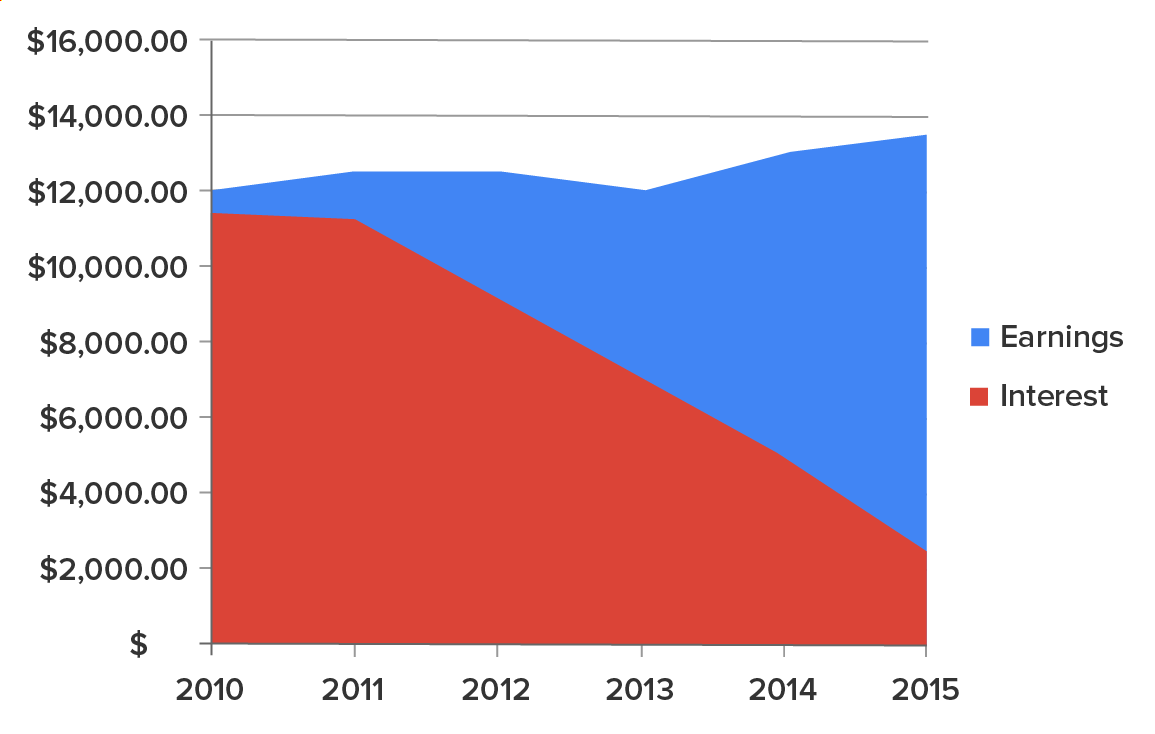
A stacked area chart showing earnings and interest in dollars from 2010 to 2015. The x-axis represents years ranging from 2010 to 2015, and the y-axis represents interest and earnings ranging from $ to $16,000, at intervals of 2000. The total height of the chart remains relatively consistent around $12,000 to $14,000 over the years. The red area represents interest, which starts high in 2010 and steadily declines to below $3,000 by 2015. The blue area represents earnings, which begin low in 2010 and rise steadily, overtaking interest by 2013 and continuing to increase through 2015. A legend to the right identifies blue as earnings and red as interest.

Notice that the company is making from $12,000 up to about $13,500 per year from 2010 to 2015. In this case, the interest along the way decreases along the maturity of the loan. Therefore, as long as there is that gap between earnings and interest, the situation is favorable for this particular financing. However, the company has to watch out for unexpected occurrences or outlays, especially at the beginning, that result in the company not being able to make up the difference between the earnings and the interest. In that case, it would be in trouble.

term to know
Debt Financing
An arrangement in financing in which a company takes a loan and agrees to pay the loan back at a specific point in time.


2. Long-Term Loans

Long-term loans are typically offered by banks. Manufacturers and suppliers may also provide long-term credit, which functions as a type of long-term loan as well. When businesses get loans for more than a year, they need to have a term loan agreement, which is a promissory note that details a repayment process for that particular loan.

These are typically very long and complicated.

EXAMPLE

Consider this older type of promissory note to pay back a loan from the Imperial Bank of India in Rangoon.
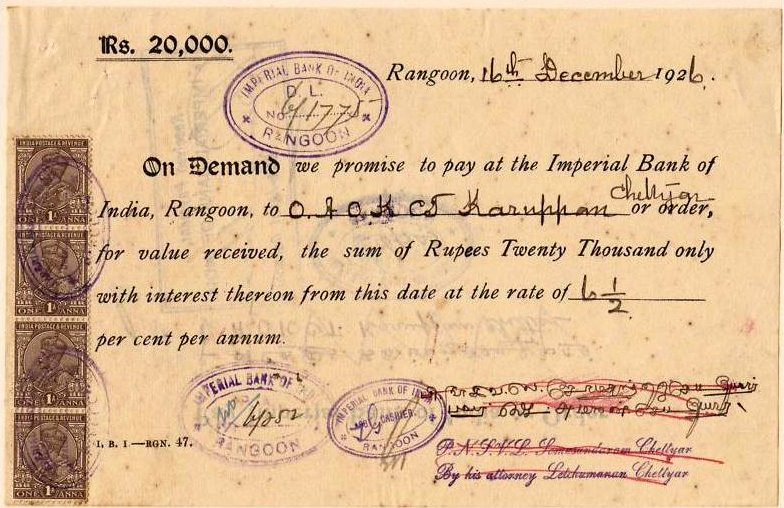
An old promissory note dated 1st December 1926, issued in Rangoon for Rupees 20,000. The note promises payment to the Imperial Bank of India, Rangoon, with interest at a specified rate per annum. It is handwritten with printed text, bearing several official stamps, seals, and signatures. The left margin features a vertical strip of revenue stamps. Ink stamps and handwritten entries are visible across the page.

The bank has loaned this particular person 20,000 rupees, who has agreed to pay it back on order at an interest rate of 6.5% every single year. Therefore, the interest builds every single year at 6.5%, and if the borrower isn’t making any payments on that particular loan, then when the bank wants its money back, the borrower will have to pay the initial 20,000 rupees plus the 6.5% that has matured over the life of the long-term loan.


3. Corporate Bonds

Corporate bonds are a slightly different type of long-term financing. A bond is a financial instrument in which the organization, a company, or the government offers an IOU to the holder of the bond. The organization promises to repay the original price of the bond (called the principal) along with a set amount of interest by a specific date. The specific period when the payout is due is called the maturity date.

hint
Corporate bonds are a great way to raise money long term for a company in addition to loans. Typically, you’ll see this done in addition to any loans a company may have through a bank, and, essentially, it’s a promise by the corporation or the government to repay the money by the maturity date.

The maturity date is the final payment due date for a loan or other monetary instrument such as a bond. Now, with bonds, all the legal information you need to know about the bond is going to be in something called the bond indenture. Typically, a corporation appoints someone called a trustee, who is an independent person or a firm that serves as the representative for the bond owner. In most cases, this is going to be a bank—one that is independent from the bondholder or the bond issuer and will be responsible for communication between the corporation and the bond owners.

There are different types of corporate bonds. One type of corporate bond is called a debenture bond. A debenture bond is unsecured, and, typically, it’s only issued by financially strong companies because the only thing that secures it is the company’s word that it will pay this bond back. Think about it—if the company wasn’t strong and trustworthy, nobody would issue this bond because there would be no guarantee that the company would actually pay it back.

Another type of corporate bond is a mortgage bond. A mortgage bond is made up of pooled property that’s used as collateral against the face value of the bond. So, if for some reason the corporation defaults or doesn’t pay back the bond in accordance with the bond indenture, then the pooled property is sold and those funds are used to pay back the bond.

terms to know
Bond
A financial instrument in which the organization (a company or the government) offers an IOU to the holder of the bond and the organization promises to repay the IOU with specified interest by a specific date.
Maturity Date
The final payment due date for a loan or other monetary instrument such as a bond.


4. Bonds Versus Loans

Now, let’s take a look at bonds versus loans and compare the two.

Long-Term Loans

  • Typically, there are a limited number of parties involved—basically just the person taking the loan and person or the institution issuing the loan.
  • It’s a relatively quick process to arrange.
  • Payback times are usually between 3 to 7 years.
  • The interest rates are generally anywhere from 6% to 12%, depending on how creditworthy the business is.
  • There’s also typically no public disclosure about the financial information involved within the long-term loan. No one else needs to know what the terms of the loan are.
Bonds

  • There are a lot more people involved with this type of financing instrument.
  • It takes a much longer time to arrange because you have to arrange for buyers and financing, find the trustees, and develop the bond indenture.
  • The term on a bond is anywhere from 10 to 30 years, so it takes a considerably long time to pay back and the bonds are hanging over the business for the entire 10- to 30-year term.
  • Bonds typically pay an interest rate between 5% and 10%, and there is a higher cost involved to sell and administer them.

EXAMPLE

If you issue a bond for $1,000, for example, because of the high sell and administration cost, you will only recoup about $900 or so against that $1,000 promise to pay back. As the one issuing the bond, you won’t recoup the full face value. However, if you buy this bond, you can be assured that you’ll get that full face value back—plus the 5% to 10% interest rate every year for the life of the bond.

summary
Today, we learned about debt financing. We also learned about long-term loans and corporate bonds. Lastly, we compared bonds versus loans to see how they stack up against each other.

Good luck!

Source: adapted from sophia instructor james howard

Terms to Know
Bond

A financial instrument in which the organization (a company or the government) offers an IOU to the holder of the bond and the organization promises to repay the IOU with specified interest by a specific date.

Debt Financing

An arrangement in financing in which a company takes a loan and agrees to pay the loan back at a specific point in time.

Maturity Date

The final payment due date for a loan or other monetary instrument, such as a bond.

