Use Sophia to knock out your gen-ed requirements quickly and affordably. Learn more
×

Continuum of Market Structures

Author: Sophia

what's covered
In this lesson, you will learn how to differentiate markets based on market concentration, market pricing power, and market structure. Specifically, this lesson will cover:

Table of Contents

1. Market Concentration

Firms produce and sell goods and services to households in a variety of product markets. A market is any place where resources, goods, and services are bought and sold. A market can be referred to as an industry. An industry is a collection of firms engaged in producing and selling similar goods or services, and competing against one another in the same market. In the U.S. soap and detergent market, buyers have a wide array of choices sold by about 670 firms. Dish soaps come in a variety of colors, brands, and formulas: standard, degreasers, powder, tablets, and eco-friendly brands with natural ingredients. In other markets, buyer choice is more limited. For example, there are only 85 firms in the U.S. breakfast cereal industry.

There are various ways to measure, classify, and compare industries, such as highest in sales, largest in employment, and highest risk. In the U.S. the largest industry is real estate, based on sales revenue. Healthcare is the largest industry in terms of employment, accounting for 13.8% of employment. Sawmills and lumber production are one of the riskiest industries in the U.S.

Concentration is one measure of the level of competition or lack thereof in an industry. Higher market concentration implies a lower intensity of competition among firms. Market concentration measures the extent to which market shares are concentrated between a small number of firms. If a market has only two firms producing similar products, then two firms share 100% of the market. The market share held by the firms need not be equal. One firm could have 80% of total sales, while the other firm has the remaining 20% of sales.

think about it
Can you think of any industries that have a high degree of market concentration, where there are only two or three companies in the industry?

Market share refers to a firm’s percentage of total market sales. In 2022, the top producers in the U.S. ready-to-eat breakfast cereal market were General Mills (43%), Kellogg’s (27%), Quaker (15%), and Post Holdings (10%). The search engine market is highly concentrated with Google the dominant player.

A concentration ratio represents the portion of the market held up by the largest firms. A concentration ratio is the percentage of market share taken up by the largest firms. The ratio can range from 0 to 100, and markets are examined as the top three or top four firms in an industry. The concentration ratio of the top four firms in the ready-to-eat breakfast cereal industry is 95%, which is the sum of the market share of each of the top four firms.

big idea
Markets can be differentiated based on how concentrated the industry is. As competitive pressures lessen, markets become more concentrated as the number of firms selling products declines. As competitive pressures increase, markets become less concentrated as the number of firms selling products increases.

terms to know
Market
Any place where resources, goods, and services are bought and sold.
Industry
A collection of firms engaged in producing and selling similar goods or services, and competing against one another in the same market.
Market Concentration
A measurement of the extent to which market shares are concentrated between a small number of firms.
Market Share
A firm’s percentage of total sales in the market.
Concentration Ratio
The percentage of market share taken up by the largest firms.


2. Market Power

Concentration ratios provide information about the degree of competition in a market. Every market experiences some degree of pressure between firms attempting to monopolize or dominate the market. This is not unlike a sporting event between two teams competing to seize the ball. In a market, firms compete against one another to gain greater leverage in setting product prices.

Most firms seek to influence their products’ price. Market power is the ability of a firm to influence the price of their product or service. In some markets, competitive forces outweigh monopolistic forces. A fragmenting of a market into many, many small firms with low market shares will, typically, result in lower market prices, as firms compete more vigorously for market shares. In other markets monopolistic forces outweigh competitive forces. A market with rising concentration ratios is an indicator of a fall in competitive pressure. Dominance by a few large players in the market can lead to higher consumer prices.

EXAMPLE


Suppose the six firms in the poultry industry held the following market shares in 2020:
  • Brand 1 (35%)
  • Brand 2 (30%)
  • Brand 3 (25%)
  • Brand 4 (6%)
  • Brand 5 (4%)
In 2022 a shift in market shares resulted in the following distribution of market shares:
  • Brand 1 (45%)
  • Brand 2 (35%)
  • Brand 3 (15%)
  • Brand 4 (3%)
  • Brand 5 (2%)
The industry became more concentrated, with the top three firms holding more than 95% of market share in 2022, compared to 90% in 2021. This is definitely not good news for shoppers. The more concentrated an industry, the greater the ability of firms to raise selling prices above market equilibrium.

term to know
Market Power
The ability of a firm to influence the market price.

big idea
Markets can be differentiated based on the degree of market power over product price. Dominance by a few large players in the market can lead to higher consumer prices.


3. Market Structure

Market concentration ratios are a helpful measure for classifying markets. Market structure refers to how different industries are differentiated, based on attributes that influence the behavior of sellers and buyers.

The structure of a market is affected by the number of sellers. When the number of sellers is quite large, and each seller’s share of the market is small, then an individual seller has little to no ability to influence the market price of its product.

The structure of a market is affected by the extent to which those who buy the goods and services prefer some products over other similar products. In some industries, the products are regarded as identical by their buyers: for example, basic green bell peppers or baby carrots. Products that are identical to products from other suppliers are referred to as homogeneous products. In other markets, buyers discern slight differences among the products, so different buyers prefer different products: all breakfast cereals are breakfast cereals, but Cheerios are not the same as Frosted Flakes. Buyers see a difference. Products that are differentiated from other suppliers' products are referred to as heterogeneous products.

The structure of a market is affected by the ease with which new sellers can enter. If there are obstacles that make it difficult to gain entry into the market, then the established sellers can earn profits without attracting new competitors.

Markets can be classified by their market structure. The following graphic shows the four types of market structures arranged along a continuum, from most competitive and no influence over prices, to least competitive and most influence over prices.
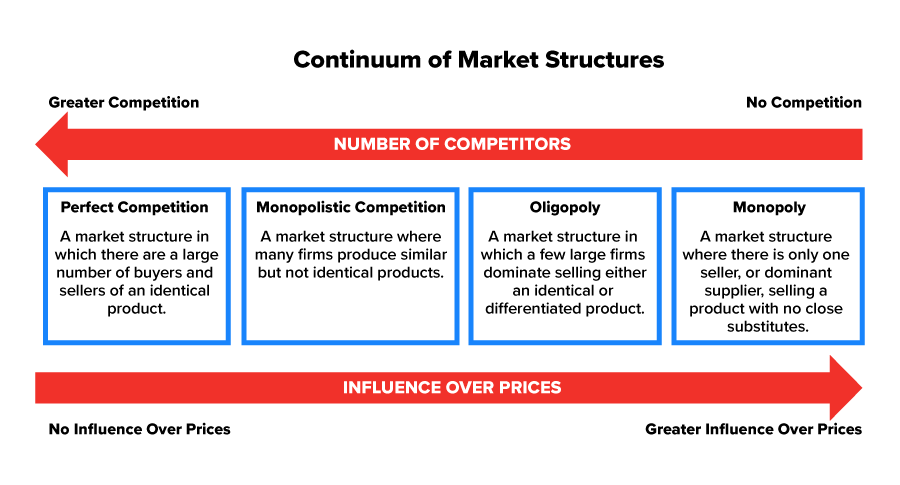
A graphic labeled ‘Continuum of Market Structures’ is arranged in a straight line from left to right. At the top, a wide arrow stretches from right to left, labeled ‘Number of Competitors’. Above this arrow, the left end is labeled ‘Greater Competition’, and the right end is labeled ‘No Competition’. At the bottom, another wide arrow runs from left to right, labeled ‘Influence Over Prices’. Below this arrow, the right end is labeled ‘Greater Influence Over prices’, and the left end is labeled ‘No Influence Over Prices’. Between these two arrows are four boxes arranged in a row from left to right and labeled as follows: ‘Perfect Competition’, ‘Monopolistic Competition’, ‘Oligopoly’, and ‘Monopoly’.

In the continuum of market structures graphic above, the market structures are arranged from left to right according to the amount of competition and influence over prices.

  • Perfect competition is a market structure in which there are a large number of buyers and sellers of an identical product. This market structure has the most competition, and the least influence over pricing. Large flea markets and open-air farmer’s markets are considered to come close to being perfectly competitive markets.
  • Monopolistic competition is a market structure where many firms produce similar but not identical products. A monopolistic competition market structure is less competitive than a perfect competition market structure, and it has more power over setting prices. A local retail gasoline market is typically considered to be a monopolistically competitive market.
  • Oligopoly is a market structure in which a few large firms dominate selling either an identical or differentiated product. Oligopoly is less competitive than monopolistic competition, and it has more power over setting prices. The search engine market is an oligopoly because it is highly concentrated among the two major players, Google and Microsoft.
  • Monopoly is a market structure where there is only one seller or dominant supplier selling a product with no close substitutes. Monopoly is the least competitive of all market structures and it, potentially, has the greatest influence over pricing. Local utilities such as water and electricity are considered to be monopolies and are regulated by the government.
In the following lessons, you will learn a lot more about the characteristics of each of the market structures. The following table outlines the characteristics that you will learn more about as you continue studying this challenge.

Characteristics of Market Structures
Characteristic Perfect Competition Monopoly Monopolistic Competition Oligopoly
Number of Sellers Large One Many Few
Barriers to Entry None Significant Few Significant
Nature of Product Identical No Close Substitutes Similar but Not Identical Identical or Differentiated
Information Perfect (Symmetric) Information Imperfect (Asymmetric) Information Imperfect (Asymmetric) Information Imperfect (Asymmetric) Information
Market Power None Significant Low Significant
Pricing Power Price Taker Price Setter Price Setter Price Setter
Demand Curve Horizontal Downward Sloping Downward Sloping Downward Sloping
Example Green Bell Pepper Sellers at Farmer's Market Local Utility Companies Local Retail Gasoline Microchip Industry

terms to know
Market Structure
How industries are differentiated based on physical characteristics that influence seller and buyer behavior.
Heterogeneous Products
Products that are differentiated from products from other suppliers.
Homogenous Products
Products that are identical to products from other suppliers.
Perfect Competition
A market structure in which there are a large number of buyers and sellers of an identical product.
Monopolistic Competition
A market structure where many sellers produce similar but not identical products.
Monopoly
A market structure where there is only one seller, or dominant supplier, selling a product with no close substitutes.
Oligopoly
A market structure in which a few large firms dominate selling either an identical or differentiated product.

summary
In this lesson, you learned in Market Concentration that all markets experience the push and pull of both competitive and monopolizing pressures. As competitive pressures lessen, markets become more concentrated as the number of firms selling products declines. As competitive pressures increase, markets become less concentrated as the number of firms selling products increases. In Market Power you learned that as markets become more concentrated, existing firms exercise some influence over the pricing of their product. You also learned that when the market is fragmented and there are many small firms with low market shares, the firms have less influence over the pricing of their products. In Market Structure you learned about the four types of market structures, and how they can be arranged along a continuum from most competitive to least competitive. You also learned that each of the market structures has specific characteristics that you will learn more about as you continue studying the lessons in this challenge.

Source: THIS TUTORIAL HAS BEEN ADAPTED FROM OPENSTAX “PRINCIPLES OF ECONOMICS 2E”. ACCESS FOR FREE AT https://openstax.org/books/principles-economics-2e/pages/1-introduction. LICENSE: CC ATTRIBUTION 4.0 INTERNATIONAL.

REFERENCES

Industry market research, reports, and statistics. IBISWorld. (n.d.). Retrieved July 24, 2022, from www.ibisworld.com/united-states/industry-trends/riskiest-industries/

Dkim. (2022, April 6). Inflation shakes up cereal market share. Earnest Research. Retrieved July 24, 2022, from www.earnestresearch.com/inflation-shakes-up-cereal-market-share/

Dun & Bradstreet. (2022, June 6). Soap & Other Detergent Manufacturing Industry Profile. First Research. Retrieved July 24, 2022, from www.firstresearch.com/Industry-Research/Soap-and-Other-Detergent-Manufacturing.html

Statista. (2022, July 27). Global Search Engine Market Share 2022. Statista. Retrieved August 12, 2022, from www.statista.com/statistics/216573/worldwide-market-share-of-search-engines/


Terms to Know
Concentration Ratio

The percentage of market share taken up by the largest firms.

Heterogeneous Products

Products that are differentiated from products from other suppliers.

Homogenous Products

Products that are identical to products from other suppliers.

Industry

A collection of firms engaged in producing and selling similar goods or services, and competing against one another in the same market.

Market

Any place where resources, goods, and services are bought and sold.

Market Concentration

A measurement of the extent to which market shares are concentrated between a small number of firms.

Market Power

The ability of a firm to influence the market price.

Market Share

A firm’s percentage of total sales in the market.

Market Structure

How industries are differentiated based on physical characteristics that influence seller and buyer behavior.

Monopolistic Competition

A market structure where many sellers produce similar but not identical products.

Monopoly

A market structure where there is only one seller, or dominant supplier, selling a product with no close substitutes.

Oligopoly

A market structure in which a few large firms dominate selling either an identical or differentiated product.

Perfect Competition

A market structure in which there are a large number of buyers and sellers of an identical product.
