Table of Contents |
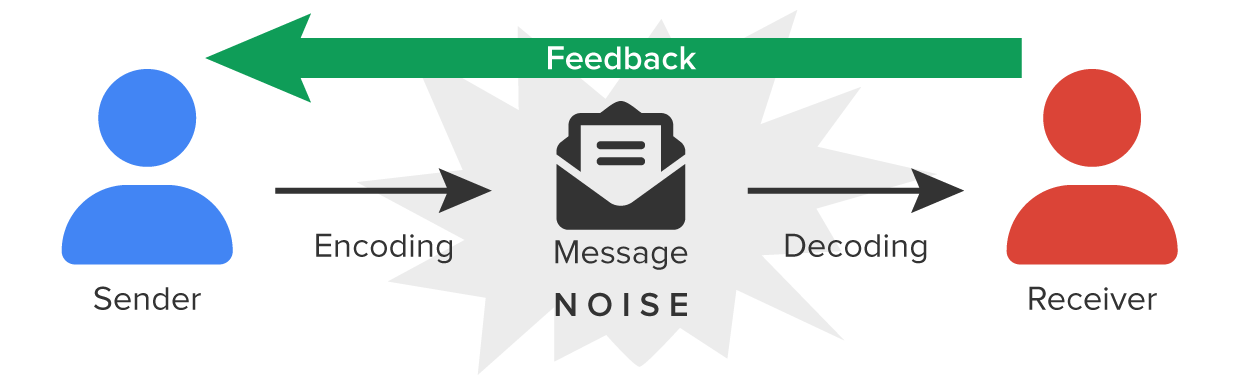
In the last unit, you learned the basic communication model. Here is a review.
There is one more consideration for the model, which is context: when and where the communication takes place, the situation, who else is present, the relationship between the sender and the receiver, and the medium used to deliver the message. The same message with the same sender, message, receiver, and noise might nevertheless be received quite differently if the circumstances create a different context.
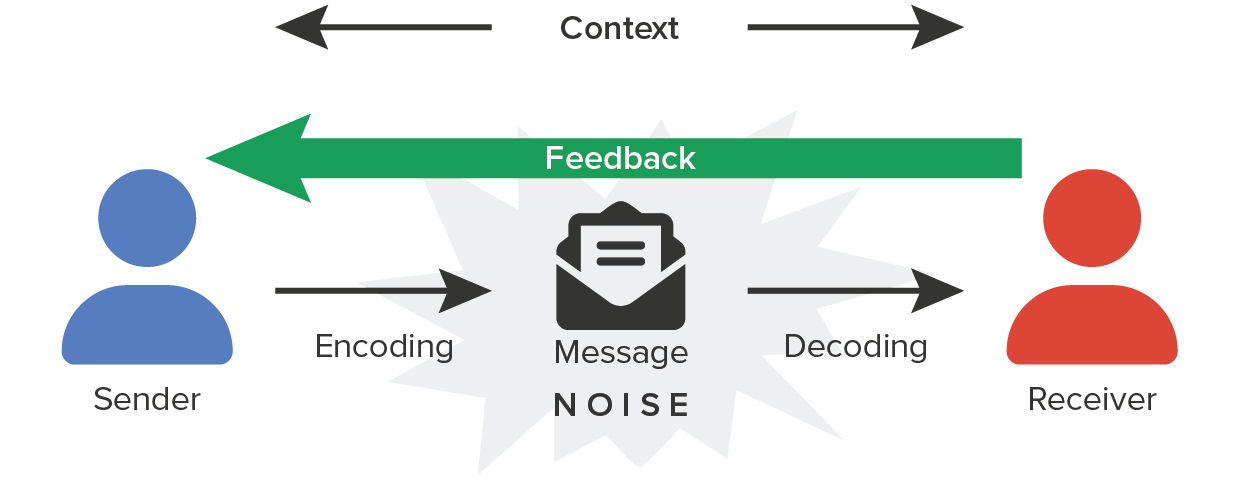
Imagine being fired. It's a terrible experience no matter when it happens! Now imagine that you are fired during a company party and must carry a box of personal effects past your former colleagues as they enjoy snacks and small talk. Even if the bad news itself was given in a private office, the context in which the news was delivered creates additional humiliation for the receiver, as well as putting a significant damper on the celebrations. Conversely, being congratulated on a major accomplishment in an all-hands meeting, or privately at the end of the day before a long weekend, will send different messages about how management actually feels about your accomplishment.
In these scenarios, the sender, receiver, and message are all the same, and there’s no noise interfering with the message. But the context can create a message of its own. On a day-to-day basis, the context or the message are usually not so dramatic, but context is always present and often affects the message.
Important elements of context include:

Where context most affects the message is when giving or receiving criticism. When done right, criticism can be constructive criticism, which is helpful feedback with specific examples and actionable suggestions for improvement. When done wrong, criticism may feel like simply finding fault with a person instead of giving helpful feedback on their performance.
Criticism itself is a necessary part of any business communication. Beyond performance reviews and other circumstances, there will be countless needs for varying levels of correcting mistakes or improving work processes. But the context in which you deliver criticism is as important as the message itself. This includes the context of your relationship with the individual you are criticizing and the relationship each of you have with the organization as a whole. Broader social considerations are also part of the context.
Providing feedback to a coworker could be uncomfortable for both the giver and receiver. In general, giving criticism privately is preferable to giving it in front of others. At most, you might give it within a small team or with a supervisor present.
When you do have to give criticism, keep the guidelines of communication in mind.

IN CONTEXT
Tanya’s colleague Stuart listens to music at work without headphones, which Tanya doesn’t like and finds distracting. She has told him this, but he dismisses her concerns because she’s the “only one who has a problem with it.” She is now ready to write a more official complaint.
Tanya is mindful of the context. She and Stuart are likely to continue sharing an office, and will continue to work together even if one of them is relocated. And in fact there are many reasons she enjoys sharing an office with Stuart. Since he has been at the job longer than she has, she finds his support and expertise to be invaluable.
In her letter she leads with that information, stating that she values Stuart as a colleague and benefits from having him in the office. She states that she understands Stuart’s music helps him concentrate when he has to “crunch some data,” and that he finds headphones uncomfortable. She then states that the music is distracting and makes it hard for her to concentrate. While she dislikes Stuart’s taste in music, she leaves this out. She also keeps the message specific to this one issue instead of piling on other criticisms, such as Stuart’s habit of teasing her about her own musical taste. She keeps focus on the distraction itself, and concludes with a proposal that Stuart find more comfortable headphones or use an empty conference room to work when he wants to blast his music. She ends with a note of confidence that they will find a way to resolve the problem.
When should you give criticism privately versus publicly? While it seems that one-on-one is best to save somebody embarrassment, there are cases where you might do it differently. For example, you may have found that direct criticisms haven’t led to change, so you start to include a supervisor. Or perhaps the criticism is of a superior and you feel uncomfortable approaching them directly. From a supervisor’s standpoint, giving the feedback to the entire group may be a way of focusing on the behavior instead of singling one person out.
EXAMPLE
Jeremy has been taking longer and longer lunch breaks as he uses the time to run errands. His supervisor notices, and issues a memo to the entire department reminding them that lunch break is forty minutes long, and should not be pushed further except in special circumstances. She sees no need here to single Jeremy out, because he will get the message, but her memo also helps to remind everybody else in case they’ve taken Jeremy’s absences as a message that longer lunch breaks are tolerated.When you respond to correction, criticism, and negative feedback, you demonstrate your professionalism and your desire to improve, for better or for worse. It is essential to learn how to take criticism gracefully, and treat these instances as opportunities to grow. If you immediately shut down and act defensively, you’re unlikely to learn and grow from past mistakes. Receiving constructive criticism is pivotal to your professional development.
The first step in receiving criticism is to practice active listening and make a concerted effort not to be defensive. Remember that giving criticism can be almost as hard as receiving it, so neither you nor your critic are likely to be entirely comfortable. Once your reviewer/critic has said their piece—whether in person or in writing—the following effective tools can help you respond:
EXAMPLE
Mandy has a customer support job that includes processing orders over the phone. She is told by her supervisor that they’ve noticed a lot of errors with her work, including incorrect addresses and misspelled names. Mandy is surprised at first to hear this. She obviously didn’t mean to make mistakes (otherwise they would not be mistakes!). She resists the urge to defend herself, and takes a few minutes to process the information. She asks a clarifying question: does her work contain more errors than the work of her colleagues? She is told that yes, it does. She asks for suggestions on how to be more accurate. Her supervisor recommends reading the entire order back to the customer before submitting it. The supervisor also notes that Mandy gets chatty with customers. Friendly interaction is great, since it makes the customers feel valued. But she does need to consider reducing the small talk so she can focus on the orders. Mandy thanks the supervisor for making her aware of the issue and promises to take the advice. She asks if they can meet again in a month and see if her work has improved.Sometimes it’s worth taking a pause and delaying your response, rather than responding with your first reaction (which could likely end up being an overreaction). Criticism can be hard to hear! Listen, be honest in your responses, and, if necessary, ask for some time to think it over: “This is hard to hear. Could I have an hour to digest your feedback?”
As with giving criticism, keep the context in mind: in most situations, you and your colleague will continue working together, maybe sharing a space, and need to maintain a positive relationship. Working through issues together can strengthen this relationship, in knowing you respect each other’s opinions and can be honest with each other.
Your professional demeanor is how you communicate that you are engaged, concerned, and present and that you have your own feelings under control. It is a small but important part of your professional image. Maintaining your demeanor can be difficult when you are upset, frustrated, or anxious.
At one point or another, everyone has been subjected to negative circumstances and situations in the workplace that can test one’s patience and professionalism. This is especially true for customer-facing roles. Your professional demeanor can be tested by hostile people, who trigger your “flight or fight” mode. Tension or exhaustion from a busy day can also erode your demeanor.
Here are some techniques that can help you deal with emotional reactions to negative situations at work.
EXAMPLE
John is giving a presentation to a group of colleagues in a conference room with his boss (as well as her boss) present. He has been very busy with a lot of projects recently, and had to more or less prepare the presentation at the last minute. Because there was little time to prepare and he hadn't developed speaker's notes, he knows he will be very dependent on his presentation slides to guide his delivery. However, he did print his presentation slides to have as back-up, just in case.Source: This tutorial has been adapted from Lumen Learning "Business Communication Skills for Managers." Access for free at courses.lumenlearning.com/wm-businesscommunicationmgrs. License Creative Commons Attribution 4.0 International. Accessed by October 2021.



