Use Sophia to knock out your gen-ed requirements quickly and affordably. Learn more
×

Connection & Transmission Media

Author: Sophia
what's covered
In this lesson, you will learn about connection and transmission media.

Specifically, this lesson will cover the following:

Table of Contents

1. T-Series Connections

The basic entry level in bandwidth or speed for leased lines that provide synchronous connections between sites is known as the T1. It serves up 24 Digital Signal 0 (DS0) 64-Kbps channels in the United States, Japan, and South Korea. There is a slightly bigger/faster version with 32 DS0 channels that’s available in Europe and called the E1 or E carrier line.

key concept
T1s use Digital Signal 1 (DS1) bit patterns to transmit packets; DS1 has to do with the service to be sent over a T1, which was originally 24 digitized voice channels. The terms “T1” and “DS1” have become synonymous and include different services, from voice to data to clear-channel pipes. The line speed is always consistent at 1.544 Mbps (millions of bits per second), but the payload can vary greatly.

T-series connections are digital connections that you can lease from the telephone company. They can use copper pairs like regular phone lines, or they can be brought in as part of a backbone, which is also called a trunk line. T-series connections use time-division multiplexing (TDM) to divide the bandwidth into channels of equal bit rate.

hint
T-series connection types are denoted by the letter T followed by a number. Each connection type differs in its speed and in the signal used to multiplex (combine) the channels.

EXAMPLE

The table below lists some of the T-series connections and their maximum data rates. The most commonly used T-series lines are T1 and T3.

Connection Maximum Speed
T1 1.544 Mbps
T1C 3.152 Mbps
T2 6.312 Mbps
T3 44.736 Gbps
T4 274.176 Gbps

terms to know
Leased Line
A private telecommunications circuit between two or more locations provided according to a commercial contract.
T1
A type of serial line that transmits data at a rate of 1,544 (or 1,536) Kbps.
Digital Signal 0 (DS0)
A 64-Kbps channel.
Digital Signal 1 (DS1)
A serial line containing 24 DS0 channels.
Time-Division Multiplexing (TDM)
A method of transmitting and receiving independent signals over a common signal path by means of synchronized switches at each end of the transmission line so that each signal appears on the line only a fraction of the time in an alternating pattern.

1a. The T1 Connection

A T1 is a 1.544 Mbps digital connection that is typically carried over two pairs of copper wires. This 1.544 Mbps connection uses DS1 and aggregates 24 discrete 64-Kbps channels that use DS0, which refers to the time slots within a channel. Each channel can carry either voice or data. In the POTS world, T1 lines are used to convert and bundle analog phone conversations over great distances because of the better quality of digital signals and the use of a great deal less wiring than would be needed if each pair carried only one call. This splitting into independent channels also allows a company to combine voice and data over one T1 connection or to use the T1 as if it were an unchannelized 1.544 Mbps pipe.

You can also order a fractional T1 (FT1) circuit that’s delivered on a T1 but doesn’t allow the use of all 24 channels. While this may seem slow given today’s standards, the T1 line is still relevant for many applications.

hint
The European version of the T1 is the E1, which operates at 2.048 Mbps and uses 32 64-Kbps channels (32 DS0s). It was designed later, is based on T1s, and is a little bigger. You’ll also find the J1, which is the Japanese version of the T1 and operates at 1.544 Mbps, just like the T1.

1b. The T3 Connection

A T3 works similarly to a T1 connection but carries 44.736 Mbps. This is equivalent to 28 T1 circuits or 672 DS0 channels. A T3 connection uses a signal known as Digital Signal 3 (DS3) that is definitely not the same as DS1, which is generally delivered over fiber-optic cables. Many local ISPs have T3 connections to their next-tier ISPs. Other entities that often opt for T3 are large multinational companies because they need the capacity to send voice and data between their major regional offices.

Similar to the T1, the T3’s European counterpart is the E3, which operates at 34.368 Mbps. The Japanese Digital Hierarchy specifies the J3 circuit, which operates at 32.064 Mbps.

terms to know
T3
A network backbone connection equivalent to 28 T1 lines, typically fiber optic.
Digital Signal 3 (DS3)
A serial line containing 672 DS0 channels.


2. Transmission Media

The transmission media is another aspect of WAN technologies that can have a big effect on the speed, bandwidth, and volume of data that can be transferred. Wireless transmissions use air as transmission media. This not only creates a challenge concerning security but also creates signal degradation. That’s because the further the signal has to travel from the original source, the weaker it gets. This is called attenuation and refers to the loss of signal strength in networking cables or connections. A solution to this issue is microwave repeaters, which retransmit signals through the air and bolster them. This approach is a lot more efficient because it can preserve signal strength over much greater distances.

hint
The most far-reaching technology uses the air and even empty space to send electromagnetic signals to satellites from which they are then re-sent to distant geographic locations.

term to know
Attenuation
Refers to the loss of signal strength in networking cables or connections.

2a. Wired Connections

Wired connections use either copper wire or glass fiber to carry bits as voltages or light pulses, respectively. That attenuation issue, where the signal gradually weakens over distances, also relates to copper wire transmissions and limits the length of wire you can use.

key concept
Fiber offers a lot more bandwidth and it’s a lot less susceptible to noise, but it also costs a lot more to buy and install. In the United States, the standard for synchronous data transmission on optical fiber is called the Synchronous Optical Network (SONET).

The international equivalent of SONET is Synchronous Digital Hierarchy (SDH). SONET defines a base data rate, or throughput, of 51.84 Mbps, and multiples of this rate are known as optical carrier (OC) levels, such as OC-3 and OC-12. Table 16.2 depicts common OC levels and their associated data rates.

Level Data Rate
OC-1 51.84 Mbps
OC-3 155.52 Mbps
OC-12 622.08 Mbps
OC-48 2.488 Gbps
OC-192 9.953 Gbps
OC-768 39.813 Gbps

Regardless of the media used to carry WAN traffic, the growing volume of voice and video traversing data networks has led to new traffic problems. Regular data traffic can arrive out of order and be reassembled back into its original order on the receiving end, but voice and video data require real-time delivery to be intelligible. Clearly, this makes regular data a lot less vulnerable to congestion or busy traffic conditions that can delay voice and video communications and totally mess them up.

reflect
The explosion in the popularity and amount of multimedia being sent over data networks is a big reason the never-ending quest for greater bandwidth and speed to avoid traffic jams on WAN links is so vital today.

As one option to address this demand, wavelength-division multiplexing (WDM) is a technology that multiplexes several optical carriers on a single optical fiber by using different wavelengths.

hint
Remember, fiber-optic signals are light, so using different wavelengths of the light spectrum is somewhat like using different frequencies in a radio wave.

Another option is found in dense wavelength-division multiplexing (DWDM), which multiplexes within a specific band (1550 nm), allowing for the use of erbium-doped fiber amplifiers (EDFAs) that boost the signal. This allows for upgrading the bit rate of a single-strand line by simply replacing the equipment at either end of the line.

key concept
The system consists of the following:
  • DWDM terminal multiplexer
  • Intermediate line repeater (every 80–100 km)
  • Intermediate terminal multiplexer (remote amplification site)
  • DWDM terminal demultiplexer

Yet another option is found in coarse wavelength-division multiplexing (CWDM), which uses larger chunks of the light spectrum and is defined by wavelengths, whereas DWDM is defined by frequencies and fits 40+ channels into the same frequency range used by just 2 CWDM channels. CWDM allows ISPs to help customers in a metropolitan area network (MAN) physical location where fiber is still too pricey to implement.

Finally, the passive optical network (PON), also called fiber to the premises, is an option for connecting homes and businesses to the internet. It is point-to-multipoint technology with a single fiber strand used for multiple premises (typically, 16–28). Unpowered optical splitters are used in the process and are the reason for the use of the term “passive.”

The system consists of an optical line termination (OLT) at the telecommunicator’s office and a number of optical network units near end users. These systems typically have downlink speeds of 155–655 Mbps and uplink bursts of 155Mbps.

terms to know
Synchronous Optical Network (SONET)
Standardized protocols that transfer multiple digital bit streams synchronously over optical fiber using lasers or highly coherent light from light-emitting diodes (LEDs).
Throughput
The rate at which data are transferred through a system.
Wavelength-Division Multiplexing (WDM)
A technology that multiplexes a number of optical carrier signals onto a single optical fiber by using different wavelengths (i.e., colors) of laser light.
Dense Wavelength-Division Multiplexing (DWDM)
Optical signals multiplexed within the 1550 nm band so as to leverage the capabilities (and cost) of erbium-doped fiber amplifiers (EDFAs).
Coarse Wavelength-Division Multiplexing (CWDM)
Two or more signals multiplexed onto a single fiber, with one signal in the 1550 nm band and the other in the 1310 nm band.
Passive Optical Network (PON)
A fiber-optic telecommunications technology for delivering broadband network access to end customers.
Optical Line Termination (OLT)
A device that serves as the service provider endpoint of a passive optical network.

2b. Wireless Technologies

As has been discussed previously, different technologies offer different distance ranges and optical fiber carries signals much farther than copper cabling can. We also discussed that fiber comes with a much higher price tag to match its higher capacity and that it’s much harder to install.

As you may be aware, Bluetooth is a type of wireless technology that’s only used for short-distance wireless transmissions. Bluetooth is actually a wireless protocol that creates personal area networks (PANs). It utilizes short-range communications technology, enabling data transmission between fixed and/or mobile devices.

key concept
Bluetooth uses a radio technology called frequency-hopping spread spectrum that chops up the data being sent and transmits chunks of them through the air on up to 75 different frequencies in the 2.4 GHz range. The transmitter and receiver change frequencies or channels in a prearranged pattern. Getting all of our wireless devices to work with each other and sync up can be challenging, so Bluetooth was developed to be a single digital wireless protocol capable of connecting multiple devices and overcoming the problems arising from trying to synchronize them. Bluetooth achieves this goal and allows us to sync our cars with our phones.

Microwave radio relay is a technology for transmitting digital, and sometimes even analog, signals between two locations on a line-of-sight radio path through the atmosphere. During microwave radio relay, radio waves are transmitted between the two locations with directional antennas that form a fixed radio connection between them. A really long connected series of links can form line-of-sight transcontinental communication systems.

hint
Although having a dedicated microwave connection is still common because it allows you to purchase your own frequency range from the FCC to ensure that you do not get any interference, a much less costly installation is the wireless 802.11 specification, which provides us with long-distance solutions and a healthy amount of bandwidth to boot.

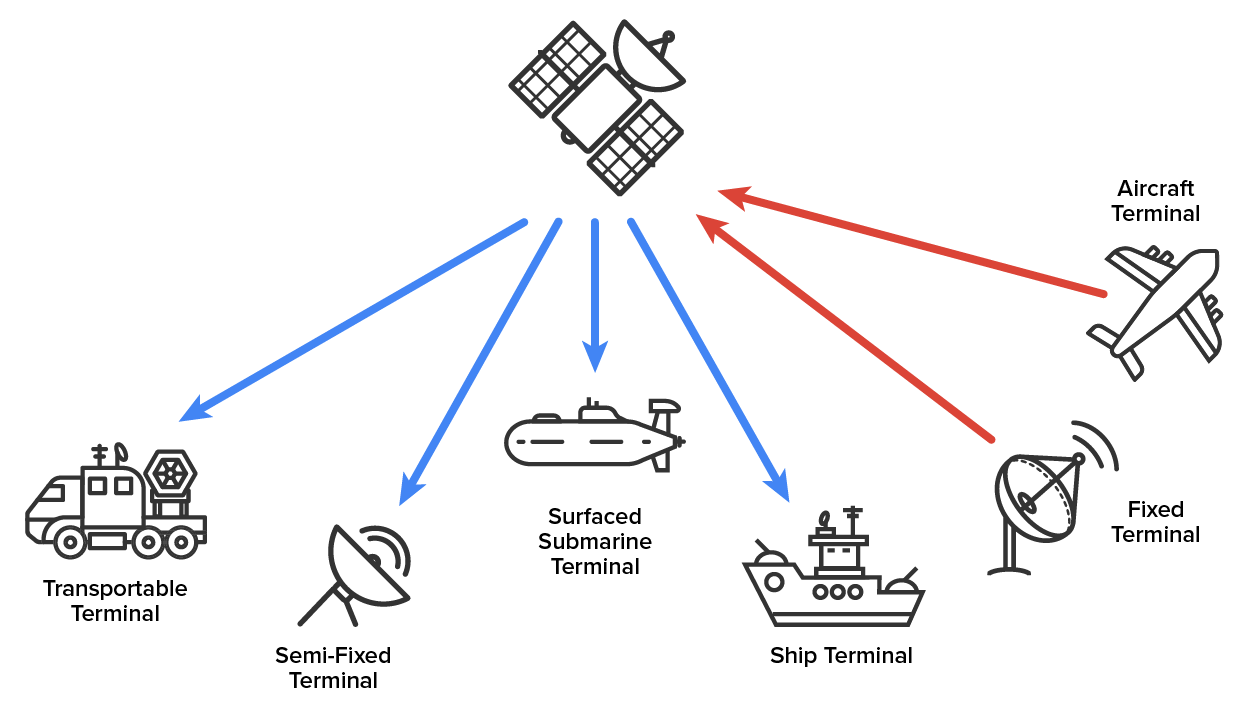
A communications satellite (comsat) is an artificial satellite stationed in space for telecommunications purposes. Modern communications satellites use a variety of orbits.

key concept
Here is a list of the orbits that are used:
  • Geostationary orbits
  • Molniya orbits (“molniya” means lightning in Russian), named after a series of communications satellites from Russia
  • Low-polar and nonpolar Earth orbits from which the satellite can first boost communications signals and then send them back to Earth

It’s important to understand point-to-multipoint services and how communications satellites provide microwave radio relay technology, as shown in the diagram below.
A building on the left is labeled ‘Headend’. One connection labeled ‘Fiber’ runs from the Headend to a square structure at the center labeled ‘Node’. A bidirectional arrow labeled ‘HFC’ extends from the Headend to a point above the Node. From the Node, multiple double-headed arrows labeled ‘Coaxial Cable Serving Area’ branch out toward a house icon on the right. At the bottom, a bidirectional arrow labeled ‘DOCSIS’ runs between the Headend and the house icon.

This technology is also used for mobile applications like GPS communications to ships, vehicles, planes, and handheld terminals as well as for watching satellite HDTV or listening to satellite radio broadcasting. These all require capabilities that are impractical or impossible to use with other technologies like cable.

think about it
Satellite technology is expensive, and although it is not necessarily slow, there is a lot of latency because of the time it takes to get from your terminal to the satellite to the provider and back. This is because you are transmitting about 20,000 miles or more!

terms to know
Bluetooth
Wireless protocol used in personal area networks.
Personal Area Network (PAN)
A computer network for interconnecting electronic devices within an individual person’s workspace.
Microwave Radio Relay
A technology for transmitting information between two terrestrial points on a narrow beam of microwaves.
Communications Satellite (Comsat)
An artificial satellite that relays and amplifies radio telecommunication signals via a transponder; it creates a communication channel between a source transmitter and a receiver at different locations on Earth.

summary
In this lesson, you learned about the various types of network connections and transmission media, including the T-series connections (such as the T1 and T3 connections), SONET, wavelength-division multiplexing, passive optical networks, and wired and wireless connections.

Source: This content and supplemental material has been adapted from CompTIA Network+ Study Guide: Exam N10-007, 4th Edition. Source Lammle: CompTIA Network+ Study Guide: Exam N10-007, 4th Edition - Instructor Companion Site (wiley.com)


Terms to Know
Attenuation

Refers to the loss of signal strength in networking cables or connections.

Bluetooth

Wireless protocol used in personal area networks.

Coarse Wavelength-Division Multiplexing (CWDM)

Two or more signals multiplexed onto a single fiber, with one signal in the 1550 nm band and the other in the 1310 nm band.

Communications Satellite (Comsat)

An artificial satellite that relays and amplifies radio telecommunication signals via a transponder; it creates a communication channel between a source transmitter and a receiver at different locations on Earth.

Dense Wavelength-Division Multiplexing (DWDM)

Optical signals multiplexed within the 1550 nm band so as to leverage the capabilities (and cost) of erbium-doped fiber amplifiers (EDFAs).

Digital Signal 0 (DS0)

A 64-Kbps channel.

Digital Signal 1 (DS1)

A serial line containing 24 DS0 channels.

Digital Signal 3 (DS3)

A serial line containing 672 DS0 channels.

Leased Line

A private telecommunications circuit between two or more locations provided according to a commercial contract.

Microwave Radio Relay

A technology for transmitting information between two terrestrial points on a narrow beam of microwaves.

Optical Line Termination (OLT)

A device that serves as the service provider endpoint of a passive optical network.

Passive Optical Network (PON)

A fiber-optic telecommunications technology for delivering broadband network access to end customers.

Personal Area Network (PAN)

A computer network for interconnecting electronic devices within an individual person’s workspace.

Synchronous Optical Network (SONET)

Standardized protocols that transfer multiple digital bit streams synchronously over optical fiber using lasers or highly coherent light from light-emitting diodes (LEDs).

T1

A type of serial line that transmits data at a rate of 1,544 (or 1,536) Kbps.

T3

A network backbone connection equivalent to 28 T1 lines, typically fiber optic.

Throughput

The rate at which data are transferred through a system.

Time-Division Multiplexing (TDM)

A method of transmitting and receiving independent signals over a common signal path by means of synchronized switches at each end of the transmission line so that each signal appears on the line only a fraction of the time in an alternating pattern.

Wavelength-Division Multiplexing (WDM)

A technology that multiplexes a number of optical carrier signals onto a single optical fiber by using different wavelengths (i.e., colors) of laser light.
