Use Sophia to knock out your gen-ed requirements quickly and affordably. Learn more
×

Concavity

Author: Sophia

what's covered
In this lesson, you will learn how to use the second derivative to determine the direction that the graph of a function opens, also known as its concavity. Specifically, this lesson will cover:

Table of Contents

1. Defining Concavity

Concavity refers to the direction in which a graph opens. A graph is concave up if it opens upward and concave down if it opens downward. A graph is concave up on an interval if it opens upward on that interval. A graph is concave down on an interval if it opens downward on that interval.
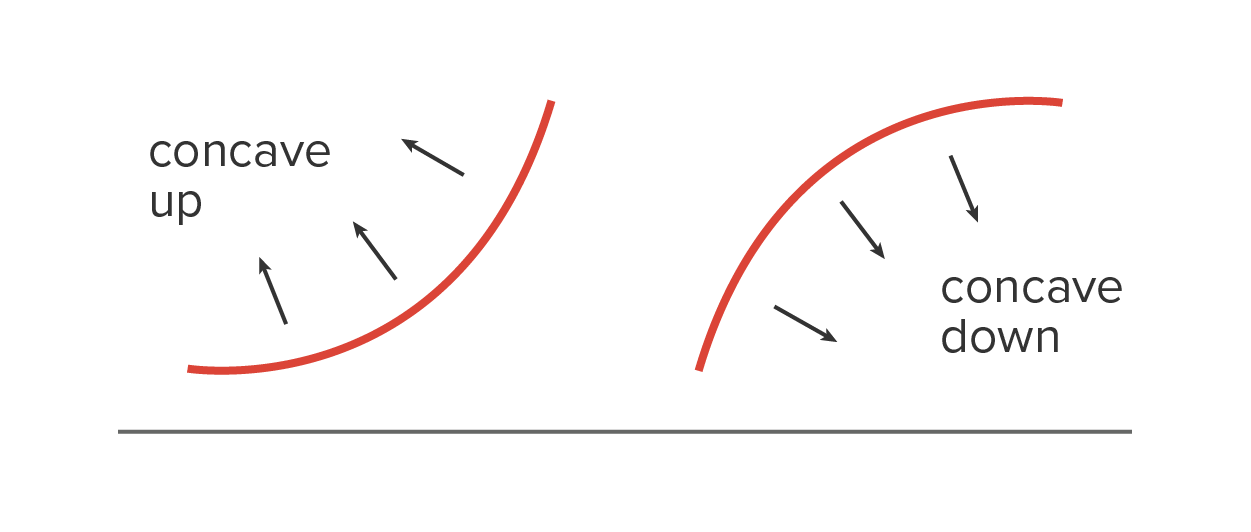
A horizontal line has two curves above it, representing the concept of concavity. One curve opens upward and is labeled ‘concave up’ with three arrows pointing outward from the concave side of the curve. The other curve opens downward and is labeled ‘concave down’, with three arrows pointing away from the concave side of the curve.

watch
This video shows how concavity relates to how slopes of tangent lines change.

big idea
Based on the video, we make the following observations:
  • If f apostrophe apostrophe open parentheses x close parentheses greater than 0 on an interval, then the graph of f open parentheses x close parentheses is concave up on the same interval.
  • If f apostrophe apostrophe open parentheses x close parentheses less than 0 on an interval, then the graph of f open parentheses x close parentheses is concave down on the same interval.

hint
Remember that a function can change between positive and negative when it is either equal to 0 or when it is undefined. Therefore, to determine where the graph of the function is concave up or concave down, find all values where f apostrophe apostrophe open parentheses x close parentheses equals 0 or f apostrophe apostrophe open parentheses x close parentheses is undefined. Then, make a sign graph similar to what you did for the first derivative test.

terms to know
Concavity
Refers to the direction in which a graph opens. A graph is concave up if it opens upward and concave down if it opens downward.
Concave Up
When a graph opens upward on an interval.
Concave Down
When a graph opens downward on an interval.


2. Determining Where a Function Is Concave Up/Concave Down

EXAMPLE

Determine the interval(s) over which the graph of f open parentheses x close parentheses equals x cubed minus 3 x squared plus 5 is concave up or concave down. Since concavity is determined from the second derivative, we start there.

f open parentheses x close parentheses equals x cubed minus 3 x squared plus 5 Start with the original function.
f apostrophe open parentheses x close parentheses equals 3 x squared minus 6 x Take the first derivative.
f apostrophe apostrophe open parentheses x close parentheses equals 6 x minus 6 Take the second derivative.

Since f apostrophe apostrophe open parentheses x close parentheses is never undefined, we set it to 0 and solve:

6 x minus 6 equals 0 The second derivative is set to 0.
6 x equals 6 Add 6 to both sides.
x equals 1 Divide both sides by 6.

Thus, f open parentheses x close parentheses could be changing concavity when x equals 1. This means that at any x-value on the interval open parentheses short dash infinity comma space 1 close parentheses comma the concavity is the same. The same can be said for the interval open parentheses 1 comma space infinity close parentheses.

Now, select one number (called a test value) inside each interval to determine the sign of f apostrophe apostrophe open parentheses x close parentheses on that interval:

Interval open parentheses short dash infinity comma space 1 close parentheses open parentheses 1 comma space infinity close parentheses
Test Value 0 2
Value of bold italic f bold apostrophe bold apostrophe open parentheses bold x close parentheses bold equals bold 6 bold italic x bold minus bold 6 -6 6
Behavior of bold italic f open parentheses bold x close parentheses Concave down Concave up

Therefore, the graph of f open parentheses x close parentheses is concave down on the interval open parentheses short dash infinity comma space 1 close parentheses and concave up on the interval open parentheses 1 comma space infinity close parentheses.

EXAMPLE

Determine the interval(s) over which the graph of f open parentheses x close parentheses equals 5 x squared minus 18 x to the power of 5 divided by 3 end exponent is concave up or concave down. Note that the domain of f open parentheses x close parentheses is all real numbers.

Since concavity is determined from the second derivative, we start there.

f open parentheses x close parentheses equals 5 x squared minus 18 x to the power of 5 divided by 3 end exponent Start with the original function.
f apostrophe open parentheses x close parentheses equals 10 x minus 18 times 5 over 3 x to the power of 2 divided by 3 end exponent
equals 10 x minus 30 x to the power of 2 divided by 3 end exponent
Take the first derivative.
f apostrophe apostrophe open parentheses x close parentheses equals 10 minus 30 open parentheses 2 over 3 close parentheses x to the power of short dash 1 divided by 3 end exponent
equals 10 minus 20 x to the power of short dash 1 divided by 3 end exponent
equals 10 minus 20 over x to the power of 1 divided by 3 end exponent
Take the second derivative.

Note that f apostrophe apostrophe open parentheses x close parentheses is undefined when x equals 0.

To find other possible transition points, set f apostrophe apostrophe open parentheses x close parentheses equals 0 and solve:

10 minus 20 over x to the power of 1 divided by 3 end exponent equals 0 The second derivative is set to 0.
10 x to the power of 1 divided by 3 end exponent minus 20 equals 0 Multiply everything by x to the power of 1 divided by 3 end exponent.
10 x to the power of 1 divided by 3 end exponent equals 20 Add 20 to both sides.
x to the power of 1 divided by 3 end exponent equals 2 Divide both sides by 10.
x equals 8 Cube both sides.

Thus, f open parentheses x close parentheses could be changing concavity when x equals 0 or x equals 8. This means that at any x-value on the interval open parentheses short dash infinity comma space 0 close parentheses comma the concavity is the same. The same can be said for the intervals open parentheses 0 comma space 8 close parentheses and open parentheses 8 comma space infinity close parentheses.

Now, select one number (called a test value) inside each interval to determine the sign of f apostrophe apostrophe open parentheses x close parentheses on that interval:

Interval open parentheses short dash infinity comma space 0 close parentheses open parentheses 0 comma space 8 close parentheses open parentheses 8 comma space infinity close parentheses
Test Value -1 1 27
Value of bold italic f bold apostrophe bold apostrophe open parentheses bold x close parentheses bold equals bold 10 bold minus bold 20 over bold x to the power of bold 1 bold divided by bold 3 end exponent 30 -10 10 over 3
Behavior of bold italic f open parentheses bold x close parentheses Concave up Concave down Concave up

Thus, the graph of f open parentheses x close parentheses is concave up on open parentheses short dash infinity comma space 0 close parentheses union open parentheses 8 comma space infinity close parentheses and concave down on the interval open parentheses 0 comma space 8 close parentheses.

watch
In this video, we’ll determine the intervals over which the function f open parentheses x close parentheses equals ln open parentheses x squared plus 1 close parentheses is concave up or concave down.

Here is a problem for you to try, step by step. This will also help you review some algebra skills.


try it
Consider the function f open parentheses x close parentheses equals short dash x to the power of 5 plus 5 x to the power of 4 plus 13 x minus 12.
Find all values of x for which f  (x  )=0.
short dash 20 x cubed plus 60 x squared equals 0 Set f apostrophe apostrophe open parentheses x close parentheses equals 0.
short dash 20 x squared open parentheses x minus 3 close parentheses equals 0 Remove common factor of short dash 20 x cubed.
short dash 20 x squared equals 0 space space or space space x minus 3 equals 0 Set each factor equal to 0.
x equals 0 space space or space space x equals 3 Solve each equation.
Make a sign graph of the second derivative, using appropriate test values.
Test values were chosen to ease calculations. For each interval, any value could be used. For example, a test value of “-5” could have have been used on the interval open parentheses short dash infinity comma space 0 close parentheses.

Interval open parentheses short dash infinity comma space 0 close parentheses open parentheses 0 comma space 3 close parentheses open parentheses 3 comma space infinity close parentheses
Test Value -1 1 4
Value of bold italic f bold apostrophe bold apostrophe open parentheses bold x close parentheses bold equals bold short dash bold 20 bold italic x to the power of bold 3 bold plus bold 60 bold italic x to the power of bold 2 80 40 -320
Behavior of bold italic f open parentheses bold x close parentheses Concave up Concave up Concave down
Find all intervals over which f  (x  ) is concave up.
According to the sign graph, f open parentheses x close parentheses is concave up on the intervals open parentheses short dash infinity comma space 0 close parentheses and open parentheses 0 comma space 3 close parentheses. Since f open parentheses x close parentheses is defined when x equals 0 comma we say that f open parentheses x close parentheses is concave up on the interval open parentheses short dash infinity comma space 3 close parentheses.
Find all intervals over which f  (x  ) is concave down.
According to the sign graph, f open parentheses x close parentheses is concave down on the interval open parentheses 3 comma space infinity close parentheses.

summary
In this lesson, you learned that concavity is defined as the direction in which a graph opens, noting that a graph is concave up if it opens upward on an interval and concave down if it opens downward on an interval. You also learned that you can determine where a function is concave up/concave down by using the second derivative of the function f open parentheses x close parentheses.

Source: THIS TUTORIAL HAS BEEN ADAPTED FROM CHAPTER 3 OF "CONTEMPORARY CALCULUS" BY DALE HOFFMAN. ACCESS FOR FREE AT WWW.CONTEMPORARYCALCULUS.COM. LICENSE: CREATIVE COMMONS ATTRIBUTION 3.0 UNITED STATES.

Terms to Know
Concave Down

When a graph opens downward on an interval.

Concave Up

When a graph opens upward on an interval.

Concavity

Refers to the direction in which a graph opens. A graph is concave up if it opens upward and concave down if it opens downward.