Have you ever wondered why your car’s side mirrors curve outward or why makeup mirrors seem to zoom in on every detail of your face? These everyday objects aren’t just clever designs. They’re based on fascinating principles of light and reflection that shape how we see the world. From telescopes that peer into distant galaxies to security mirrors that keep stores safe, the way a mirror bends light can completely change its purpose. In this lesson, you will uncover the secrets behind these designs and explore how something as simple as a curved surface can have powerful applications in science, technology, and daily life.
Unlike flat mirrors that reflect objects at their actual size and position, curved mirrors transform our perception by bending light in unique ways. Their behavior isn’t random. They obey the precise laws of reflection that dictate where an image forms and how it appears. A spherical mirror is formed from a section of a sphere, and depending on which side of the sphere’s surface is reflective, we get two types of curved mirrors:
Concave mirrors, which have the reflective surface on the inner side of the sphere (curving inward)
Convex mirrors, which have the reflective surface on the outer side of the sphere (curving outward)
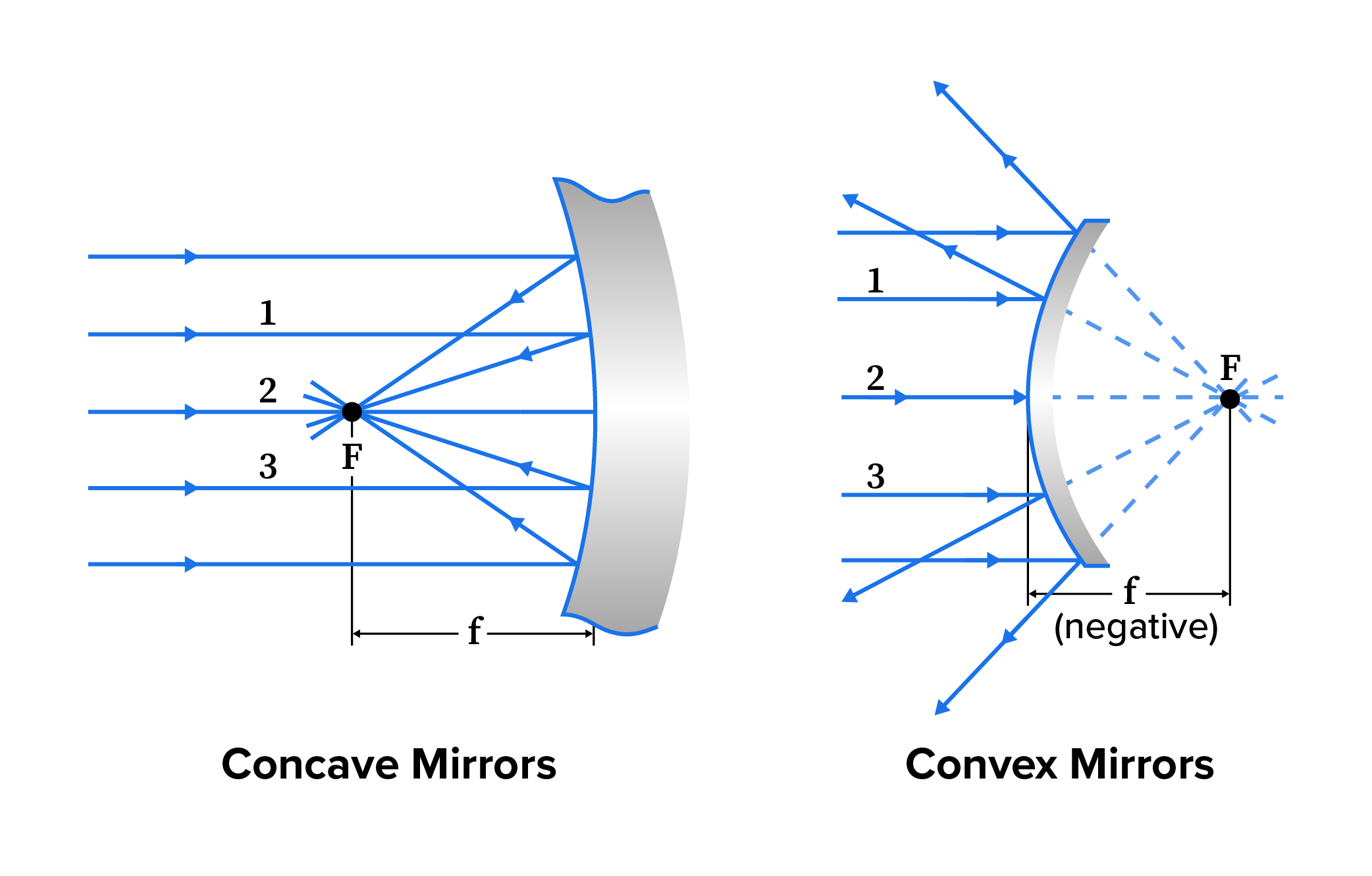
These two diagrams compare concave and convex mirrors. Arrows show reflected rays and labeled focal points. (a) Parallel rays reflect from a concave mirror and converge at the focal point in front of the mirror. (b) Parallel rays reflect from a convex mirror and diverge as if coming from a focal point behind the mirror.
These two types behave differently when reflecting light, leading to distinct image properties and applications.
When light reflects off a curved mirror, two ideas help us describe what happens: the radius of curvature and the focal length.
The radius of curvature (C) is related to the imaginary sphere the mirror comes from. If you imagine “completing” the curved mirror into a full sphere, the radius of that sphere is the radius of curvature. It’s the distance from the mirror’s surface to the center of that sphere.
The focal length (f) tells us how the mirror bends light. It’s the distance from the mirror to the focal point (F), or the point where reflected light rays either come together or seem to spread out from:
For a concave mirror (curving inward like a spoon), parallel rays reflect and meet in front of the mirror. The focal point is in front, so we call the focal length positive. These are converging mirrors.
For a convex mirror (bulging outward), parallel rays spread out after reflecting. They appear to come from a point behind the mirror, so the focal length is treated as negative. These are diverging mirrors.
We’ll use these two distances, radius of curvature and focal length, to understand and predict where images form in curved mirrors.
formula to know
Relationship Between the Focal Length and the Radius of Curvature
Where f is the focal length and C is the center of curvature.
The SI units of both focal length (f) and the center of curvature (C) are meters (m).
terms to know
Concave Mirrors
Reflective surface on the inner side of the sphere (curving inward).
Convex Mirrors
Reflective surface on the outer side of the sphere (curving outward).
Radius of Curvature
The distance from the mirror’s surface to the center of the sphere from which the mirror is shaped.
Focal Length (Mirror)
The distance from the mirror to the point where reflected rays either converge or appear to diverge.
Focal Point (Mirror)
The point where the light rays converge or diverge.
1a. Concave Mirrors
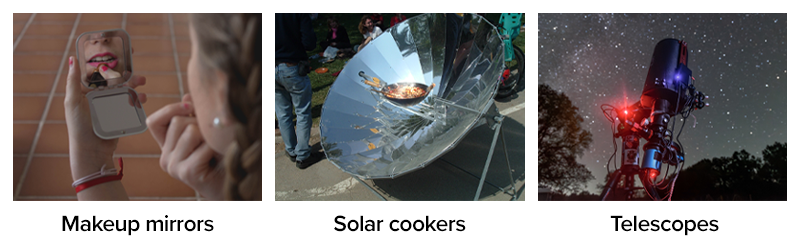
Concave mirrors curve inward, like the inside of a bowl, and they have a unique ability to focus light. When parallel rays of light strike a concave mirror, they reflect and meet at the focal point. This property makes concave mirrors extremely useful in applications where magnification or concentration of light is needed, such as in telescopes, makeup mirrors, and even solar cookers. Their inward curvature allows them to form real images, which occur when light rays actually meet at a point after reflection, as well as virtual images depending on the position of the object, making them one of the most versatile types of mirrors in optics.
Applications of concave mirrors
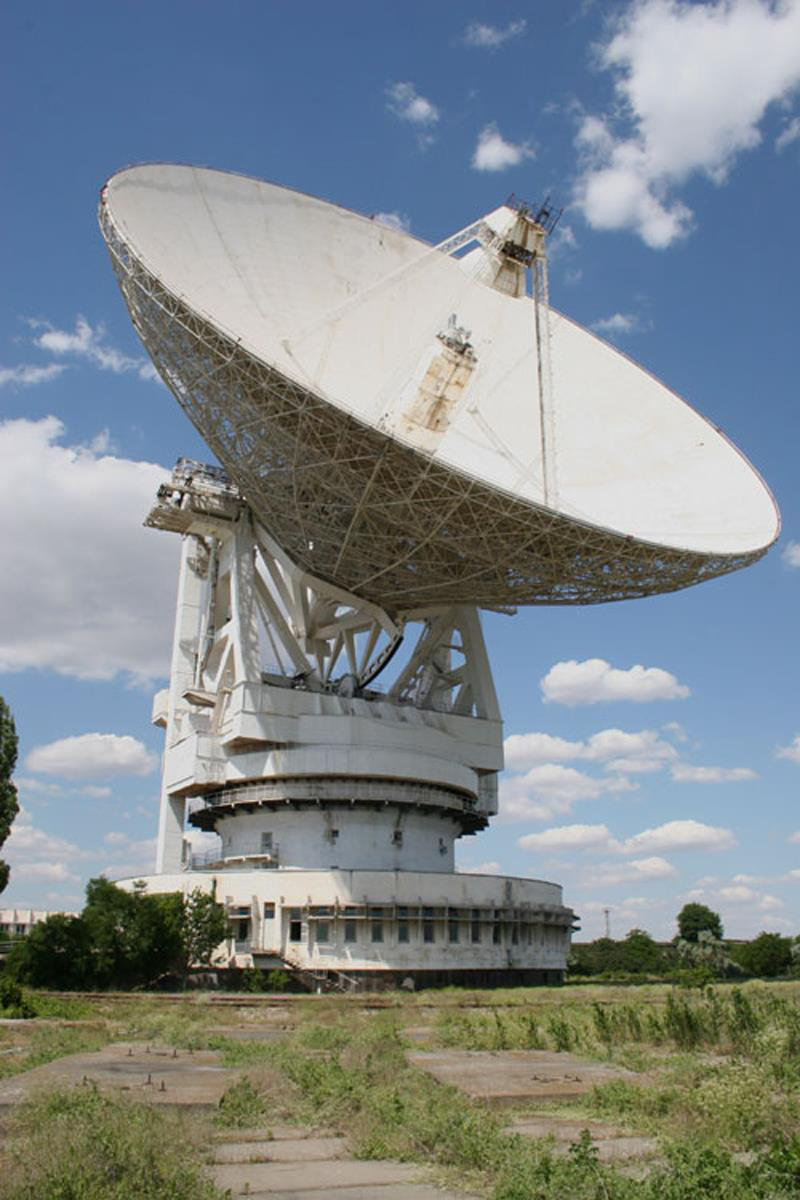
IN CONTEXT A Radio Telescope Dish Is a Concave Mirror for Invisible LightAn RT-70 radio telescope
When you see a huge satellite dish or radio telescope, you’re looking at a concave “mirror” designed for radio waves instead of visible light. The curved reflecting surface redirects incoming waves toward a focal region, where a receiver (often at a feed horn) collects and measures the signal. In other words, the same concave mirror idea, a different part of the electromagnetic spectrum.
This is exactly the kind of physics that made the Event Horizon Telescope possible. The EHT linked multiple radio observatories around the world to form an Earth-sized “virtual telescope,” capturing landmark observations using radio waves that were gathered and focused by dish-shaped reflectors.
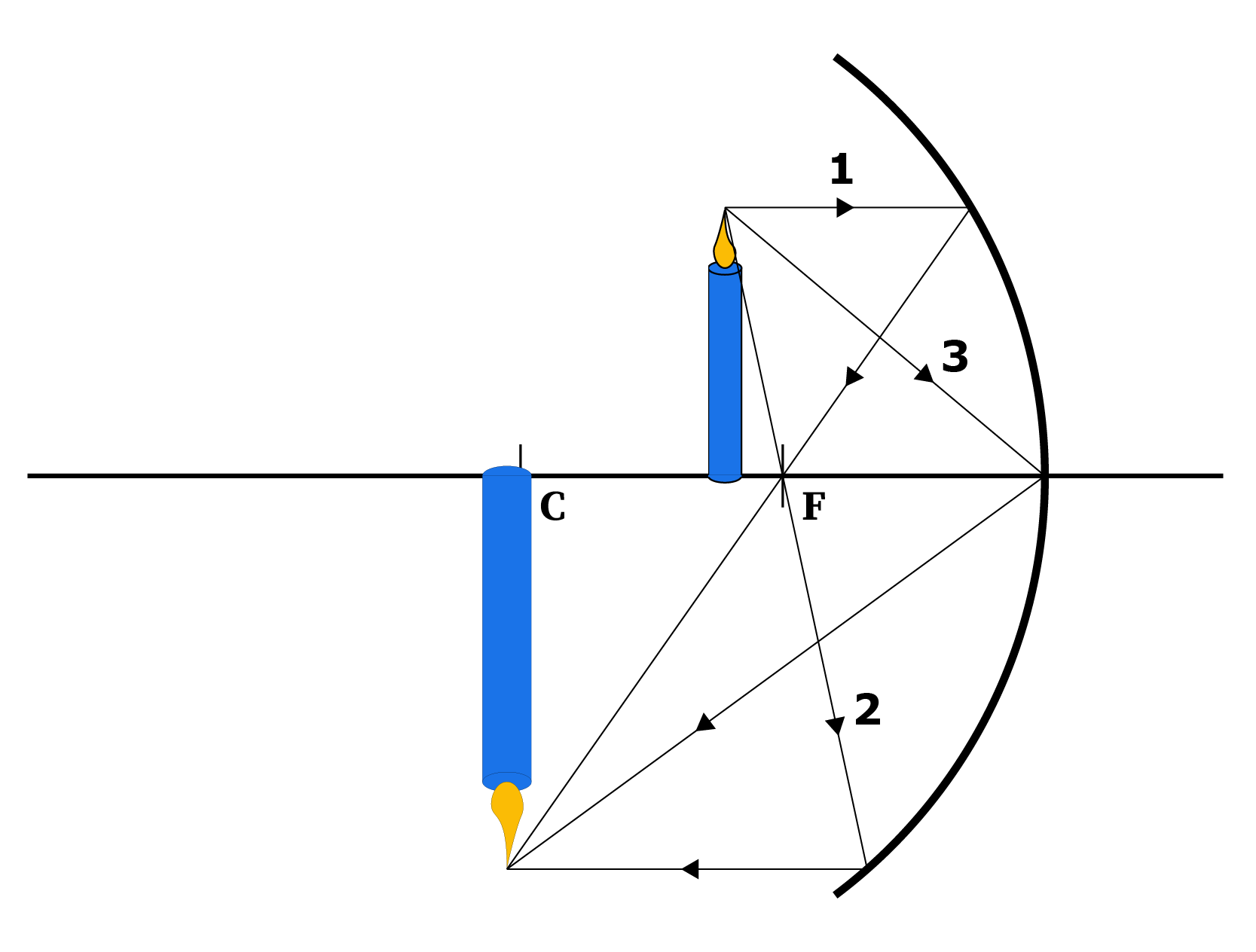
When we use a concave mirror, we often want to know what the image will look like: Will it be bigger or smaller? Upright or upside down? Closer or farther than the object? Ray diagrams are a simple drawing method used to show how light rays travel and interact with optical surfaces such as mirrors or lenses, which are transparent materials (usually glass or plastic) with at least one curved surface that bends light rays. They help us predict where an image will form and what it will look like. They’re useful for understanding things like makeup mirrors, telescope mirrors, satellite dishes, and car headlights. To locate the image formed by a concave mirror, we usually draw three special rays from the top of the object. Each one follows a predictable path based on the law of reflection. We draw a:
Ray parallel to the principal axis – After reflection, it passes through the focal point (F).
Ray through the focal point – Before reflection, it moves toward the focal point; after reflection, it becomes parallel to the principal axis.
Ray through the center of curvature (C) – It strikes the mirror and reflects back along the same path because it hits the mirror at a right angle.
Three principal rays for a concave mirror showing an object, a horizontal axis, and three numbered light rays reflecting from the mirror to form the image. The focal point and center of curvature are labeled.
For concave mirrors, the properties of the image depend on where the object is placed relative to the mirror’s focal point (F) and center of curvature (C). Let’s look at some examples.
EXAMPLE
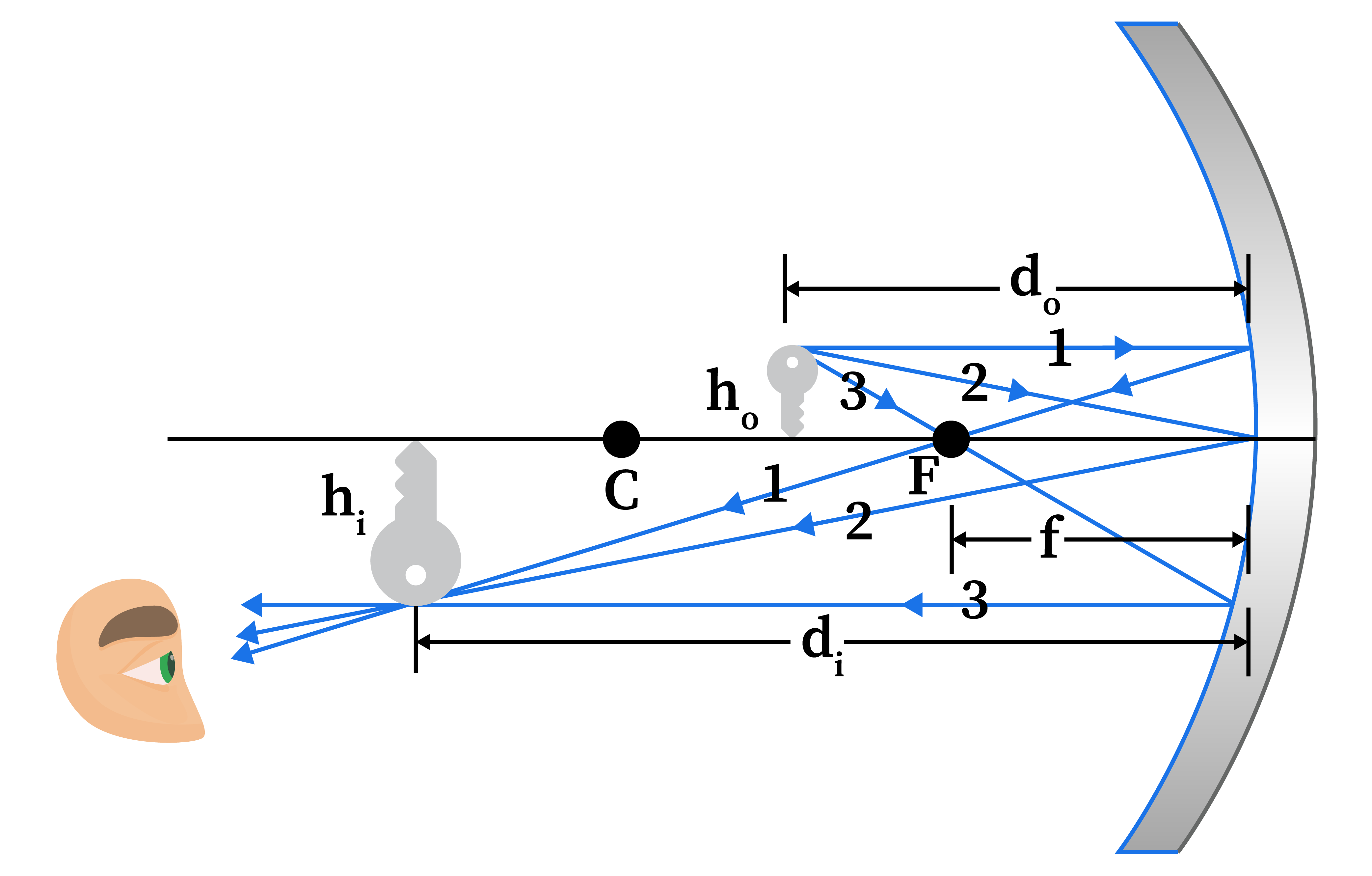
The object is placed behind the focal point.
Ray diagram for object placed further than focal length for concave mirror
As shown in the figure, when the object is placed behind the focal point (F) the image formed by a concave mirror is real, inverted, and larger than the object.
EXAMPLE
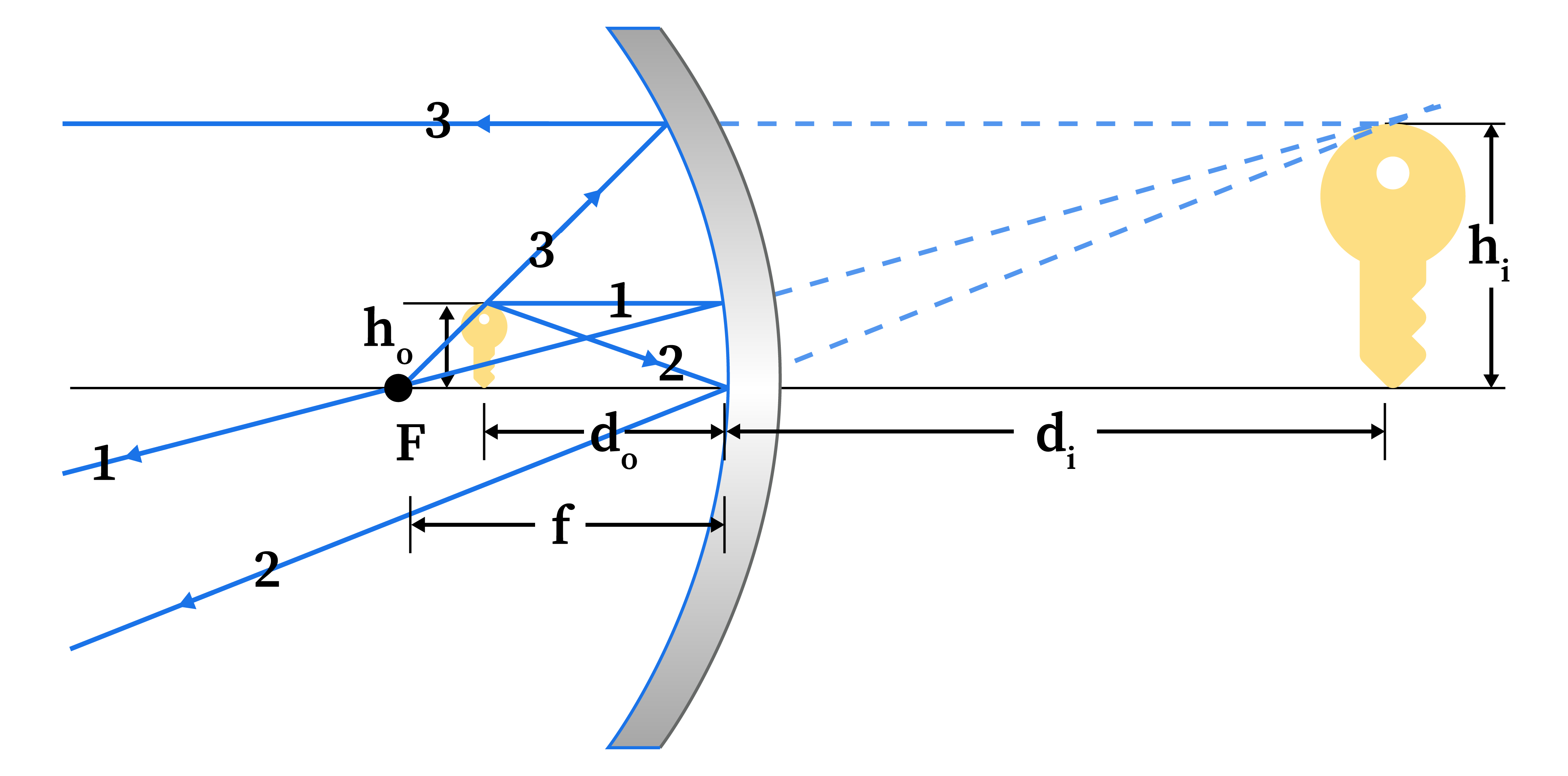
The object is placed inside the focal point
Ray diagram for object placed inside the focal length for a concave mirror
As shown in the figure, when the object is placed inside the focal point (F) the image formed by a concave mirror is virtual, inverted, and larger than the object
Because the image appears behind the mirror, it cannot be projected onto a screen. The light rays reflecting from the mirror do not actually meet behind the mirror—they only seem to come from that point when your brain traces them backward.
That’s why this type of image is called a virtual image:
The light rays don’t really converge at the image location.
The image can’t be caught on a screen because there is no actual light there—just the appearance of light coming from that spot.
Application of concave mirror
This is different from a real image, where the reflected (or refracted) rays actually meet at a point in space. A real image can be projected onto a screen—for example, the image formed on a movie screen by a projector, or on the wall by a lens.
This idea of a virtual image is very useful in everyday life. For example, concave makeup mirrors use this principle. When you bring your face very close to the mirror, your face is inside the focal point of the mirror. In this position, the mirror forms a magnified, upright, virtual image of your face. Even though the image seems to float behind the glass, your brain interprets the reflected light as coming from that location, making it easier to see fine details like eyelashes, pores, or eyebrow hairs.
terms to know
Real Image
Formed when light rays actually meet at a point after reflection.
Ray Diagram
A graphical method used to show how light rays travel and interact with optical surfaces, such as mirrors or lenses.
Lenses
Transparent materials (usually glass or plastic) with at least one curved surface that bends light rays.
Virtual Image (Mirror)
Formed when light rays don’t really converge at the location where they seem to be.
1b. Convex Mirrors
A convex mirror curves outward and is called a diverging mirror because it makes light rays spread out. In mirror equations, this is shown by giving it a negative focal length.
Unlike concave mirrors, which can form different types of images depending on where the object is, a convex mirror always forms the same kind of image: it is virtual, upright, and smaller than the object, no matter where the object is placed.
To find where this image appears in a convex mirror, we can still use principal rays in a ray diagram, just as we did with concave mirrors.
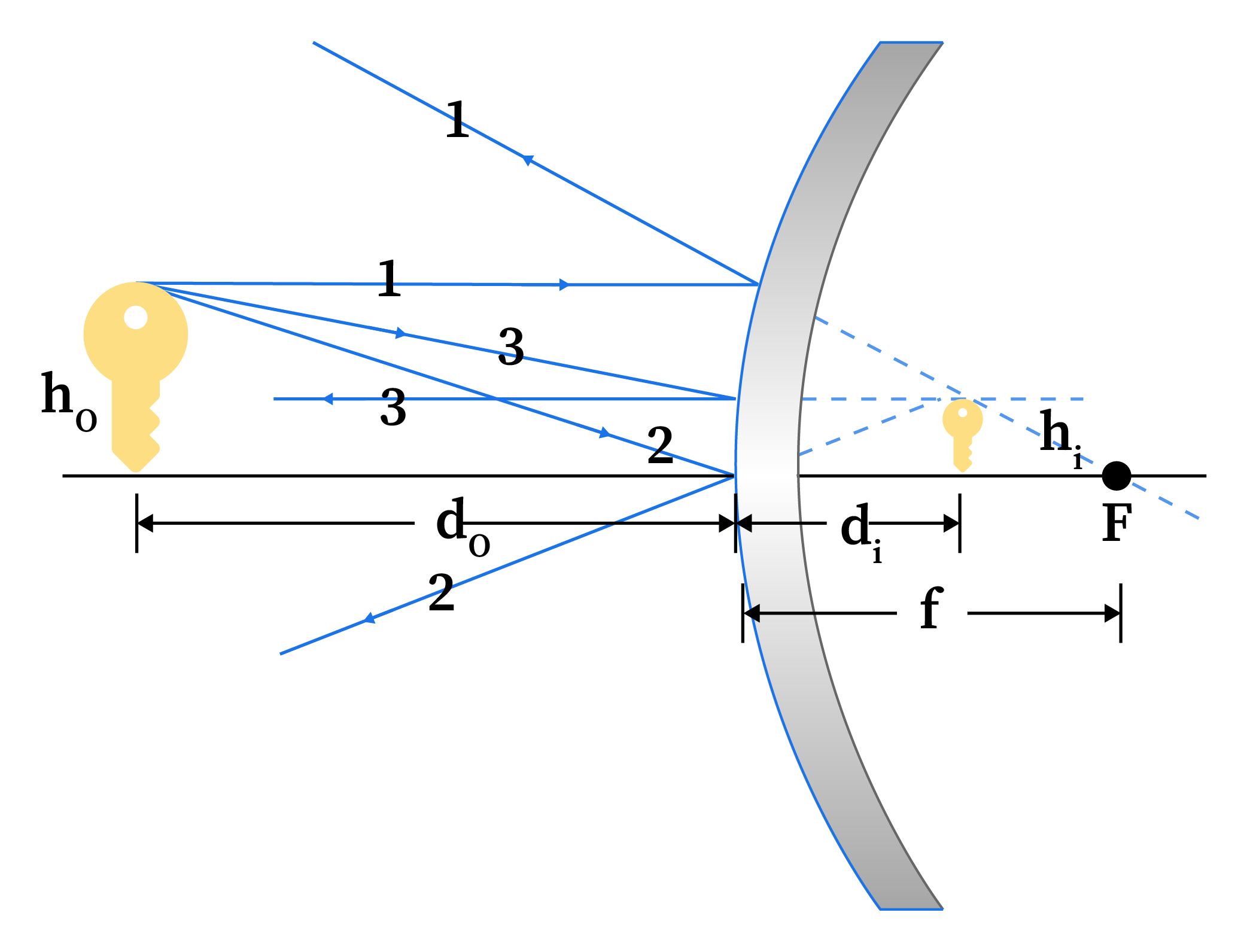
To locate an image in a convex mirror, we also use these three principal rays:
Ray parallel to the principal axis – After reflection, it appears to come from the focal point (F) behind the mirror.
Ray directed toward the focal point – Before reflection, it heads toward the focal point; after reflection, it becomes parallel to the principal axis.
Ray directed toward the center of curvature (C) – It approaches the mirror as if heading toward C; after reflection, it bounces back following the law of reflection, appearing to originate from behind the mirror.
By extending these reflected rays backward, they seem to meet at a point behind the mirror, forming a virtual, upright, and reduced image.
Three principal rays for a convex mirror
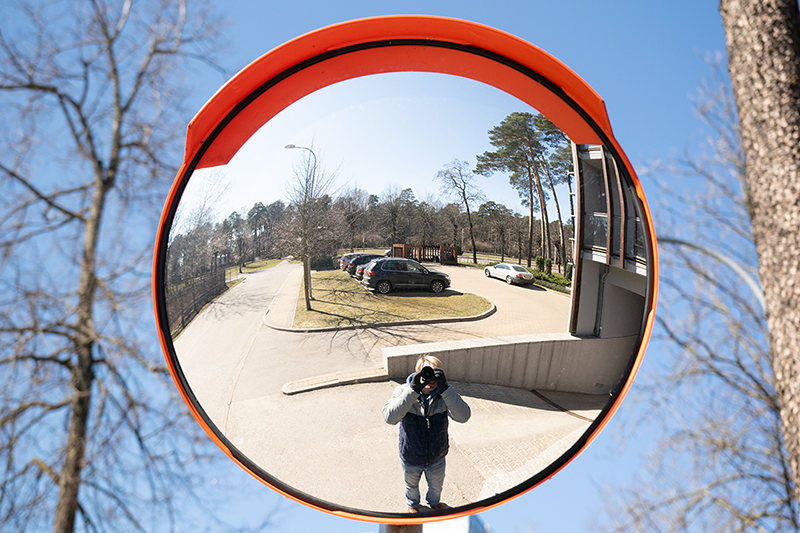
An application of a convex mirror is the use of security mirrors.
This image is always virtual, upright, and smaller than the object Because the image appears behind the mirror, it cannot be projected onto a screen. The tray diagram above shows that the reflected rays spread outward, but when extended backward, they seem to originate from a point behind the mirror. This is why convex mirrors are commonly used in vehicle side mirrors and security mirrors to provide a wider field of view while keeping the image reduced in size.
summary
In this lesson, you learned about spherical mirrors, which include concave mirrors (curving inward) and convex mirrors (curving outward). You discovered that the behavior of light in these mirrors depends on two key measurements: radius of curvature (C) and focal length (f). You explored concave mirrors, their ability to form real or virtual images, and how ray diagrams using three principal rays help locate these images. You examined how image properties change depending on the object’s position relative to the focal point and center of curvature, and saw applications like telescopes, solar cookers, and makeup mirrors. Finally, you studied convex mirrors, which always form a single type of image, virtual, upright, and reduced, making them ideal for applications such as vehicle side mirrors and security mirrors.

 the image formed by a concave mirror is real, inverted, and larger than the object.

 the image formed by a concave mirror is virtual, inverted, and larger than the object

 Because the image appears behind the mirror, it cannot be projected onto a screen. The tray diagram above shows that the reflected rays spread outward, but when extended backward, they seem to originate from a point behind the mirror. This is why convex mirrors are commonly used in vehicle side mirrors and security mirrors to provide a wider field of view while keeping the image reduced in size.