Table of Contents |
The color spectrum is made up of the seven hues of visible light: red, orange, yellow, green, blue, indigo, and violet, commonly known by the mnemonic ROY G BIV. ROYGBIV are sometimes deemed the colors of the rainbow because they are actually visible in the rainbow’s bands. During the latter half of the 17th century, Sir Isaac Newton conducted a number of experiments using natural light and prisms. Newton proved that white light is composed of the seven colors of the rainbow, and these colors are visible when light is dispersed through a prism, essentially the same effect as light passing through water vapor in the air.

Light is electromagnetic radiation. The human eye can only perceive a small amount of this electromagnetic radiation in a spectrum ranging between 380–750 nanometers (nm). All light outside of this narrow range is imperceptible. The image below demonstrates where red, orange, yellow, green, blue, indigo, and violet fall on the visible spectrum and the wavelength associated with each color.
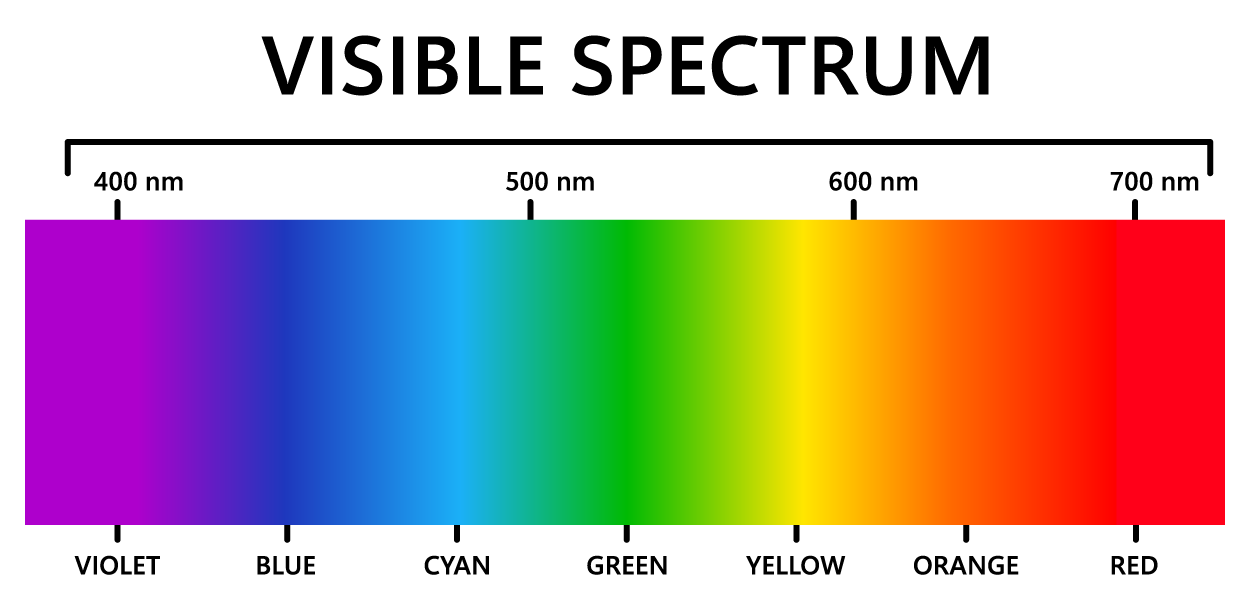
Color is the makeup of each individual band of the refracted visible light waves. A hue is the name of a specific color.
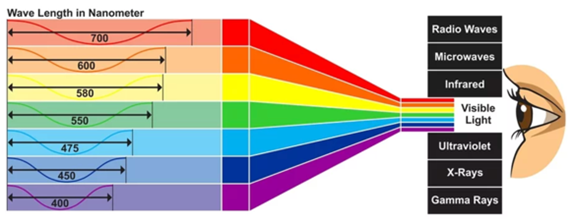
The concept may start to make more sense if you think about how the word “hue” is typically used in a sentence: “That grass has a green hue,” or “These flowers have beautiful rainbow hues.”
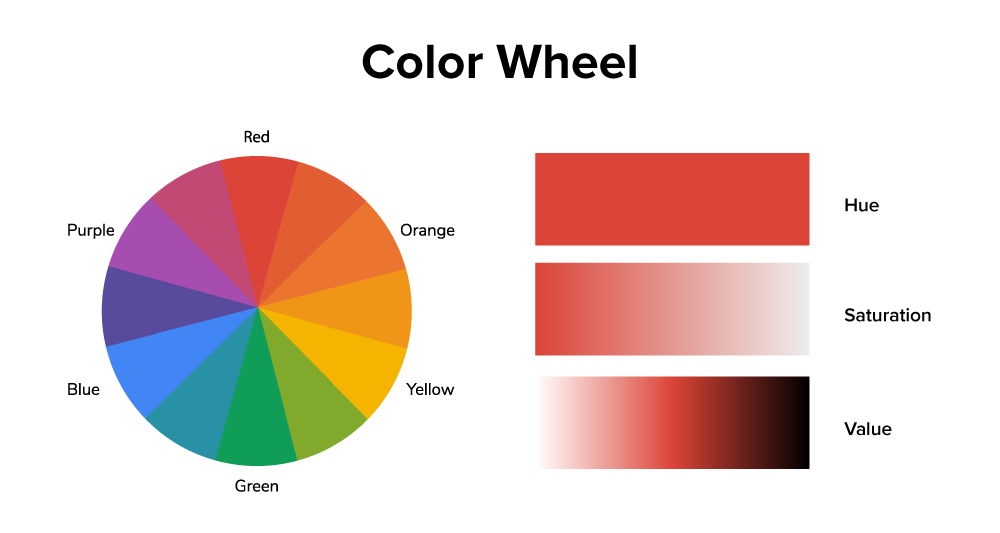
Saturation is another term for the intensity of a color and refers to a color's purity or vividness. When saturation is raised, a color becomes more pure and vivid; when saturation is lowered, a color becomes more muted. Below is an image of a color wheel with the hue, saturation, and value expanded for the color red. A color wheel is a useful tool for designers, as it helps to define different color harmonies and relationships. Notice that the color wheel substitutes purple for indigo and violet, as both hues are closely related. Hue, saturation, and value (HSV) is a type of color model, a system that uses numerical values to define color. The HSV color model utilizes a combination of a specific hue and the amount of saturation and value to select a color.
Colors are modified by adding white or black to the base hue. Adding white to a color creates a tint. For example, adding white to the color red will create pink, which is a tint of red. On the contrary, adding black to a hue will create a shade. Again, using red as the base hue, the addition of black creates the shade maroon. Adding amounts of black and white to an image is often defined as adding values of gray. The darker the gray, the closer it is to black, and the lighter the gray becomes, it turns white.
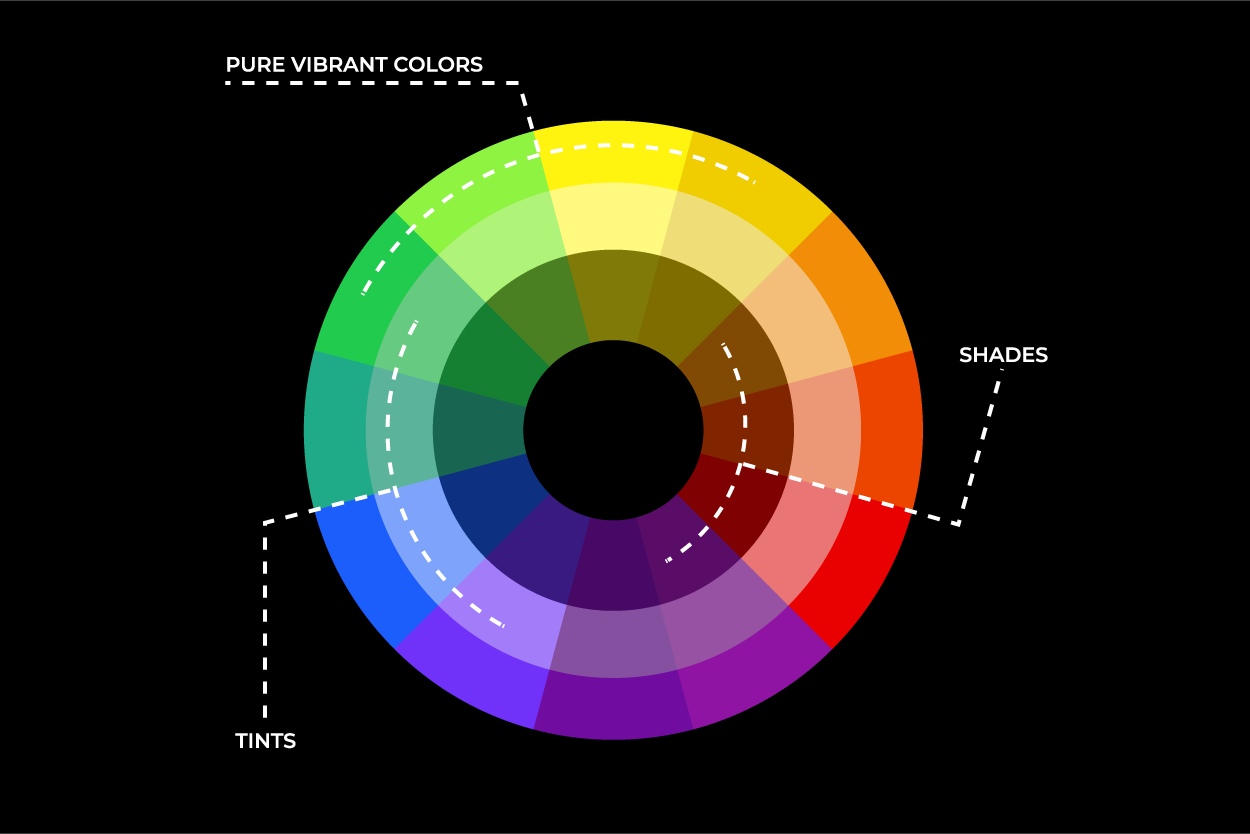
Adjusting white or black to a hue is sometimes referred to as changing the brightness of a color. This process is the same as adding white or black, but the adjustment is based on the HSB color model, which stands for hue, saturation, and brightness. Both HSB and HSV color models are essentially the same.
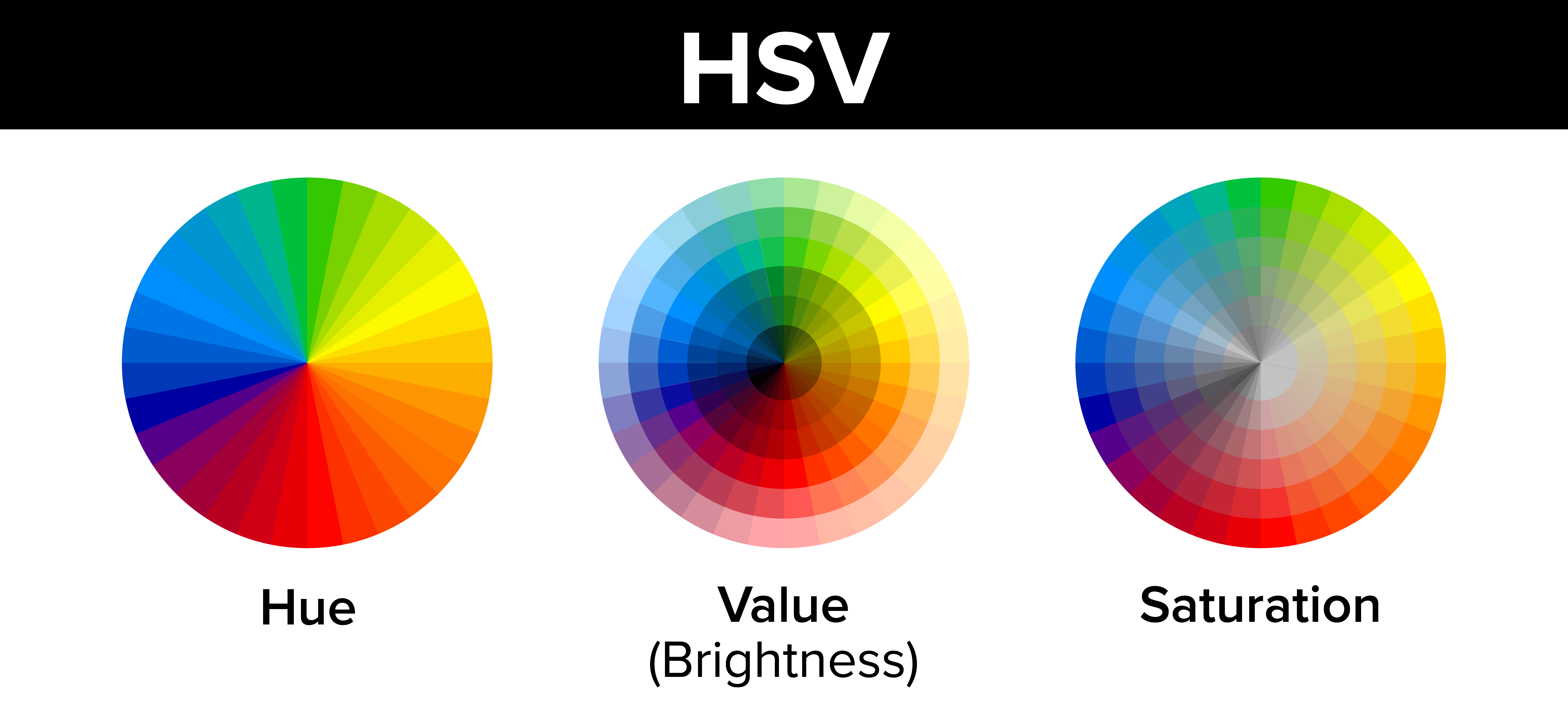
All of these aspects of color play a huge role in design, as they work together with other elements to create visual interest, mood, appeal, and many other factors.
There are various color models aside from HSV and its counterparts. Although these color models differ by names and the methods in which colors are selected and identified, they are separated into two different groups: additive and subtractive. Additive color models formulate hues, tints, and shades by blending visible light. Subtractive color models are formulated through pigments, such as ink. Because additive color models work with light, they are used for screen outputs like websites, digital video, and mobile applications. Perhaps the most notable additive color model is RGB. The acronym RGB stands for red, green, and blue. In this model, all visible colors are formed through different combinations of these three colors. Subtractive color models are used for print outputs. The color model CMYK stands for cyan, magenta, yellow, and black, and uses these four colors to blend and identify hues created with ink.
Source: THIS TUTORIAL WAS AUTHORED BY MARIO E. HERNANDEZ FOR SOPHIA LEARNING. PLEASE SEE OUR TERMS OF USE.



