Table of Contents |
As you have learned, elasticity is a ratio measuring the sensitivity of one variable to a change in another variable. The responsiveness of a product to a change in its price is, more specifically, known as price elasticity. Price elasticity applies to both the demand and supply side of the market.
Suppose we are interested in elasticity of demand, which measures how sensitive a product's demand is to changes in its price. Elasticity of demand is calculated by dividing the percentage change in quantity demanded of a good or service by the percentage change in its price. For example, if we want to determine how sensitive drivers are to a change in the price of gasoline, then we calculate the price elasticity of demand for gasoline. We do this by dividing the percent change in the number of gallons of gasoline demanded by the percent change in the price of gasoline per gallon.
Likewise, suppose that we are interested in elasticity of supply, which measures how sensitive a product's supply is to changes in its price. Elasticity of supply is calculated by dividing the ratio of the percentage change in quantity supplied of a good or service by the percentage change in its price. For example, if we want to determine how sensitive gas station owners are to a price change, then we calculate the price elasticity of supply for gasoline. We do this by dividing the percent change in quantity of gallons of gasoline supplied by the percent change in the price of gasoline per gallon.

EXAMPLE
The U.S. Energy Information Administration (EIA) has measured the effect of a change in the price of gasoline on the amount of automobile travel. EIA estimates that the price elasticity of gasoline is currently in the range of -0.02 to -0.04 in the short term, meaning it takes a 25% to 50% decrease in the price of gasoline to raise automobile travel by 1%. Drivers are not very responsive to the price change.There are four basic classifications of price elasticity, whether we consider demand or supply. The interpretation is the same for both because we are examining how responsive buyers or sellers are to own-price change of a product.
Let's begin our review of the four types of price elasticity with an extreme example, the monthly demand for life-saving medicine.
No matter how expensive this life-saving medication becomes, the people who need it will purchase the exact same quantity of 30 pills per month. Therefore, they will not be responsive to price hikes or price drops. Life-saving medicine is a necessity, and there are no substitutes, as in the case of toothpaste or hand soap.
If we plot the relationship between price and quantity for this medicine, we will fix the quantity at 30 pills per month. The graph below shows the relationship. The price of this life-saving medicine is plotted on the y-axis and the quantity purchased on the x-axis.
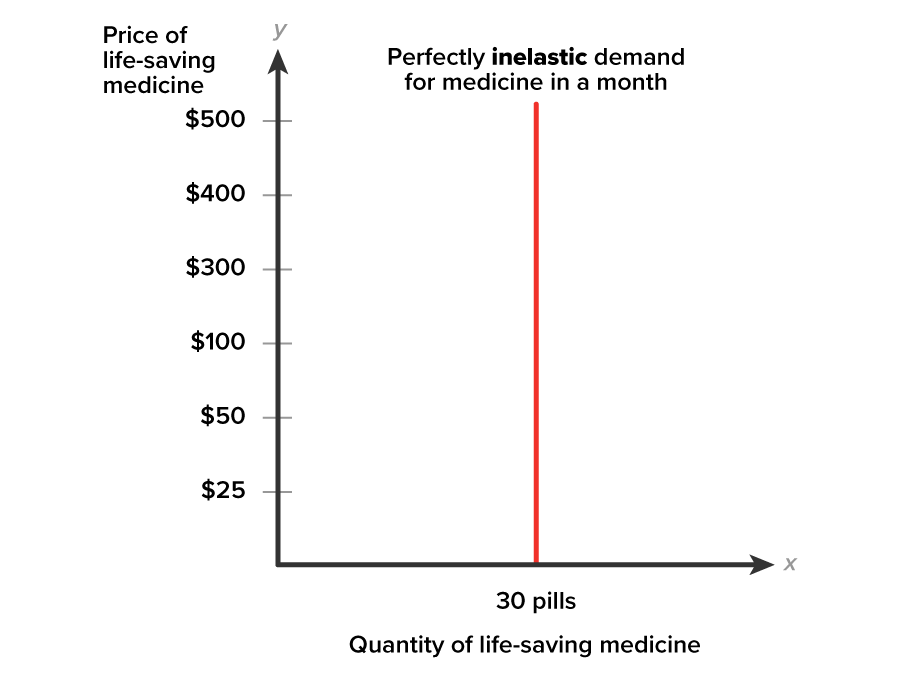
This curve is vertical. If you choose any two price points, say, $50 and $100, the change in quantity is still “0.” Buyers are not sensitive to this 50% increase in price. This extreme case is classified as perfectly inelastic.
EXAMPLE
Supply curves can be perfectly inelastic, too. The price elasticity of primary care physicians has been estimated at 0.0. Changing the earnings of primary care physicians does not change the quantity of these physicians, at least in the short term.Perfectly inelastic demand, then, is defined as quantity remaining unchanged regardless of a change in price, resulting in a vertical demand curve.
Most goods and services are not perfectly inelastic but are relatively sensitive to price changes. When one variable does not respond as fully to the change in another variable, it is classified as inelastic.
In the case of price inelasticity of demand, the curve has a downward slope because people do change their behavior at least slightly; that is, people are somewhat responsive to a change in price. However, a 1% price change results in a less than 1% quantity change. The graph below shows a downward sloping curve with a steep slope.
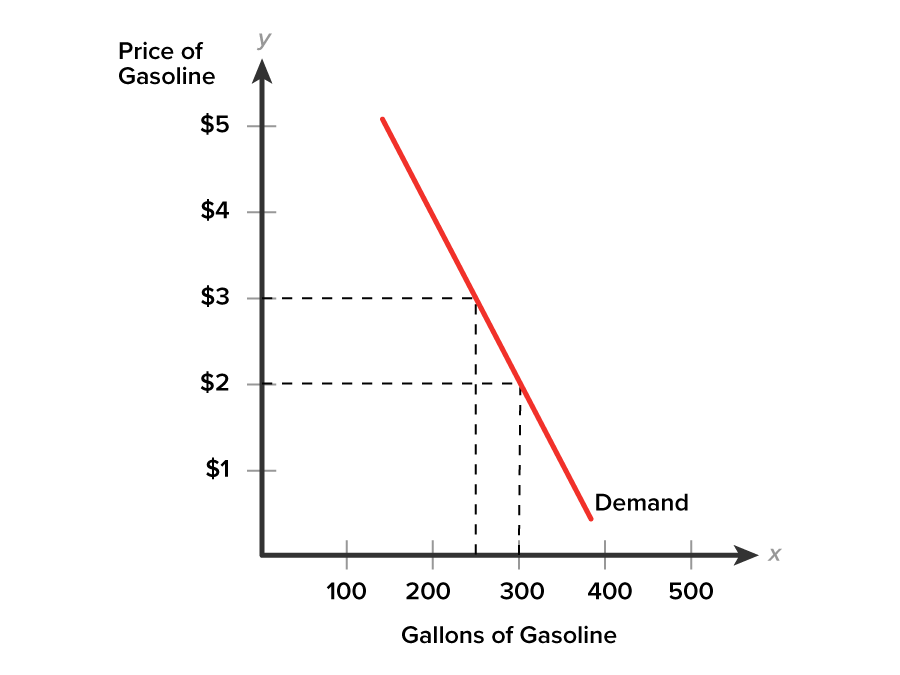
Suppose the price of gasoline in the graph above rises from $2 to $3 per gallon. The change in price is 50%. And quantity falls from 300 to 250 gallons. The change in quantity is -16.67%. Therefore, the coefficient of price elasticity is -0.33, meaning a 1% rise in the price leads to a less than 1% change (0.33%) fall in the quantity of gasoline demanded by drivers. The coefficient’s negative sign indicates that price and quantity are moving in opposite directions, reinforcing the idea of a downward-sloping curve.
The following formula shows how to calculate price elasticity for this scenario:

Drivers do not change their purchasing habits a full 1% to match the 1% price increase. Most people—at least in the short term—recognize that gasoline is a necessity and without a substitute, unlike the case of breakfast cereals.
EXAMPLE
In the previous example, for primary care physicians, we determined that the price elasticity of supply was perfectly inelastic but when examined by gender a difference appears. The coefficient of price elasticity for female primary care physicians is 0.5 versus male primary care physicians at 0.2. The values indicate female primary care physicians are slightly more responsive to a 1% increase in wages than male primary care physicians.IN CONTEXT
Does raising prices curb unhealthy behavior? Perhaps, in the case of price inelastic demand, it is possible.
State and federal governments have, historically, taxed products such as alcoholic beverages, tobacco and cigarettes, and marijuana products in the interest of public safety. Taxes on these products are often referred to as “sin taxes.” The legislated objective of the tax is to deter behaviors that are perceived as being socially harmful. Despite the stated objective(s), sin taxes have proven to be a gold mine for state and federal governments due to price inelasticity. One estimate for the price elasticity of demand for alcohol is -0.30, for tobacco between -0.32 and -0.40, and for marijuana, -0.40. A 1% increase in price leads to a negligible 3 to 4% drop in consumption of these products.
Given buyers’ low responsiveness to price hikes, the real beneficiaries of “sin” taxes have been public coffers, with some states benefiting more than others depending on the legislated tax rate. Of states with legal marijuana markets, Washington has the highest statewide marijuana sales tax rate at 37%, while Illinois is the lowest at 7%. In 2020, Washington collected nearly $700 million in tax revenue from legal marijuana sales as sales soared during the pandemic.
So what’s the conclusion? Does raising prices curb unhealthy behavior? Perhaps, but minimally when product demand is price inelastic.
Let's look at another extreme case of elasticity: the situation in which price does not change at all, but the change in quantity is highly responsive.
A realistic example is difficult to find so let’s consider this scenario. Suppose that 200 hot dog stands are packed into a baseball stadium on game night. All vendors are selling an identical product and all are charging $5 for that identical hot dog. The price is fixed at $5. Vendors can sell all they want at $5 per hot dog. The spectators are very hungry!
If price is fixed and quantity can freely change, then plotting the relationship produces a horizontal line. This situation is illustrated in the graph below.
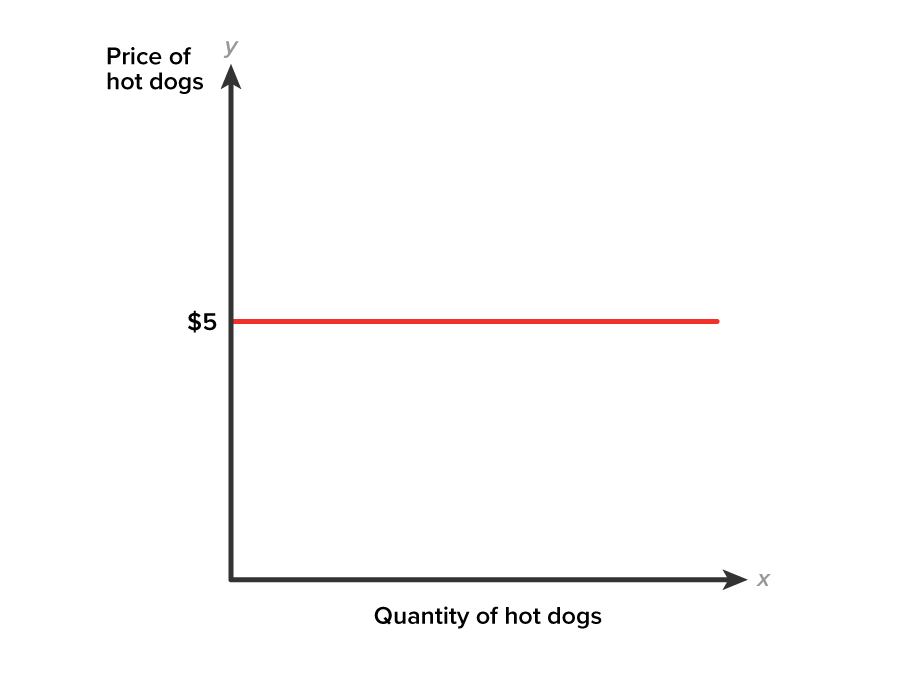
This demand curve is horizontal at $5 per hot dog. If you choose any two points along the demand curve, then only quantity changes. This type of elasticity is classified as perfectly elastic.
What do you think would happen if one out of 200 hot dog stands decided to charge a nickel more for their hot dog? In theory, customers would avoid this hot dog stand and, according to this demand curve, the quantity demanded at that stand would drop to zero sales.
There is only one price sellers can charge. Sellers have no ability to change prices here. There is also no incentive to drop the price. Perfectly elastic demand refers to the demand for goods and services that changes significantly without any change in price, resulting in a horizontal line for a demand curve.
In truth, not many things are perfectly elastic in the world. Many things are simply elastic; buyers are responsive to the change in price but not perfectly. When mall stores place items on sale, such as shoes, sweaters, jeans, and toys, the store knows in advance that customers will be enticed into their stores.
Suppose we return to the demand for a category of food, say Gala apples, which have many substitute varieties of apples. Demand for a specific type of apples, like Gala apples, would be somewhat elastic because shoppers can substitute away from a higher-priced apple variety. Demand is elastic. The relationship between price and quantity is illustrated below with a relatively shallow downward-sloping demand curve.
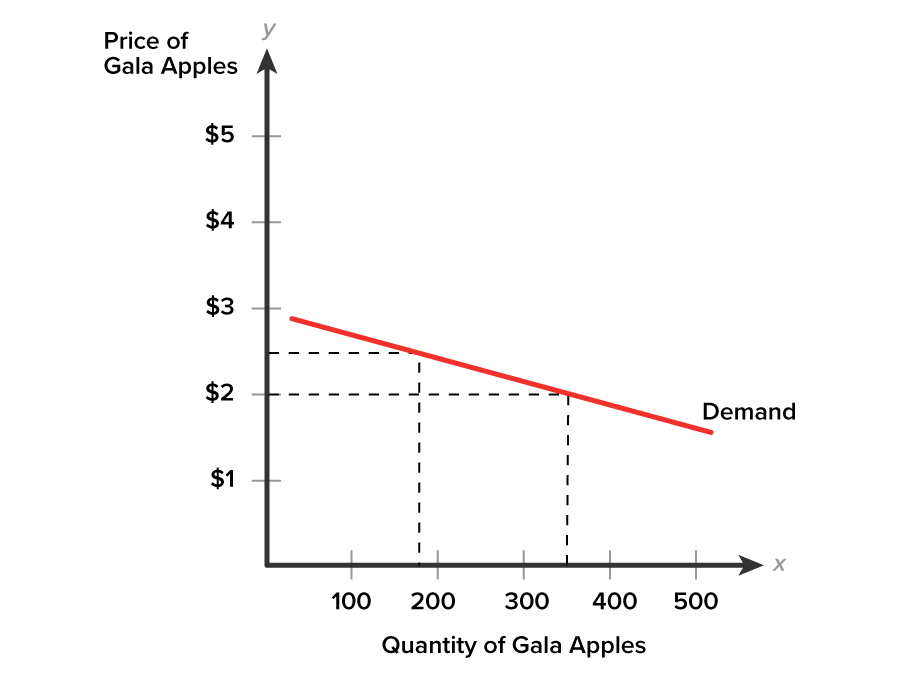
Assume that Gala apples are the only variety of apples changing price. A small change in the price on the vertical y-axis, say from $2.50 to $2 per pound, results in a large change in the quantity of Gala apples being purchased along the horizontal x-axis.
The demand curve is downward-sloping but not completely horizontal. Shoppers are very responsive to small changes in price. This is referred to as elastic demand.
IN CONTEXT
Are you wondering if elasticity of demand has any real application? While customers react to price changes in the goods and services they buy, interpreting their responses in the context of price elasticity is a rather foreign concept. Businesses, on the other hand, regularly exploit price elasticity to gauge the likely impact on revenue of a price change. In an ideal business world, customers would never respond to price hikes and businesses would easily pad their bottom lines.
During the Covid period, many companies raised prices including PepsiCo, makers of soda drinks. Soda is in the ready-to-drink market, so it has lots of competition both from other soft drink makers as well as from other drink markets, such as juice, energy drinks, nutrient waters, and coffee and tea, not to mention the many alternate brands and flavors of soda. Given the diversity of substitutes, consumers of Pepsi should be very price sensitive, making price hikes rare. One estimate places price elasticity of demand for Pepsi at -2.08 (absolute value).
In 2021, the PepsiCo company reported that it began raising prices in the summer and expected to continue doing so into 2022. A myriad of factors from global supply chain disruptions to the rising cost of inputs puts the company in a position to either absorb cost increases internally or pass costs on to the end buyer. PepsiCo executives reported a much lower price responsiveness than historically data projected. Raising price had little effect on sales.
One explanation for the lowered price responsiveness was the desire of shoppers to “get-and-get-out” of the store as quickly as possible. A fast shopping trip minimizes the comparison shopping buyers might typically engage in. People continued buying Pepsi without noticing, or caring, that the price had gone up. This is wonderful news for PepsiCo. It means rising prices contribute to growing income and higher share prices on PepsiCo stock.
Source: THIS TUTORIAL HAS BEEN ADAPTED FROM LUMEN LEARNING’S “Microeconomics”. ACCESS FOR FREE AT https://courses.lumenlearning.com/wm-microeconomics/. LICENSE: CC ATTRIBUTION 4.0 INTERNATIONAL.
REFERENCES
Cammenga, J. (2021, August 25). How high are taxes on recreational marijuana in your state? Tax Foundation. Retrieved May 18, 2022, from taxfoundation.org/state-excise-taxes-on-recreational-marijuana-2020/
Gasoline prices tend to have little effect on demand for car travel. U.S. Energy Information Administration (EIA). (2014, December 15). Retrieved May 18, 2022, from www.eia.gov/todayinenergy/detail.php?id=19191
Tatevosian, P., (2021, October 20). Good news for Pepsico: Consumer reaction to price increases is better than expected. Nasdaq. Retrieved May 18, 2022, from www.nasdaq.com/articles/good-news-for-pepsico%3A-consumer-reaction-to-price-increases-is-better-than-expected-2021
Washington state adult-use cannabis generates huge impacts, but tax burden high. MJBizDaily. (2022, January 11). Retrieved May 27, 2022, from mjbizdaily.com/washington-state-adult-use-cannabis-generates-huge-impacts-but-tax-burden-high/





