Table of Contents |
The Civil Rights movement was a social movement in the United States from 1954 to 1968.
The artists of the Civil Rights movement created works that vividly depicted the struggles and aspirations of African Americans, offering both a critique of societal racism and a vision of equality and justice. Civil Rights art not only documented the era but also played a crucial role in shaping art and social change.
Romare Bearden is often considered a successor to the Harlem Renaissance, carrying forward its spirit into the Civil Rights era—a pivotal period in African American history that profoundly shaped his artistic vision.
During this transformative time, Bearden made a significant shift in his medium, moving from painting to collage. Bearden used this medium to explore the complex themes of identity, memory, and cultural heritage, often depicting scenes of African American life in a way that was both deeply personal and broadly resonant.
Bearden’s work during the Civil Rights movement not only reflected the struggles and aspirations of the time but also contributed to the broader dialogue on race and culture in America. By combining fragments of photographs, magazine clippings, and painted elements, he created powerful visual narratives that captured the richness and diversity of the African American experience. His collages are celebrated for their ability to convey a sense of community, resilience, and hope.
 View The Calabash.
Bearden incorporates a common artistic motif: a nude woman bathing. The nude woman in the foreground seems unaware of, or simply ignores, the elderly (or maybe prematurely aged) woman in the background holding the child. The title, The Calabash, may refer to the name of a particular type of gourd, sometimes called the bottle gourd, which would be dried out and used as a container for liquids.
Historically, the gourd—nature’s canteen—is associated with human migration, alluding to the migration of African Americans northward or the figurative migration of the African American population out of the past and into the present, symbolizing the cultural shift of the Civil Rights movement.
Faith Ringgold’s painting Die is a powerful and provocative work that addresses the themes of racial violence, civil rights, and the social upheaval of the 1960s in the United States. This painting is part of her larger series titled American People, which explores the complexities of race relations in America.
 View The American People Series #20: Die.
Die directly confronts the pervasive racial violence and tensions that were erupting across the United States during the 1960s. The painting depicts a chaotic and brutal scene of interracial violence, with both Black and White figures involved in a violent confrontation. The figures are bloodied and distressed, with expressions of fear, anger, and desperation. This stark portrayal reflects the violent clashes that were occurring during the Civil Rights movement, including riots and protests.
The painting’s composition is dense and dynamic, with overlapping figures and jagged movements that create a sense of urgency and turmoil. The use of bold colors—especially red for the blood—adds to its visceral effect. Ringgold’s choice to depict both Black and White figures as both the victims and perpetrators of violence complicates the narrative, suggesting that the cycle of violence and racial hatred affects everyone, regardless of race, age, or gender.
As a Black woman artist, Ringgold brings a unique perspective to the portrayal of violence in Die. The inclusion of women and children in the painting emphasizes the pervasive effect of violence on all members of society, not just those typically depicted in political conflicts. This inclusion also points to the often-overlooked role of women and families in the struggle for civil rights and social justice.
David Hammons is a prominent artist known for his provocative and conceptually rich works that address the issues of race, identity, and social injustice. His art often challenges mainstream notions of art and society, using found objects and unconventional materials to make powerful statements.
 View The Door (Admissions Office).
The Door (Admissions Office) is a powerful critique of the systemic racism and exclusionary practices within American educational institutions. Created during the height of the Civil Rights movement, The Door (Admissions Office) reflects the intense struggles for racial equality and justice that were taking place across the United States. The artwork consists of a wooden door with a darkened, ghostly imprint of a human body, symbolizing the physical and psychological barriers that Black students face in accessing higher education. By referencing an admissions office, Hammons directly critiques the gatekeeping role of these institutions that historically denied or severely limited access to African Americans.
Hammons’ work often engages with the ideas of Dada. By using a simple, everyday object like a door and transforming it into a powerful symbol of exclusion, Hammons challenges the art world’s focus on aesthetics and commercial value, emphasizing instead the conceptual and political significance of art. This approach aligns with the broader aims of Conceptual Art, which prioritizes ideas and social critique over traditional artistic techniques.
The themes explored in The Door (Admissions Office)—racism, exclusion, and the fight for equality—remain relevant today. The artwork continues to resonate in discussions about access to education, systemic racism, and the ongoing struggle for civil rights.
Sam Gilliam was a pioneering African American artist known for his innovative approach to abstract and color field painting. He is particularly celebrated for his “drape” paintings, in which he removed the canvas from the stretcher and allowed it to hang freely, creating dynamic works that blurred the line between painting and sculpture. One of his most notable artworks is April 4, created in response to the assassination of Dr. Martin Luther King Jr. on April 4, 1968—a pivotal and traumatic event in American history.
 View April 4.
April 4 captures the grief, anger, and turmoil that followed King’s death. By creating this artwork, Gilliam not only paid tribute to King’s legacy but also engaged with the broader social and political upheaval of the Civil Rights era.
Stylistically, April 4 is an abstract work characterized by Gilliam’s use of rich, saturated colors and his distinctive technique of staining the free-hanging draped canvas. The abstraction allows for a universal expression of grief, transcending specific imagery to convey the collective sorrow and chaos felt by the nation. The interplay of colors and the physicality of the draped canvas evoke a sense of mourning, a funeral shroud, and the unraveling of the social fabric.
Sam Gilliam’s April 4 has had a lasting effect on the art world, particularly in how it expanded the possibilities of abstract painting. His ability to convey profound emotional and social themes through abstraction has influenced many artists who seek to address complex issues in their work. April 4 remains a powerful symbol of the intersection between art and activism, illustrating how abstract art can engage with and respond to critical moments in history.
Jacob Lawrence, a pivotal figure who built upon the legacy of the Harlem Renaissance, was a peerless force in shaping the narrative of American art and African American history for generations. Lawrence’s decision to paint a self-portrait in 1977, after decades of chronicling the African American experience, is an acknowledgment of his own place in history.
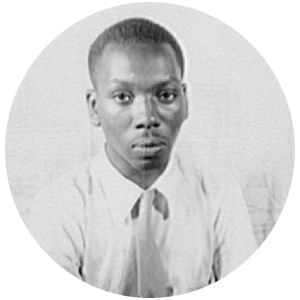 View Self-Portrait.
This style is something Lawrence referred to as dynamic Cubism—the forms are flattened and broken up into blocks of color but appear simultaneously independent and cohesive. His Self-Portrait showcases these elements with a focus on clarity and expressiveness. Also, by creating a self-portrait, Lawrence not only asserts his presence in the art world but also invites viewers to engage with him. It goes beyond mere likeness, offering a window into the artist’s soul and his understanding of his role as a chronicler of the African American experience.
Like many figures of the Harlem Renaissance and their descendants, Lawrence turned to education, eventually settling in Seattle to teach and inspire new generations of artists at the University of Washington. His artistic production never ceased, and he continued working until his death in 2000 at the age of 82.
Source: THIS TUTORIAL WAS AUTHORED BY IAN MCCONNELL AND TAMORA KOWALSKI FOR SOPHIA LEARNING. PLEASE SEE OUR TERMS OF USE.



