Table of Contents |
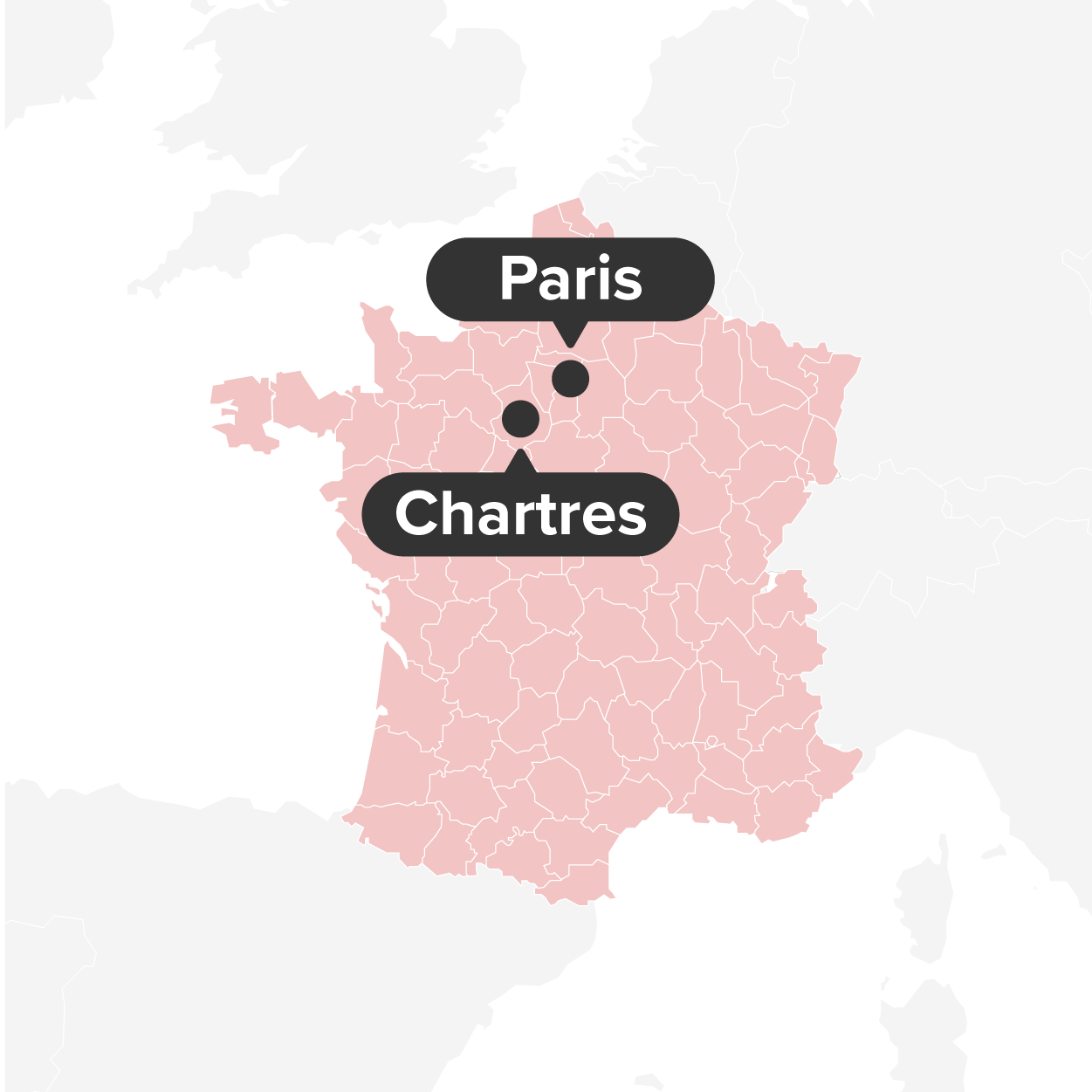
This lesson spans 1134 to 1260, and focuses on Chartres, France, which is very close to Paris.
Here is a map of France showing the cities of Chartres and Paris:
Chartres Cathedral is a beautiful example of Gothic architecture in France. Interestingly, the stained glass windows in Chartres are, for the most part, completely original. To have survived in the elements for roughly 900 years is nothing short of amazing. The artistry of the windows themselves is truly amazing as well.
Chartres was dedicated to the Virgin Mary, as part of a growing movement of devotion to her. The relic that was housed at the church was Mary’s cloak, which was taken out during religious festivals and paraded. All churches called “Notre Dame” (“Our Lady” in French) are dedicated to her. Construction on the church had begun in 1134 but needed to be rebuilt after a fire in 1194.
Here is an image of the exterior of Chartres Cathedral. Notice how completely it dominates the skyline of the town. Part of the popularity of the Gothic style came from towns competing to have the most beautiful and tallest cathedral:
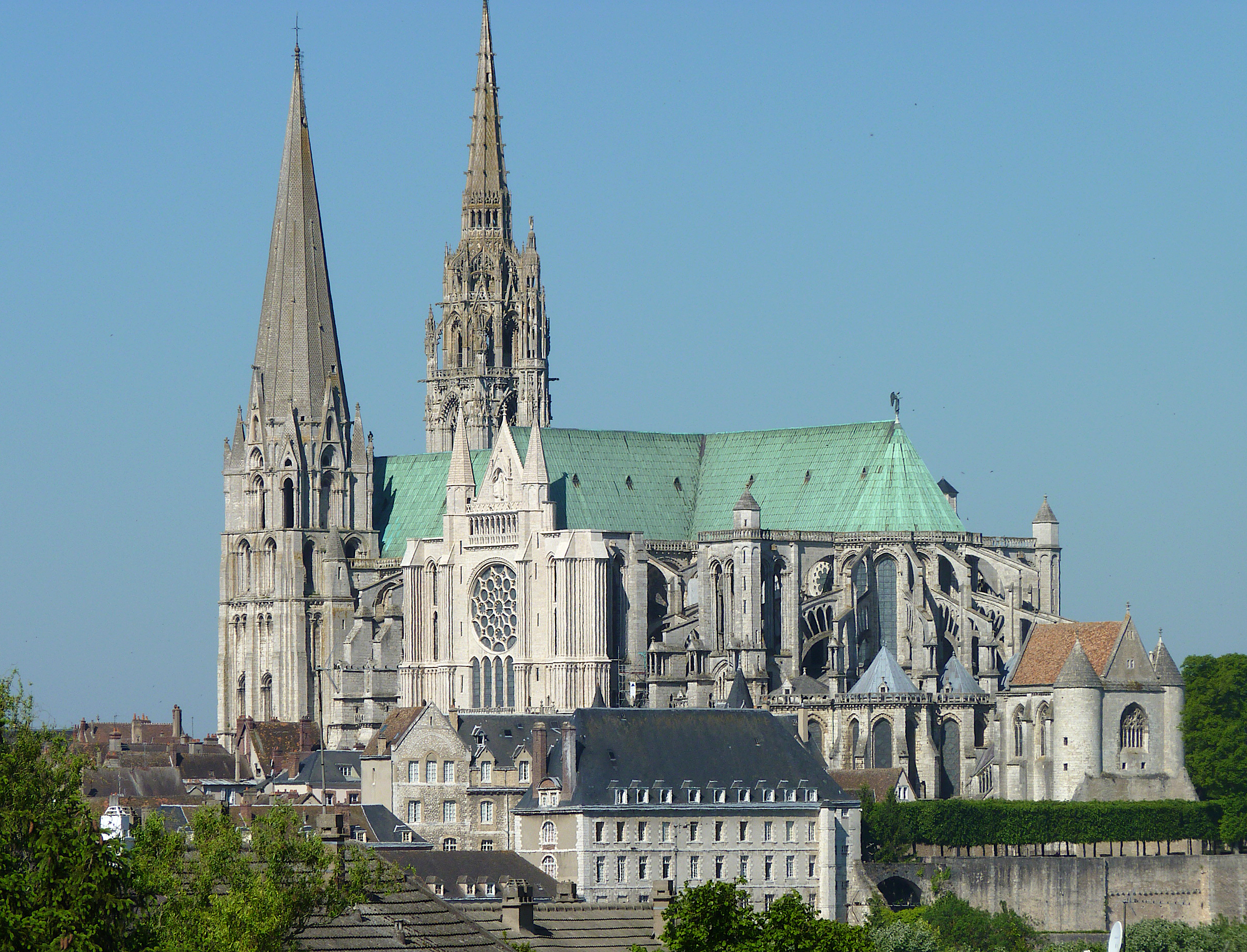
Cathédrale Notre-Dame de Chartres (Chartres Cathedral)
Chartres, France
1126 - 1252 CE
Stone
The western façade of a cathedral is the primary entrance, as they are arranged west to east. Chartres Cathedral had a standard three-portal entrance, and the tympanums were all filled with religious imagery. Sculptures adorn the supportive jambs that flank the doorways of these churches.
Here is the western façade of the church:
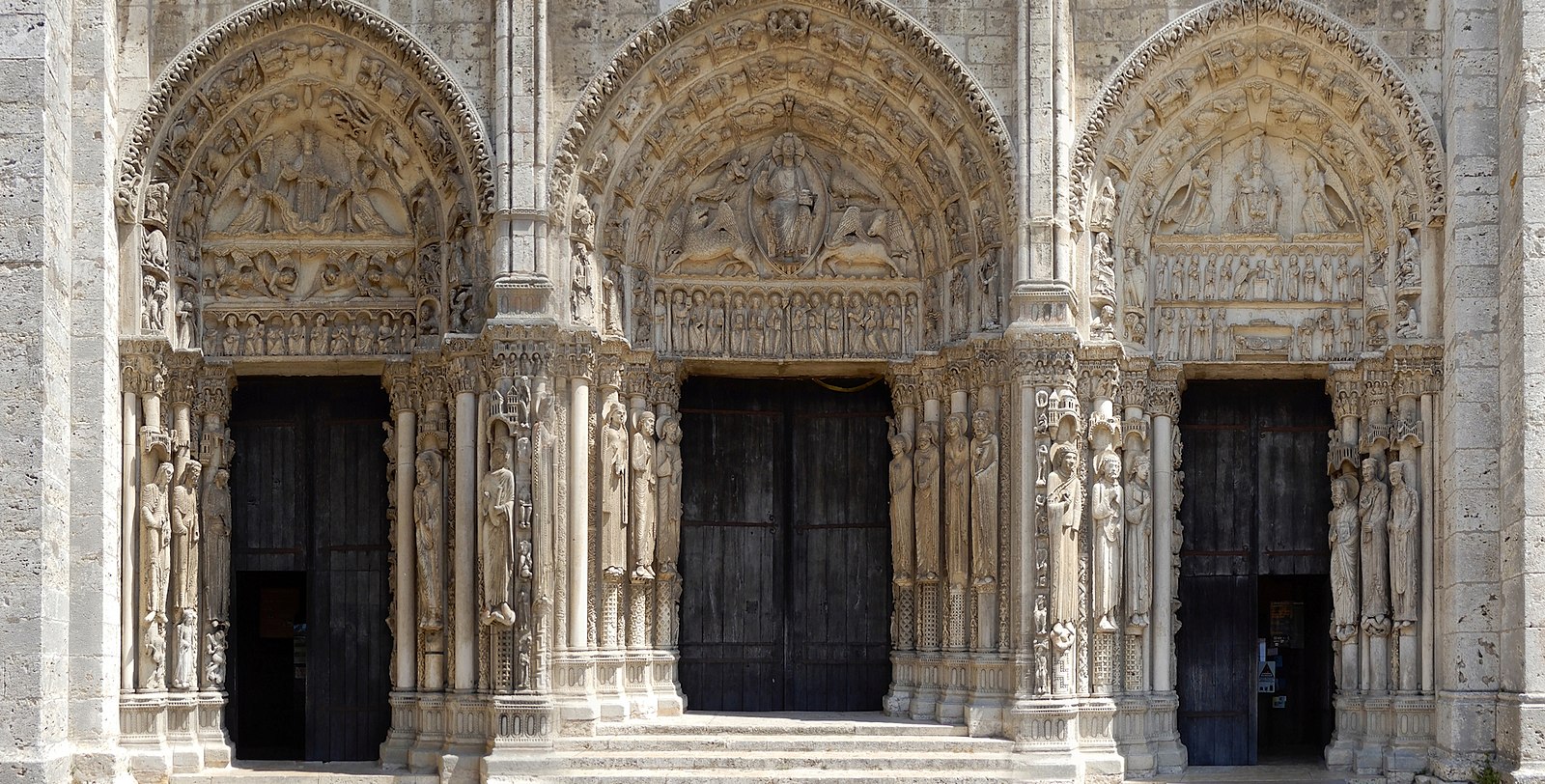
Chartres has a rather interesting style in that it had engaged portal sculptures constructed on the exterior of the church. In the image below, notice how tall and thin the bodies of these sculptures are. Their faces look more expressive and naturalistic than what we see in Byzantine art; however, the figures are still closely integrated with the column. Their feet make them appear to be floating upward.
Pictured here are sculptures of the men and women of the Old Testament.
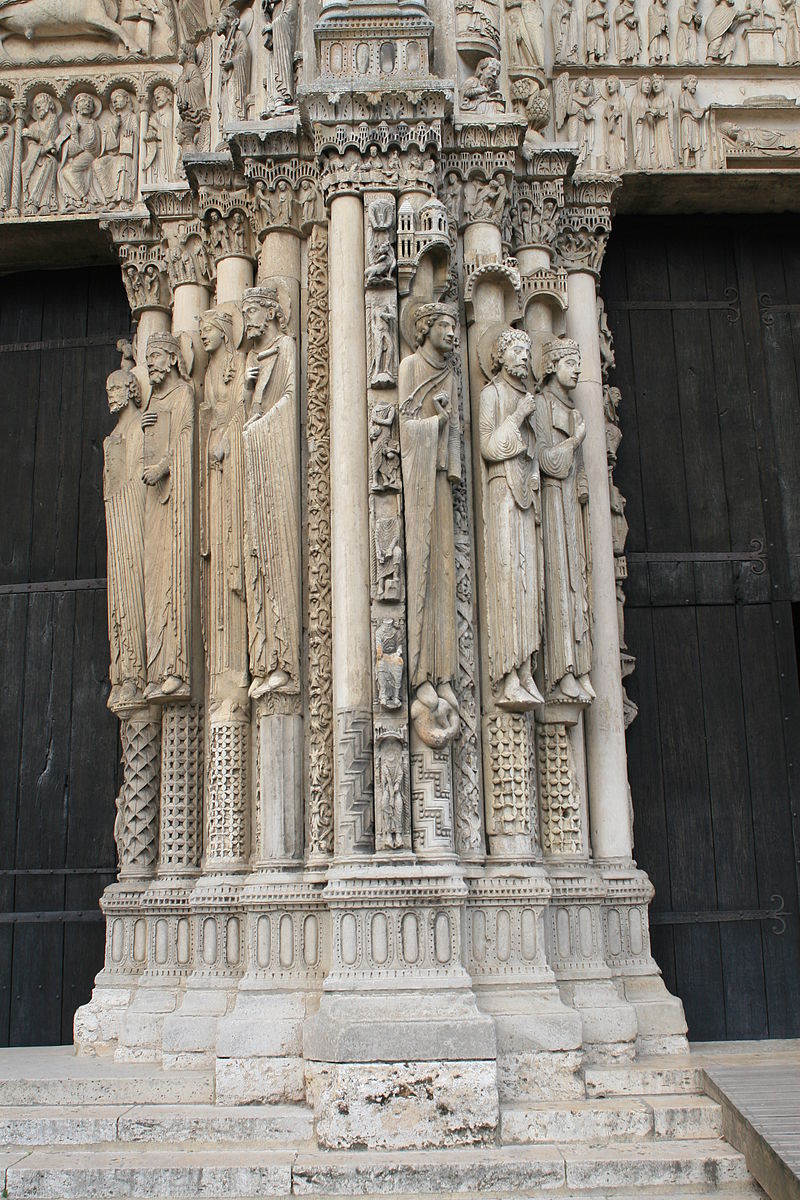
Compare and contrast these figures with those of sculptures of New Testament figures Simeon, John the Baptist, and Saint Peter below. These sculptures are naturalistic in their appearance, yet still unnaturally elongated. This might have been done purposefully to fit the sculptures into the length of jamb itself.
These are sculptures of Simeon, John the Baptist, and Saint Peter:
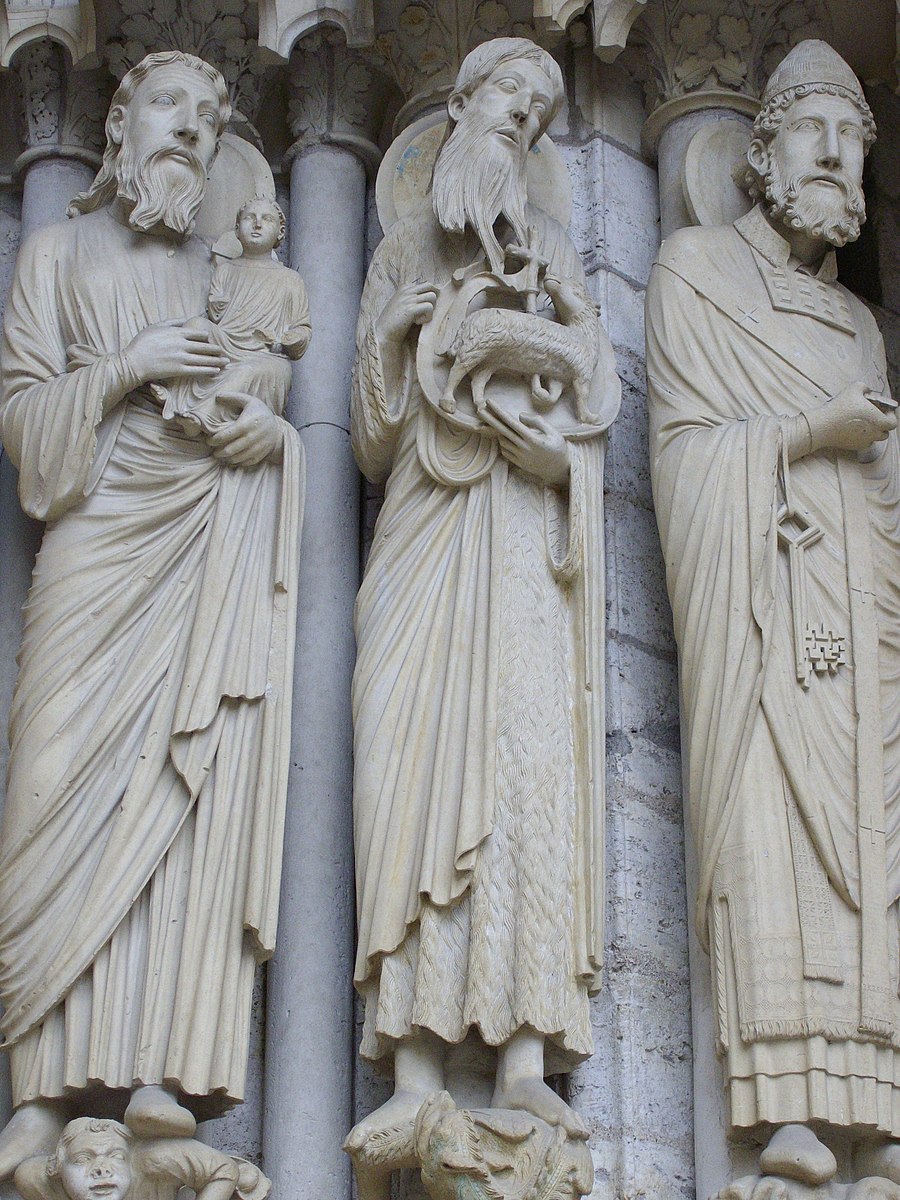
These sculptures show the influence of humanism that penetrated this age, sometimes referred to as the Proto-Renaissance, and contributed to the rise of humanism during the actual Renaissance. Other examples of sculptures such as these are the Christ as Beau Dieu at Amiens Cathedral and the visitation jamb sculptures at Reims Cathedral, which are all in France.
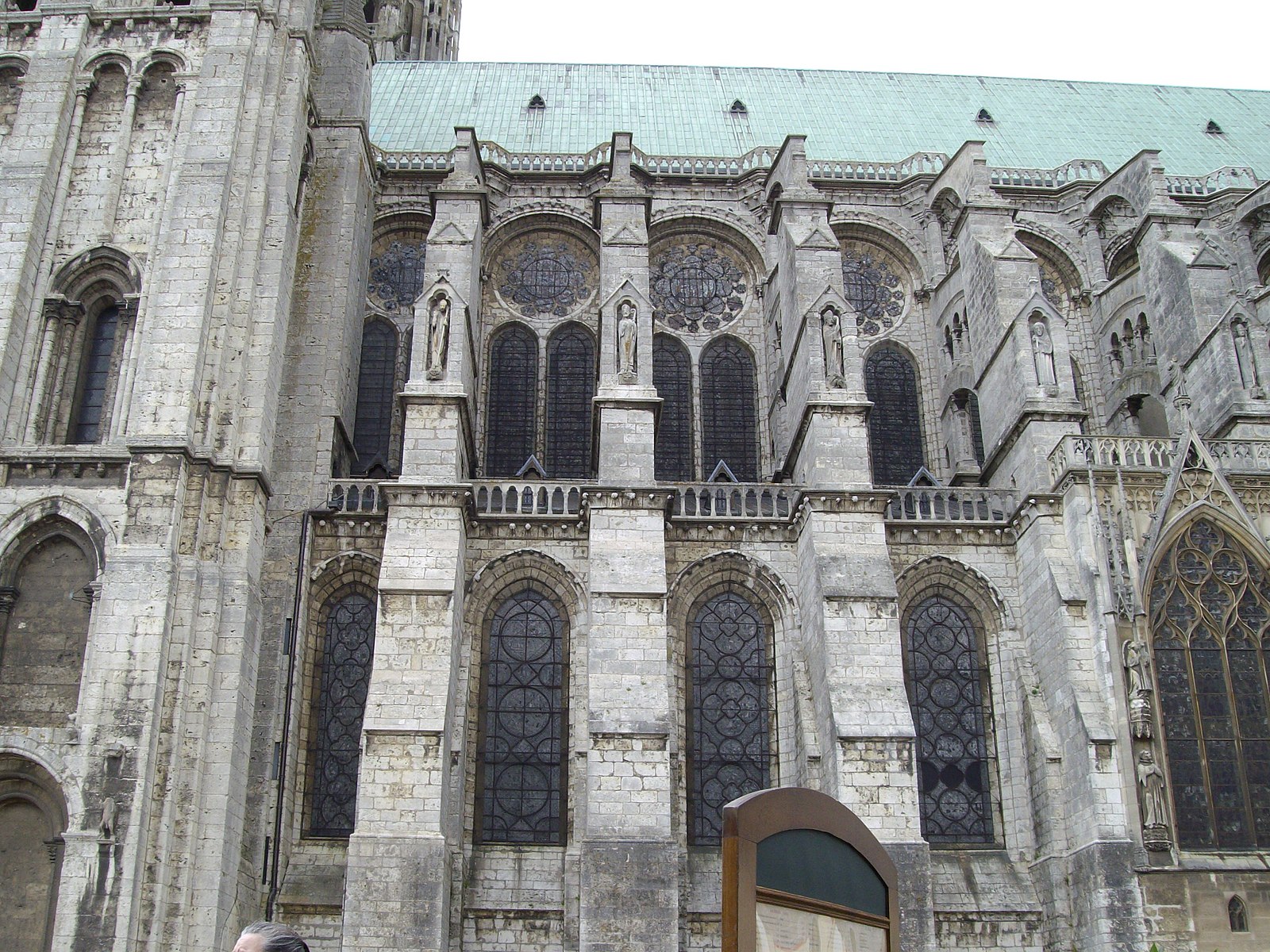
Finally, on the exterior, the flying buttress supports enabled the wall to function as a support for stained glass rather than a support for the weight of the building itself. This specific element is a unique characteristic of Gothic architecture.
Here is an image of the flying buttress at Chartres Cathedral.
It is worth pointing out the numeric symbology of Chartres Cathedral. Chartres was the location of a school where the seven liberal arts were taught. Sculptures in the archivolts of the portals depict the seven liberal arts, consisting of the Trivium, or humanities, including grammar, logic, and rhetoric, and the Quadrivium, or sciences, including arithmetic, geometry, music, and astronomy. Monks, primarily from Ireland, had preserved knowledge of the liberal arts and included them in their education. Their inclusion in the portal sculptures of Chartres reference both the School of Chartres and the larger interest in bringing together religious and classical learning through scholasticism.
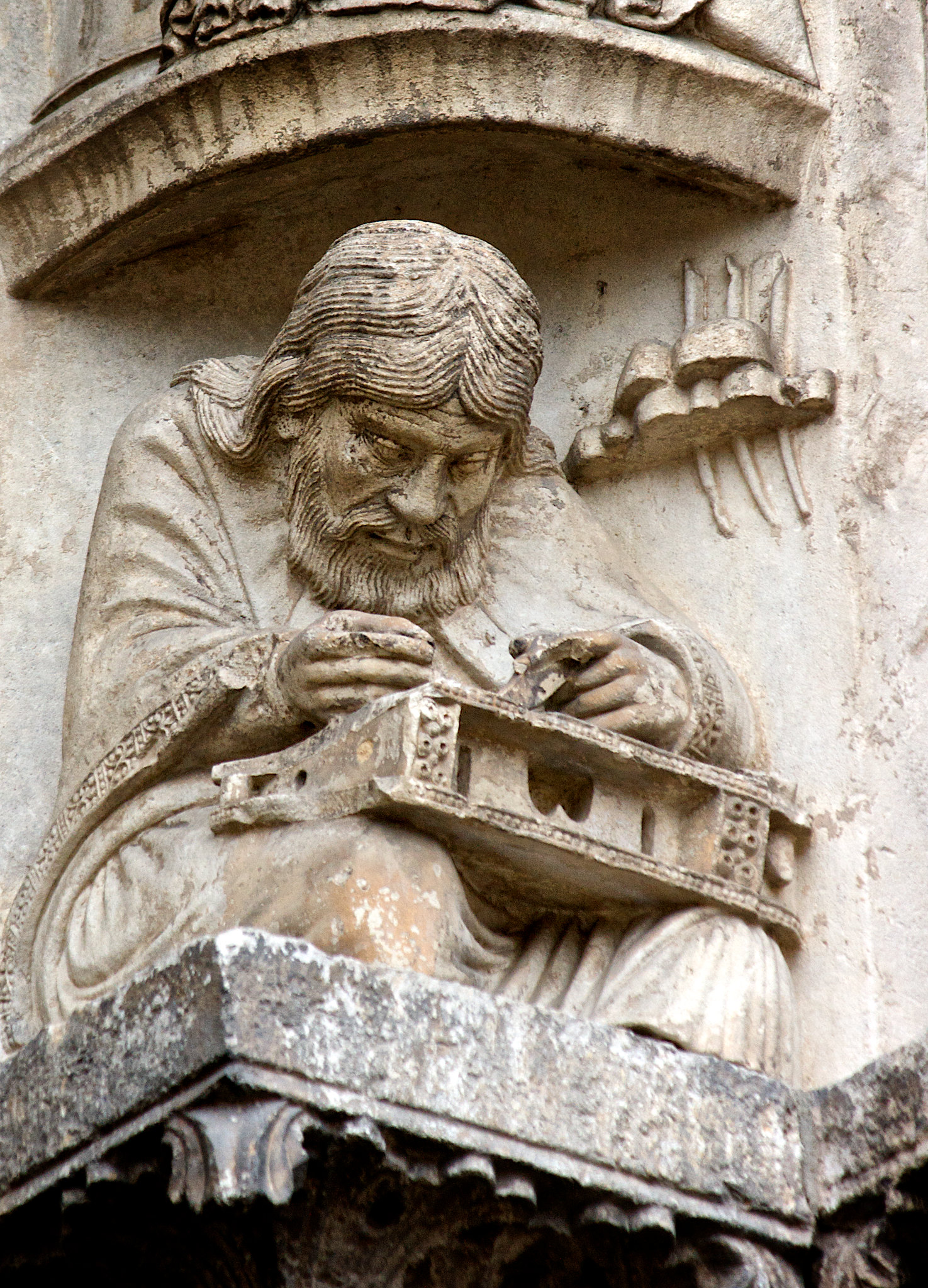
Here is a sculpture of Pythagoras, a Greek philosopher who studied mathematics and music, from the exterior of Chartres:
Numeric symbolism is used throughout Chartres. Part of this involves developing a symbolism that was easy to understand.
EXAMPLE
The three portals in the western façade. Why three? Three is an important number in Christianity, as it represents the Holy Trinity: Father, Son, and Holy Spirit.Four is another important number. It represents the four cardinal directions of earth: North, East, South, and West. This symbolism also gets quite complicated.
EXAMPLE
The floor plan of Chartres corresponds to the ideal proportions of the human body.Three plus four represents the union of heaven and earth. The resulting number is seven, which is found in several groupings within the church, such as the seven bays within the apse. This is another example of scholasticism’s presence in the architecture of the 12th and 13th centuries. It emphasized the divine nature of geometry, with the process of creating a building resembling God’s process of creation, as well as numeric symbolism and harmonious proportions.
The increasing emphasis on geometry in floor plans started with Romanesque but was taken further by Gothic architects. It represented a return to the idea that harmony in architecture was related to mathematical ratios first seen in classical Greece. The architects at Chartres connected with the School of Chartres studied the works of St. Augustine and Plato related to harmony and order in geometry, music, and architecture. Their use of harmonious ratios was similar to that used at the Parthenon, but much more complex.
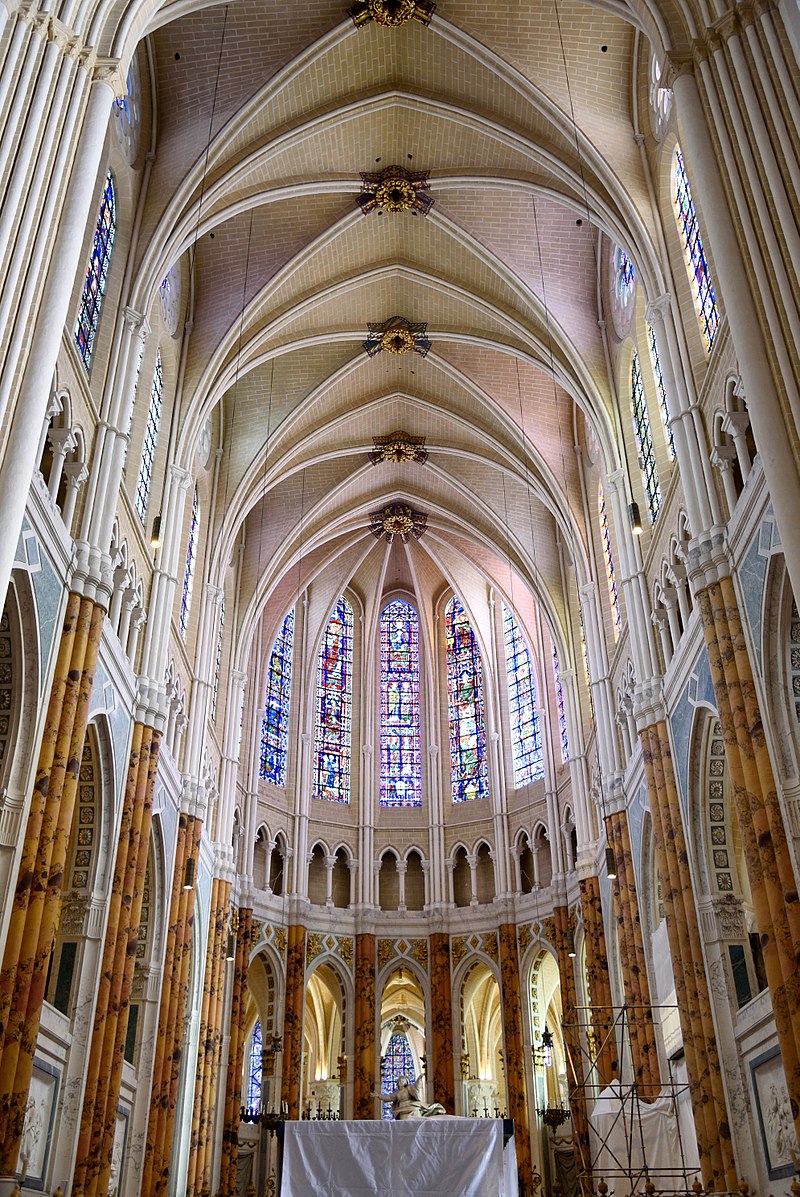
The inside of the church is where we see the full effect of the walls filled with colored glass. Narratives or iconography important to the Church and Christ’s history fill these glass windows. The narratives were elaborate in the windows that lined the nave because they were closer to people and could be seen in detail. Patterns of icons were easier to see from a distance.
The nave is pictured below.
The windows that lined the nave each had a theme.
EXAMPLE
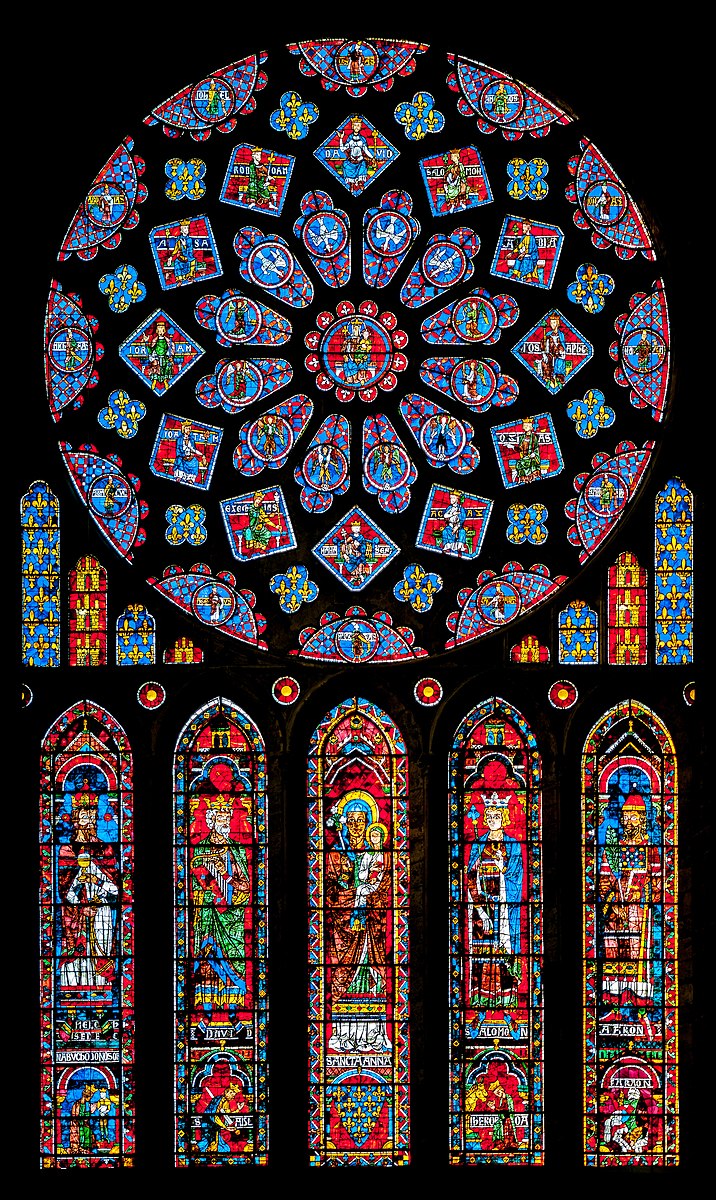
The Charlemagne window, which is not pictured, depicted a narrative about Charlemagne that included his departure from Spain.The rose window located in the north transept describes the ancestry of Jesus and Mary.
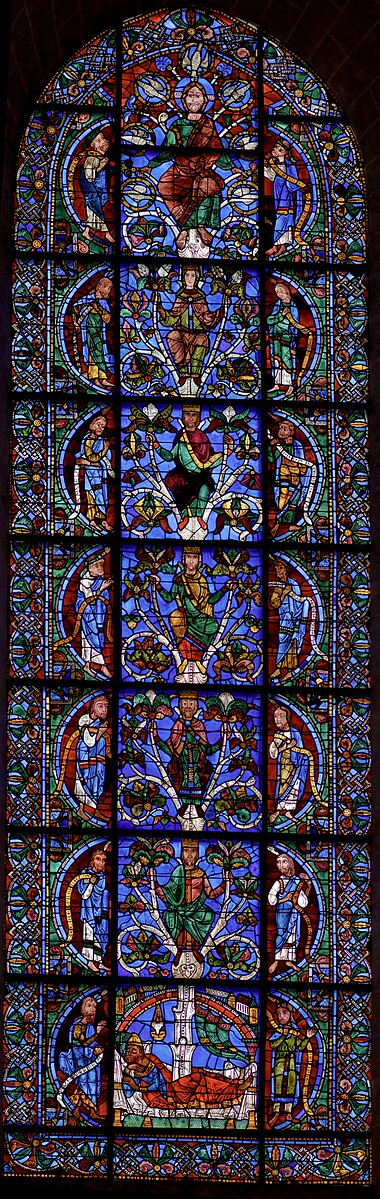
The Jesse Tree, shown below, is another example depicting the ancestral lineage of Christ. This time it’s displayed vertically with the image of Christ located at the top.
This final example is of the Virgin and Child and Angels window, more commonly called the "Blue Virgin window" because of her blue robes. In much European art, the Virgin Mary wears a blue robe to distinguish her from other people.
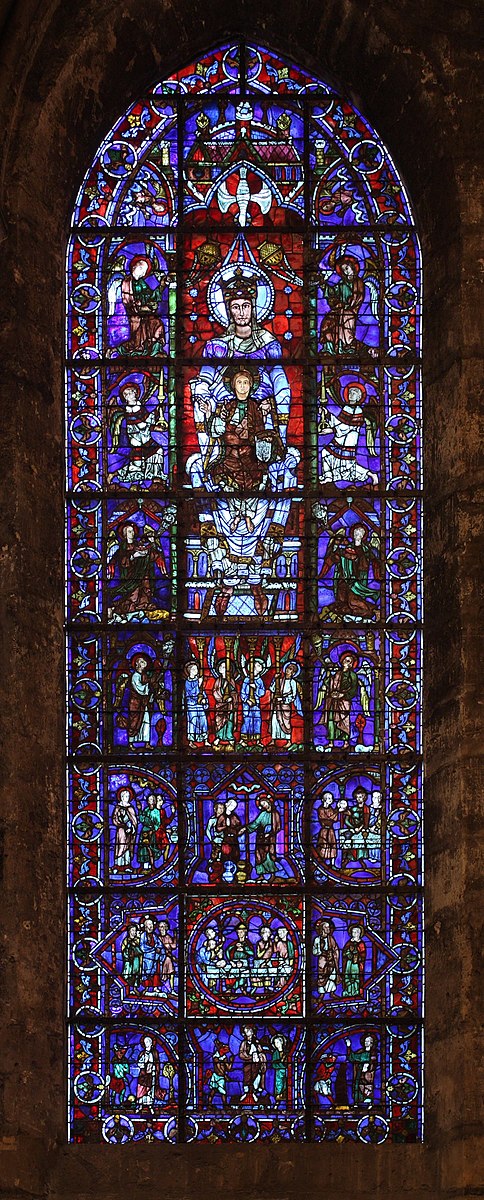
In this window, the Virgin Mary is enthroned with Christ in front of her and a dove near her head, symbolizing the Holy Spirit. The bottom three rows depict two stories. The first two are of the wedding feast at Cana, where Jesus turned water to wine, and the last row of that set depicts the temptation of Christ.
Source: THIS TUTORIAL WAS AUTHORED BY SOPHIA LEARNING. PLEASE SEE OUR TERMS OF USE.