Use Sophia to knock out your gen-ed requirements quickly and affordably. Learn more
×

Central Nervous System: Spinal Cord

Author: Sophia

what's covered
In this lesson, you will learn about the structure and function of the spinal cord. Specifically, this lesson will cover:

Table of Contents

1. The Spinal Cord

The brain and the spinal cord are the central nervous system, and they represent the main organs of the nervous system. The spinal cord is a single structure, whereas the adult brain is described in terms of four major regions: the cerebrum, the diencephalon, the brainstem, and the cerebellum. A person’s conscious experiences are based on neural activity in the brain. The regulation of homeostasis is governed by a specialized region in the brain. The coordination of reflexes depends on the integration of sensory and motor pathways in both the brain and the spinal cord.
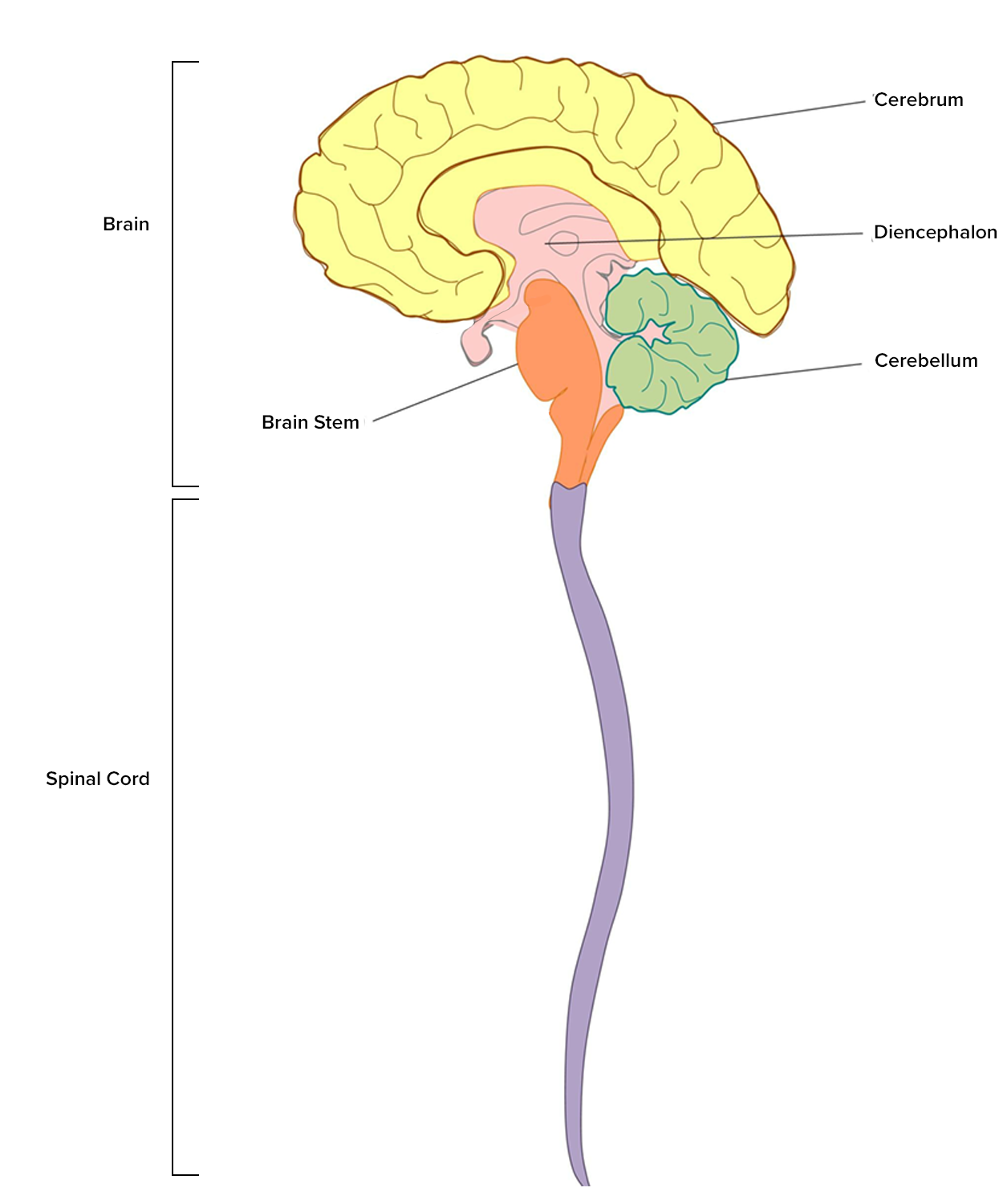
This diagram identifies the location and relative size of the main parts of the central nervous system.
The Central Nervous system - The central nervous system is composed of the brain and spinal cord. The brain is subdivided into the cerebrum, diencephalon, brainstem, and cerebellum.

1a. Gross Anatomy of the Spinal Cord

Recall that the spinal cord is an organ of the nervous system primarily made of nervous tissue and located in the vertebral canal formed by the vertebrae. At the superior end, the spinal cord connects to the brain through the foramen magnum in the occipital bone. In the adult body, the inferior end of the spinal cord extends to approximately vertebrae L1 or L2 because the spinal cord stops growing before the vertebrae do. The inferior tip of the spinal cord is cone-shaped and is called the conus medullaris. Beyond this, a strand of fibrous connective tissue called the filum terminale connects the conus medullaris to the sacrum to hold it in place.

Along the length of the spinal cord, 31 pairs of spinal nerves (collections of axons in the peripheral nervous system) exit the vertebral space between each vertebra and extend out to various points throughout the body. Each vertebra has its own set, which are named after the vertebral region where they originate—cervical, thoracic, lumbar, and sacral spinal nerves. At the inferior end of the spinal cord, beyond the conus medullaris, the lumbar and sacral spinal nerves extend into the vertebral cavity towards their exit. This collection of inferior spinal nerves resembles a horse's tail and is known as the cauda equina (cauda, tail; equine, horse).
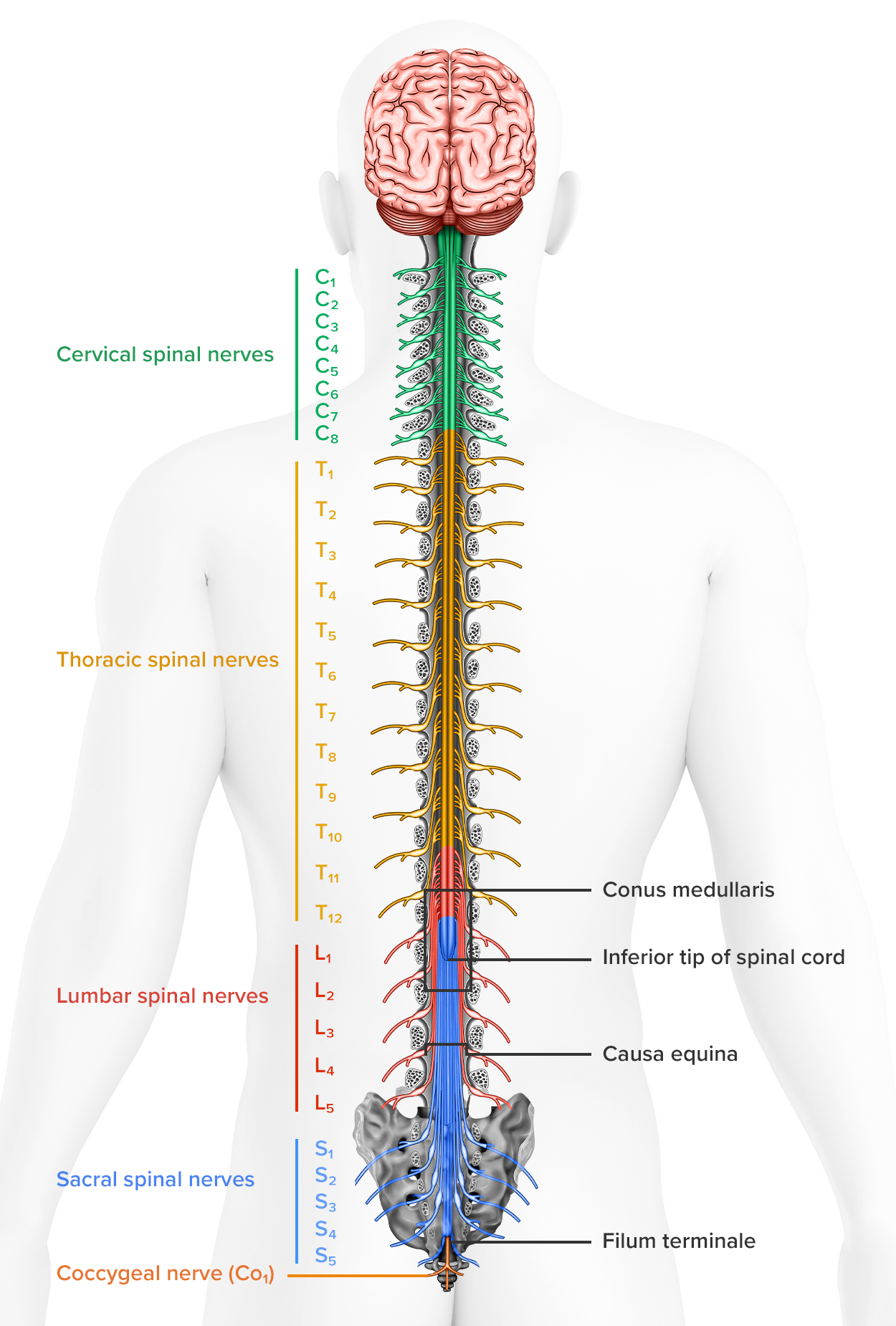

This diagram identifies major structures of the spinal cord.
Gross Anatomy of the Spinal Cord - The spinal cord is an organ of the CNS located in the vertebral canal created by the vertebrae. The superior end is connected to the brain. The inferior end extends to the level of L1/L2 and forms the conus medullaris. A connective tissue extension called the filum terminale connects the inferior spinal cord to the coccyx. Between each vertebra, a pair of spinal nerves exit, connecting the CNS to the peripheral body.

1b. Cross-Sectional Anatomy of the Spinal Cord

The anterior midline is marked by the deep anterior median fissure, and the posterior midline is marked by the shallow posterior median sulcus. These two grooves allow you to orient any view of the spinal cord to determine the anterior and posterior sides. In the center of the spinal cord is a longitudinal hollow tube called the central canal which circulates cerebrospinal fluid (CSF). CSF is produced in the brain and functions much like synovial fluid to circulate nutrients and remove wastes from a region that does not have direct access to blood.
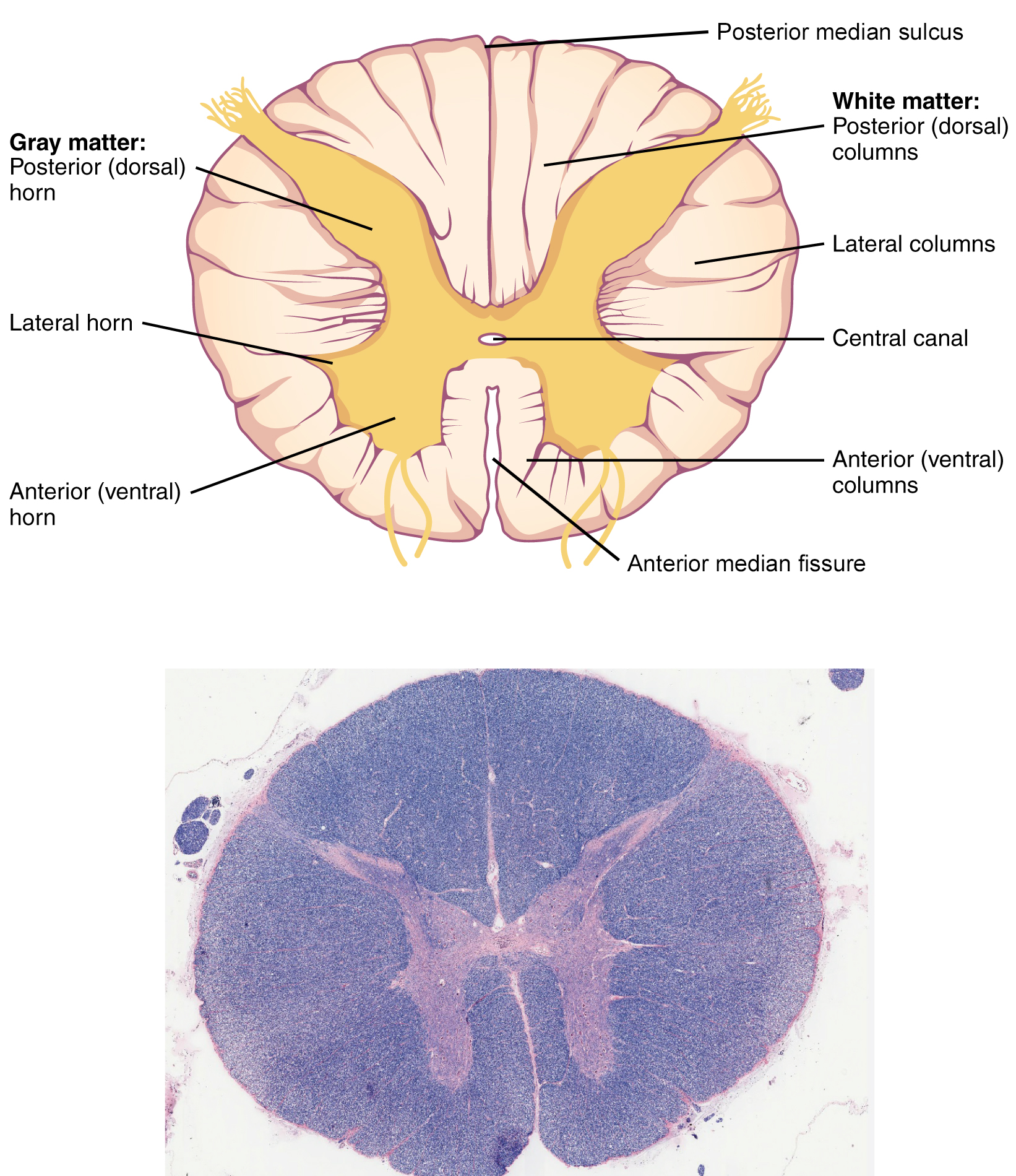
This figure shows the cross-section of the spinal cord. The top panel shows a diagram of the cross-section and the major parts are labeled. The bottom panel shows an ultrasound image of the spinal cord cross-section.
Cross-section of Spinal Cord - The cross-section of a thoracic spinal cord segment shows the posterior, anterior, and lateral horns of gray matter, as well as the posterior, anterior, and lateral columns of white matter. LM × 40.

Recall that nervous tissue can be grouped into gray and white matter. Gray matter is primarily composed of cell bodies, dendrites, and non-myelinated axons while white matter is primarily composed of myelinated axons. The spinal cord is organized with the white matter being superficial and the gray matter being mostly deep. As you can see in the image above, the gray matter is organized in what some call a letter H, a butterfly, or an ink-blot test. The gray matter can be further subdivided into regions referred to as horns. The posterior horn is responsible for sensory processing. The anterior horn sends out motor signals to the skeletal muscles. The lateral horn, which is only found in the thoracic, upper lumbar, and sacral regions, contains cell bodies of motor neurons of the autonomic nervous system.

did you know
Some of the largest neurons of the spinal cord are the multipolar motor neurons in the anterior horn. The fibers that cause contraction of skeletal muscles are the axons of these neurons. The motor neuron that causes contraction of the big toe, for example, is located in the sacral spinal cord. The axon that has to reach all the way to the belly of that muscle may be a meter in length. The neuronal cell body that maintains that long fiber must be quite large, possibly several hundred micrometers in diameter, making it one of the largest cells in the body.

Just as the gray matter is separated into horns, the white matter of the spinal cord is separated into columns. These columns contain tracts (groups of axons in the central nervous system) that transport action potentials up (ascending) or down (descending) the spinal cord. Ascending tracts of the spinal cord of nervous system fibers in these columns carry sensory information up to the brain, whereas descending tracts of the spinal cord carry motor commands from the brain. Looking at the spinal cord longitudinally, the columns extend along its length as continuous bands of white matter. Between the two posterior horns of gray matter are the posterior columns. Between the two anterior horns, and bounded by the axons of motor neurons emerging from that gray matter area, are the anterior columns. The white matter on either side of the spinal cord, between the posterior horn and the axons of the anterior horn neurons, are the lateral columns. The posterior columns are composed of axons of ascending tracts. The anterior and lateral columns are composed of many different groups of axons of both ascending and descending tracts—the latter carrying motor commands down from the brain to the spinal cord to control output to the periphery.

1c. Roots, Spinal Nerves, and Rami

Attached to the spinal cord are the axons which connect the central nervous system to all peripheral structures such as the internal organs, muscles, skin, and more. Axons enter the posterior side through the posterior (dorsal) root. Axons emerge from the anterior side through the anterior (ventral) root. The directionality of information flow through the nerve roots is one-way traffic in which incoming sensory information travels through the posterior root to enter the spinal cord and outgoing motor information travels through the anterior root to travel to the effector. Along the posterior root is a ganglion (collection of neuron cell bodies in the peripheral nervous system) called the posterior root ganglion. This ganglion contains the cell bodies of the sensory neurons that make up the posterior root.

Where the posterior and anterior root meet, they combine together for a short time before separating again. This short segment is called the spinal nerve and contains both sensory and motor information. There are 31 pairs of spinal nerves named for the vertebral region where they are located: cervical, thoracic, lumbar, and sacral. Beyond the spinal nerve, the axons that make it up separate into three different pathways, each referred to as a ramus (ramus, branch). Each ramus (plural, rami) serves a different region of the body by transporting sensory signals from that region to the spinal cord and motor signals from the spinal cord to that region. The anterior rami serve the anterior and lateral parts of the body as well as the limbs. The posterior rami serve the posterior side of the body. The rami communicantes (communicating branch) transports signals to and from the internal organs and structures within the trunk.
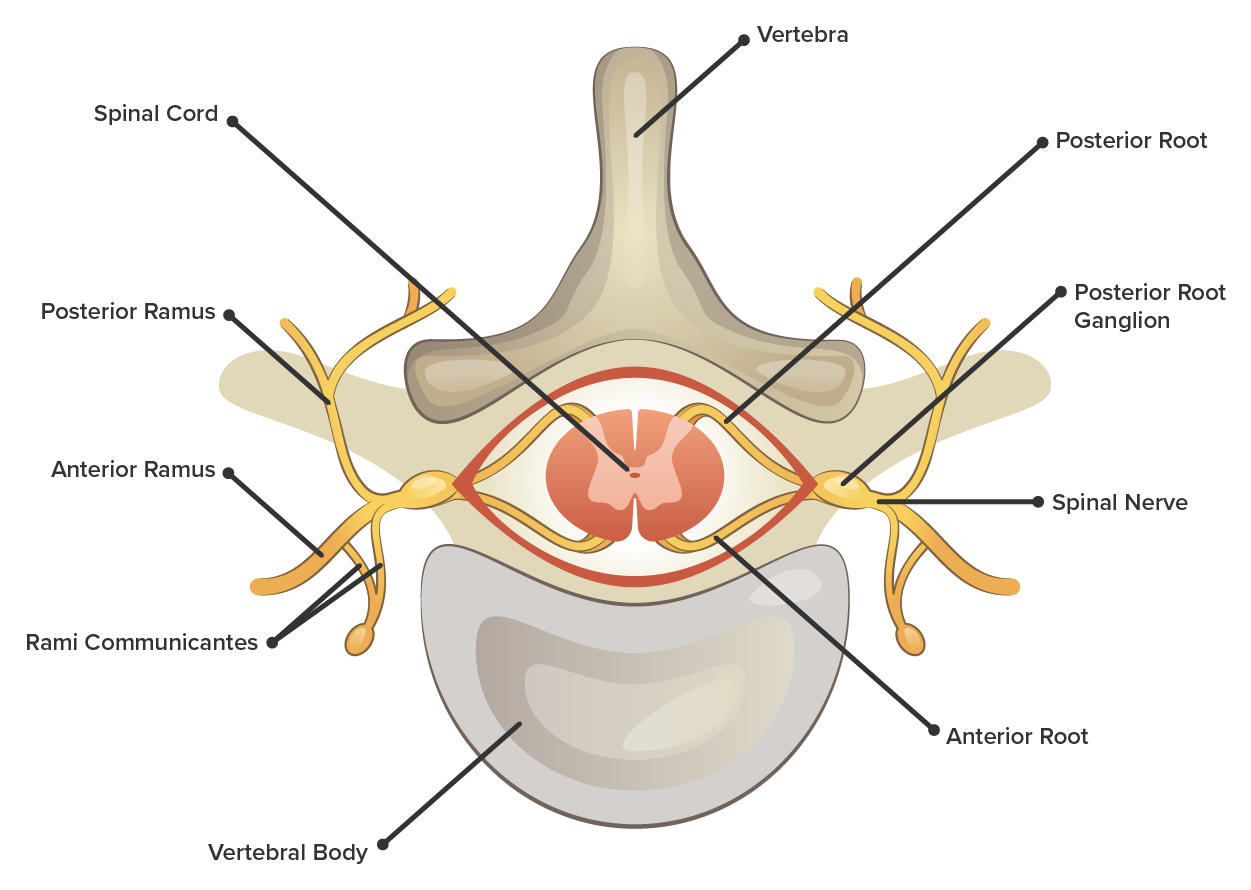
This diagram shows a cross-section of the vertebrae, including the nerve pathways that carry information to and from the central nervous system.
Roots, Spinal Nerves, and Rami - The axons connected to the spinal cord form a network of pathways for incoming and outgoing signals. The roots are connected directly to the spinal cord and only carry one type of signal—posterior carries sensory and anterior carries motor. The roots combine to form a spinal nerve which then branches into three rami which each serve unique regions of the body.

try it
Directions: Use the information about the pathway that sensory and motor information take to and from the spinal cord to identify the pathway (rami, nerve, and roots) that the following signals take in chronological order.
Define the sensory and motor pathway for the sensation of a handshake to which your body responds by squeezing your hand.
  • Sensory: Anterior rami, spinal nerve, posterior root, spinal cord
  • Motor: Spinal cord, anterior root, spinal nerve, anterior rami
Define the sensory and motor pathway for the sensation of something crawling on your back to which your body responds by swatting at it with your hand.
  • Sensory: Posterior rami, spinal nerve, posterior root, spinal cord
  • Motor: Spinal cord, anterior root, spinal nerve, anterior rami
Define the sensory and motor pathway for the sensation of the stomach expanding to which your body responds by relaxing the muscles around your stomach.
  • Sensory: Rami communicantes, spinal nerve, posterior root, spinal cord
  • Motor: Spinal cord, anterior root, spinal nerve, rami communicantes
Define the sensory and motor pathway for the sensation of a the hot sun on the back of your neck to which your body responds by releasing sweat on that region of the skin.
  • Sensory: Posterior rami, spinal nerve, posterior root, spinal cord
  • Motor: Spinal cord, anterior root, spinal nerve, posterior rami

terms to know
Conus Medullaris
The cone-shaped inferior end of the spinal cord.
Filum Terminale
A strand of connective tissue that connects the inferior spinal cord to the sacrum.
Spinal Nerve
One of thirty-one sets of nerves transporting sensory and motor information into and out of the spinal cord through the anterior and posterior roots.
Cauda Equina
A bundle of spinal nerves that resembles a horse’s tail and extends beyond the conus medullaris in the vertebral cavity.
Anterior Median Fissure
A deep midline groove on the ventral side of the spinal cord.
Posterior Median Sulcus
A shallow midline groove on the dorsal side of the spinal cord.
Central Canal of the Spinal Cord
A hollow tube in the center of the spinal cord which allows for the circulation of cerebrospinal fluid.
Posterior Horn
Posterior gray matter region of the spinal cord.
Anterior Horn
Anterior gray matter region of the spinal cord.
Lateral Horn
Gray matter region of the spinal cord only found in the thoracic, upper lumber, and sacral regions.
Ascending Tracts of the Spinal Cord
Axons of the spinal columns carrying sensory signals.
Descending Tracts of the Spinal Cord
Axons of the spinal column carrying motor signals.
Posterior Column
White matter region of the spinal cord.
Anterior Column
White matter region of the spinal cord.
Lateral Column
White matter region of the spinal cord.
Posterior Root
Sensory axons entering the spinal cord at the posterior horn.
Anterior Root
Motor axons exiting the spinal cord at the anterior or lateral horn.
Posterior Root Ganglion
A collection of sensory neuron cell bodies along the posterior root.
Anterior Rami
The branch of the spinal nerve which serves the anterior and lateral portions of the trunk as well as the limbs.
Posterior Rami
The branch of the spinal nerve which serves the posterior portions of the trunk.
Rami Communicantes
The branch of the spinal nerve which serves the internal organs of the trunk.

summary
In this lesson, you learned about the anatomy and function of the spinal cord and brainstem. You learned the structures of both the gross anatomy and cross-sectional anatomy of the spinal cord as well as the roots, spinal nerves, and rami that transport action potentials into and out of the spinal cord.

Source: THIS TUTORIAL HAS BEEN ADAPTED FROM OPENSTAX “ANATOMY AND PHYSIOLOGY 2E.” ACCESS FOR FREE AT HTTPS://OPENSTAX.ORG/DETAILS/BOOKS/ANATOMY-AND-PHYSIOLOGY-2E. LICENSE: CC ATTRIBUTION 4.0 INTERNATIONAL.

Terms to Know
Anterior Column

White matter region of the spinal cord.

Anterior Horn

Anterior gray matter region of the spinal cord.

Anterior Median Fissure

A deep midline groove on the ventral side of the spinal cord.

Anterior Rami

The branch of the spinal nerve which serves the anterior and lateral portions of the trunk as well as the limbs.

Anterior Root

Motor axons exiting the spinal cord at the anterior or lateral horn.

Ascending Tracts of the Spinal Cord

Axons of the spinal columns carrying sensory signals.

Cauda Equina

A bundle of spinal nerves that resembles a horse’s tail and extends beyond the conus medullaris in the vertebral cavity.

Central Canal of the Spinal Cord

A hollow tube in the center of the spinal cord which allows for the circulation of cerebrospinal fluid.

Conus Medullaris

The cone-shaped inferior end of the spinal cord.

Descending Tracts of the Spinal Cord

Axons of the spinal column carrying motor signals.

Filum Terminale

A strand of connective tissue that connects the inferior spinal cord to the sacrum.

Lateral Column

White matter region of the spinal cord.

Lateral Horn

Gray matter region of the spinal cord only found in the thoracic, upper lumber, and sacral regions.

Posterior Column

White matter region of the spinal cord.

Posterior Horn

Posterior gray matter region of the spinal cord.

Posterior Median Sulcus

A shallow midline groove on the dorsal side of the spinal cord.

Posterior Rami

The branch of the spinal nerve which serves the posterior portions of the trunk.

Posterior Root

Sensory axons entering the spinal cord at the posterior horn.

Posterior Root Ganglion

A collection of sensory neuron cell bodies along the posterior root.

Rami Communicantes

The branch of the spinal nerve which serves the internal organs of the trunk.

Spinal Nerve

One of thirty-one sets of nerves transporting sensory and motor information into and out of the spinal cord through the anterior and posterior roots.


