Use Sophia to knock out your gen-ed requirements quickly and affordably. Learn more
×

Cardiovascular System Terminology

Author: Sophia

what's covered
In this lesson, you will learn about cardiovascular system terminology, including common prefixes, combining forms of root words, and suffixes. You will also have an opportunity to practice using this terminology. Specifically, this lesson will cover:

Table of Contents

1. Introduction to Cardiovascular System Terminology

The cardiovascular system transports substances all over the body, including nutrients, oxygen, carbon dioxide, hormones, wastes, antibodies, and many other things. The cardiovascular system includes the heart and all of the blood vessels.

Many cardiovascular terms can be constructed by understanding commonly used prefixes, combining forms of root words, and suffixes. As you begin to learn these and other cardiovascular system terms, pay particular attention to those that can be easily confused.

1a. Prefixes

You have already learned many prefixes that are also useful in cardiology. For example, anemia uses the prefix a- (without, lacking) and means having insufficient red blood cells. Also, hyper- means above or excessive, and the term hypercoagulable means having blood that is excessively prone to clotting (coagulation).

The table below summarizes some of the prefixes that you will encounter as you learn about the cardiovascular system and cardiovascular conditions.

Term Definition Example Definition of Example
Bi- Two Bicuspid valve A valve with two leaflets (note that a valve is a structure that can prevent movement of a substance such as a liquid or gas, in this case, by regulating the flow of blood from one chamber of the heart to another; Merriam-Webster, n.d.)
Brady- Slow Bradycardia Slow heartbeat
Dys- Bad, abnormal, painful, difficult Dysrhythmia Having an irregular heartbeat
Endo- Within, in Endocardium Epithelial tissue that forms the inner lining of the heart
Peri- Surrounding, around Pericardiocentesis Using a needle to remove fluid from the pericardial sac around the heart
Poly- Excessive, over, many Polyarteritis nodosa (Cleveland Clinic, 2024) Condition in which many blood vessels are inflamed
Tachy- Fast, rapid Tachycardia Rapid heartbeat
Tri- Three Trisomy 21 Having three copies of chromosome 21 instead of two copies (Down syndrome)

try it
Let’s try an example. One of the heart valves is called the bicuspid valve, and another is called the tricuspid valve.  
If you know that cuspid means having a single leaflet or flap, then how do bicuspid and tricuspid valves differ?
Bicuspid valves have two leaflets, and tricuspid valves have three leaflets.

try it
Let’s try another example. There is a sac called the pericardium.  
Based on the word parts, what does pericardium mean?
Peri- means around, and cardi/o means heart, so the pericardium is a sac that surrounds the heart.

1b. Combining Forms

There are many combining forms that specifically relate to the cardiovascular system. These include some you have already learned, like cardi/o (heart) and ather/o (vessel).

The table below shows common combining forms that refer specifically to the heart.

Term Definition Example Definition of Example
Atri/o Atrium Atrioventricular valve A valve that regulates blood flow between the atrium and the ventricle
Card/i or cardi/o Heart Cardiology Study of the heart; medical specialty focusing on the cardiovascular system
Valv/o or valvu/o Valve (typically a heart valve) Valvuloplasty Surgical repair of a valve
Ventricu/o Ventricle Ventriculography Imaging of a ventricle

try it
Let’s try some examples.  
Based on the word parts, what does valvulopathy mean?
Valvulopathy is a disease of the heart valves.
Based on the word parts, what does atrioventricular valve mean?
An atrioventricular valve is a valve that regulates blood flow between an atrium and a ventricle.
Where do you think the pericardial sac (pericardium) is?
Peri- means around, and cardi/o means heart. The pericardium is a sac that surrounds the heart.

The table below shows terms that refer specifically to blood vessels.

Term Definition Example Definition of Example
Angi/o Blood vessel Angiogenesis Formation of blood vessels
Arteri/o Artery Arteriosclerosis A condition that causes hardening and stiffening of arteries
Phleb/o Vein Phlebitis Inflammation of a vein
Vas/o Vessel Vasospasm Spasm of a blood vessel
Ven/o Vein Venipuncture Puncture of a vein (e.g., inserting a needle into a vein to take blood)

try it
Let’s try an example. One common cardiology test is angiography.  
Based on your knowledge of word parts, what do you think angiography means?
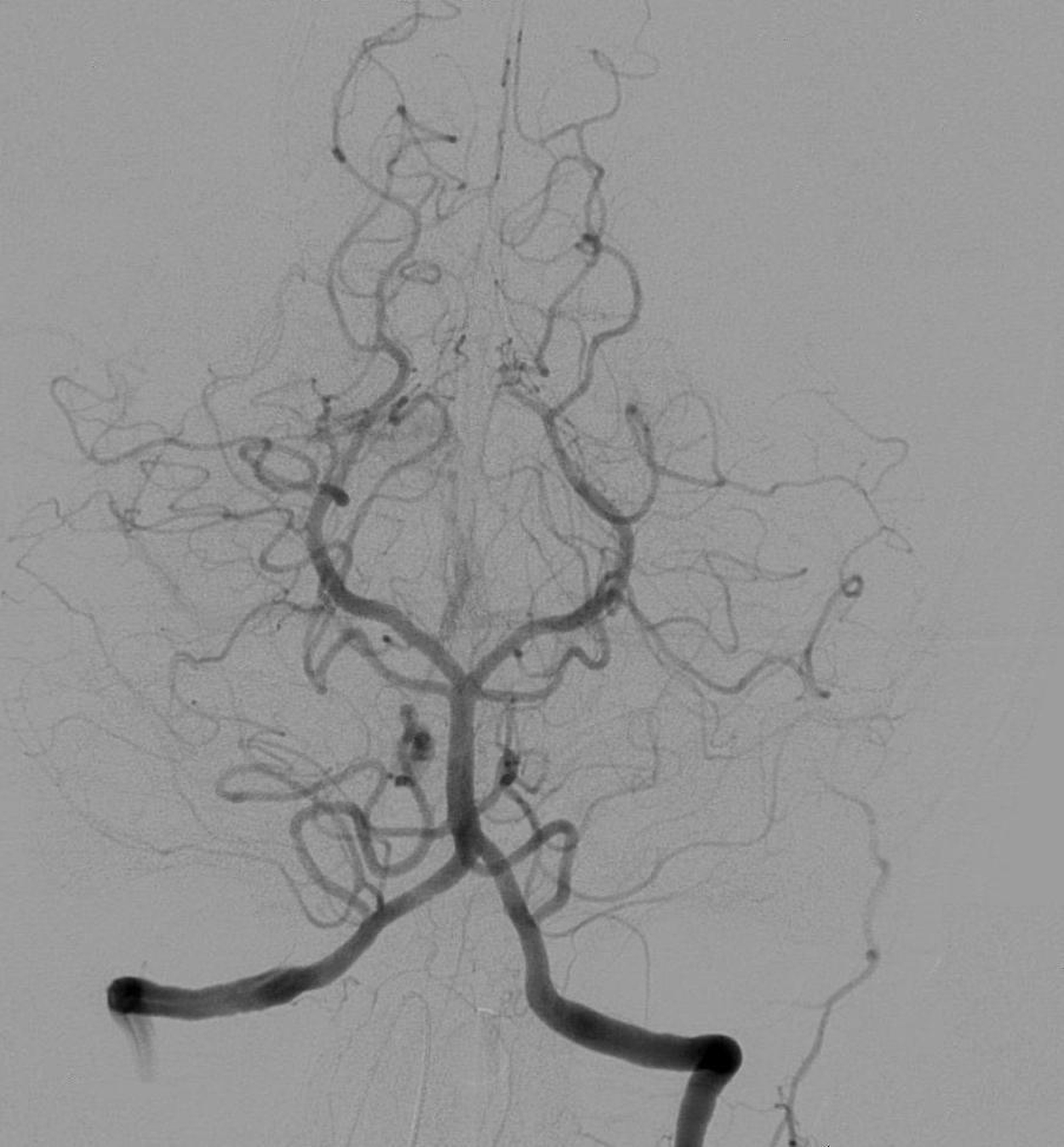
Angiography is an imaging technique to visualize blood vessels.

The figure below shows angiography. Note how the branching blood vessels are distinctively visible.
key concept
Angiography is often performed with percutaneous coronary intervention (PCI). This technique typically involves inserting a stent or balloon through an artery while visualizing blood vessels using X-rays (specifically fluoroscopy). A balloon can be inserted on the end of a catheter (a balloon catheter) and positioned in a narrowed blood vessel, then expanded to open the blood vessel. Alternatively, a stent can be placed in the blood vessel to hold it open.

Finally, the table below shows other combining forms related to the cardiovascular system.

Term Definition Example Definition of Example
Ather/o Fatty plaque Atherosclerosis A condition in which there are fatty plaques in the walls of blood vessels
Ech/o Sound Echocardiogram A sonographic imaging test that uses sound waves to produce images of the heart.
Electr/o Electricity Electrocardiogram A test that measures the electrical activity of the heartbeat
Isch/o Deficiency, blockage Ischemia Insufficient blood flow (and therefore insufficient oxygen supply)
Thromb/o Clot Thrombosis A condition involving a blood clot or clots in vessels

try it
Let’s try an example. There is a technique called thrombolysis.  
Based on your knowledge of word parts, what do you think thrombolysis means?
Thrombolysis means dissolving (-lysis) a blood clot (thromb/o).

1c. Suffixes

Now that you have learned some prefixes and combining forms, it’s time to look at some suffixes. Again, remember that many of the suffixes that you have already learned are commonly used in cardiology.

The table below shows some suffixes that are often used in cardiovascular system terms.

Term Definition Example Definition of Example
-ac Pertaining to Cardiac Pertaining to the heart
-ade Process of Cardiac tamponade A process in which the heartbeat is blocked (fluid such as blood in the pericardial sac puts pressure on the heart, preventing normal contraction)
-al Pertaining to Jugal Pertaining to the jugular vein
-apheresis Removal Plasmapheresis A procedure in which plasma (the liquid part of blood) is removed from the blood, used to remove toxins, antibodies, or other compounds from blood
-cardia Heart Bradycardia Slow heartbeat
-dynia Pain Cardiodynia Pain in the heart or heart region

try it
Let’s try an example. 
Based on your knowledge of word parts, what do you think gastrodynia means?
Gastrodynia is pain in the stomach. Gastr/o means stomach and –dynia means pain.

try it
Let’s try another example.  Review the meaning of plasmapheresis.
Based on the word parts, what does leukapheresis mean?
Leukapheresis means removing white blood cells (leukocytes) from the blood (Cleveland Clinic, 2024). Leuk/o means white (for white blood cells) and –apheresis means removal.

The table below shows additional suffixes that are often used in cardiovascular system terms.

Term Definition Example Definition of Example
-emia Blood condition Anemia Low red blood cell count
-penia Abnormal reduction in number Leukopenia Abnormally low number of white blood cells
-poiesis Formation Hematopoiesis Formation of blood cells
-sclerosis Hardening Atherosclerosis A condition in which there are fatty plaques in the walls of blood vessels
-stasis Stop, stopping, controlling Hemostasis The process by which the body stops bleeding
-stenosis Narrowing Aortic valve stenosis Narrowing of the aortic valve

try it
Let’s try an example. Atherosclerosis is a type of arteriosclerosis.  
Based on your knowledge of word parts, what do you think atherosclerosis means?
Atherosclerosis is a condition in which fatty plaques in the walls of blood vessels cause the blood vessels to narrow and harden. Ather/o refers to the plaques, and –sclerosis means hardening.
Based on the word parts, what does erythropoiesis mean?
Erythropoiesis means the formation of red blood cells. Erythr/o means red (as in red blood cells) and –poiesis is formation.


2. Practice Using Cardiovascular System Terminology

Now that you have reviewed some terms related to the cardiovascular system, try using these terms. In this section, you will build cardiovascular terms, break down cardiovascular terms, and correct simple medical documentation statements.

try it
Break apart cardiomegaly and explain what the word parts mean.
Cardi/o means heart and –megaly means enlarged, so cardiomegaly is a condition in which the heart is unusually large. This can be caused by medical conditions or heart damage.
Break apart cardiomyopathy and explain what the word parts mean.
Cardi/o means heart, my/o means muscle, and –pathy means disease or disorder. Cardiomyopathy means a disorder of the heart muscle.
Break apart valvulitis and explain what the word parts mean.
Valvu/o means valve, and –itis means inflammation. Valvulitis is the inflammation of a valve.

Next, try building words from word parts.

try it
Combine word parts to produce the term that means inserting a needle into the sac surrounding the heart to draw out fluid.
The term is pericardiocentesis. Peri- means around, cardi/o is heart, and -centesis is using a needle to withdraw fluid.

Finally, try correcting the statements below.

summary
In this lesson, you had an introduction to cardiovascular system terminology, including examples of important prefixes, combining forms, and suffixes that are often used in cardiology. You also had an opportunity to practice using cardiovascular system terminology to build and deconstruct words. This terminology will help you as you learn more about the components of the cardiovascular system, especially the heart, and how the cardiovascular system functions.

Source: THIS TUTORIAL HAS BEEN ADAPTED FROM “OPEN RN | MEDICAL TERMINOLOGY – 2e” BY ERNSTMEYER & CHRISTMAN AT OPEN RESOURCES FOR NURSING (Open RN). ACCESS FOR FREE AT https://wtcs.pressbooks.pub/medterm/ LICENSING: CREATIVE COMMONS ATTRIBUTION 4.0 INTERNATIONAL.

REFERENCES

Polyarteritis nodosa. (2024, May 13). Polyarteritis Nodosa (PAN): Symptoms & Treatment. Cleveland Clinic. https://my.clevelandclinic.org/health/diseases/polyarteritis-nodosa-pan.

Apheresis. (2024, February 7). Apheresis: How It Works. Cleveland Clinic. https://my.clevelandclinic.org/health/procedures/apheresis.

Merriam-Webster. (n.d.). Valve. Merriam-Webster Dictionary. Merriam-Webster.com dictionary. https://www.merriam-webster.com/dictionary/valve .


Attributions
Terms to Know
-ac

Pertaining to a blood clot.

-ade

Process of.

-al

Pertaining to.

-apheresis

Pertaining to removal.

-cardia

Pertaining to the heart.

-centesis

Using a needle to withdraw fluid.

-dynia

Pertaining to pain.

-poiesis

Pertaining to formation.

-stasis

Pertaining to a stop, stopping, or controlling.

-stenosis

Pertaining to narrowing.

Angiogenesis

Formation of a blood vessel.

Angiography

An imaging technique used to visualize blood vessels.

Aortic Valve Stenosis

Narrowing of the aortic valve.

Aortic valve

The semilunar valve that regulates the flow of blood between the left ventricle and the aorta.

Arteri/o

Pertaining to an artery.

Atri/o

Pertaining to the atrium.

Atrioventricular Valve

A valve that regulates blood flow between the atrium and the ventricle.

Balloon

A device inflated within a vessel to open it.

Balloon Catheter

A catheter with a balloon attached that can be used to open a vessel.

Bi-

Two.

Bicuspid Valve

An atrioventricular valve with two leaflets that regulates blood flow from the left atrium to the left ventricle.

Card/i

Pertaining to the heart.

Cardiac Tamponade

A process in which the heartbeat is blocked (fluid such as blood in the pericardial sac puts pressure on the heart, preventing normal contraction).

Cardiomegaly

Enlargement of the heart.

Coagulation

Typically blood clotting; more generally, a liquid becoming more solid.

Dysrhythmia

Having an irregular heartbeat.

Echo

Pertaining to sound.

Echocardiogram

A sonographic imaging test that uses sound waves to produce images of the heart.

Endocardium

Epithelial tissue that forms the inner lining of the heart.

Erythropoiesis

Formation of red blood cells.

Hemostasis

The process by which the body stops bleeding.

Hypercoagulable

Blood that is especially prone to clotting.

Isch/o

Pertaining to a deficiency or blockage.

Ischemia

Insufficient blood flow (and therefore insufficient oxygen supply).

Jugal

Pertaining to the jugular vein (in the neck).

Leukapheresis

Removing white blood cells (leukocytes) from the blood.

Leukopenia

Abnormally low number of white blood cells.

Myocarditis

Inflammation of the heart muscle.

Percutaneous Coronary Intervention (PCI)

A technique that typically involves inserting a stent or balloon through an artery while visualizing blood vessels using X-rays (specifically fluoroscopy).

Peri-

Around.

Pericardial Sac

The sac that surrounds the heart.

Pericardiocentesis

Using a needle to remove fluid from the pericardial sac around the heart.

Pericarditis

Inflammation of the pericardium (the sac around the heart).

Phleb/o

Pertaining to a vein.

Phlebitis

Inflammation of a vein.

Plasma

The liquid portion of blood.

Plasmapheresis

A procedure in which plasma is removed from the blood, used to remove toxins, antibodies, or other compounds from blood.

Polyarteritis Nodosa

Condition in which many blood vessels are inflamed.

Stent

A device inserted into a vessel to hold it open.

Thromb/o

Pertaining to a blood clot.

Thrombosis

A condition involving a blood clot or blood clots in a blood vessel.

Tri-

Three.

Tricuspid Valve

An atrioventricular valve with three leaflets that regulates blood flow from the right atrium to the right ventricle.

Trisomy 21

A genetic disorder in which a person has three copies of chromosome 21 instead of 21; commonly called Down syndrome.

Valv/o

Pertaining to a valve (particularly a heart valve).

Valvu/o

Pertaining to a valve (particularly a heart valve).

Valvulitis

Inflammation of a valve.

Valvulopathy

Disease of the heart valves.

Valvuloplasty

Surgical repair of a valve.

Vas/o

Pertaining to a blood vessel.

Vasospasm

Spasm of a blood vessel.

Ven/o

Pertaining to a vein.

Venipuncture

Puncture of a vein (e.g., inserting a needle into a vein to take blood).

Ventricu/o

Pertaining to a ventricle.

Ventriculography

Imaging of a ventricle.
