Table of Contents |
Cardinal numbers are those that denote quantity (one, two, three, etc.), as opposed to ordinal numbers (first, second, third, etc.). The first set of cardinal numbers that we will cover in this lesson ranges from 0 to 20. Take a look at the table below to see how the numbers are spelled out and listen to how each of them is pronounced. Repeat the numbers out loud as you follow along.
| Numeral | French Number | French Pronunciation | English Number |
|---|---|---|---|
|
| |||
| 0 | zéro | “zay-ro” | zero |
| 1 | un | “uhn” (with the same “un” nasal sound you learned in French Pronunciation: Nasal Vowels) | one |
| 2 | deux | “deuh” | two |
| 3 | trois | “trwah” | three |
| 4 | quatre | “katr” (gentle “r” sound at the end) | four |
| 5 | cinq | “suhnk” (with the same “in” nasal sound you learned in French Pronunciation: Nasal Vowels) | five |
| 6 | six | “seece” | six |
| 7 | sept | “set” | seven |
| 8 | huit | “wheet” | eight |
| 9 | neuf | “neuhff” | nine |
| 10 | dix | “deece” | ten |
| 11 | onze | “onz” (with the same “on” nasal sound you learned in French Pronunciation: Nasal Vowels) | eleven |
| 12 | douze | “dooz” | twelve |
| 13 | treize | “trehz” | thirteen |
| 14 | quatorze | “ka-torz” | fourteen |
| 15 | quinze | “kuhnz” (with the same “in” nasal sound you learned in French Pronunciation: Nasal Vowels) | fifteen |
| 16 | seize | “sehz” | sixteen |
| 17 | dix-sept | “dee-set” | seventeen |
| 18 | dix-huit | “deez-wheet” | eighteen |
| 19 | dix-neuf | “deez-neuhff” | nineteen |
| 20 | vingt | “vuhn”(with the same “in” nasal sound you learned in French Pronunciation: Nasal Vowels) | twenty |
Similarly to English, almost all cardinal numbers in French are invariable, i.e., they are spelled out the same whether the noun that follows is a masculine or a feminine noun in the singular or the plural form.
However, the cardinal number un (one) does vary depending on whether the noun that follows it is in the masculine or in the feminine form. As mentioned in a previous lesson, this is because the French word un can mean one of two different words in English: either the indefinite article “a/an,” or the number “one.”
Here are a few examples of the number un used in the masculine form (un) and the feminine form (une), based on the gender of the noun that follows it:
| Audio | French | English |
|---|---|---|
|
|
un biscuit (masculin) | one cookie |
|
|
un stylo (masculin) | one pen |
|
|
une tomate (féminin) | one tomato |
|
|
une voiture (féminin) | one car |
When you listened to the list of cardinal numbers from 0 to 20, you may have noticed that the number dix (10) is pronounced differently depending on the digit that follows it, if any.
Listen again to these different numbers and how the pronunciation of dix changes, depending on the situation. We have indicated any mandatory liaison with this mark ‿ but remember that it is only used to show you where to make the liaison when speaking, and you should not write down this mark when spelling out words.
| Audio | Numeral | French | Pronunciation | English |
|---|---|---|---|---|
|
|
10 | dix | “deece” | ten |
|
|
17 | dix-sept | “dee-set” | seventeen |
|
|
18 | dix-huit (dix‿huit) | “Deez-wheet” | eighteen |
|
|
19 | dix-neuf | “Deez-neuhff” | nineteen |
The next set of numbers we will cover in this lesson ranges from 21 to 69. Take a look at the table below to see how the numbers are written, notice the repeated structures, and listen to how they are pronounced. Repeat the numbers out loud as you follow along.
| Numeral | French Number | French Pronunciation | English Number |
|---|---|---|---|
|
| |||
| 21 | vingt-et-un |
“vant‿eh uhn” For the word “vingt” say the “in” nasal sound you learned in French Pronunciation: Nasal Vowels). Then add a slight “t” sound for the liaison between “vingt” and “et.” |
twenty-one |
| 22 | vingt-deux |
“vant deuh” Add a slight “t” sound at the end of vingt. |
twenty-two |
| 23 | vingt-trois | “vant trwah” | twenty-three |
| 24 | vingt-quatre |
“vant katr” (gentle “r” sound at the end) |
twenty-four |
| 25 | vingt-cinq | “vant sank” | twenty-five |
| 26 | vingt-six | “vant seece” | twenty-six |
| 27 | vingt-sept | “vant set” | twenty-seven |
| 28 | vingt-huit | “vant wheet” | twenty-eight |
| 29 | vingt-neuf | “vant neuhf” | twenty-nine |
| 30 | trente |
“trawnt” Note the silent “e” at the end of the word. |
thirty |
| 31 | trente-et-un |
“trawnt‿eh uhn” Be sure to add a slight “t” sound for the liaison between “trente” and “et.” |
thirty-one |
| 32 | trente-deux | “trawnt deuh” | thirty-two |
| 33 | trente-trois | “trawnt trwah” | thirty-three |
| 34 | trente-quatre | “trawnt katr” | thirty-four |
| 35 | trente-cinq | “trawnt sank” | thirty-five |
| 36 | trente-six | “trawnt seece” | thirty-six |
| 37 | trente-sept | “trawnt set” | thirty-seven |
| 38 | trente-huit | “trawnt wheet” | thirty-eight |
| 39 | trente-neuf | “trawnt neuhff” | thirty-nine |
| 40 | quarante | “kah-rawnt” | forty |
| 41 | quarante-et-un | “kah-rawnt‿eh uhn” | forty-one |
| 42 | quarante-deux | “kah-rawnt deuh” | forty-two |
| 49 | quarante-neuf | “kah-rawnt neuhff” | forty-nine |
| 50 | cinquante | “sank-awnt” | fifty |
| 51 | cinquante-et-un | “sank-awnt‿eh uhn” | fifty-one |
| 52 | cinquante-deux | “sank-awnt deuh” | fifty-two |
| 59 | cinquante-neuf | “sank-awnt neuhff” | fifty-nine |
| 60 | soixante | “swah-sawnt” | sixty |
| 61 | soixante-et-un | “swah-sawnt‿eh uhn” | sixty-one |
| 62 | soixante-deux | “swah-sawnt deuh” | sixty-two |
| 69 | soixante-neuf | “swah-sawnt neuhff” | sixty-nine |
Recall that the hyphens used in the compound numbers to link the digits are mandatory and used to show that the two digits go together to form a new number.
You may have noticed that every number that ends in un, such as 21, 31, 41, etc., is formed using this structure: “ten number”-et-un. The use of et (and) for these numbers is mandatory.
In addition, as you first learned earlier in this lesson, the cardinal number un (one) does vary depending on whether the noun that follows it is in the masculine or in the feminine form, and this rule applies to these numbers too. However, the word un, when used as part of a number, is always used in the singular form (un or une), and never ends with an s.
Here are a few examples of the number un used in the masculine form (un) and the feminine form (une), based on the gender of the noun that follows it.
| Audio | French | English |
|---|---|---|
|
|
vingt-et-un documents (masculin) | twenty-one documents |
|
|
trente-et-un téléphones (masculin) | thirty-one telephones |
|
|
quarante-et-une filles (féminin) | forty-one girls |
|
|
cinquante-et-une fourchettes (féminin) | fifty-one forks |
Cardinal numbers are used in a wide variety of situations. Some other uses will be introduced later in the unit, but for now, let’s take a look at how to use cardinal numbers to express basic mathematical operations and to say French phone numbers out loud.
Cardinal numbers can be used to perform basic math operations, such as l’addition (addition), la soustraction (subtraction), la multiplication (multiplication), and la division (division). Here is some common vocabulary you will need to learn to perform these operations.
| Audio | Operation Sign | French | English |
|---|---|---|---|
|
|
+ | plus | plus |
|
|
- | moins | minus |
|
|
x | fois | times |
|
|
x | multiplié par | multiplied by |
|
|
÷ | divisé par | divided by |
|
|
= | égale | equals |
|
|
= | est égal à | is equal to |
|
|
= | font | make |
Now here are some examples of these terms being used to say mathematical operations out loud.
| Audio | Operation | French | English |
|---|---|---|---|
|
|
2 + 4 = 6 | deux plus quatre égale six | two plus four equals six |
|
|
17 - 9 = 8 | dix-sept moins neuf est égal à huit | seventeen minus nine is equal to eight |
|
|
6 x 8 = 48 | six fois huit font quarante-huit | six times eight makes forty-eight |
|
|
7 x 9 = 63 | sept multiplié par neuf égale soixante-trois | seven multiplied by nine equals sixty-three |
|
|
64 ÷ 4 = 16 | soixante-quatre divisé par quatre est égal à seize | sixty-four divided by four is equal to sixteen |
In France, phone numbers have 10 digits written as five pairs, with a space separating each pair. To say a phone number out loud, you say each pair separately, as shown in the table below.
| Audio | Phone Number | French | English |
|---|---|---|---|
|
|
06 59 11 23 45 | zéro six, cinquante-neuf, onze, vingt-trois, quarante-cinq | zero six, fifty-nine, eleven, twenty-three, forty-five |
|
|
01 23 45 67 15 | zéro un, vingt-trois, quarante-cinq, soixante-sept, quinze | zero one, twenty-three, forty-five, sixty-seven, fifteen |
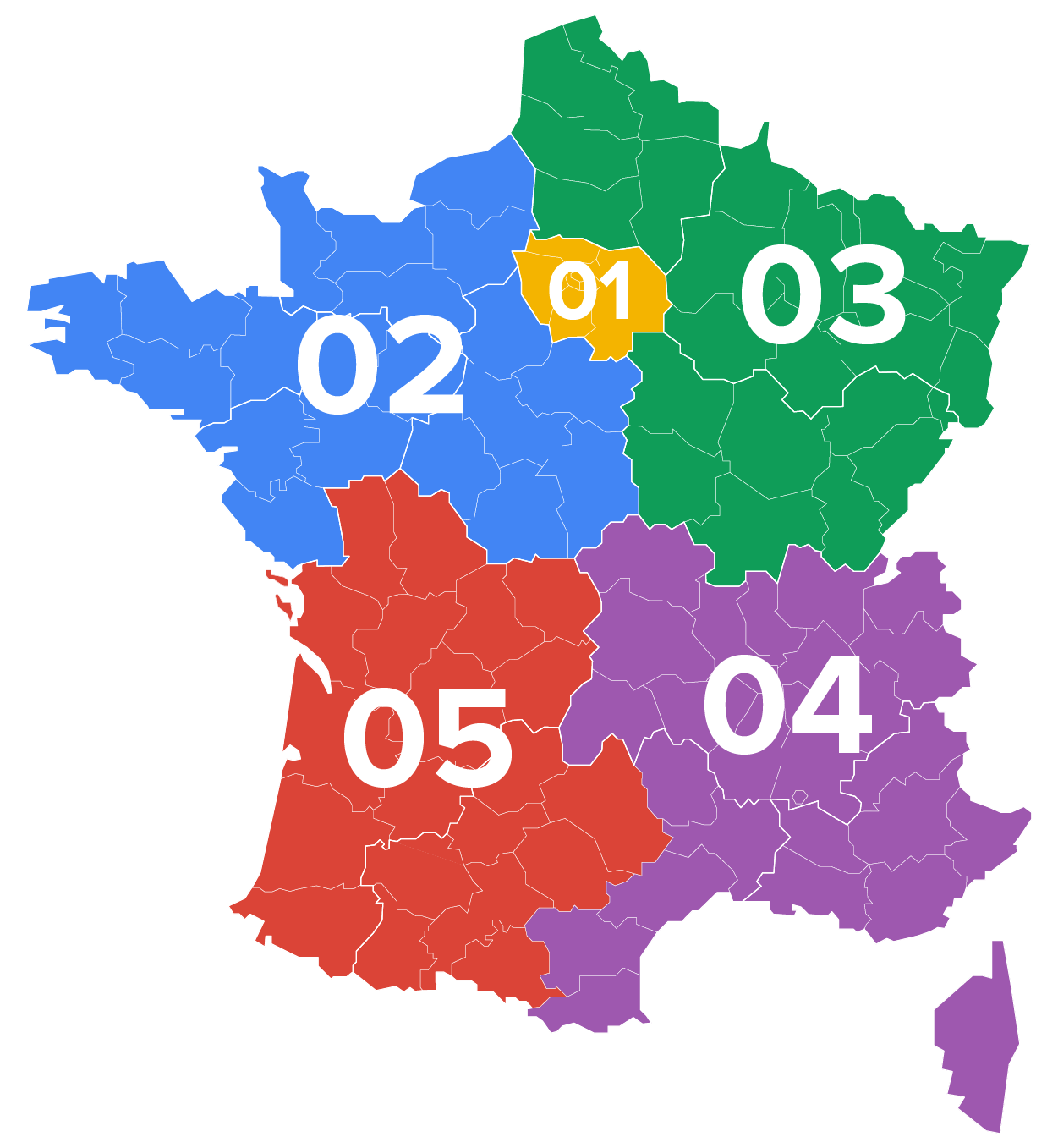 The first two digits of a French phone number represent l’indicatif téléphonique (area code), from 01 to 05, depending on the region the landline is located in, as shown in the map on the right. 06 and 07 are dedicated area codes for cell phone numbers, no matter which region they are issued in.
EXAMPLE
To call a fixed phone in Northeast France whose number is 03 45 67 34 10, you would dial 33 3 45 67 34 10.Practice numbers 0-69 all together in French:
Source: THIS TUTORIAL HAS BEEN ADAPTED FROM THE UNIVERSITY OF TEXAS AT AUSTIN’S LAITS’ "les nombres cardinaux 1-69” TUTORIAL. ACCESS FOR FREE AT www.laits.utexas.edu/fi/. LICENSE: CREATIVE COMMONS ATTRIBUTION 3.0 UNPORTED.



