Table of Contents |
Scholars don’t always agree on a single definition of capitalism. For our purposes, we will define capitalism as an economic system in which there is private ownership (as opposed to state ownership) and where there is an impetus to produce profit, and thereby wealth. This is the type of economy in place in the United States today.
Under capitalism, people invest capital (money or property) in a business to produce a product or service that can be sold in a market to consumers. The investors in the company are generally entitled to a share of any profit made on sales after the costs of production and distribution are taken out. These investors often reinvest their profits to improve and expand the business or acquire new ones.
EXAMPLE
Sarah, Antonio, and Chris each invest $250,000 into a start-up company that offers an innovative product. When the company nets $1 million in profits its first year, a portion of that profit goes back to Sarah, Antonio, and Chris as a return on their investment. Sarah reinvests with the same company to fund the development of a second product line, Antonio uses his return to fund another start-up in the technology sector, and Chris buys a yacht for vacations.To provide their product or service, owners hire workers to whom they pay wages. The cost of raw materials, the retail price they charge consumers, and the amount they pay in wages are determined through the law of supply and demand and by competition. When demand exceeds supply, prices tend to rise. When supply exceeds demand, prices tend to fall. When multiple businesses market similar products and services to the same buyers, there is competition. Competition can be good for consumers because it can lead to lower prices and higher quality as businesses try to get consumers to buy from them rather than from their competitors.
Wages tend to be set in a similar way. People who have talents, skills, education, or training that are in short supply and are needed by businesses tend to earn more than people without comparable skills. Competition in the workforce helps determine how much people will be paid. In times when many people are unemployed and jobs are scarce, people are often willing to accept less than they would when their services are in high demand. In this scenario, businesses are able to maintain or increase profits by not increasing workers' wages.
As capitalists began to dominate the economies of many countries during the Industrial Revolution, the rapid growth of businesses and their tremendous profitability gave some owners the capital they needed to create enormous corporations that could monopolize an entire industry. Many companies controlled all aspects of the production cycle for their industry, from the raw materials, to the production, to the stores in which they were sold. These companies were able to use their wealth to buy out or stifle any competition.
In the United States, the predatory tactics used by these large monopolies caused the government to take action. Starting in the late 1800s, the government passed a series of laws that broke up monopolies and regulated how key industries—such as transportation, steel production, and oil and gas exploration and refining—could conduct business.
The United States is considered a capitalist country. However, the U.S. government has a great deal of influence on private companies through the laws it passes and the regulations enforced by government agencies. Through taxes, regulations on wages, guidelines to protect worker safety and the environment, plus financial rules for banks and investment firms, the government exerts a certain amount of control over how all companies do business.
State and federal governments also own, operate, or control large parts of certain industries, such as the post office, schools, hospitals, highways and railroads, and many water, sewer, and power utilities. Debate over the extent to which the government should be involved in the economy remains an issue of contention today. Some criticize such involvements as tyrannical and over-bearing, while others believe intervention is necessary to protect the rights of workers and the well-being of the general population.
Socialism is an economic system in which there is government ownership (often referred to as “state run”) of goods and their production, with an impetus to share work and wealth equally among the members of a society. Under socialism, everything that people produce, including services, is considered a social product. Everyone who contributes to the production of a good or to providing a service is entitled to a share in any benefits that come from its sale or use. To make sure all members of society get their fair share, governments must be able to control property, production, and distribution.
As with capitalism, the basic ideas behind socialism go far back in history. Plato, the ancient Greek philosopher, suggested a republic in which people shared their material goods. Early Christian communities believed in common ownership, as did the systems of monasteries set up by various religious orders. Many of the leaders of the French Revolution called for the abolition of all private property, not just the estates of the aristocracy they had overthrown. Thomas More's Utopia, published in 1516, imagined a society with little private property and mandatory labor on a communal farm. A utopia has since come to mean an imagined place or situation in which everything is perfect. Most experimental utopian communities had the abolition of private property as a founding principle.
Modern socialism really began as a reaction to the excesses of uncontrolled industrial capitalism in the 1800s and 1900s. The enormous wealth and lavish lifestyles enjoyed by owners contrasted sharply with the miserable conditions of the workers.
Some of the first great sociological thinkers studied the rise of socialism. Max Weber admired some aspects of socialism, especially its rationalism and how it could help social reform, but he worried that letting the government have complete control could result in an “iron cage of future bondage” from which there is no escape.
Pierre-Joseph Proudhon (1809−1865) was another early socialist who thought socialism could be used to create utopian communities. In his 1840 book, What Is Property?, he famously stated that “property is theft.” By this he meant that if an owner did not work to produce or earn the property, then the owner was stealing it from those who did. Proudhon believed economies could work using a principle called mutualism, under which individuals and cooperative groups would exchange products with one another on the basis of mutually satisfactory contracts.
By far the most important influential thinker on socialism is Karl Marx. Through his own writings and those with his collaborator, industrialist Friedrich Engels, Marx used a scientific analytical process to show that throughout history, the resolution of class struggles caused changes in economies. He saw the relationships evolving from slave and owner, to serf and lord, to journeyman and master, to worker and owner.
Neither Marx nor Engels thought socialism could be used to set up small utopian communities. Rather, they believed a socialist society would be created after workers rebelled against capitalistic owners and seized the means of production. They felt industrial capitalism was a necessary step that raised the level of production in society to a point where it could progress to a socialist and then communist state. These ideas form the basis of the sociological perspective of social conflict theory.
The focus in socialism is on benefiting society, whereas capitalism seeks to benefit the individual. Socialists claim that a capitalistic economy leads to inequality, with unfair distribution of wealth and individuals who use their power at the expense of society. Socialism strives, ideally, to control the economy to avoid the problems inherent in capitalism.
Within socialism, there are diverging views on the extent to which the economy should be controlled. One extreme believes all but the most personal items are public property. Other socialists believe only essential services such as healthcare, education, and utilities need direct control. Under this form of socialism, farms, small shops, and businesses can be privately owned but are subject to government regulation.
The other area on which socialists disagree is on what level society should exert its control. In communist countries like the former Soviet Union, China, Vietnam, and North Korea, the national government exerts control over the economy centrally. They have the power to tell all businesses what to produce, how much to produce, and what to charge for it. Other socialists believe control should be decentralized so it can be exerted by those most affected by the industries being controlled.
EXAMPLE
Imagine a town collectively owning and managing the businesses on which its residents depend.Because of challenges in their economies, several of these communist countries have moved from central planning to letting market forces help determine many production and pricing decisions. Market socialism describes a subtype of socialism that adopts certain traits of capitalism, like allowing limited private ownership or consulting market demands. This could involve situations like profits generated by a company going directly to the employees of the company or being used as public funds. Many Eastern European and some South American countries have mixed economies. Key industries are nationalized and directly controlled by the government; however, most businesses are privately owned and regulated by the government.
Organized socialism never became powerful in the United States. The success of labor unions and the government in securing workers’ rights, joined with the high standard of living enjoyed by most of the workforce, made socialism less appealing than the controlled capitalism practiced here.
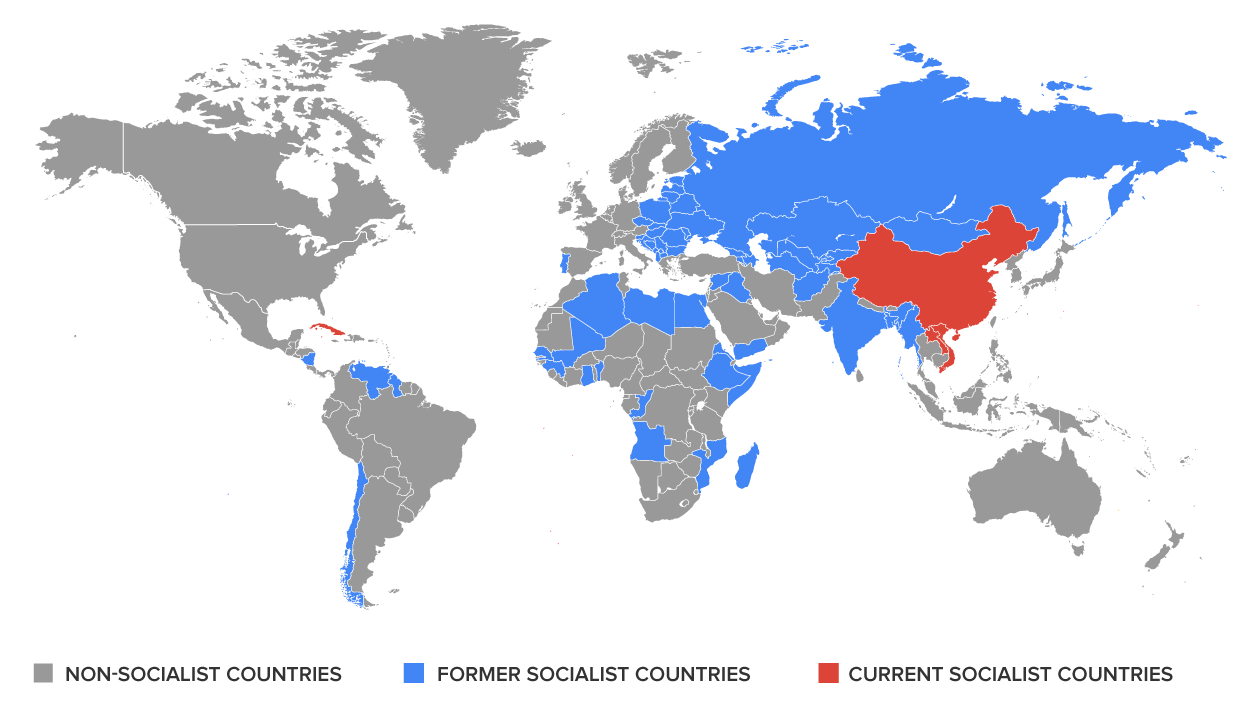
This map shows countries that have adopted a socialist economy at some point. While many countries have had a socialist economy at some point in the 20th century, today the only remaining fully socialist economies are China, Cuba, Vietnam, and Laos. But many more countries have active socialist parties and/or socialist principles invoked in their constitutions.
Although socialism is often held up in counterpoint to capitalism, which encourages private ownership and production, socialism is not typically an all-or-nothing plan.
EXAMPLE
Both the United Kingdom and France, as well as other European countries, have socialized medicine, meaning that medical services are run nationally to reach as many people as possible. These nations are, of course, still essentially capitalist countries with free-market economies.We have seen how the economies of some capitalist countries such as the United States have features that are very similar to socialism. Some industries, particularly utilities, are either owned by the government or controlled through regulations. Public programs such as welfare, Medicare, and Social Security exist to provide public funds for private needs. We have also seen how several large communist (or formerly communist) countries such as Russia, China, and Vietnam have moved from state-controlled socialism with central planning to market socialism, which allows market forces to dictate prices and wages and for some businesses to be privately owned. In many formerly communist countries, these changes have led to economic growth compared to the stagnation they experienced under communism.
In studying the economies of developing countries to see if they go through the same stages as previously developed nations did, sociologists have observed a pattern they call convergence. This describes the theory that societies move toward similarity over time as their economies develop.
Convergence theory explains that as a country's economy grows, its societal organization changes to become more like that of an industrialized society. Sociologists observe that in a growing economy, people begin to move from job to job as conditions improve and opportunities arise, rather than staying in one job for a lifetime. This means the workforce needs continual training and retraining. Workers move from rural areas to cities as they become centers of economic activity, and the government takes a larger role in providing expanded public services.
Supporters of the theory point to Germany, France, and Japan—countries that rapidly rebuilt their economies after World War II. Despite their decimated economies and industries, these countries were able to adopt the modern technology and banking practices of other, more modern countries, and ultimately achieve an extremely successful economic recovery. Supporters also point out how, in the 1960s and 1970s, underdeveloped East Asian countries like Singapore, South Korea, and Taiwan converged with countries with developed economies. They are now considered developed countries themselves.
To experience this rapid growth, the economies of developing countries must be able to attract inexpensive capital to invest in new businesses and to improve traditionally low productivity. They need access to new, international markets for buying the goods. If these characteristics are not in place, then their economies cannot catch up. This is why the economies of some countries are diverging rather than converging.
Another key characteristic of economic growth regards the implementation of technology. A developing country can bypass some steps of implementing technology that other nations faced earlier. Television and telephone systems are a good example. While developed countries spent significant time and money establishing elaborate system infrastructures based on metal wires or fiber-optic cables, developing countries today can go directly to cell phone and satellite transmission with much less investment.
Another factor affects convergence concerning social structure. Early in their development, countries such as Brazil and Cuba had economies based on cash crops (coffee or sugarcane, for instance) grown on large plantations by unskilled and frequently enslaved workers. The elite ran the plantations and the government, with little interest in training and educating the populace for other endeavors. This restricted economic growth until the power of the wealthy plantation owners was challenged. Improved economies generally lead to wider social improvement. Society benefits from improved educational systems and allows people more time to devote to learning and leisure.
Source: THIS TUTORIAL HAS BEEN ADAPTED FROM (1) "INTRODUCTION TO SOCIOLOGY" BY LUMEN LEARNING. ACCESS FOR FREE AT LUMEN LEARNING. (2) "INTRODUCTION TO SOCIOLOGY 2E" BY OPENSTAX. ACCESS FOR FREE AT OPENSTAX. LICENSE (1 & 2) CREATIVE COMMONS ATTRIBUTION 4.0 INTERNATIONAL.



