The Byzantine Empire is historically and religiously very important. It was during this time that the focus of the Roman Empire was moved east, and Christianity replaced centuries of polytheism. Things changed, including architecture and artistic styles. In this lesson, you will explore:
1. Time Period and Location: Byzantine Art and Architecture
The Byzantine Empire can be broken into the following periods:
The Early Period (330–843 CE): Constantinople became the new capital of the eastern Roman Empire.
Middle Byzantium (843 to 1204 CE): Art and architecture flourished.
Late Byzantium (1204 to 1453 CE): Constantinople is finally overrun by the Ottoman Turks.
Two empires were prominent during these times, Western and Eastern. Historically, Rome was the capital of the Western Empire. However, it is important to know that this capital did move twice. When Rome was defeated by the barbarians in 410 CE, the capital had already moved to Ravenna, Italy, from its former location in present-day Milan.
The new capital of the Eastern Empire, established under Emperor Constantine, was the city of Constantinople. This was originally the Greek city of Byzantium. After the conquest of Constantinople by the Ottoman Turks in 1453, it was renamed Istanbul. Istanbul is located in modern-day Turkey.
The Byzantine Empire lasted more than 1,000 years, so it is difficult to make generalizations about it. However, one interesting point is that its people did not think of themselves as being any different from the Roman Empire that preceded them and even referred to themselves as Romans.
terms to know
Byzantine
A term referencing the Byzantine Empire, and a style of art developed during the Byzantine Empire characterized by religious iconography, very formal, shallow pictorial space, and rich colors.
Byzantium
A Greek city rebuilt by Constantine in 330 CE and renamed Constantinople.
2. Emperor Constantine
Constantine was a major figure in the political shakeup and subsequent religious changes that occurred during the fourth century CE. He is often credited with splitting the empire of Rome, but this is not true.
It was his predecessor, the emperor Diocletian, who split the empire into Eastern and Western empires. The Roman Empire had become so huge, it had become a bureaucratic nightmare to run. When Constantine became ruler of the Eastern Empire, he moved the capital to Byzantium, renamed it Constantinople, and ran his empire from there.
Political disorganization of the time left major parts of the Western Empire vulnerable to continued barbarian attacks. Eventually, Rome was defeated in 410 CE by the Visigoths, a barbarian tribe. The Western Empire officially ended after the conquest of Ravenna by barbarians in 479 CE.
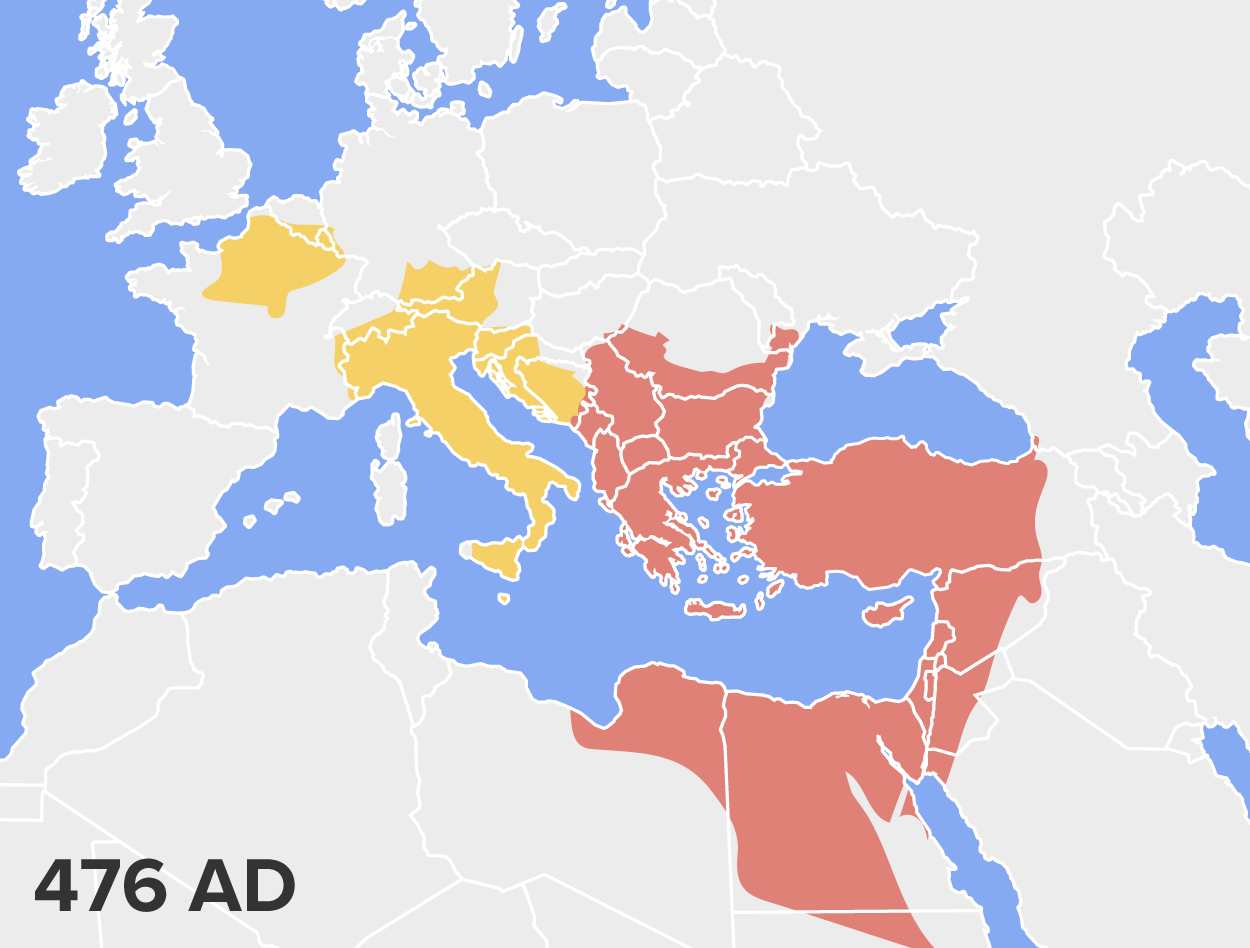
Take a look below at this image showing the approximate borders of the Western and Eastern Empires of Rome at the time of the conquest of Ravenna, Italy, in 476 CE:
3. Rise of Christianity
The rise of Christianity was also historically important. Emperor Constantine is largely responsible for later adoption of Christianity as the official state religion, replacing centuries of polytheism. The Edict of Milan declared religious tolerance to Christians and others, and by the end of the fourth century, Christianity was officially declared the state religion. This all happened many years after Constantine’s death in 337 CE.
4. Hagia Sophia
The Byzantine Empire, as it came to be known, developed its own unique blended style of Eastern and Western convention. It was in this new blended style that the church of Hagia Sophia in Constantinople was designed under the reign of Emperor Justinian during the sixth century CE.
This church embodies the style and architectural elements that are now associated with the Byzantine Empire, including:
A pendentive dome
A centralized plan
Extensive detail covering every surface of the church’s interior
Hagia Sophia was built to be a cathedral, or a church that houses the cathedra, the throne of a Christian bishop. Justinian developed an ambitious plan to return the empire to its former glory, and from this plan came the architectural masterpiece, Hagia Sophia.
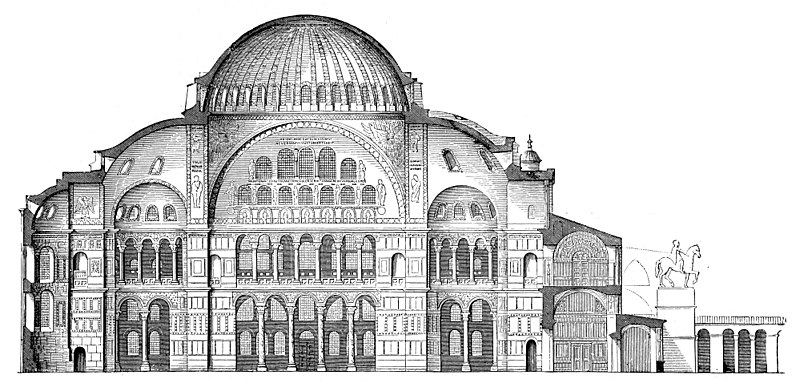
Consider this cross section of Hagia Sophia, showing its support system.
Wilhelm Lübke and Max Semrau Cross-section of Hagia Sophia, reconstruction Esslingen, Germany 1908 Grundriß der Kunstgeschichte, 14 Auflage
did you know
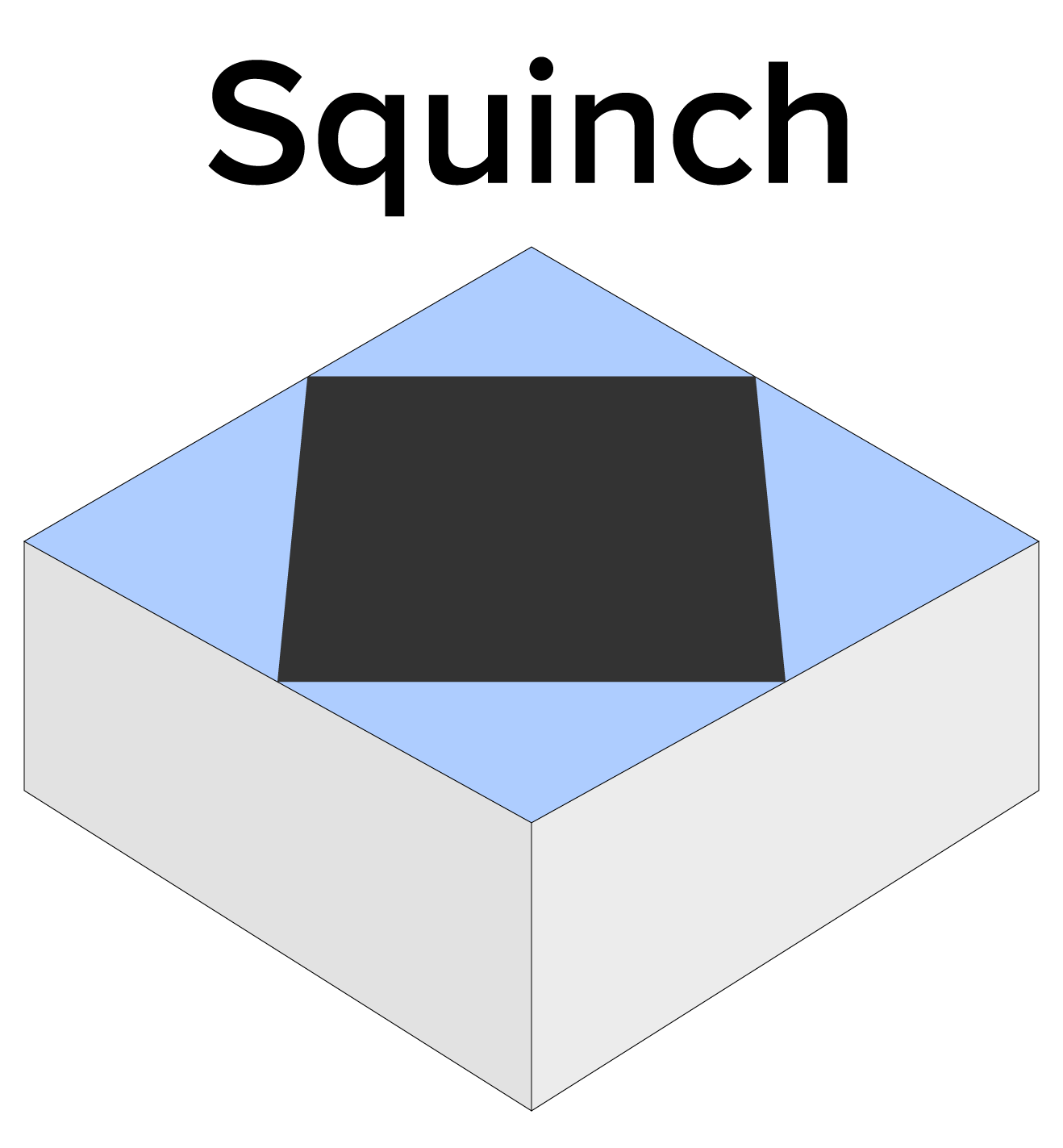
The supportive pendentives are separated by a clerestory at the base of the massive dome, which creates the effect of the dome appearing to float effortlessly above the building. Pendentive is one of two primary architectural methods of supporting a circular dome on a rectangular or polygonal base. A squinch is another method.
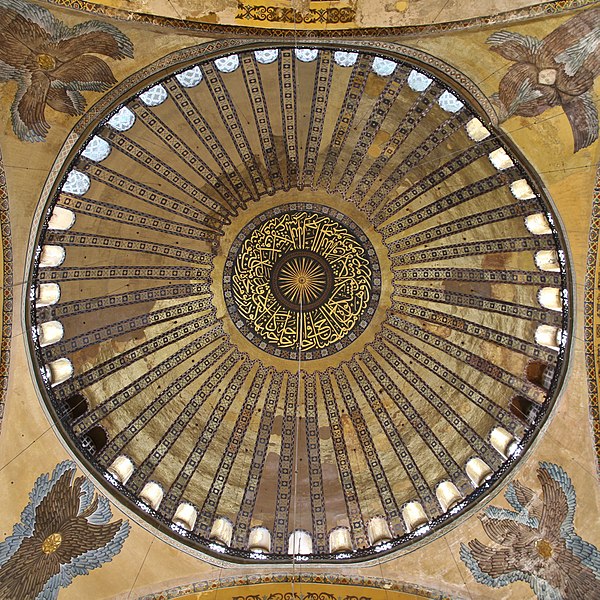
Below is the dome of Hagia Sophia. Note the angels with six wings on each of the pendentives, which have been painted over, except for the one in the top left corner.
Artist unknown Dome from Hagia Sophia, reconstruction Faith, Istanbul, Turkey mid 1800s Paint
In the image below, the lower case "a" highlights the pendentive.
Take a look at the rectangular base below. The squinches are the four blue triangles that are built in to provide a base for the circular bottom of the dome.
It might be useful to think about Hagia Sophia in competition with and responding to the Pantheon in Rome. The Pantheon’s dome is 143 feet in height and diameter, while Hagia Sophia’s dome is 108 feet in diameter and 180 feet in height. The entire building is about 270 feet long and 240 feet wide.
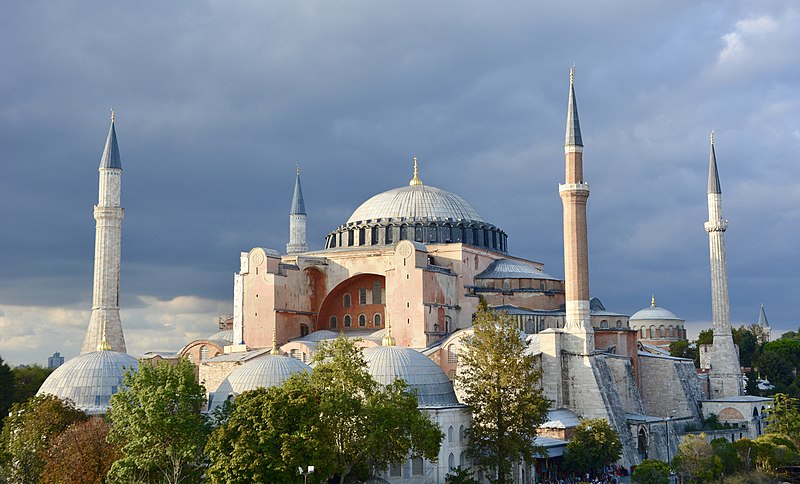
Here is an exterior view of Hagia Sophia:
Isidore of Miletus and Anthemius of Tralles Hagia Sophia Grand Mosque Faith, Istanbul, Turkey 532–537 CE Brick and mortar
The Pantheon used coffers, the oculus, and varying thicknesses and strength of concrete to support the weight of its dome, while Hagia Sophia used pendentives and a series of half domes to support the weight of its main dome.
Notice the minarets, the four towers, one on each corner. These were a later addition completed when the church was converted to a Muslim mosque after the Ottoman Turks. Hagia Sophia is in Istanbul, Turkey, which is the modern-day city of what used to be Constantinople.
terms to know
Pendentive
An architectural term; a construction that allows the placement of the circular dome over a rectangular room.
Squinch
An architectural term; a small arch, or corbelling, built across the interior between two walls as a support in a square tower.
5. San Vitale and the Mosaics of San Vitale
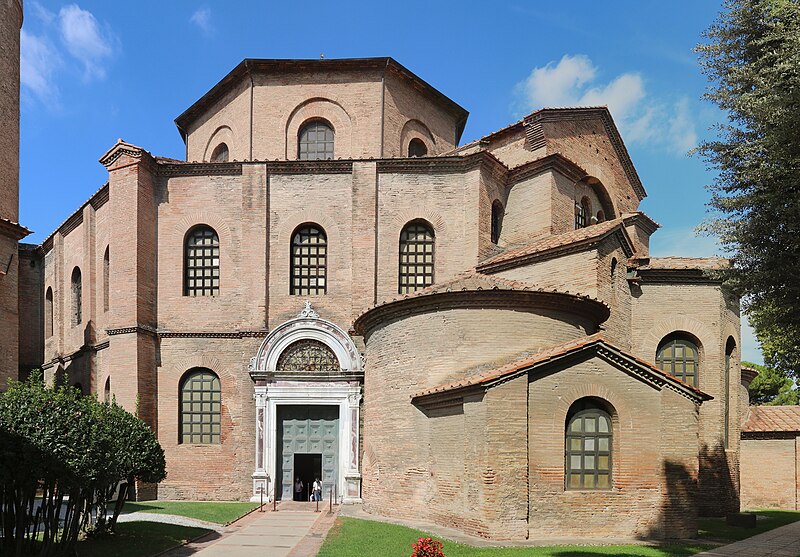
The Basilica of San Vitale in Ravenna, Italy, is a centrally planned church. Construction began in 526 CE. The exterior brick facade, an octagonal shape, is rather constrained in comparison to the interior design of the church.
Here is an exterior image of San Vitale:
Artist unknown Basilica of San Vitale Ravenna, Italy 526–547 CE Terracotta and fresco
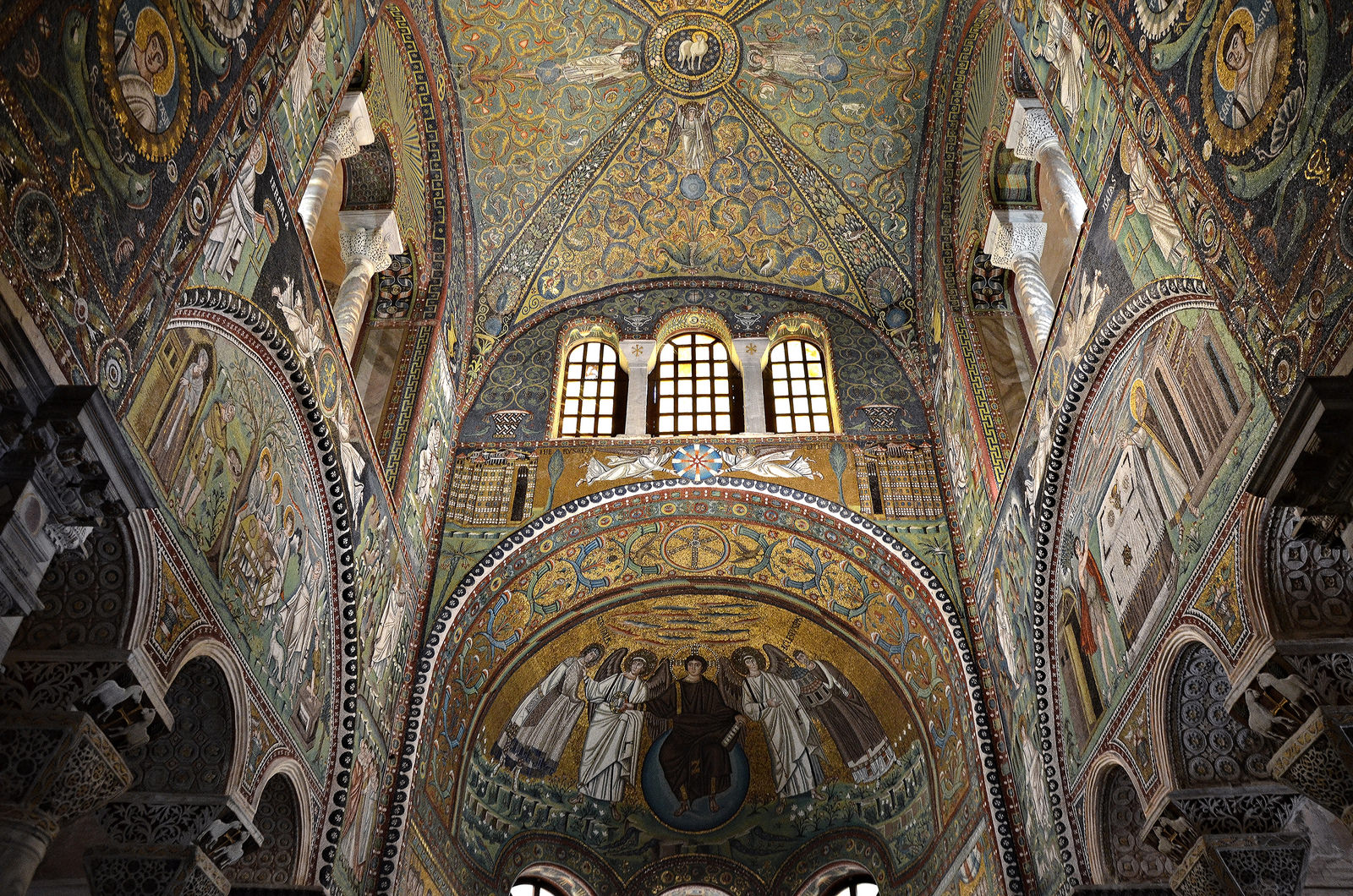
The interior space of San Vitale is almost completely covered in mosaics. The individual tesserae are set at slightly different angles, making the images appear to sparkle like jewels from a distance. The plan, which was based on two octagons, made the interior space appear kaleidoscopic.
Below is an interior view of San Vitale.
Artist unknown The Presbytery of Basilica of San Vitale Ravenna, Italy 527 - 548 CE Mosaic
The Basilica or Church of San Vitale is important because it is an example of classical Byzantine architectural design. The interior mosaics really capture our interest. It’s literally covered in these interior mosaics that have remained in relatively excellent condition, considering their age. The imagery depicted is all religious in nature.
San Vitale was completed during the reign of the emperor Justinian, but it is not known whether he actually saw the church. He was a very religious man who ambitiously sought to establish the former greatness of the Roman Empire. In addition to his artistic campaign, his military campaign was successful in reclaiming large portions of the former empire, including Italy, much of North Africa, and parts of Spain.
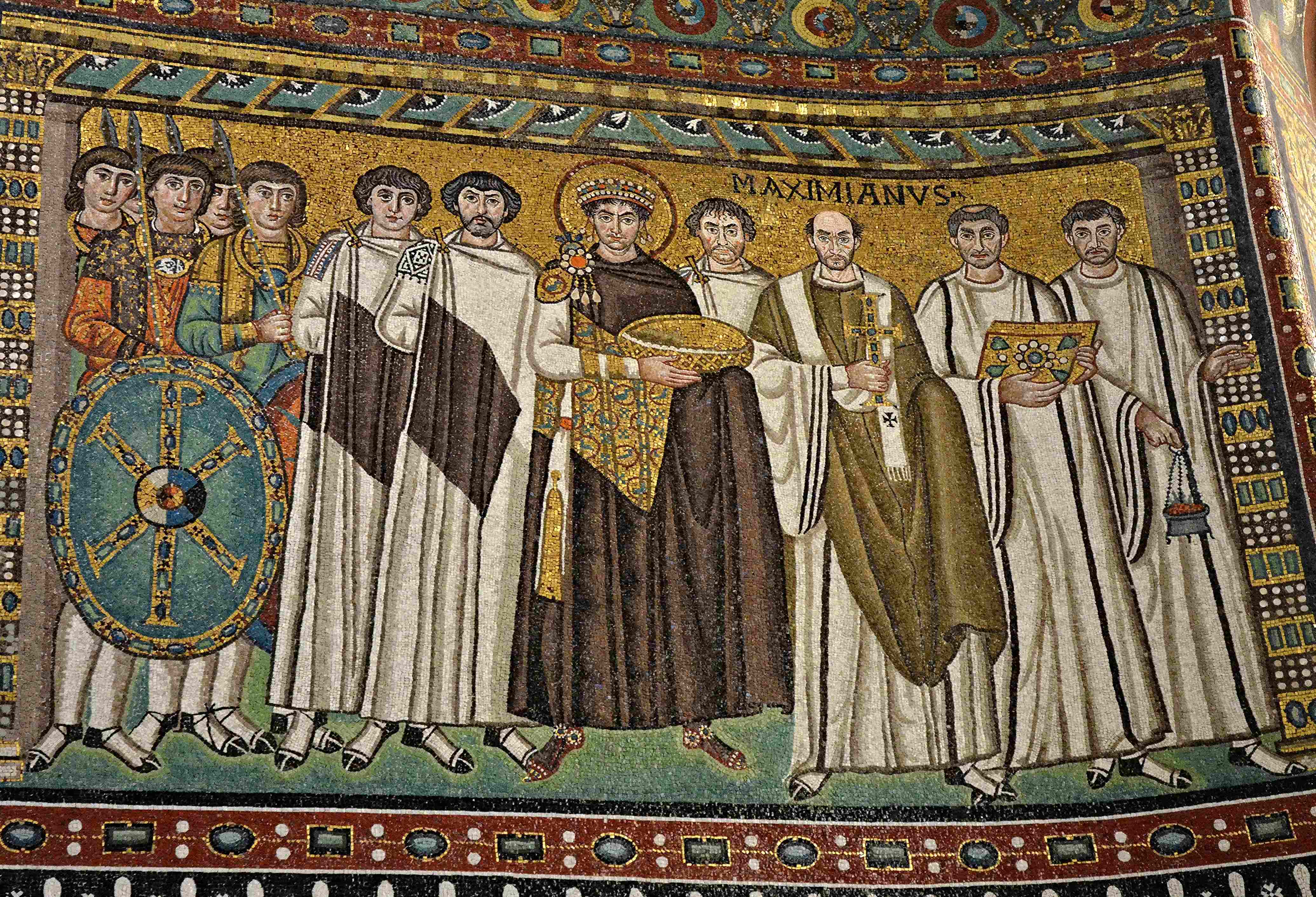
Justinian was married to the Empress Theodora. He saw himself as Christ’s representative on Earth. This notion is evident in this depiction of Justinian and his attendants in this mosaic from the north wall of San Vitale. By including Justinian’s army, Maximianus, the bishop of Ravenna, and church clergy, this image mixes together politics and religion. There is even a portrait of the patron who donated money to have San Vitale built.
Artist unknown Emperor Justinian and his Retinue, from the Basilica of San Vitale Ravenna, Italy 547 CE Mosaic
This mosaic from 547 CE is positioned under and perpendicular to that mosaic on the right side of Christ, which was, symbolically, a very important position.
Some of the Byzantine stylistic high points that stand out include:
Almond-shaped eyes
Tall, elongated bodies
Roughly nine heads tall
Flat, two-dimensional rendering
Use of overlapping to suggest space and denote importance
It is not totally clear whether Justinian or Maximianus is the most important person in this image. Justinian wears the purple and gold imperial robes. His head is surrounded by a golden halo, and he holds a Eucharistic platter. Maximianus has his name written above his head and his feet are slightly ahead of Justinian’s, while Justinian appears to be elbowing the bishop ever so slightly.
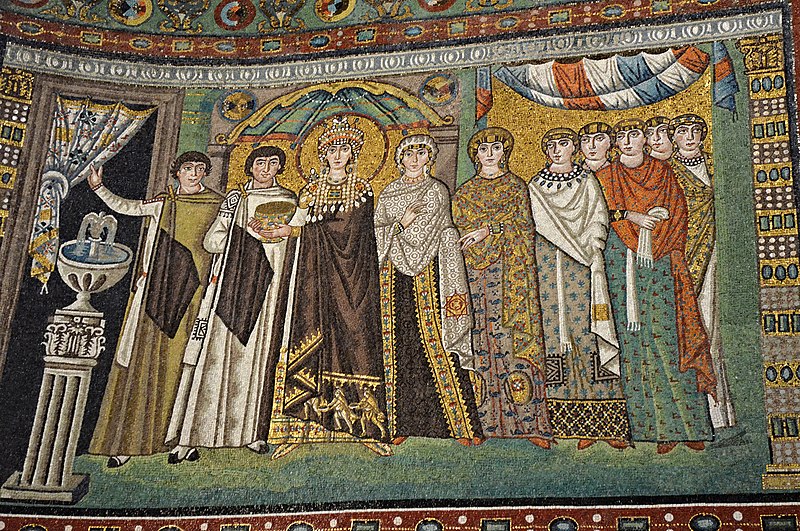
Directly across from Justinian is his wife, Theodora, in a similar composition from 547 CE, shown below.
Artist unknown Empress Theodora and her Retinue, from the Basilica of San Vitale Ravenna, Italy 547 CE Mosaic
Notice above that the figures are elongated, and there is the use of overlapping. Theodora is the furthest forward and wears the purple and gold imperial robes. Hers, however, are trimmed with images of the Magi, or the three wise men. Her head is framed by a halo, and she is wearing a crown dripping with pearls, which were thought at the time to have healing powers.
Like her husband, she holds a Eucharistic object, a Eucharistic cup of Christ. However, she is attended by fewer people and is positioned on the less desirable left side of Christ, symbolic of her status in comparison to Justinian.
did you know
An interesting tidbit of information about the mosaic of Justinian and his attendants is the number of attendants, which not coincidentally was the number 12. This is the same as the number of disciples of Jesus Christ.
IN CONTEXT
Both mosaics are said to be examples of reverse perspective, which is also called Byzantine perspective, where lines of vanishing points diverge outside the picture plane or outside a painting.
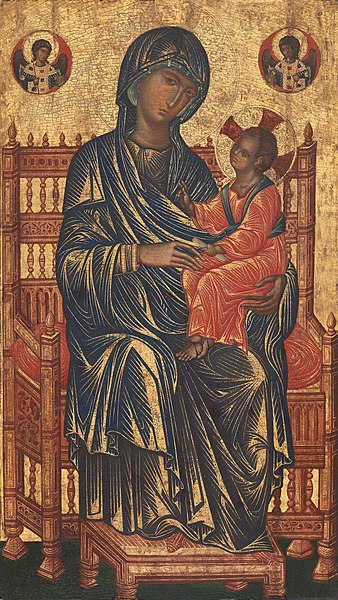
Another example can be shown below. Look at the Virgin's footstool; you'll notice that the back of it is bigger than the front of it. If you imagine a series of orthogonal lines coming off of the edges of the footstool, those would converge in the viewer space, and they would break the picture plane, which is the invisible plane that corresponds to the surface of the painting. The picture plane is like a window opening out onto another world.
Artist unknown Madonna and Child Enthroned Washington D.C, USA c. 1250 - 1275 CE Tempera on poplar wood
terms to know
Reverse Perspective
Also called Byzantine perspective, where lines of vanishing points diverge outside the picture plane or outside a painting.
Picture Plane
The invisible plane that corresponds to the surface of the painting; the picture plane is like a window opening out onto another world.
6. Christ Pantocrator
Other images designed in the Byzantine style can also be found in Greece several hundred years later.
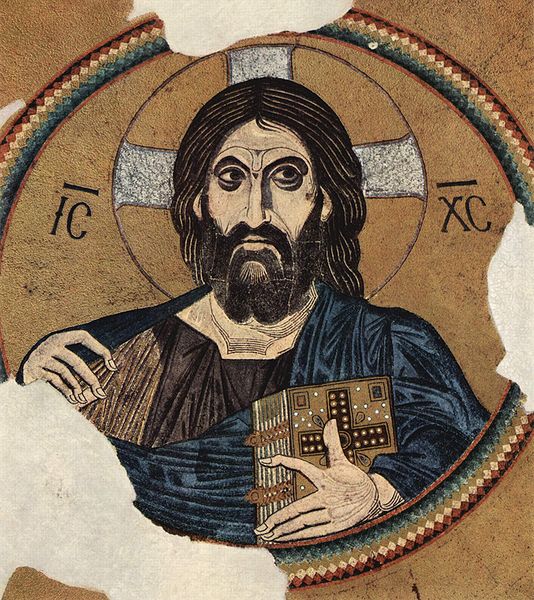
Below is an image of Christ Pantocrator from the central dome of the Church of the Dormition.
Master of Daphne Christ Pantocrator, from the Church of the Dormition Daphne, Greece c. 1080-1100 CE Mosaic
This above image of Christ is designed in the Byzantine style. Notice the almond-shaped eyes, the sharp nose, and the elongated features. This almost brooding figure of Christ would actually be looking down on you from above. It’s a mosaic that’s situated within the dome of the church. Other images of Christ Pantocrator use a similar depiction with the right hand of Christ in a blessing gesture and the left hand holding the New Testament.
think about it
In this image of Christ in comparison to those from the tutorial on early Christian art and images of Christ, instead of the youthful Good Shepherd version of Christ, we have an image that is stern and imposing. Can we draw any conclusions regarding the evolution of Christianity during this time?
big idea
The establishment of the new capital in Constantinople moved the focus of the Roman Empire east and facilitated a new artistic style that combined eastern and western conventions.
term to know
Pantocrator
Refers to a specific Christian iconography; icon image of Christ understood in Greek as “ruler of all.”
summary
During the Byzantine Empire, the focus of the Roman Empire was moved east, and Christianity replaced centuries of polytheism. Architecture and artistic styles began to change and adapt. In this lesson, you learned about the time period and location of Byzantine art and architecture.
You learned about Emperor Constantine, who was a major figure in the political shakeup and subsequent religious changes that occurred during the fourth century CE. It was during this time that there was a notable rise in Christianity. By the end of the fourth century, Christianity was officially declared the state religion. This all happened years after Constantine’s death in 337 CE.
Finally, you explored several examples of Byzantine art and architecture, including:
Hagia Sophia
San Vitale and the Mosaics of San Vitale
Christ Pantocrator
Source: THIS TUTORIAL WAS AUTHORED BY SOPHIA LEARNING. PLEASE SEE OUR TERMS OF USE.
A term referencing the Byzantine Empire, and a style of art developed during the Byzantine Empire characterized by religious iconography, very formal, shallow pictorial space, and rich colors.
Byzantium
A Greek city rebuilt by Constantine in 330 CE and renamed Constantinople.
Pantocrator
Refers to a specific Christian iconography; icon image of Christ understood in Greek as “ruler of all.”
Pendentive
An architectural term; a construction that allows the placement of the circular dome over a rectangular room.
Picture Plane
The invisible plane that corresponds to the surface of the painting; the picture plane is like a window opening out onto another world.
Reverse Perspective
Also called Byzantine perspective, where lines of vanishing points diverge outside the picture plane or outside a painting.
Squinch
An architectural term; a small arch, or corbelling, built across the interior between two walls as a support in a square tower.