In this tutorial, you will look at some of the personal career skills you can learn to help with your career and personal success. Specifically, this lesson will cover the following:
1. Interpersonal Skills for Business Success
Since we’ve been addressing human resource management, it is a good time to talk about your career in business and some of the skills you might want to consider developing to support your endeavors both personally and professionally.
Here are some of the most commonly sought-after business skills:
- Communication (written and verbal)
- Teamwork and collaboration
- Leadership and management
- Critical thinking and problem-solving
|
- Time and project management
- Data analysis and financial literacy
- Customer service
- Adaptability and resilience
|
-
A successful business professional often exhibits a blend of these skills, and the ability to strengthen each one is key to long-term career success.
Interpersonal skills, often referred to as “people skills” or “soft skills,” are the abilities that allow us to interact effectively and harmoniously with others. These include:
- Active listening
- Empathy
- Emotional intelligence
- Negotiation
|
- Conflict resolution
- Networking
- Nonverbal communication
- Team collaboration
|
In business, interpersonal skills are essential because most roles involve working with others—be it customers, coworkers, clients, or stakeholders. A brilliant strategy or product can falter if the team behind it cannot communicate effectively or resolve internal conflicts. Businesses are powered by people, and interpersonal skills are the glue that holds these relationships together. Besides interpersonal skills, becoming savvy in organizational politics (in an ethical way) can also help your career. Let’s look at that next.
-
- Interpersonal Skills
- The abilities needed to effectively communicate and interact with others.
2. Become Politically Savvy
Politics is an inevitable part of every organization. Office politics, often called workplace politics, has always been a part of the workplace and always will be. The trick is to learn to play the political game to your own advantage and to the advantage of others without causing harm to anyone else. Being political means getting along with others in order to move them toward accomplishing a specific goal. It does not mean maneuvering for selfish purposes, manipulating to deceive, or scheming so others lose while you win.
Here are some tips and techniques for navigating workplace dynamics, or politics, positively:
- 🗣️ Be thoughtful with your words:
Before speaking or writing, consider how your message might be received. Aim for clarity and respect.
- 💛 Practice empathy:
Try to see situations from others’ perspectives. It helps build understanding and trust.
- 🧪 Suggest a trial run:
If your idea meets resistance, propose a short trial period. Let results speak for themselves.
- 🔍 Understand the environment:
Learn how things work in your organization—what’s encouraged, what’s not, and how people succeed.
- 🙋♀️ Step up occasionally:
Volunteering for less popular tasks shows initiative. Just be mindful not to overextend yourself.
- 🎯 Align with leadership goals:
Understand what your leaders value and aim to support those goals. If you feel overlooked, communicate your contributions respectfully.
- 👏 Share the spotlight:
Give credit where it’s due. Acknowledging others builds goodwill and strengthens relationships.
- 👥 Learn your manager’s style:
Adapt to your supervisor’s preferences while staying true to your values. Offer improvements when appropriate.
- 🤐 Respect confidentiality:
Keep private matters private—both yours and others’. Trust is built on discretion.
-
- Workplace Politics
- The informal, often behind-the-scenes, actions and behaviors that individuals engage in to influence decisions, gain advantages, or navigate power dynamics within an organization.
3. Manage Conflict
Managing conflict effectively and productively can help us grow both professionally and personally. But what are the types of conflicts that we might experience?
Conflict can take various forms in the workplace and in social interactions, often arising from differences in goals, beliefs, emotions, or behaviors.
-
Goal conflict occurs when individuals or groups desire different outcomes, leading to a clash over which goals should be pursued. This type of conflict is centered around competing interests and priorities.
-
Cognitive conflict arises when there are disagreements in ideas, opinions, or beliefs. This is common in political debates or decision-making discussions, where individuals hold opposing viewpoints.
-
Affective conflict stems from emotional incompatibility, such as when two people simply don’t like each other or have clashing personalities. This kind of conflict can create tension and discomfort within a team.
- Lastly, behavioral conflict occurs when someone’s actions or behaviors are considered unacceptable or offensive by others.
-
EXAMPLE
Behavioral conflict could arise due to an inappropriate dress or the use of profane language in a professional setting.
Each type of conflict requires different strategies for resolution and can significantly impact group dynamics and productivity. To best manage conflict, consider the KIND technique. The letters stand for:
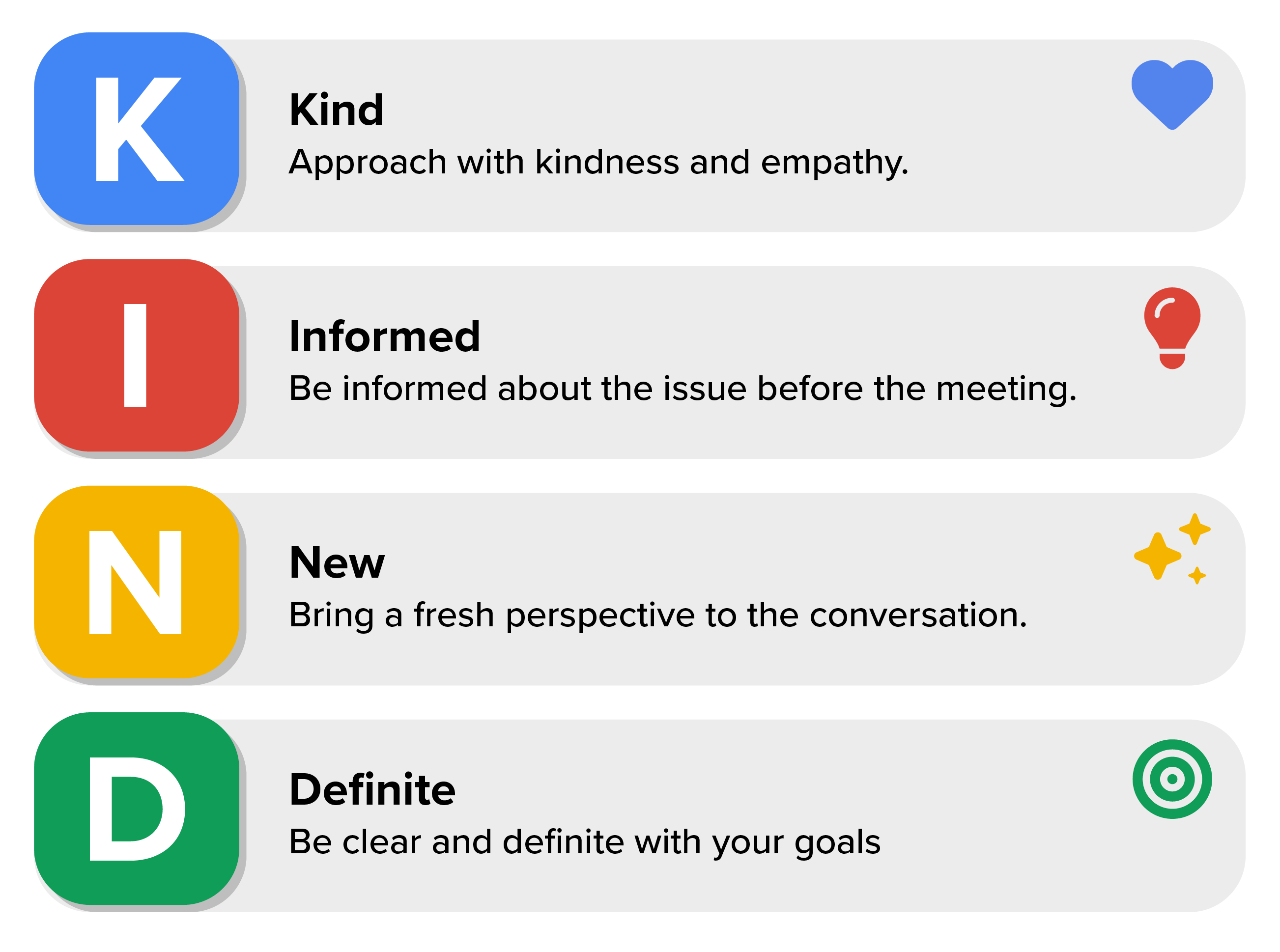
The technique involves the following steps:
-
The KIND technique:
- Request a meeting with the difficult person, whether they are having a conflict with you or with others. Start off with kind words, words that encourage cooperation, words that show your determination to make the conflict situation better.
- Demonstrate that you have taken the time to learn more about the person, what is important to them, and what they prefer in terms of work. Show by your words that you have taken the time to become informed about the individual.
- Do something novel, something you have not tried before. Put your creativity to work and discover a plan to which you can both subscribe (e.g., keeping a journal regarding the problem and possible solutions).
- Finally, do not permit the exchange to conclude until you have made a definite overture to ensure future success. What can you promise the other person you will do differently? What are you asking them to do differently? Set a time to meet again and review your individual attempts to achieve collective improvement.
How might Maya use the KIND technique in her organization?
IN CONTEXT: Blossom & Bloom Floral Boutique and the KIND Technique
 Maya has been frustrated with her flower supplier, Carlos, because several recent deliveries have arrived late or with damaged blooms. This has affected her ability to fulfill customer orders on time. Instead of reacting with anger, Maya decides to use the KIND approach to address the issue constructively.
Kind:
Maya calls Carlos and begins the conversation with kindness and professionalism. She says, "Carlos, I really value our long-standing relationship and the quality of flowers you usually provide. I know how hard you work, and I appreciate it. I just wanted to talk through something that’s been bothering me."
Informed:
Before the call, Maya reviewed her records to gather specific information—three late deliveries and two instances where flowers arrived wilted or damaged in the past month. She calmly shares these facts:
"Over the past few weeks, I’ve had a few issues with the deliveries—like the one on the 5th that arrived after business hours and the roses last Tuesday that were already browning. I know there can be hiccups, so I wanted to make sure we’re on the same page."
New:
Rather than just complaining, Maya offers a new idea to improve the situation.
"I was thinking maybe we could schedule my deliveries earlier in the day when traffic is lighter, and perhaps you could do a quick quality check before loading the truck. That might help prevent any surprises on my end."
Definite:
Maya ends the conversation with a clear next step.
"Let’s try that plan for the next 2 weeks and touch base after the 15th to see how it goes. If issues continue, we may need to talk about a backup plan or partial refunds for damaged goods." Her approach is respectful but firm, ensuring her expectations are understood and action is taken.
-
- Goal Conflict
- A type of conflict that occurs when individuals or groups desire different outcomes, leading to a clash over which goals should be pursued.
- Cognitive Conflict
- A type of conflict that arises when there are disagreements in ideas, opinions, or beliefs.
- Affective Conflict
- A type of conflict that stems from emotional incompatibility, such as when two people simply don’t like each other or have clashing personalities.
- Behavioral Conflict
- A type of conflict that occurs when someone’s actions or behaviors are considered unacceptable or offensive by others.
4. Strategies to Develop Skills
To begin building business skills, the first essential step is conducting a self-assessment to identify your strengths and weaknesses. Take time to evaluate your current skill set, focusing on both technical and interpersonal areas such as communication, problem-solving, leadership, and time management. Reflect on past feedback from peers or supervisors and consider how confident and effective you feel in various business tasks.
-
This honest inventory will help you understand what skills need attention and growth.
Once you’ve assessed your current abilities, the next step is to set SMART goals—which you first looked at in the lesson Controlling.
-
EXAMPLE
Rather than vaguely deciding to "get better at finance," commit to completing an online course in financial accounting within 3 months. SMART goals provide a clear road map and make progress easier to track, ensuring your efforts are focused and productive.
Let’s suppose you wish to improve your communication skills. Review how you might make this goal into a SMART goal.
IN CONTEXT: SMART Communication Skills
Turning the desire to improve communication skills into a SMART goal means making it:
-
Specific
-
Measurable
-
Achievable
-
Relevant
-
Time bound
Here’s how you might frame it:
|
Specific
|
Measurable
|
Achievable
|
Relevant
|
Time Bound
|
Example:
Communication Skills Goal
|
|
What do you want to accomplish?
|
How will you track progress and know when it’s done?
|
Is it realistic given your current resources?
|
Why does this goal matter to you or your business?
|
When will you complete this goal?
|
I will improve my verbal communication skills by attending a weekly public speaking workshop and practicing presentations with a peer group, aiming to reduce filler words and increase clarity. I will track my progress through monthly feedback from my peers and aim to show a 30% improvement in clarity scores over the next 3 months.
|
After setting goals, click through and follow these steps:
Start Seeking Learning Opportunities.
Enroll in relevant courses, workshops, or certificate programs—many of which are available online through platforms like Coursera, LinkedIn Learning, and Udemy. Whether you want to develop your marketing insight, master project management tools, or improve your communication, there are countless resources designed for all experience levels.
Get Real-World Experience.
Learning doesn’t only happen in classrooms; your workplace can serve as an excellent training ground. Volunteer for new assignments or projects that push you outside your comfort zone. Take on leadership roles, offer to manage a team, or work cross-functionally with departments you’re unfamiliar with. These real-world experiences allow you to practice skills like time management, negotiation, and critical thinking while also building credibility and confidence.
Seek Mentorship.
In addition, mentorship can play a powerful role in skill development. Seek out mentors within your company or professional network who can provide guidance, feedback, and encouragement. A good mentor can help you navigate challenges, share personal insights, and connect you with new opportunities. Similarly, working with a business coach can offer targeted help in areas like public speaking, leadership presence, or conflict resolution.
Read.
Reading is another powerful and often underestimated way to build business knowledge and skills. Stay up to date with business books, articles, and case studies to understand emerging trends, innovative strategies, and best practices. Books like The 7 Habits of Highly Effective People, Good to Great, or Emotional Intelligence offer practical insights that can be applied immediately in your professional life.
Develop Self-Awareness and Emotional Intelligence.
It’s also important to develop self-awareness and emotional intelligence, which are foundational to many business skills. Take time to reflect on your emotional responses, how you handle stress, and how you interact with others. Tools like journaling, personality assessments, or mindfulness exercises can enhance self-understanding and help you better manage relationships at work.
Improve Communication Skills.
Improving communication skills should be an ongoing priority. Aim to write clearly and concisely, speak with confidence, and actively listen during conversations. Nonverbal communication, such as body language and tone, is just as important as what you say. Practicing these elements in different settings—from emails to team meetings—helps build versatility and clarity in your interactions.
Develop Cultural Intelligence.
Finally, embrace diversity and develop cultural intelligence. As businesses become more global and inclusive, being able to collaborate with people from different backgrounds is a major asset. Attend workshops, seek diverse perspectives, and remain open and respectful during cross-cultural interactions. The ability to work well with others—no matter their background—is a hallmark of a strong business professional.
By following these steps with intention and consistency, you’ll gradually build a powerful and adaptable set of business skills that will support your success across a wide range of roles and industries.
In this lesson, you learned that building a successful career in business involves developing a broad range of skills that combine technical knowledge with interpersonal skills. Key business skills include communication, teamwork, leadership, critical thinking, time management, data analysis, customer service, adaptability, and resilience. Interpersonal or “soft” skills—such as active listening, empathy, emotional intelligence, negotiation, conflict resolution, and networking—are crucial because most business roles require effective collaboration and relationship management. Understanding and navigating organizational politics ethically, or becoming politically savvy, can also enhance career growth by fostering positive connections and helping you align with workplace dynamics.
Effectively managing conflict is another essential skill, as conflicts often arise from differences in goals, beliefs, emotions, or behaviors. Different types of conflict—goal, cognitive, affective, and behavioral—require tailored strategies for resolution. The KIND approach (kind, informed, new, definite) offers a structured method to address conflicts constructively, emphasizing empathy, preparation, creativity, and clear follow-up. To build and enhance business skills, individuals should conduct self-assessments, set SMART goals, seek learning opportunities, gain real-world experience, pursue mentorship, read widely, develop self-awareness, and embrace diversity. With consistent effort, these strategies to develop skills will support your growth into versatile and effective business professionals.



