In this lesson, you will learn about broadband and wireless WAN technologies.
Specifically, this lesson will cover the following:
1. Digital Subscriber Line (DSL) Technology
Digital Subscriber Line (DSL) is a physical layer transmission technology like dial-up, cable, or wireless. DSL connections are deployed in the last mile of a local telephone network or local loop. The term last mile means the same thing as local loop and defines the physical connection from the customer to the first aggregation device of the provider network.
-
A DSL connection is set up between a pair of modems on either end of a copper wire that is between the CPE and the
digital subscriber line access multiplexer (DSLAM). A DSLAM is the device located at the provider’s Central Office (CO) that concentrates connections from multiple DSL subscribers.
xDSL is really a family of technologies that have become popular for data transmission over phone lines because xDSL uses regular PSTN phone wires to transmit digital signals and is extremely inexpensive compared with other digital communications methods. The x in xDSL represents the various letters that refer to different DSL flavors. xDSLs use high-frequency signals, whereas regular phone calls use low-frequency signals over the same lines.
-
Communicating via xDSL requires an interface to a PC. All xDSL configurations require a DSL modem called an endpoint and a network interface card (NIC) in your computer. The NIC can be connected directly to the DSL modem using a straight-through Ethernet UTP patch cord with standard RJ-45 connectors on each end.
However, if there are other connecting devices between the computer and the cable modem, you’ll need either a special switchable port or an Ethernet crossover cable for things to work out well.
A nice feature of xDSL implementations is that they cost tens of dollars instead of the hundreds, sometimes up to the thousands, you would have to pay for a dedicated, digital point-to-point link like a T1.
These cost-effective implementations could include the following.
-
- Digital Subscriber Line (DSL)
- A family of technologies that provides digital data transmission over the wires of a local telephone network.
- Last Mile
- The portion of the infrastructure that carries communication signals from the main system to the end user's business or home, often involves greater expense to install and maintain, and lower transmission speeds.
- Local Loop
- The physical link or circuit that connects from the demarcation point of the customer premises to the edge of the common carrier or telecommunications service provider's network.
- Digital Subscriber Line Access Multiplexer (DSLAM)
- A network device, often located in telephone exchanges, that connects multiple customer digital subscriber line (DSL) interfaces to a high-speed digital communications channel using multiplexing techniques.
1a. High Bit-Rate Digital Subscriber Line (HDSL)
High Bit-Rate Digital Subscriber Line (HDSL) was the first DSL technology to use a higher-frequency spectrum of copper twisted-pair cables. HDSL was developed in the United States as a better technology for high-speed, synchronous circuits. It was typically used to interconnect local-exchange carrier systems and to carry high-speed corporate data links and voice channels using T1 lines.
-
- High Bit-Rate Digital Subscriber Line (HDSL)
- A telecommunications protocol to transport DS1 services at 1.544 Mbps over telephone local loops without a need for repeaters.
1b. Symmetric Digital Subscriber Line (SDSL)
Symmetric Digital Subscriber Line (SDSL) provides T1/E1 type speeds symmetrically (the same) for both uploading and downloading data, but does not allow low-frequency phone calls on the same line. How much it will set you back ranges between the cost of ADSL and T1s. This option is typically used by small to medium-sized businesses that do not require the higher performance of a leased line for connecting to a server.
-
- Symmetric Digital Subscriber Line (SDSL)
- A digital subscriber line (DSL) that transmits digital data over the copper wires of the telephone network, where the bandwidth in the downstream direction, from the network to the subscriber, is identical to the bandwidth in the upstream direction, from the subscriber to the network.
1c. Very High Bit-Rate Digital Subscriber Line (VDSL)
Very High Bit-Rate Digital Subscriber Line (VDSL) provides faster data transmission over single, flat, untwisted or twisted pairs of copper wires. This capacity for high performance speeds mean that VDSL is capable of supporting high-bandwidth applications like HDTV and telephone services like the ever popular Voice over IP (VoIP) as well as general Internet access over a single connection. VDSL is deployed over existing wiring used for POTS and lower-speed DSL connections. Second-generation VDSL2 systems utilize bandwidths of up to 30 MHz to provide data rates exceeding 100 Mbps simultaneously in both the upstream and downstream directions. The maximum available bit rate is achieved at a range of about 300 meters with the signal performance degrading as the loop attenuation increases.
-
- Very High Bit-Rate Digital Subscriber Line (VDSL)
- Digital subscriber line (DSL) technologies providing data transmission faster than the earlier standards of asymmetric digital subscriber line.
1d. Asymmetric Digital Subscriber Line (ADSL)
Asymmetric Digital Subscriber Line (ADSL) has become the most popular xDSL because it focuses on providing reasonably fast upstream transmission speeds (768 Kbps) and very fast downstream transmission speeds of up to 9 Mbps (ADSL2+ can get up to 20 Mbps). In ADSL, ‘asymmetric’ means that it has different upload and download speeds. This enables fast downloading graphics, audio, video, and data files from any remote computer. The majority of web traffic is downstream. The best part is that ADSL works on a single phone line without losing voice call capability. This is accomplished with something called a splitter that enables the use of multiple frequencies on your POTS line.
-
xDSL provides Internet connectivity over a regular POTS telephone line.
-
- Asymmetric Digital Subscriber Line (ADSL)
- A type of digital subscriber line (DSL) technology, a data communications technology that enables faster data transmission over copper telephone lines than a conventional voiceband modem can provide.
- Splitter
- An analog low-pass filter installed between analog devices (such as telephones or analog modems) and a plain old telephone service (POTS) line.
2. Cable Internet
Cable Internet uses cable television infrastructure to provide a cost-effective Internet connection to end users in a small office or home office (SOHO) environment. Even in larger organizations, cable, or even DSL, can be great to have around as a backup link.
Here are a few cable network terms that will help your understanding of cable internet:
The headend of a cable system is where all cable signals are received, processed, and formatted. The signals are then transmitted over the distribution network from the headend.
IN CONTEXT
These are relatively small service areas that usually range in size from 100 to 2,000 customers. They are typically composed of a mixed, fiber-coaxial, or hybrid fiber-coaxial (HFC) architecture, with optical fiber substituting for the distribution network’s trunk portion. The fiber forms both the connection from the headend and an optical node that changes light to radio frequency (RF) signals that are then distributed through a coaxial cable throughout the specific service area like your home or office.
Data over Cable Service Interface Specifications (DOCSIS) is a specification that provides the interface requirements for a data-over-cable system, including that of high-speed data transfer to an existing cable TV system. All cable modems and similar devices have to measure up to this standard.
-
EXAMPLE
The diagram below shows where you would be likely to find the various types of networks and how the terms we just listed would be used in a network diagram. The area on the right where coaxial cable is in use is the distribution network, and the box labeled Node is the optical node where light is converted to RF signals for use on the coaxial cable.
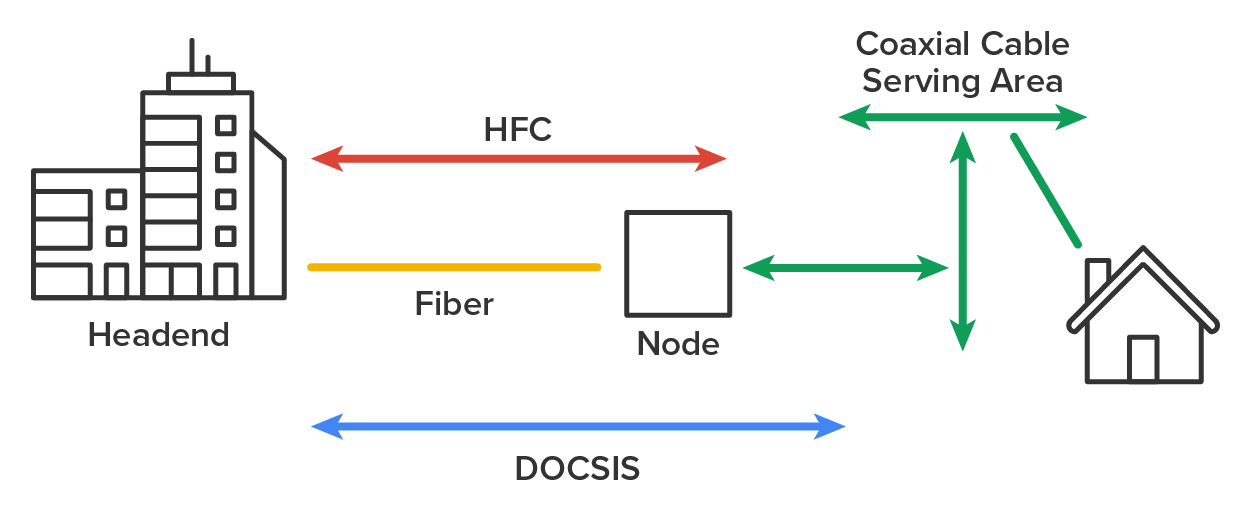
ISPs often use a fiber-optic network that extends from the cable operator’s master headend, sometimes even to regional headends, out to a neighborhood’s hubsite and finally to a fiber-optic node that services anywhere from 25 to 2,000 or more homes.
Cable Internet is usually more available and less expensive than xDSL and remains a popular choice for providing Internet access to homes and businesses.
-
Cable networks provide Internet connectivity over a coaxial cable from a cable television company.
-
- Cable Internet
- A form of high-speed connection that uses cable television infrastructure to provide Internet access to end users.
- Headend
- A cable TV control center, at which terrestrial and satellite signals are received, monitored and injected into the cable network.
- Hybrid Fiber-Coaxial (HFC)
- A telecommunications industry term for a broadband network that combines optical fiber and coaxial cable.
- Data Over Cable Service Interface Specifications (DOCSIS)
- A specification that provides the interface requirements for a data-over-cable system.
3. Wireless WAN Technologies
A number of new technologies provide Internet access, and even multimedia performance, without a landline. The following are some of the cellular WAN technologies that demonstrate how far we have really come in WAN technologies.
3a. Cellular WAN
Cellular technologies have evolved since their introduction in the late 1970s. Terms like 1G (first generation) 2G, 3G, 4G, and 5G are often used to describe significant advances in the technology. This section provides a quick overview of the major developments, and looks closely at a couple of the newer technologies, specifically what these technologies bring to the table and what they may promise for the future.
- First-generation cellular (1G) was a voice-only analog network. The second generation (2G) marked the switch to digital, which allowed voice and, for the first time, simple data, such as a text message.
- GSM, or Global System for Mobile Communications, is a standard developed by the European Telecommunications Standards Institute (ETSI). It delineates protocols for 2G digital cellular networks, which are used by mobile phones, and it is the default global standard for mobile communications and enjoys over 90 percent market share. 2G is available in over 219 countries and territories worldwide. The GSM standard was created to replace first-generation (1G) analog cellular networks and originally described a digital, circuit-switched network optimized for full-duplex voice telephony. It evolved to include data communications, at first via circuit-switched transport, then through packet data transport via General Packet Radio Services (GPRS) and EDGE, alternately via Enhanced Data Rates for GSM Evolution (EGPRS).
- Third generation (3G) refers to the third generation of cellular technology that enables mobile telephony. The third-generation standard follows two earlier generations that were deployed on mobile networks and across mobile phones.
- Fourth generation (4G) allows high-speed voice and data, even Internet. This is the type of network supporting most of today's smartphones.
- 5G is the fifth-generation technology standard for broadband cellular networks, which cellular service providers started to deploy worldwide in 2019. 5G is much faster than 4G, and supports speeds up to 20 Gbps for data transfer.
- Finally, Code division multiple access (CDMA) a channel access method is used by various radio communication technologies. CDMA offers multiple access, where several transmitters can send information simultaneously over a single communication channel, allowing several users to share a band of frequencies. To make this work without a bunch of interference between users, CDMA relies upon spread-spectrum technology and a special coding scheme in which each transmitter is assigned a unique code.
-
- Cellular
- A mobile telephone system.
- Global System for Mobile Communications (GSM)
- A standard developed by the European Telecommunications Standards Institute (ETSI) to describe the protocols for second-generation (2G) digital cellular networks used by mobile devices such as mobile phones and tablets.
- Code Division Multiple Access (CDMA)
- A channel access method used by various radio communication technologies.
3b. WiMAX
World Wide Interoperability for Microwave Access (WiMAX) is considered a true 4G technology, and it’s based on the IEEE 802.16 standard.
-
Today, WiMAX is generally used outside of the United States, which has largely moved to 5G cellular deployments. WiMAX supports both fixed, tower-to-tower applications and mobile applications. It was originally designed as a last-mile technology to deliver Internet to areas where implementing landlines wasn’t possible as an alternative to DSL and cable.
WiMAX is not compatible with 2G and 3G technologies, and it is expensive and requires lots of power. It also lags behind LTE in speed, with downlink speeds of 5 Mbps to 6 Mbps and uplink speeds of 2 Mbps to 3 Mbps.
-
- World Wide Interoperability for Microwave Access (WiMAX)
- A family of wireless broadband communication standards based on the IEEE 802.16 set of standards, which provide physical layer (PHY) and media access control (MAC) options.
3c. LTE
Finally, Long Term Evolution (LTE) is an example of these technologies, uses an all-IP-based core, offers high data rates, and it is compatible with 3G and WiMAX. And it happens to have good indoor coverage while maintaining high data rates all the way to the edge of a coverage cell. LTE also accommodates more devices in a given area and maintains data rates of 7 Mbps to 12 Mbps on the downlink and 3 Mbps to 5 Mbps on the uplink. In the United States, some cellular providers have begun to shut down LTE services in favor of 5G technologies.
-
Cellular telephone networks provide Internet connectivity to smartphone and other wireless devices via RF transmissions.
-
- Long Term Evolution (LTE)
- A standard for wireless broadband communication for mobile devices and data terminals.
In this lesson, you learned about broadband and wireless WAN technologies. We discussed popular xDSL technologies, including HDSL , SDSL, VDSL, and ADSL. We also introduced Cable Internet and its components, including the headend, distribution network, and DOCSIS protocol. Finally, we covered wireless WAN technologies, including cellular networks, WiMAX, and LTE.



