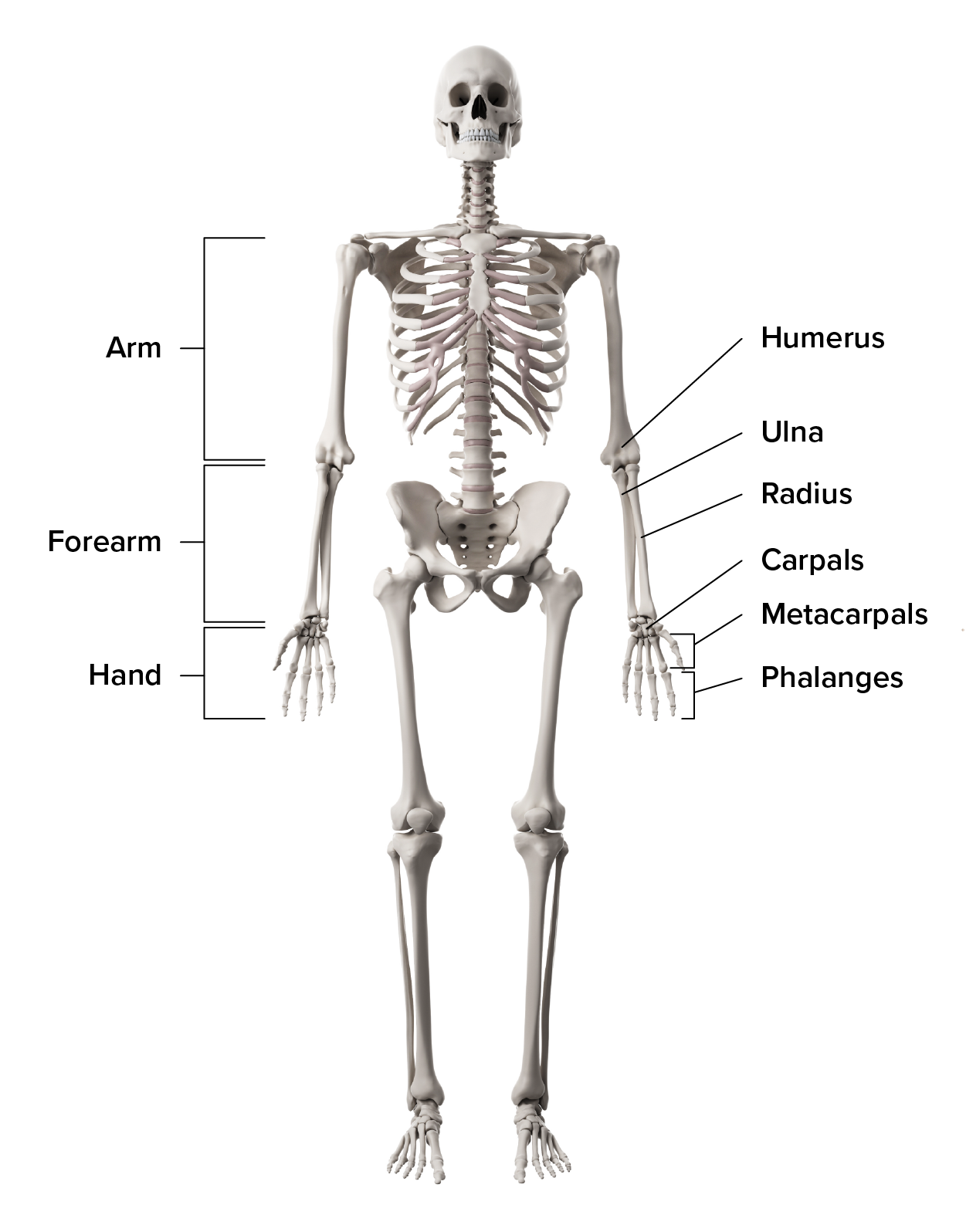
While you may be used to referring to your entire upper limb as your ‘arm,’ in anatomy, the arm is the region between the shoulder and elbow joints. The forearm (fore, in front of) is the region between the elbow and wrist joints. The hand is the region beyond the wrist.
There are 30 bones in each upper limb. The humerus is the single bone of the arm, and the ulna (medially) and the radius (laterally) are the paired bones of the forearm. The base of the hand contains eight bones, each called a carpal bone, and the palm of the hand is formed by five bones, each called a metacarpal bone. The fingers and thumb contain a total of 14 bones, each of which is a phalanx bone of the hand.
The Upper Limb - The upper limb is divided into the arm, forearm, and is composed of 30 bones.
learn more
To see additional bones and landmarks in this area, please visit the supplemental Appendicular Bones.pdf.
terms to know
Arm
The region of the upper limb from the shoulder to the elbow.
Forearm
The region of the upper limb from the elbow to the wrist.
Hand
The region of the upper limb beyond the wrist.
2. Humerus
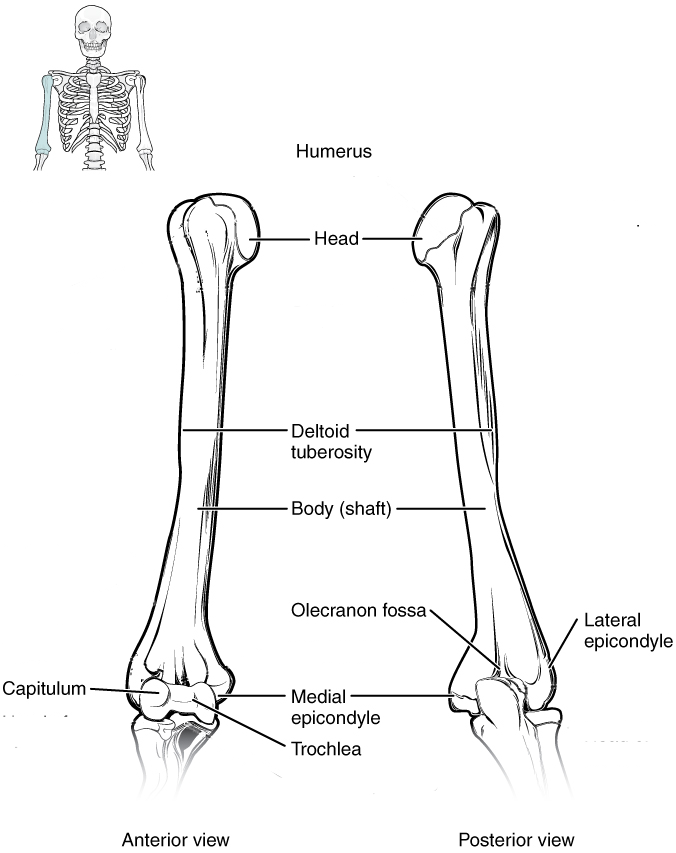
The humerus is the single long bone of the arm region. The rounded proximal end forms a joint with the scapula while the flattened distal end forms two joints—one with the ulna and one with the radius.
The head of the humerus is the large, round, smooth region at the proximal end of the bone that projects medially. The head articulates with the glenoid cavity of the scapula to form the glenohumeral (shoulder) joint.
The deltoid tuberosity is a roughened, V-shaped region located on the lateral side in the middle of the humerus shaft. As its name indicates, it is the site of attachment for the deltoid muscle.
The diaphysis of this bone is called the shaft of the humerus.
The epicondyles form two prominent bony projections of the flattened distal end of the humerus which serve as attachment points for muscles of the forearm, wrist, and hand. The medial epicondyle projects medially while the smaller lateral epicondyle projects laterally. These projections can be palpated as the widest bony point just proximal to the elbow.
The trochlea is the smooth, medial, pulley-shaped region (trochlea, pulley) of the distal humerus which forms a joint with the ulna of the forearm.
The capitulum is a smooth knob-like structure just lateral to the trochlea which forms a joint with the radius of the forearm.
The olecranon fossa is a large depression on the posterior side of the distal humerus just proximal to the trochlea that receives the olecranon process of the ulna when the forearm is fully extended.
Humerus and Elbow Joint - The humerus is the single bone of the upper arm region. It articulates with the radius and ulna bones of the forearm to form the elbow joint.
try it
Directions: Find the epicondyles of your humerus.
1. Place one hand on the arm of the opposite upper limb. Along the middle region of the bone is the shaft of the humerus.
2. If you run your arm down the arm towards the elbow, you will feel that the distal humerus expands. The widest point along the humerus can be felt by two prominent bony projections. On the inner (medial) side is the medial epicondyle of the humerus while on the outer (lateral) side is the lateral epicondyle.
The humerus is also commonly referred to as the funny bone. If you hit the distal end of the humerus on a table, wall, or another hard surface, it creates a pain signal which may be humorous (funny) to onlookers but is certainly not that funny for you.
terms to know
Humerus
The long bone of the arm region of the upper limb.
Head of the Humerus
The round, smooth region at the proximal end of the humerus.
Deltoid Tuberosity
The roughened, V-shaped region located on the lateral side in the middle of the humerus shaft.
Shaft of the Humerus
The diaphysis of the humerus.
Medial Epicondyle of the Humerus
The prominent bony projection on the medial side of the distal humerus.
Lateral Epicondyle of the Humerus
The prominent bony projection on the lateral side of the distal humerus.
Trochlea
The medial, pulley-shaped region of the distal humerus which forms a joint with the ulna.
Capitulum
The smooth knob-like structure of the distal humerus just lateral to the trochlea which forms a joint with the radius.
Olecranon Fossa
The large depression on the posterior side of the distal humerus just proximal to the trochlea.
3. Ulna
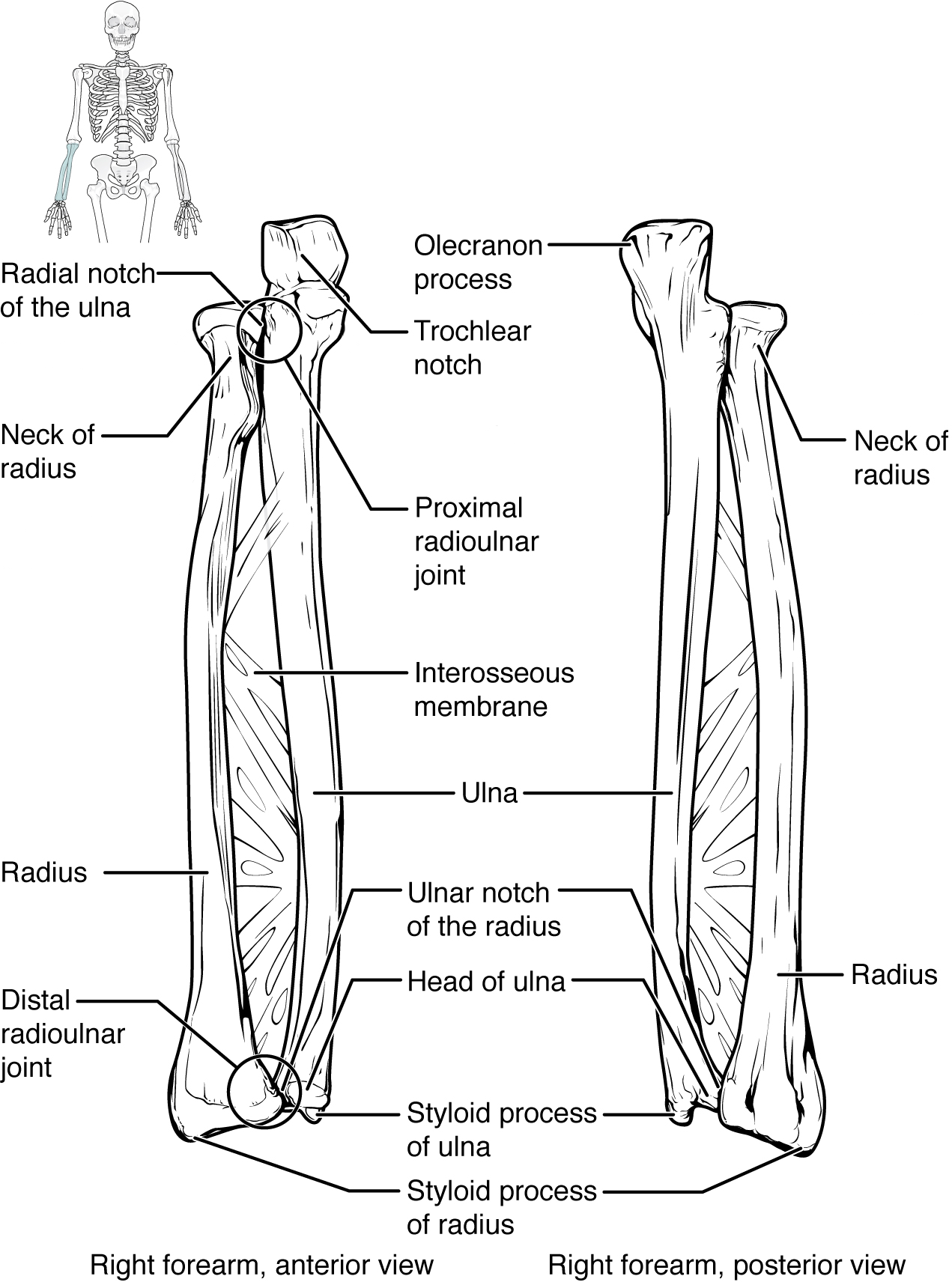
The ulna is the medial bone (pinky side) of the forearm. It runs parallel to the radius, which is the lateral bone (thumb side) of the forearm. The proximal end of the ulna is C-shaped and forms a joint with the humerus. The distal end is more pointed and forms a joint with the carpal bones. Along the shaft, it forms two joints with the radius.
The proximal end of the ulna forms a large, C-shaped trochlear notch. This depression forms part of the humeroulnar joint, or elbow joint, with the trochlea of the humerus. The superior margin of the trochlear notch is called the olecranon process and fits into the olecranon fossa of the humerus when the elbow is extended. This forms the bony top of the elbow.
The radial notch is a small, smooth area on the lateral side of the proximal ulna. This area forms a joint with the radius called the proximal radioulnar joint.
The diaphysis of the ulna is called the shaft of the ulna.
The head of the ulna is the rounded area at the distal end of the bone.
The styloid process of the ulna is a short projection from the posterior side of the head. This serves as an attachment site for ligaments between the ulna and radius. The styloid process gets its name from the word ‘stylus’ which means an instrument for writing. Because of this, it is common to see pens made using the shape of the ulna.
Ulna and Radius - The ulna is located on the medial side of the forearm, and the radius is on the lateral side. These bones are attached to each other by an interosseous membrane
did you know
In the anatomical position, with the elbow fully extended and the palms facing forward, the arm and forearm do not form a straight line. Instead, the forearm deviates laterally by 5–15 degrees from the line of the arm. This deviation is called the carrying angle. It allows the forearm and hand to swing freely or to carry an object without hitting the hip. The carrying angle is larger in females to accommodate their wider pelvis.
terms to know
Ulna
The medial bone of the forearm.
Radius
The lateral bone of the forearm.
Trochlear Notch
The large C-shaped depression on the proximal end of the ulna.
Humeroulnar Joint
A joint formed by the humerus and ulna; elbow joint.
Olecranon Process
The superior margin of the trochlear notch.
Radial Notch
A small, smooth area on the lateral side of the proximal ulna which forms a joint with the radius.
Proximal Radioulnar Joint
A joint formed by the proximal ends of the radius and ulna.
Shaft of the Ulna
The diaphysis of the ulna.
Head of the Ulna
The rounded distal end of the ulna.
Styloid Process of the Ulna
A short projection from the posterior side of the head of the ulna.
4. Radius
The radius runs parallel to the ulna on the lateral (thumb) side of the forearm. The disc-shaped proximal end of the bone forms a joint with the humerus. The pointed distal end of the radius forms a joint with the carpal bones. Along the shaft, it forms two joints with the ulna.
The head of the radius is a disc-shaped structure that forms the proximal end of the bone. The small depression on the surface of the head articulates with the capitulum of the humerus to form the humeroradial joint, an associated part of the elbow joint. Additionally, the smooth, outer margin of the head articulates with the radial notch of the ulna to participate in the proximal radioulnar joint.
The diaphysis of the radius is the shaft of the radius.
The ulnar notch is a shallow depression on the medial side of the distal radius which forms the distal radioulnar joint with the ulna.
The styloid process of the radius is a pointed projection on the lateral side of the distal radius. Similarly, to the styloid process of the ulna, this landmark provides attachment for ligaments that support the wrist.
terms to know
Head of the Radius
A disc-shaped structure that forms the proximal end of the bone.
Humeroradial Joint
A joint formed between the humerus and the radius.
Shaft of the Radius
The diaphysis of the radius.
Ulnar Notch
A shallow depression on the medial side of the distal radius which forms a joint with the ulna.
Distal Radioulnar Joint
A joint formed between the distal ends of the radius and ulna.
Styloid Process of the Radius
A short projection from the lateral side of the distal end of the radius.
5. Carpal Bones
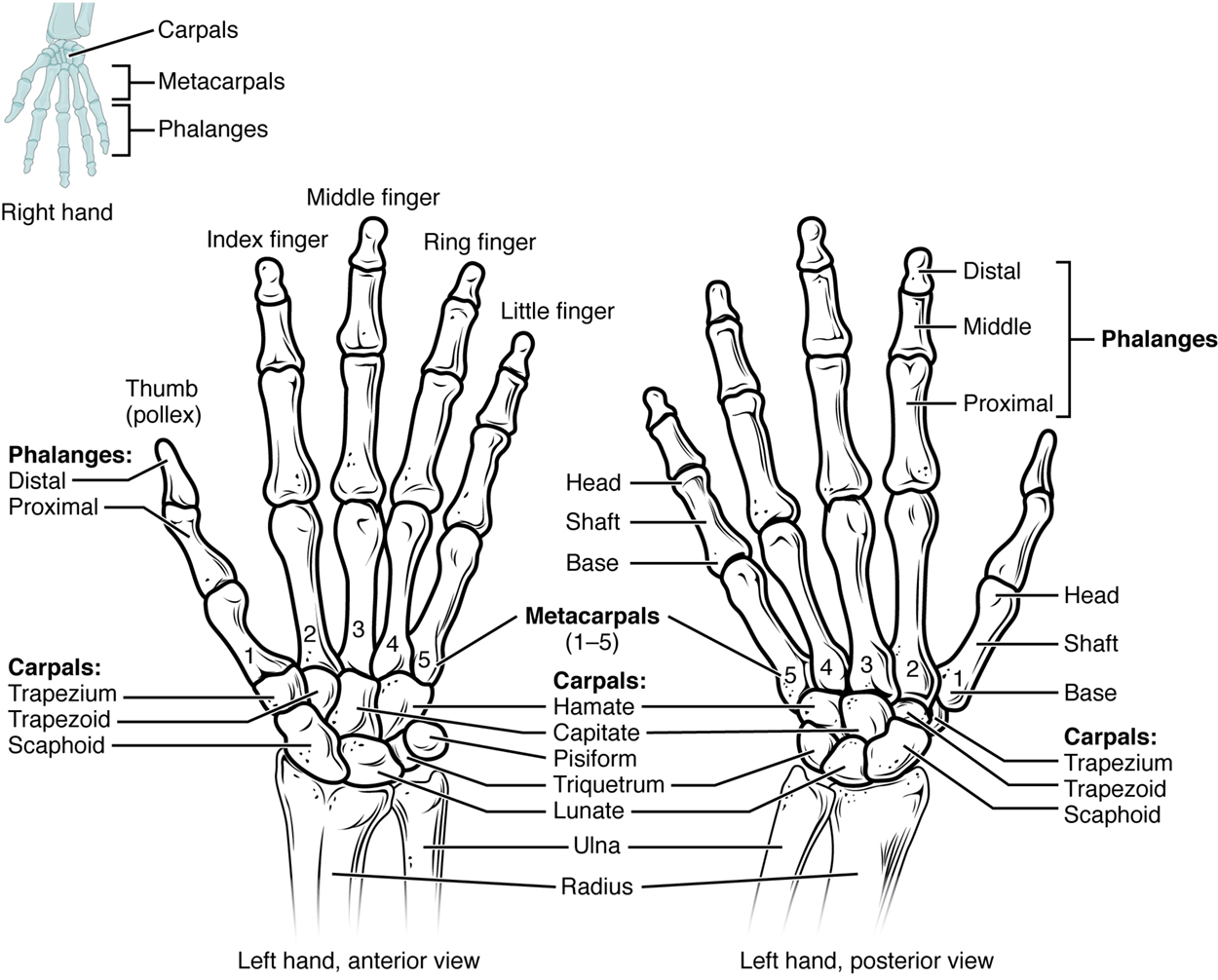
The wrist and base of the hand are formed by a series of eight short bones called the carpal bones. The carpal bones are arranged in two rows, forming a proximal row of four carpal bones and a distal row of four carpal bones. The bones in the proximal row, running from the lateral (thumb) side to the medial (pinky) side, are the scaphoid (“boat-shaped”), lunate (“moon-shaped”), triquetrum (“three-cornered”), and pisiform (“pea-shaped”) bones. The small, rounded pisiform bone articulates with the anterior surface of the triquetrum bone. The pisiform thus projects anteriorly, where it forms the bony bump that can be felt at the medial base of your hand. The distal bones (lateral to medial) are the trapezium (“table”), trapezoid (“resembles a table”), capitate (“head-shaped”), and hamate (“hooked bone”) bones. The hamate bone is characterized by a prominent bony extension on its anterior side called the hook of the hamate bone.
hint
There is a mnemonic for remembering the arrangement of the carpal bones that may be helpful.
“So Long To Pinky, Here Comes The Thumb”
This mnemonic starts on the lateral side and names the proximal bones from lateral to medial (scaphoid, lunate, triquetrum, pisiform), then makes a U-turn to name the distal bones from medial to lateral (hamate, capitate, trapezoid, trapezium). Thus, it starts and finishes on the lateral side.
Bones of the Wrist and Hand - The eight carpal bones form the base of the hand. These are arranged into proximal and distal rows of four bones each. The metacarpal bones form the palm of the hand. The thumb and fingers consist of the phalanx bones.
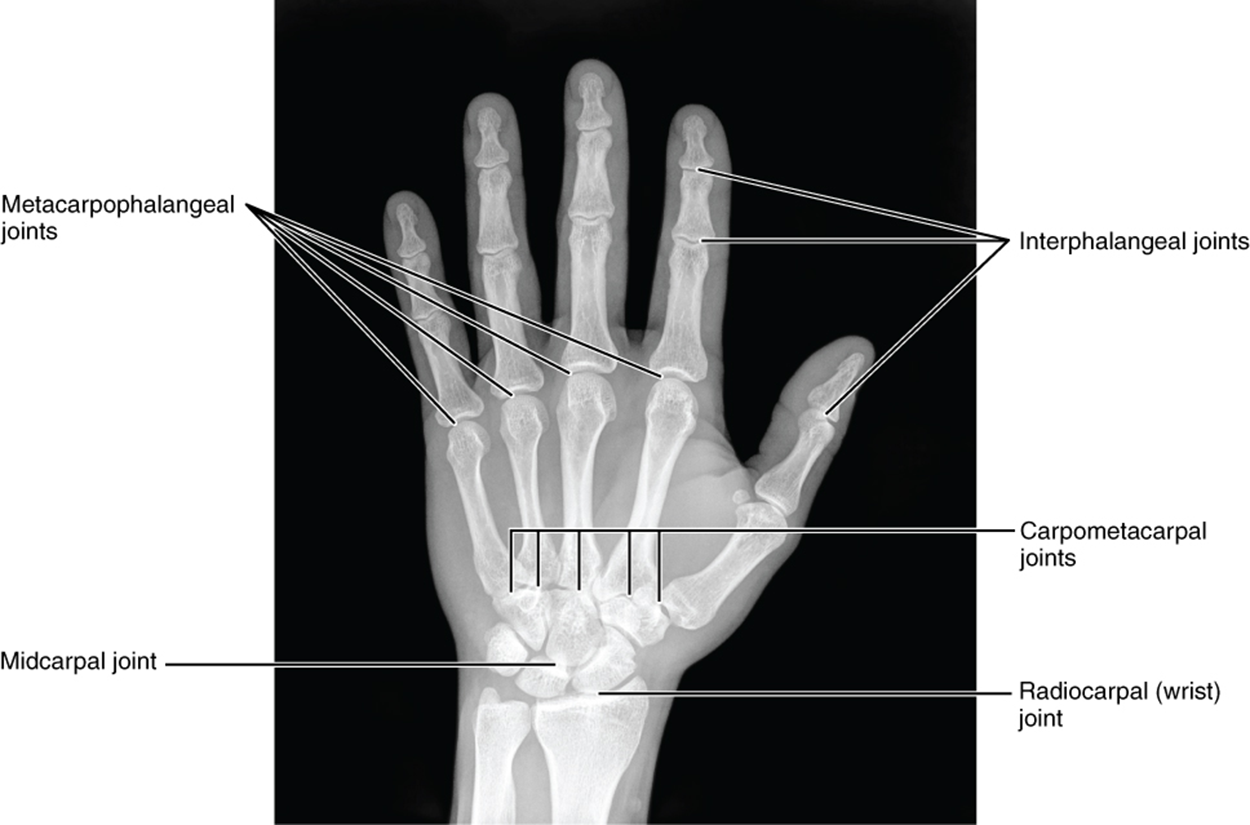
The carpal bones form the base of the hand. This can be seen in the radiograph (X-ray image) of the hand. These bones form several joints. The radiocarpal joint is formed between the radius and three of the four proximal carpal bones—the scaphoid, lunate, and triquetrum. The ulna does not directly articulate with the carpal bones. However, through a fibrocartilaginous pad, the ulnocarpal joint is formed between the ulna and two of the four proximal carpal bones—lunate and triquetrum.
The proximal and distal rows of carpal bones articulate with each other to form the midcarpal joint. Together, the radiocarpal and midcarpal joints are responsible for all movements of the hand at the wrist. The distal carpal bones also articulate with the metacarpal bones of the hand.
Bones of the Hand - This radiograph shows the position of the bones within the hand. Note the carpal bones that form the base of the hand. Credit: modification of work by Trace Meek
watch
View the following video for more information on this topic.
IN CONTEXT Disorders of the Appendicular System: Carpal Tunnel Syndrome
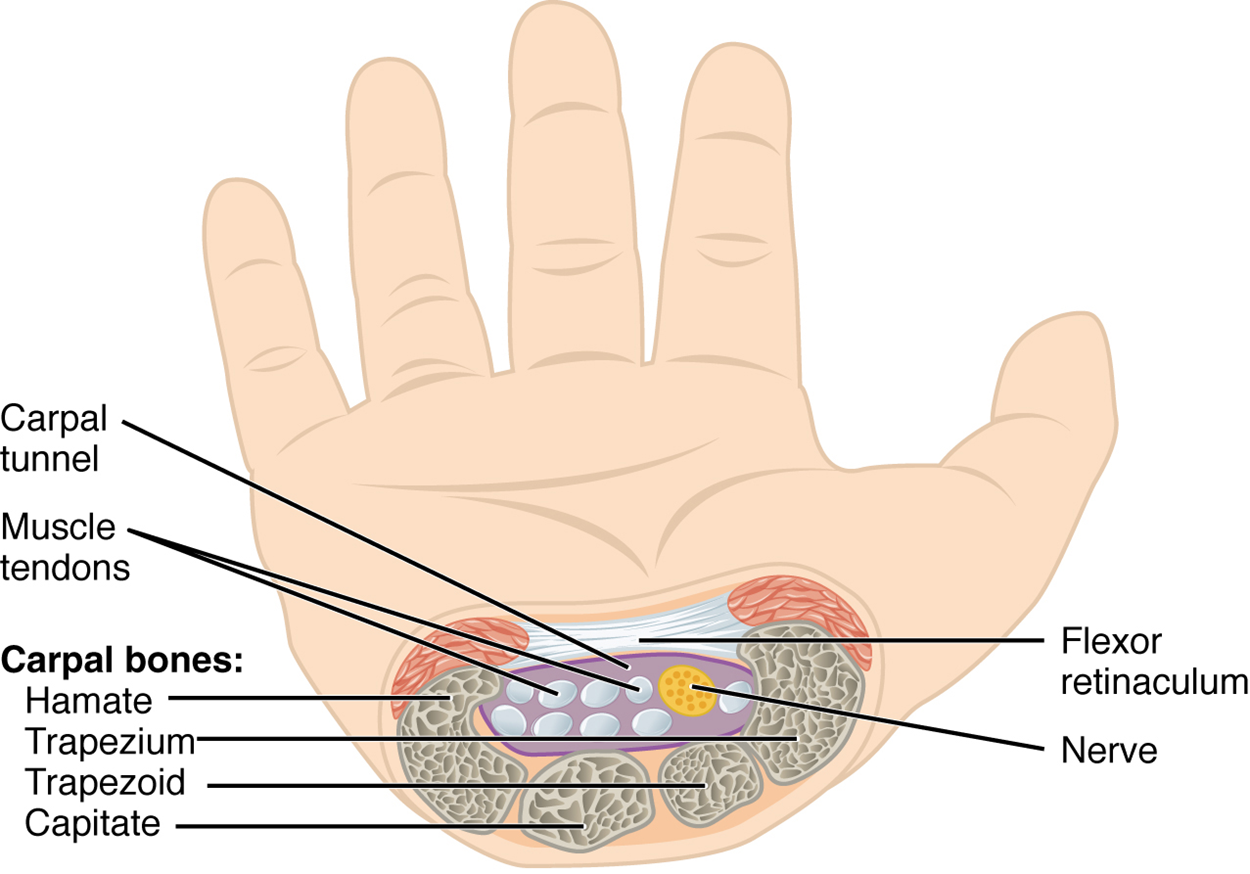
In the articulated hand, the carpal bones form a U-shaped grouping. A strong ligament called the flexor retinaculum spans the top of this U-shaped area to maintain this grouping of the carpal bones. The flexor retinaculum is attached laterally to the trapezium and scaphoid bones and medially to the hamate and pisiform bones. Together, the carpal bones and the flexor retinaculum form a passageway called the carpal tunnel, with the carpal bones forming the walls and floor, and the flexor retinaculum forming the roof of this space. The tendons of nine muscles of the anterior forearm and an important nerve pass through this narrow tunnel to enter the hand. Overuse of the muscle tendons or wrist injury can produce inflammation and swelling within this space. This produces compression of the nerve, resulting in carpal tunnel syndrome, which is characterized by pain or numbness and muscle weakness in those areas of the hand supplied by this nerve. Carpal Tunnel - The carpal tunnel is the passageway by which nine muscle tendons and a major nerve enter the hand from the anterior forearm. The walls and floor of the carpal tunnel are formed by the U-shaped grouping of the carpal bones, and the roof is formed by the flexor retinaculum, a strong ligament that anteriorly unites the bones.
terms to know
Carpal Bone
A short bone of the wrist.
Scaphoid
A proximal carpal bone, first of four from the lateral side.
Lunate
A proximal carpal bone, second of four from the lateral side.
Triquetrum
A proximal carpal bone, third of four from the lateral side.
Pisiform
A proximal carpal bone, fourth of four from the lateral side.
Trapezium
A distal carpal bone, first of four from the lateral side.
Trapezoid
A distal carpal bone, second of four from the lateral side.
Capitate
A distal carpal bone, third of four from the lateral side.
Hamate
A distal carpal bone, fourth of four from the lateral side.
6. Metacarpal Bones
The palm of the hand contains five elongated metacarpal bones. These bones lie distal to the carpal bones of the wrist (meta, after) and proximal to the bones of the fingers and thumb. The proximal end of each metacarpal bone articulates with one of the distal carpal bones. Each of these articulations is a carpometacarpal joint. The expanded distal end of each metacarpal bone articulates at the metacarpophalangeal joint with the proximal phalanx bone of the fingers. The distal end also forms the knuckles of the hand, at the base of the fingers. The metacarpal bones are numbered 1–5, beginning on the lateral (thumb) side.
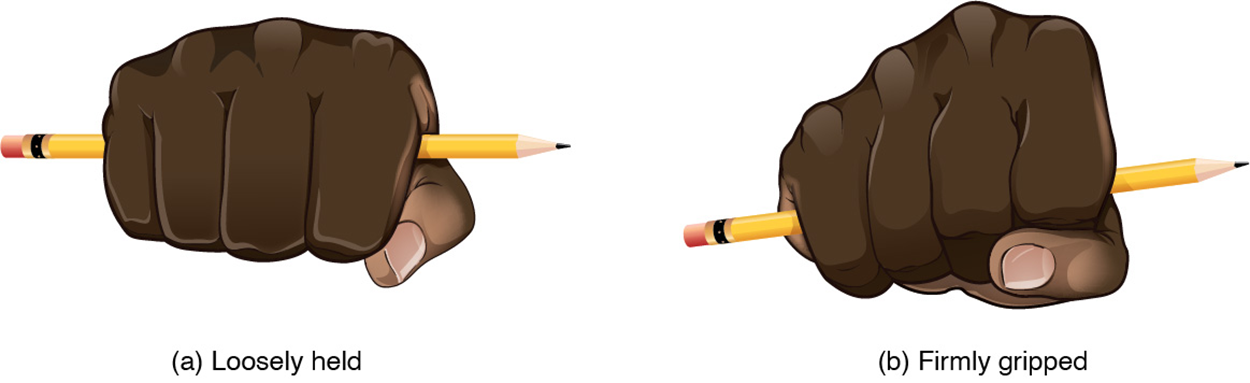
The first metacarpal bone, at the base of the thumb, is separated from the other metacarpal bones. This allows it freedom of motion that is independent of the other metacarpal bones, which is very important for thumb mobility. The remaining metacarpal bones are united together to form the palm of the hand. The second and third metacarpal bones are firmly anchored in place and are immobile. However, the fourth and fifth metacarpal bones have limited anterior-posterior mobility, a motion that is greater for the fifth bone. This mobility is important during power gripping with the hand. The anterior movement of these bones, particularly the fifth metacarpal bone, increases the strength of contact for the medial hand during gripping actions.
Hand During Gripping - During tight gripping—compare (b) to (a)—the fourth and, particularly, the fifth metatarsal bones are pulled anteriorly. This increases the contact between the object and the medial side of the hand, thus improving the firmness of the grip.
terms to know
Metacarpal Bone
A long bone located in the palm of the hand.
Carpometacarpal Joint
A joint formed between carpal and metacarpal bones.
Metacarpophalangeal Joint
A joint formed between metacarpal bones and proximal phalanges.
7. Phalanges
The digits of the hand (fingers) are numbered the same as the metacarpal bones, lateral (thumb) side to medial (pinky) side. Each bone that makes up a part of a digit is called a phalanx bone (plural, phalanges). This seemingly odd name comes from the Greek phalanx meaning ‘a rectangular block of soldier.’ Recall that the term ‘digits’ also refers to the toes. Therefore, you will see that the bones of the fingers and toes both share the same name.
Each digit contains multiple phalanges, which are named based on their numerical digit and the distance from the palm—proximal, middle, or distal. The thumb is digit number 1 and has two phalanges, a proximal phalanx, and a distal phalanx bone. Digits 2 (index finger) through 5 (little finger) have three phalanges each, called the proximal, middle, and distal phalanx bones. An interphalangeal joint is one of the articulations between adjacent phalanges of the digits.
terms to know
Phalanx Bone (fingers and toes)
The bones of the digits (plural phalanges).
Interphalangeal Joint
A joint between two adjacent phalanges.
summary
In this lesson, you learned the bones that make up the upper limb. You learned the functions and select landmarks of the humerus, ulna, radius, carpal bones, metacarpal bones, and phalanges as well as their connections to one another and the appendicular skeleton.