Use Sophia to knock out your gen-ed requirements quickly and affordably. Learn more
×

Bone Anatomy and Common Terms

Author: Sophia

what's covered
In this lesson, you will learn about bone structure and function. First, you will learn about the different parts of bones in an overview of bone structure and function. This will help you learn useful word parts and important bone terminology. Next, you will learn about bone growth and development. Finally, you will learn more about how bones are classified. This will prepare you for a more in depth discussion of bone conditions and procedures. Specifically, this lesson will cover:

Table of Contents

1. Introduction to Bones

Recall that bone (osseous) tissue is a rigid connective tissue that provides protection to internal organs and supports the body. Osseous tissue forms most of the adult skeleton, the support structure of the body. In the areas of the skeleton where bones move (i.e., the ribcage and joints), cartilage, a semi-rigid form of connective tissue, provides flexibility and smooth surfaces for movement. Recall that the skeletal system is the organ system composed of bones and cartilage that performs the following critical functions for the human body:
  • Supports the body.
  • Facilitates movement.
  • Protects internal organs.
  • Produces blood cells.
  • Stores and releases minerals and fat.
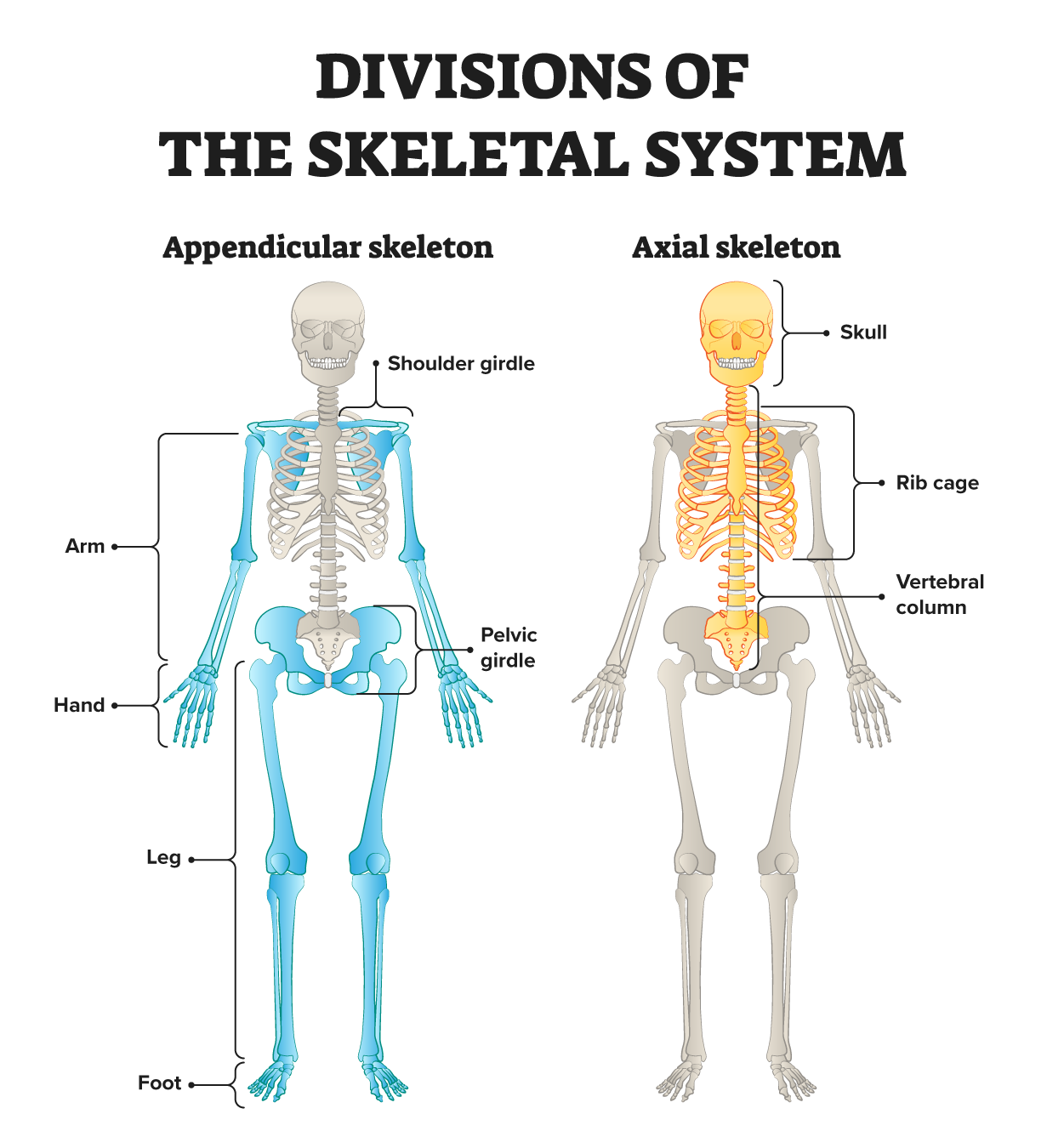
The illustration below shows the skeletal system.

Illustration of the human skeletal system showing bones. Two skeletons are shown with different regions highlighted. The appendicular skeleton includes the shoulder girdle, arms, hands, pelvic girdle, legs, and feet. The axial skeleton includes the skull, rib cage, and vertebral column.

The table below shows some especially important combining forms related to the skeletal system:

Term Definition Example Definition of Example
Arthr/o Pertaining to a joint or joints Arthropathy Joint disease
Chondr/o Pertaining to cartilage Chondrocyte Cartilage cell
Myel/o Pertaining to bone marrow Myelofibrosis A type of bone cancer that results in restructuring of bone
Oste/o Pertaining to bone Osteogenesis Bone formation

Important medical terminology related to bones includes:

  • Osteomalacia refers to the softening of bone.
  • Osteomyelitis refers to the inflammation of bone and bone marrow.
  • Osteonecrosis refers to bone death due to lack of adequate blood supply.
  • Osteosarcoma refers to a malignant tumor of bone.
  • Osteopenia refers to abnormal reduction of bone mass.
  • Osteoporosis refers to a medical condition in which bones become weak, brittle, and prone to fractures.
try it
Let’s try an example. There is a disorder called osteogenesis imperfecta.  
Based on your knowledge of word parts, what do you think osteogenesis imperfecta means?
Osteogenesis means bone formation (oste/o and –genesis). Imperfecta means imperfect. So the word parts suggest that this is a disorder in which bone is formed incorrectly. There are different types of osteogenesis imperfecta, but all of them involve problems with collagen in bone and result in unusually brittle bones that break too easily (Cleveland Clinic, 2024).

Some combining forms relate to particular bones. Examples of these are shown in the table below.

Term Bone Referenced
Calcane/o Calcaneus (heel bone)
Clavicul/o Clavicle
Ili/o Ilium (pelvic bone)
Ischi/o Ischium (pelvic bone)
Metacarp/o Metacarpal or metacarpals (hand bones)
Metatars/o Metatarsal or metatarsals (foot bones)
Pelv/o Pelvic bone
Phalang/o One or more bones of the fingers and toes (phalanges)
Spondyl/o Vertebra or vertebrae
Vertebr/o Vertebra or vertebrae

try it
Let’s try a couple of examples.
Based on your knowledge of word parts, what do you think spondylitis means?
Spondylitis means inflammation of the vertebrae (spondyl/o refers to vertebrae, and –itis means inflammation).
Based on your knowledge of word parts, what do you think vertebroplasty means?
Vertebroplasty means surgical repair of the vertebral column (vertebr/o refers to vertebrae, and –plasty means surgical repair).

There are also many general terms that relate to the skeletal system but are often used to describe other systems as well. The terms below are examples of these types of terms.

Term Bone referenced
Brachi/o Pertaining to the arm
Cephal/o Pertaining to the head
Dactyl/o Pertaining to the digits (fingers or toes)
Pod/o Pertaining to the foot
Pub/o Pertaining to the pubic area or pubic bones

For example, pod/o can be used to form the word podiatrist (pod/o = foot + -ist, a suffix used to describe a certain type of practitioner, such as a pharmacist). A podiatrist is a specialist in foot conditions and has a doctorate in podiatric medicine (DPM). A podiatrist treats all sorts of foot conditions, including those involving the skeletal system.

try it
Let’s try an example. Some monkeys move through brachiation.  
What do you think it means to use moving brachiation?
Brachiation is movement using the arms. When monkeys swing from tree to tree using their arms, that is brachiation.

The picture below shows examples of cephalopods. The picture on the upper left shows an octopus, which is a type of cephalopod. Look at the octopus’s anatomy and think about how the name cephalopod describes it. Can you see the same pattern in the other cephalopods?
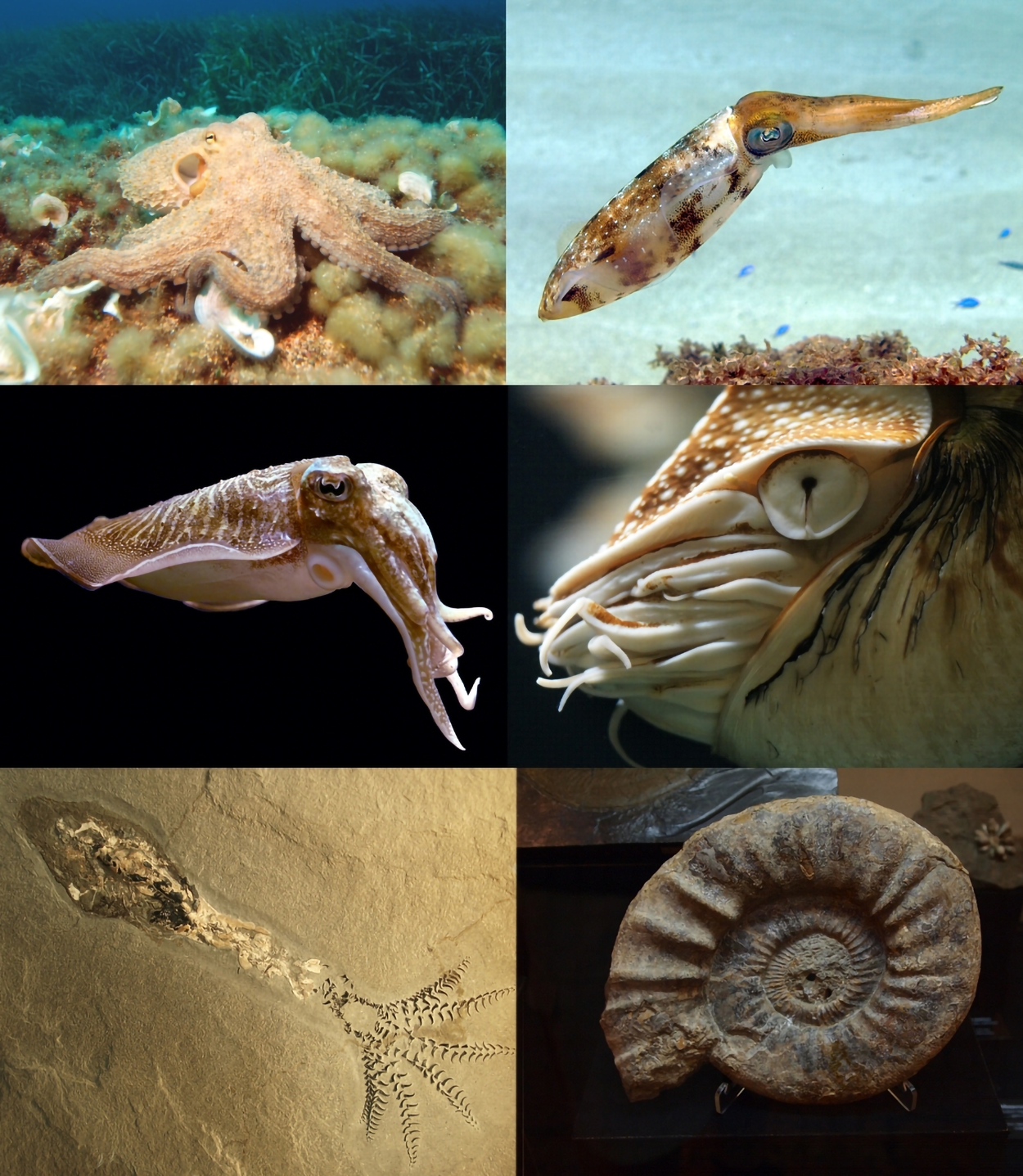
A diverse array of cephalopods is shown, including an octopus in the upper left corner with its characteristic rounded body and tentacles. It highlighting their distinct anatomical features, such as their prominent heads and tentacles, which justify the name


2. Bone Structure and Terminology

Although you will be focusing on medical terms related to bones, it is important to have a basic understanding of bone structure and function to more fully understand the medical terms.

The image below is a long bone. Long bones are useful for studying the parts of bones in general because you can see the major parts clearly. A long bone has two parts: the diaphysis and the epiphysis. The diaphysis is the tubular shaft that runs between the proximal and distal ends of the bone. The epiphysis (plural epiphyses) is the rounded end of a bone. The hollow region in the diaphysis is called the medullary cavity, which is filled with yellow marrow. The walls of the diaphysis are composed of dense and hard compact bone.

Compact bone (cortical bone) is the dense outer layer that provides strength. Spongy bone (trabecular or cancellous bone) is the porous inner layer containing marrow. It can be found under the periosteum and in the diaphyses of long bones, where it provides support and protection. It is made up of concentric rings of tissue, called osteons. Spongy bone (cancellous bone) is the porous interior region, and some spongy bone contains bone marrow. Bone marrow produces blood cells (hematopoiesis).

You can see these bone parts in the figure below. Note the articular cartilage at the ends of the bone, where it articulates with other bones.
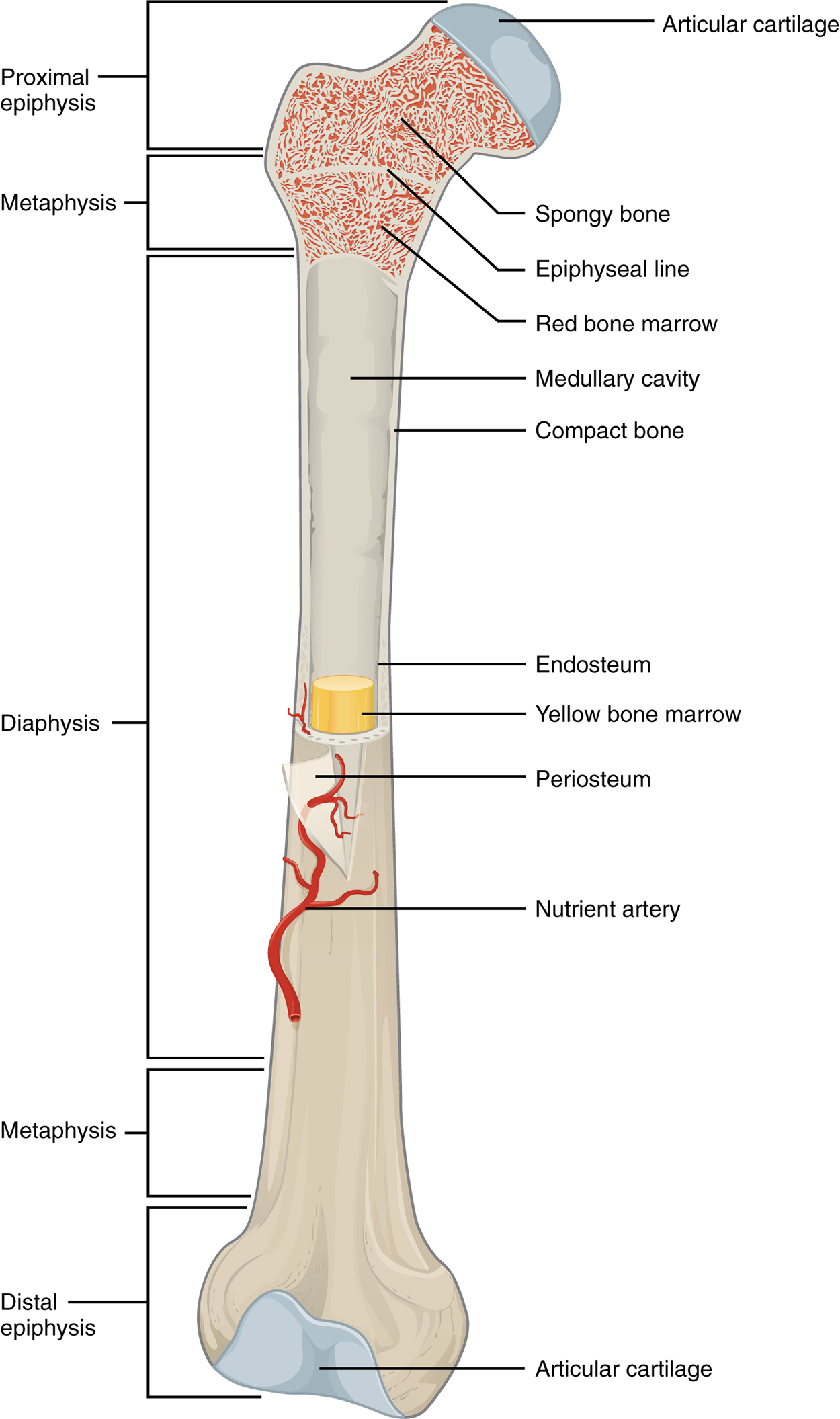
The illustration depicts a long bone, clearly showcasing its major components. It highlights the diaphysis, the tubular shaft at the center, and the epiphyses at both rounded ends. The image also labels the medullary cavity within the diaphysis, filled with yellow marrow, as well as the compact (cortical) bone forming the outer walls. The spongy (cancellous) bone is visible at the epiphyses, containing red bone marrow. Articular cartilage covers the ends where the bone articulates with other bones. Other labeled features include periosteum covering the outer surface and endosteum lining the medullary cavity.

The medullary cavity has a delicate membranous lining called the endosteum (end- = “inside”; oste/o- = “bone”), where bone growth, repair, and remodeling occur. The outer surface of the bone is covered with a fibrous membrane called the periosteum (peri- = “around” or “surrounding”). The periosteum contains blood vessels, nerves, and lymphatic vessels that nourish compact bone. The periosteum covers the entire outer surface, except where the epiphyses meet other bones to form joints. In this region, the epiphyses are covered with articular cartilage, a thin layer of cartilage that reduces friction and acts as a shock absorber.
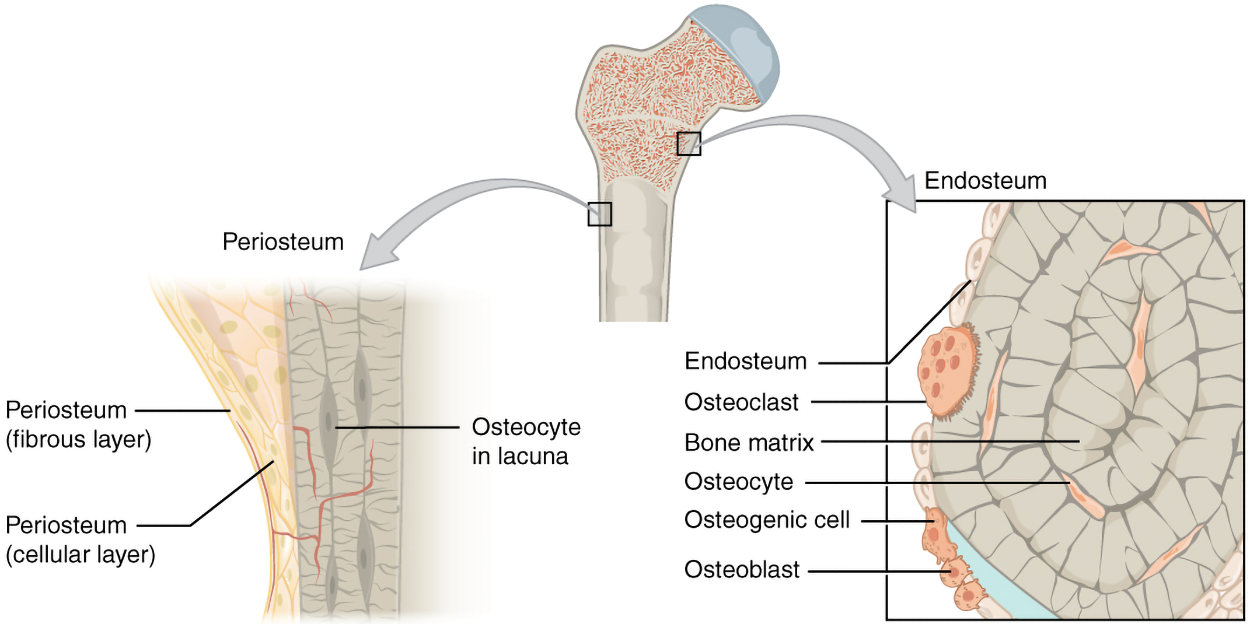
 long bone with two magnified call-outs that identify specific structures. A left-side arrow highlights the outer layer as the periosteum on the outer surface; the close-up shows that the periosteum has an outer fibrous layer and inner cellular layer. Inside the periosteum, there is a region of bone with a cell inside a fusiform opening. The cell is labeled as osteocyte in lacuna. A right-side arrow highlights a region of endosteum lining the medullary cavity near the top of the bone. The enlargement labels the endosteum itself with the medullary opening to the left and concentric rings of bone matrix to the right. There is a large, oval osteocyte along the surface of the endosteum. Lower along the endosteum, there is a specialized osteogenic cell adjacent to three osteoblasts. There is an osteocyte visible in a flattened opening between concentric layers of bone matrix with similar osteocytes visible elsewhere.

Tendons and ligaments also attach to bones at the periosteum. Both tendons and bones are types of connective tissue. Tendons connect muscles to bones, and ligaments connect bones to other bones at joints. The figure below shows examples of ligaments and tendons.
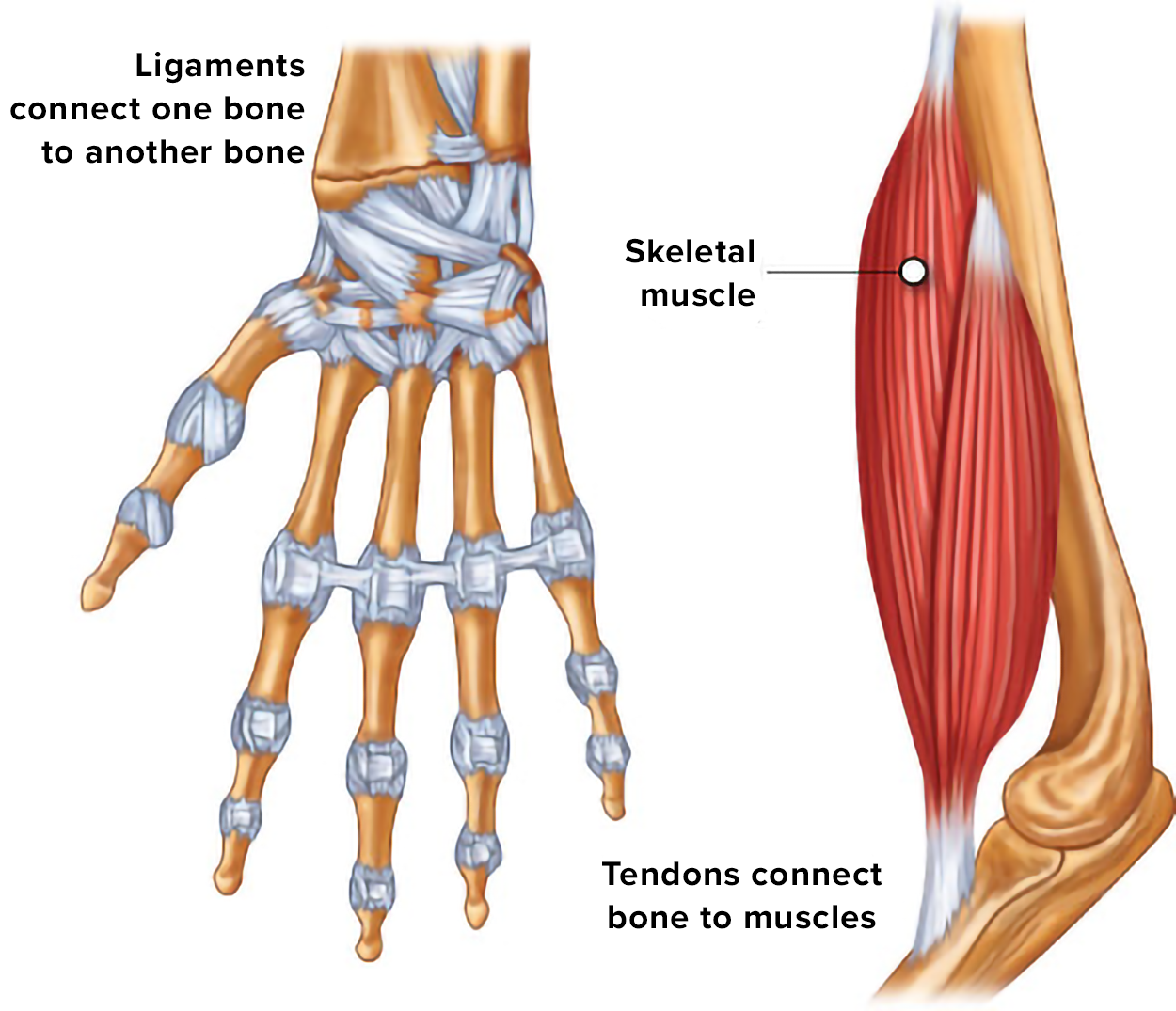
 comparison illustrating the structural differences between ligaments and tendons. Ligaments are depicted as connective tissue bands linking hand bones at joints, including the wrist and knuckles. A tendon is shown as a tough cord connecting skeletal muscle to bone. Skeletal muscle is attached directly to one bone with its other end attached to a tendon that extends down to another bone.

The figure above also shows bone cells. Look for osteoblasts, osteoclasts, and osteocytes. Osteoblasts build bone, osteoclasts break down bone, and osteocytes are mature bone cells. The table below provides more information about these cell types. Together, they work to remodel bone and regulate calcium homeostasis. When bone is broken down, calcium is released into the blood. When there is plenty of calcium in the blood, calcium can be stored in bone.
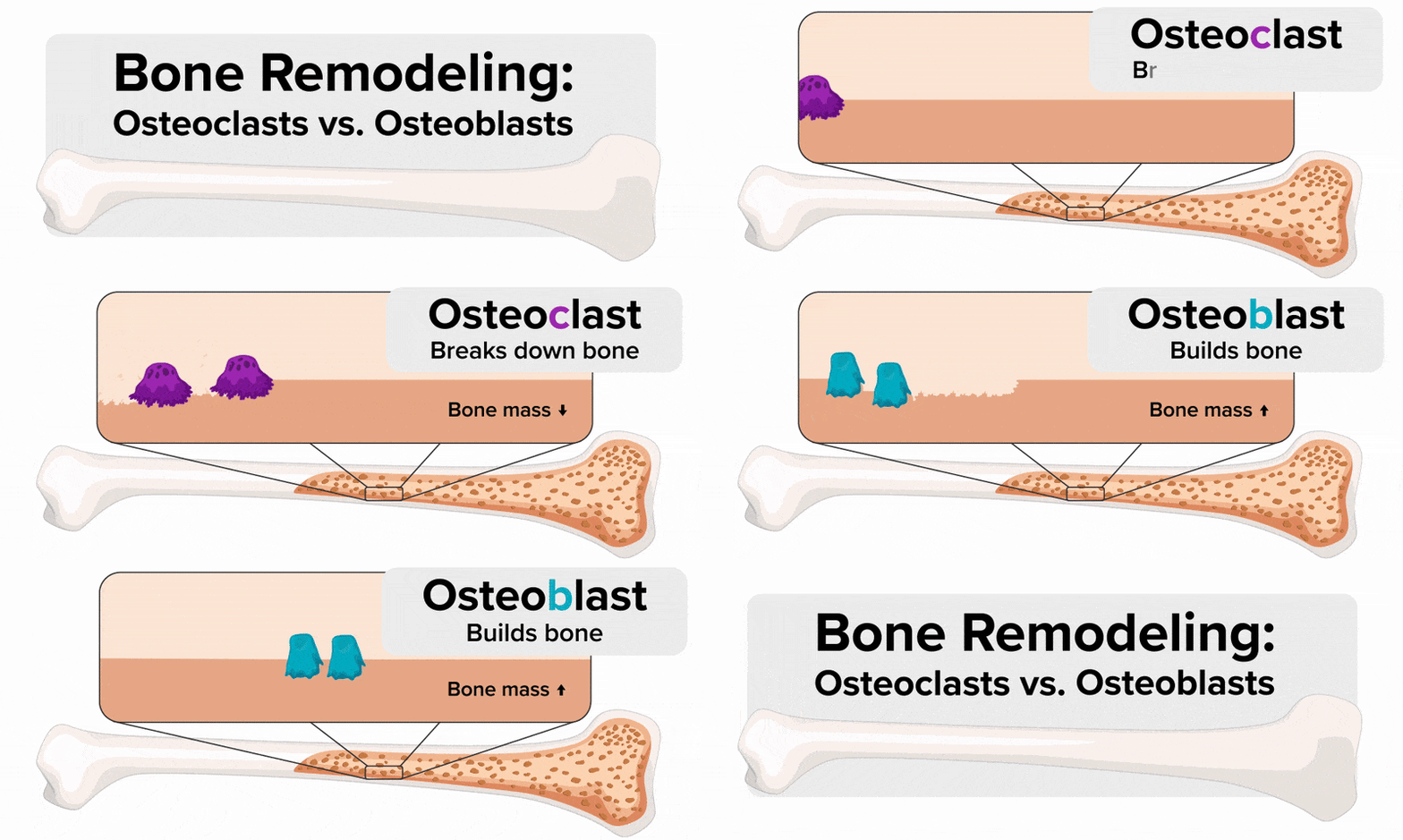
An illustration of a long bone is displayed horizontally in the center of the screen, spanning most of the screen. Above it is the text ‘Bone Remodeling: Osteoclasts vs. Osteoblasts’. Half of the bone animates as being cut away, with the label ‘Bone Matrix’ appearing, and the bone matrix depicted as a light brown center with slightly darker brown edges, with small irregular darker brown shapes throughout to depict the structure of the matrix. All text on screen fades out, and a small black rectangle outline appears in the center of the bone over some of the matrix. Four thin black lines branch off the small black rectangle outline to a larger rectangle covering most of the center of the screen. Text on screen appears in upper right corner as ‘Osteoclast – breaks down bone’. The letter ‘c’ in ‘Osteoclast’ is purple to differentiate it. In smaller letters underneath this text is the text ‘Bone mass’ with a down arrow. Inside the larger rectangle is a zoomed-in view of the bone matrix. Two purple cells move across the surface of the bone matrix, as the surface develops a jagged border and small crumb-like particles follow the cells, depicting the breaking down of bone. The purple cells fade out as well as the text inside the rectangle. New text on screen appears in upper right corner as ‘Osteoblast – builds bone’. The letter ‘b’ in ‘Osteoblast’ is blue to differentiate it. In smaller letters underneath this text is the text ‘Bone mass’ with an up arrow. Atop the jagged border of the bone matrix arrive two teal colored cells moving smoothly across the surface, and as they pass over the jagged surface, it turns to a smooth surface, depicting the building of bone. All text on screen fades out and the view zooms back out to the long bone in the center of the screen with half of it showing the bone matrix. Underneath the bone appears the text ‘Homeostasis Achieved’.

An anterior view of a human skeleton highlights five bones. The sternum (breastbone) lies along the midline of the thorax and connects to the ribs. It is classified as a flat bone and is shaped somewhat like a tie, with an enlarged upper section and a long, flattened, tapering lower section, classified as a flat bone. The femur (thigh bone) is a long bone with a broad lower end connecting to the knee and a ball-shaped upper end fitting into the hip socket. The patella (kneecap) is a small, wedge-shaped sesamoid bone on the front of the knee. The tarsal bones in the foot are small, square-shaped short bones located between the toes and the shin. Lastly, a lumbar vertebra, an irregular bone, is shown with its kidney-shaped body and projecting spines.

Cell type Function Location
Osteogenic cells Develop into osteoblasts Deep layers of the periosteum and the marrow
Osteoblasts Bone formation Growing portions of bone, including periosteum and endosteum
Osteocytes Maintain mineral concentration of matrix Entrapped in matrix
Osteoclasts Bone resorption Bone surfaces and at sites of old, injured, or unneeded bone

did you know
Bisphosphonates are medications that are commonly used to treat osteoporosis. These medications inhibit osteoclast activity, meaning that they slow the breakdown of bone (Drake et al., 2010). People with hypocalcemia (low blood calcium levels) need to use caution in taking these medications because bisphosphonates can lower blood calcium levels in some cases (Do et al., 2012). Why do you think that there is a link between bisphosphonates and blood calcium levels? Remember that calcium is stored in bone and released as bone is remodeled. If osteoclasts are inhibited from breaking down bone, then the balance is shifted toward calcium storage.


3. Bone Growth and Development

Although it is beyond the scope of this course to discuss bone development in full, there are some important terms for you to know. Ossification (osteogenesis) is the process of bone formation. Epiphyseal plates (growth plates) are areas where bones grow in length. They are located at epiphyses. These plates close at maturity, so examination of the epiphyseal plates can be helpful in assessing a person’s development.

Throughout life, bone is constantly being remodeled. It can be reabsorbed and then rebuilt. This allows bone to respond to stresses and strains.


4. Classification of Bones

Bones can be further classified by shape and function. Long bones are involved in support and movement. A long bone is longer than it is wide and functions as a lever. These include important leg and arm bones such as the femur (upper leg), tibia (lower leg), humerus (upper arm), and radius (lower arm).

Short bones are involved in shock absorption and stability. A short bone is approximately equal in length, width, and thickness and provides stability, support, and limited movement. These include the carpals in your hand and the tarsals in the equivalent part of your foot.

Flat bones play important roles in protection and muscle attachment. A flat bone is thin and curved, and provides an attachment point for muscles as well as protection. For example, these include the sternum (breastbone), ribs, scapula (shoulder blade), and skull bones.

Some bones are irregular and have a complex structure. These include the vertebrae in your vertebral column (spine) and the bones of your pelvis.

Sesamoid bones are embedded in tendons. A sesamoid bone is small, round, and sesamoid shaped and protects tendons from compressive forces. An example of a sesamoid bone is the patella (kneecap).

You can see examples of these bone types in the image below.
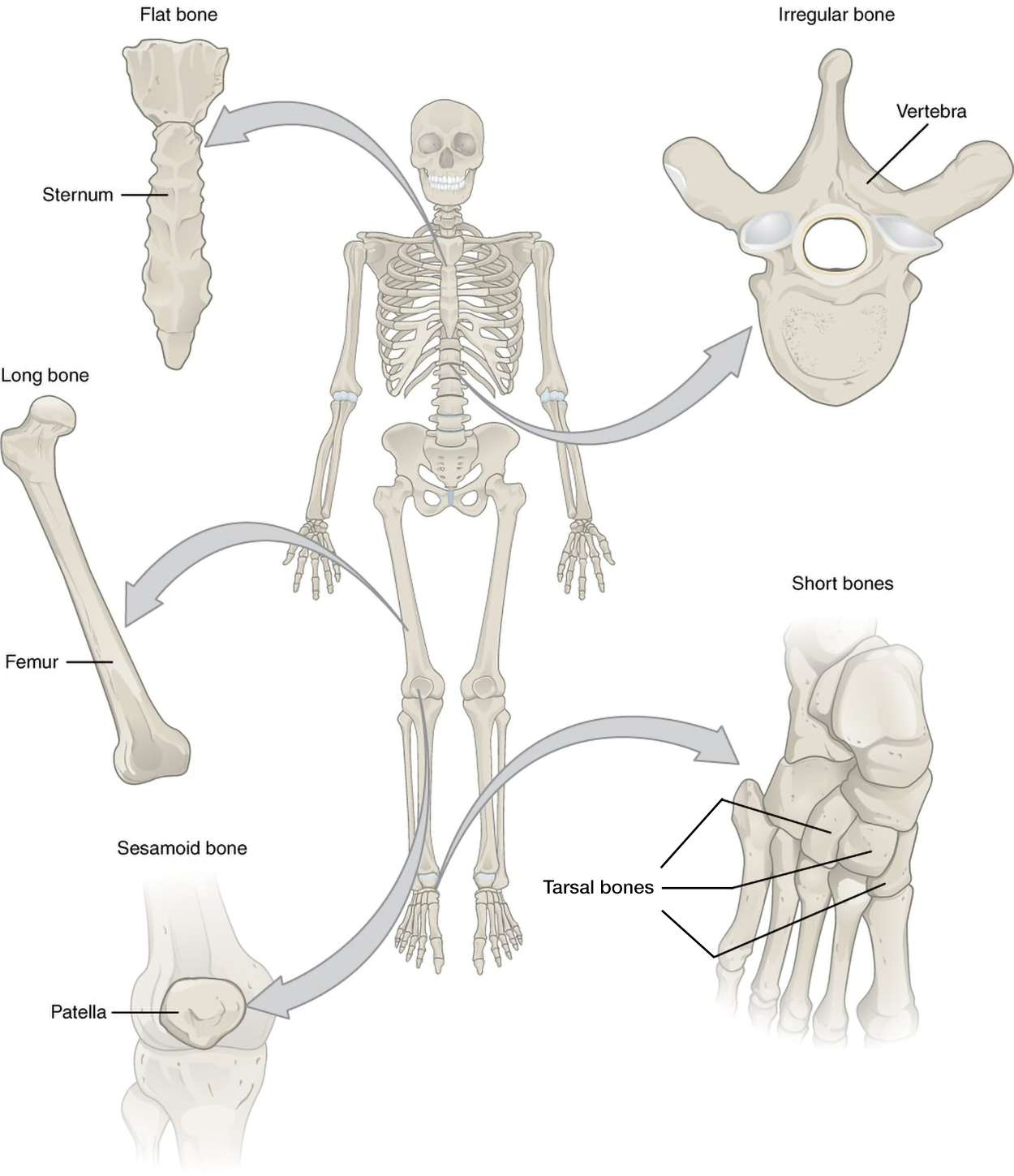
An anterior view of a human skeleton highlights five bones. The sternum (breastbone) lies along the midline of the thorax and connects to the ribs. It is classified as a flat bone and is shaped somewhat like a tie, with an enlarged upper section and a long, flattened, tapering lower section, classified as a flat bone. The femur (thigh bone) is a long bone with a broad lower end connecting to the knee and a ball-shaped upper end fitting into the hip socket. The patella (kneecap) is a small, wedge-shaped sesamoid bone on the front of the knee. The tarsal bones in the foot are small, square-shaped short bones located between the toes and the shin. Lastly, a lumbar vertebra, an irregular bone, is shown with its kidney-shaped body and projecting spines.

terms to know
The table below lists terms that are especially important or that may be difficult to pronounce. Audio is provided to help you learn how to say these terms.

Term Definition Audio
Diaphysis The tubular shaft that runs between the proximal and distal ends of the bone
Epiphysis The rounded end of a long bone
Hematopoiesis Blood cell production
Epiphyseal plate Areas where bones grow in length

summary
In this lesson, you had an introduction to bones and skeletal system, beginning with information on bone structure and terminology followed by a discussion of bone growth and development. Finally, you learned a little bit about the classification of bones. This information will help as you begin to learn about medical conditions, diagnostic procedures, and treatments related to the skeletal system.

SOURCE: THIS TUTORIAL HAS BEEN ADAPTED FROM (1) “OPEN RN | MEDICAL TERMINOLOGY – 2E” BY ERNSTMEYER & CHRISTMAN AT OPEN RESOURCES FOR NURSING (OPEN RN). (2) "ANATOMY AND PHYSIOLOGY 2E" AT OPENSTAX. ACCESS FOR FREE AT WTCS.PRESSBOOKS.PUB/MEDTERM/ AND OPENSTAX.ORG/DETAILS/BOOKS/ANATOMY-AND-PHYSIOLOGY-2E. LICENSING: CREATIVE COMMONS ATTRIBUTION 4.0 INTERNATIONAL.

REFERENCES

Osteogenesis imperfecta. (2024, August 18). Cleveland Clinic. Osteogenesis Imperfecta: What It Is, Symptoms & Types. https://my.clevelandclinic.org/health/diseases/osteogenesis-imperfecta-brittle-bone-disease.

Drake, M. T., & Cremers, S. C. (2010). Bisphosphonate therapeutics in bone disease: the hard and soft data on osteoclast inhibition. Molecular Interventions, 10(3), 141–152. doi.org/10.1124/mi.10.3.5

Do, W. S., Park, J. K., Park, M. I., Kim, H. S., Kim, S. H., & Lee, D. H. (2012). Bisphosphonate-induced Severe Hypocalcemia - A Case Report. Journal of Bone Metabolism, 19(2), 139–145. doi.org/10.11005/jbm.2012.19.2.139

Hypocalcemia. (2022, May 31). Cleveland Clinic. Hypocalcemia: Causes, Symptoms & Treatment. https://my.clevelandclinic.org/health/diseases/23143-hypocalcemia.


Attributions
  • Cephalopoda diversity | Author: No author given | License: public domain
  • Anatomy of a Long Bone | Author: J. Gordon Betts, Kelly A. Young, James A. Wise, Eddie Johnson, Brandon Poe, Dean H. Kruse, Oksana Korol, Jody E. Johnson, Mark Womble, Peter DeSaix | License: Creative Commons Attribution
  • Periosteum and Endosteum | Author: J. Gordon Betts, Kelly A. Young, James A. Wise, Eddie Johnson, Brandon Poe, Dean H. Kruse, Oksana Korol, Jody E. Johnson, Mark Womble, Peter DeSaix | License: Creative Commons Attribution
  • Bone Classification | Author: OpenStax College | License: Creative Commons Attribution 3.0 Unported
Terms to Know
Arthr/o

Pertaining to a joint or joints.

Arthropathy

Joint disease.

Articular Cartilage

Cartilage that covers epiphyses at joints.

Brachi/o

Pertaining to an arm or arms.

Calcane/o

Pertaining to the calcaneus.

Cancellous Bone

Porous interior bone region containing bone marrow.

Cartilage

A type of connective tissue; important in providing structure and support.

Cephal/o

Pertaining to the head.

Clavicu/o

Pertaining to the clavicle.

Compact Bone

Dense layer that provides strength, forms outer layer of diaphysis.

Cortical Bone

Dense layer that provides strength, forms outer layer of diaphysis.

Dactyl/o

Pertaining to the digits (fingers and toes).

Diaphysis

The tubular shaft that runs between the proximal and distal ends of the bone.

Endosteum

Lining of the medullary cavity in a bone.

Epiphyseal Plate

Areas where bones grow in length.

Epiphysis

The rounded end of a long bone.

Femur

Large upper leg bone.

Flat Bone

A bone that is thin, curved, and provides an attachment point for muscles as well as protection.

Growth Plate

Areas where bones grow in length.

Hematopoiesis

Blood cell production.

Humerus

Large upper arm bone.

Ili/o

Pertaining to the ilium.

Irregular Bone

A bone with a complex structure.

Ischi/o

Pertaining to the ischium.

Ischium

One of the bones that forms the pelvis.

Long Bone

A bone that is longer than it is wide and functions as a lever.

Medullary Cavity

Bone cavity containing bone marrow.

Metacarp/o

Pertaining to a metacarpal or metacarpals.

Metacarpal

A hand bone.

Metatars/o

Pertaining to a metatarsal or metatarsals.

Metatarsal

A foot bone.

Myel/o

Pertaining to bone marrow.

Myelofibrosis

A type of bone cancer that results in restructuring of bone.

Ossification

The process of bone formation.

Oste/o

Pertaining to bone.

Osteoblast

Cells that build up bone.

Osteoclast

Cells that break down bone.

Osteocyte

Mature bone cells.

Osteogenesis

Bone formation.

Osteomyelitis

Inflammation of bone and bone marrow.

Osteonecrosis

Bone death due to lack of an adequate blood supply.

Osteopenia

Abnormal reduction in bone mass less than in osteoporosis.

Osteosarcoma

A type of malignant bone cancer that develops from osteoblasts in bones, especially long bones.

Pelv/o

Pertaining to the pelvic bone.

Periosteum

Outer covering of a bone.

Phalang/o

Pertaining to a phalanx or phalanges.

Phalanges

Fingers and toes.

Pod/o

Pertaining to the foot.

Podiatrist

A doctor who specializes in foot conditions, with a degree called doctor of podiatric medicine (DPM).

Pub/o

Pertaining to the pubic area or pubic bone.

Radius

One of the two bones of the lower arm (the shorter bone).

Rib

One of the bones that extends from the vertebral column to enclose the thoracic cavity.

Scapula

Shoulder blade.

Sesamoid Bone

A bone that is small, round, and sesamoid shaped and protects tendons form compressive forces.

Short Bone

A bone that is approximately equal in length, width, and thickness and provides stability, support, and limited movement.

Spondyl/o

Pertaining to a vertebra or vertebrae.

Spongy Bone

Porous interior bone region containing bone marrow.

Tendon

Connective tissue that connects a muscle to a bone.

Trabecular Bone

Spongy bone.

Vertebr/o

Pertaining to a vertebra or vertebrae.
