Table of Contents |
Body cavities are internal spaces within the body that house and protect organs. The cavities cushion organs from physical damage, separate structures to prevent friction and allow independent functioning, allow movement and expansion, and other roles.
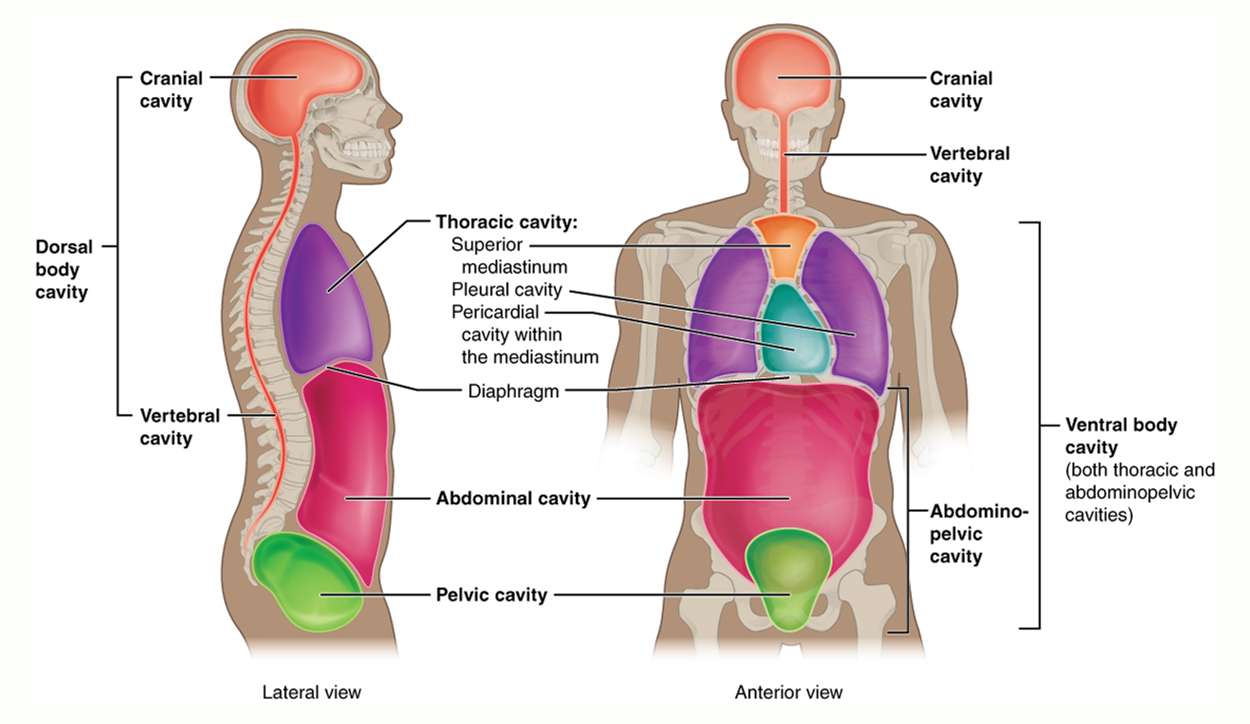
Knowing these cavities is helpful in understanding relationships between different body parts, including different organs. It is also useful in understanding some body functions. The dorsal (posterior) cavity includes the cranial and spinal (vertebral) cavities. The ventral (anterior) cavity includes the thoracic and abdominopelvic cavities.
The dorsal cavity includes:
Cranial cavity – Contains the brain
Spinal (vertebral) cavity – Encases the spinal cord
Remember that the brain and spinal cord make up the central nervous system. So the central nervous system is enclosed within this cavity.
The ventral body cavity houses organs involved in respiration, circulation, digestion, and reproduction. There are two main cavities:
Thoracic cavity – Located in the chest
Abdominopelvic cavity – Includes the abdominal and pelvic regions
The thoracic cavity is located above the diaphragm and contains:
Right and left pleural cavities – enclose the lungs
Pericardial cavity – encloses the heart
The abdominopelvic cavity is located below the diaphragm and contains:
Abdominal cavity – Contains major digestive organs.
Pelvic cavity – Contains the bladder, reproductive organs, and part of the intestines.
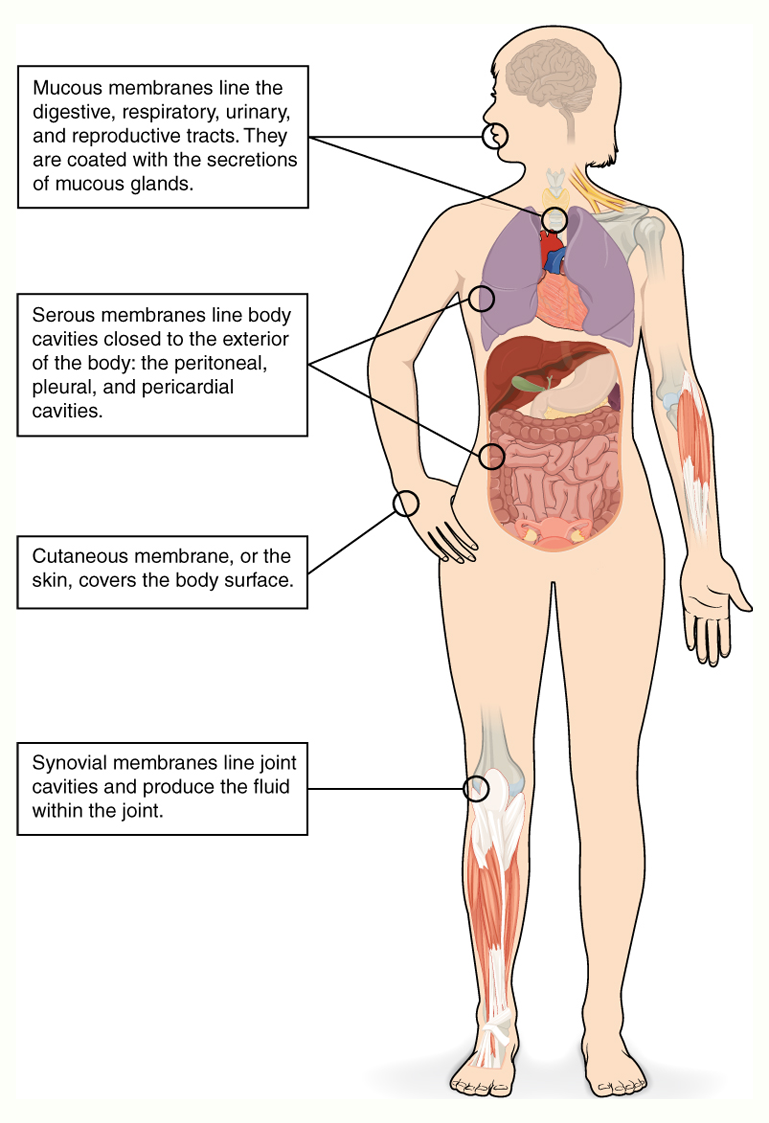
A tissue membrane is a thin layer of cells that covers the outside of the body, an organ, internal passageways that lead to the exterior of the body, or the lining of joint cavities.
Here are some examples:
- Synovial membranes line movable joints and produce fluid within the joint.
- Epithelial membranes can be found in the skin, which covers body surfaces (including organs), lines body cavities, and protects underlying tissues.
- Mucous membranes are epithelial membranes that line and protect the digestive, respiratory, urinary, and reproductive tracts and are coated with mucous for protection and lubrication.
- Serous membranes line body cavities such as the peritoneal, pleural, and pericardial cavities; they secrete serous fluid to reduce friction between organs.
Connective tissue membranes are formed solely from connective tissue and cover organs and line movable joints. A synovial membrane is a type of connective tissue membrane that lines the cavities of joints that hold synovial fluid. Synovial fluid lubricates joints for movement. For example, synovial membranes surround the joints of the shoulder, elbow, and knee.
Epithelial membranes are composed of a thin layer of protective cells and are attached to a layer of connective tissue. Skin, mucous membranes, and serous membranes are types of epithelial membranes.
The skin is also sometimes called a cutaneous membrane. It consists of epithelial tissue that rests on top of connective tissue. The outer surface of the epithelial membrane is exposed to the external environment and is covered with dead, tough cells to protect the body from invading organisms and from desiccation (i.e., drying out).
Mucous membranes are another type of epithelial membrane that line body cavities and their passageways that open to the external environment. Mucus covers the epithelial membrane and provides protection. In addition to the mucous membranes of the digestive, respiratory, excretory, and reproductive tracts, there is a mucous membrane covering your eye called a conjunctiva.
Serous membranes are a third type of epithelial membrane that are contained in body cavities and composed of layers. A parietal layer lines the walls of a body cavity, and a visceral layer covers the organ within the body cavity. There is a thin, fluid-filled serous space between these layers. Serous membranes provide protection to the organs they enclose by reducing friction that can lead to inflammation of the organs.
There are three body cavities with serous membranes:
Source: THIS TUTORIAL HAS BEEN ADAPTED FROM “OPEN RN | MEDICAL TERMINOLOGY – 2e” BY ERNSTMEYER & CHRISTMAN AT OPEN RESOURCES FOR NURSING (Open RN). ACCESS FOR FREE AT https://wtcs.pressbooks.pub/medterm/ LICENSING: CREATIVE COMMONS ATTRIBUTION 4.0 INTERNATIONAL.
REFERENCES
Oxford English Dictionary. (n.d.). Viscera. In Oxford English Dictionary. Retrieved May 7, 2025, from viscera, n. meanings, etymology and more | Oxford English Dictionary
Merriam-Webster. (n.d.). Visceral. In Merriam-Webster.com dictionary. Retrieved May 7, 2025, from www.merriam-webster.com/dictionary/visceral



