Use Sophia to knock out your gen-ed requirements quickly and affordably. Learn more
×

Blood Typing

Author: Sophia

what's covered
In this lesson, you will learn to identify blood types and determine their compatibility. Specifically, this lesson will cover:

Table of Contents

before you start
Today, blood transfusions are a fairly common procedure with minimal risks. However, prior to 1900, the risk of death from a blood transfusion was relatively high. It was only after 1900 thanks to Karl Landsteiner, an Austrian biologist and physician, that the major human blood groups were discovered. Until that point, physicians did not understand that there were different types of blood and that certain types of blood were incompatible with one another.

As you will see in this lesson, blood groups are determined by the presence or absence of specific marker molecules on the plasma membranes of erythrocytes. With their discovery, it became possible for the first time to match patient-donor blood types and prevent transfusion reactions and deaths.

1. Antigens and Antibodies

Antigens are substances that may trigger an immune response from leukocytes. Take note that antigens MAY or MAY NOT trigger an immune response. Therefore, antigens are categorized into two groups—self and foreign antigens. Self-antigens are antigens that the body has been programmed not to react to—they are part of the “self” or body. Foreign antigens are antigens that the body has not been previously programmed on and therefore are reacted against—they are foreign and should be removed.

reflect
You are likely aware that some people have varying reactions to things like pet hair, peanut butter, or a specific plant. You are also likely aware that not everyone has the same things that they react to—only certain people react to certain things. This is the basis for self versus foreign antigens.

The item being reacted to is an antigen. The fact that it has the potential to cause a reaction in a person's body is what makes it an antigen. However, for some people, that antigen is a self-antigen while for others, their body considers it a foreign antigen.

Antigens are generally large proteins but may include other classes of organic molecules, including carbohydrates, lipids, and nucleic acids. When foreign antigens enter and are identified by the body, the ultimate response is the production of antibodies, also known as immunoglobulins, one of the globulin proteins in the blood. These Y-shaped proteins are produced by a specific version of B lymphocyte called a plasma cell. Each antibody binds to a specific antigen and neutralizes it and/or facilitates its removal from the body. You will learn more about antigens and antibodies when you cover the lymphatic system. This lesson will focus on their relevance to blood typing.

The antigens that are relevant to blood typing are located on the plasma membrane surface of erythrocytes. When a patient is infused with an incompatible type of blood, the antigens on the infused erythrocytes are identified as foreign and that patient produces antibodies against them. Because the antibodies are Y-shaped, they bind to two separate antigens which inherently causes clumping among antibody-antigen complexes, a process known as agglutination.

The reason that this process carries a risk of death is that the clumps of erythrocytes and antibodies can block small blood vessels which can deprive tissues of necessary nutrients or waste removal. Additionally, as the clumps are degraded, the hemoglobin (the primary molecule found within erythrocytes) is released into circulation. This hemoglobin travels to the kidneys, which are responsible for filtration of the blood. However, the load of hemoglobin released can easily overwhelm the kidney’s capacity to clear it, and the patient can quickly develop kidney failure and death.

key concept
More than 50 antigens have been identified on erythrocyte membranes, but the most significant in terms of their potential harm to patients are classified into two groups: the ABO blood group and the Rh blood group.

terms to know
Antigen
Substances that may trigger an immune response.
Self-Antigen
An antigen that the body is programmed to not react to.
Foreign Antigen
An antigen that the body will react to.
Antibody
A protein produced by plasma cells in response to a specific antigen stimulus.

2. ABO Blood Groups

The ABO blood group designates four separate blood types (A, B, AB, and O) but is only based on the presence or absence of two antigens (A and B). Both are glycoproteins and their presence or absence, and therefore your ABO blood type, is genetically determined.

  • Type A blood has erythrocytes that only express antigen A.
  • Type B blood has erythrocytes that only express antigen B.
  • Type AB blood has erythrocytes that express both antigens A and B.
  • Type O blood has erythrocytes that don’t express either antigen A or B.
For the body to contain a specific antibody, it must have been previously exposed to that specific foreign antigen. ABO blood group antigens are found in foods and microbes throughout nature. Thus, the human immune system is exposed to A and B antigens at an early age and antibodies are formed naturally. For example, individuals with type A blood—without any prior exposure to incompatible blood—have naturally formed antibodies to the B antigen circulating in their blood plasma.

Knowing that antibodies are specific to a given antigen, each ABO blood type can be identified by the antibodies present in the blood just as easily as by the antigens present or absent on their erythrocytes.

  • Type A blood can produce anti-B antibody.
  • Type B blood can produce anti-A antibody.
  • Type AB blood does not produce either anti-A or anti-B antibodies.
  • Type O blood can produce both anti-A and anti-B antibodies.
With this information, you can begin to understand what types of blood are compatible with others. You can also determine which ABO blood types are incompatible with one another.

ABO Blood Group Table - This table summarizes the characteristics of the blood types in the ABO blood group.

Red Blood Cell Type A B AB O
Antibodies in Plasma Anti-B Anti-A None Anti-A and Anti-B
Antigens in Red Blood Cell A antigen B antigen A and B antigens None
Can receive blood from… A, O B, O A, B, AB, O O
Can give blood to… A, AB B, AB AB A, B, AB, O


terms to know
ABO Blood Group
A classification system for blood types based on the presence or absence of antigens A and B on the erythrocyte surface.

3. Rh Blood Groups

The Rh blood group is classified according to the presence or absence of another erythrocyte antigen identified as Rh, DEF, or D. The label “Rh” comes from the discovery of this antigen in a primate known as a rhesus macaque, which is often used in research because its blood is similar to humans. Since then, dozens of Rh antigens have been identified. Of those, three—D, E, and F—are the most prominent. And of those three, D is the most prominent. Therefore, while this blood group can be labeled as being based on the antigen Rh, DEF, or D, all three are reporting the same information.

key concept
Those who have the Rh antigen present on their erythrocytes—about 85% of Americans—are described as Rh positive (Rh⁺) and those who lack it are Rh negative (Rh⁻). Note that the Rh group is distinct from the ABO group, so any individual, no matter their ABO blood type, may have or lack this Rh antigen. When identifying a patient’s blood type, the Rh group is designated by adding the word positive or negative to the ABO type. For example, A positive (A⁺) means ABO group A blood with the Rh antigen present, and AB negative (AB⁻) means ABO group AB blood without the Rh antigen. This increases the number of blood types from four to eight.
  • Type A positive (A⁺)
  • Type A negative (A⁻)
  • Type B positive (B⁺)
  • Type B negative (B⁻)
  • Type AB positive (AB⁺)
  • Type AB negative (AB⁻)
  • Type O positive (O⁺)
  • Type O negative (O⁻)

The following table summarizes the distribution of the ABO and Rh blood types within the United States. As you can tell, the predominant blood types are different within different subpopulations, indicating a different genetic background among each group. These numbers also differ when compared to different countries.

Summary of ABO and Rh Blood Types within the United States
Listed as percentages

Blood Type Asian Black non-Hispanic Hispanic North American Indian White non-Hispanic
A⁺ 27.3 24.0 28.7 31.3 33.0
A⁻ 0.5 1.9 2.4 3.8 6.8
B⁺ 25.0 18.4 9.2 7.0 9.1
B⁻ 0.4 1.3 0.7 0.9 1.8
AB⁺ 7.0 4.0 2.3 2.2 3.4
AB⁻ 0.1 0.3 0.2 0.3 0.7
O⁺ 39.0 46.6 52.6 50.0 37.2
O⁻ 0.7 3.6 3.9 4.7 8.0

In contrast to the ABO group antibodies, which are formed prior to any potential exposure to incompatible blood, antibodies to the Rh antigen are produced only in Rh⁻ individuals after exposure to the antigen. This process, called sensitization, occurs following a transfusion with Rh⁻ incompatible blood or, more commonly, with the birth of an Rh⁺ baby to the Rh⁻ birthing parent.

During pregnancy, the fetus’s blood cells rarely cross the placenta (the organ of gas and nutrient exchange between the fetus and the birthing parent). However, the birthing parent's antibodies do cross the placenta. For the three antigens related to blood type, the anti-A and anti-B antibodies are significantly less reactive than Rh. Therefore, preexisting anti-A and anti-B antibodies are not a concern if the fetus’s blood is a mismatch for the birthing parent. However, an Rh mismatch is strongly reactive and can be a concern. Specifically, the Rh⁻ birthing parent who can produce anti-Rh antibodies against an Rh⁺ fetus is of concern.

During the first pregnancy, the Rh⁻ birthing parent has had no exposure to the Rh antigen and has not begun production of the anti-Rh antibody. Unless there is a blood vessel broken during the pregnancy, the first Rh⁺ baby is born without an issue. However, during or immediately after birth, the Rh⁻ birthing parent can be exposed to the baby’s Rh⁺ cells. Research has shown that this occurs in about 13−14% of such pregnancies. After exposure, the birthing parent’s immune system begins to generate anti-Rh antibodies. If the same person should then become pregnant with another Rh⁺ fetus, the Rh antibodies they have produced can cross the placenta into the fetal bloodstream and destroy the fetal RBCs. This condition, known as hemolytic disease of the newborn (HDN) or erythroblastosis fetalis, may cause anemia in mild cases, but the agglutination and hemolysis can be so severe that without treatment the fetus may die in the womb or shortly after birth.
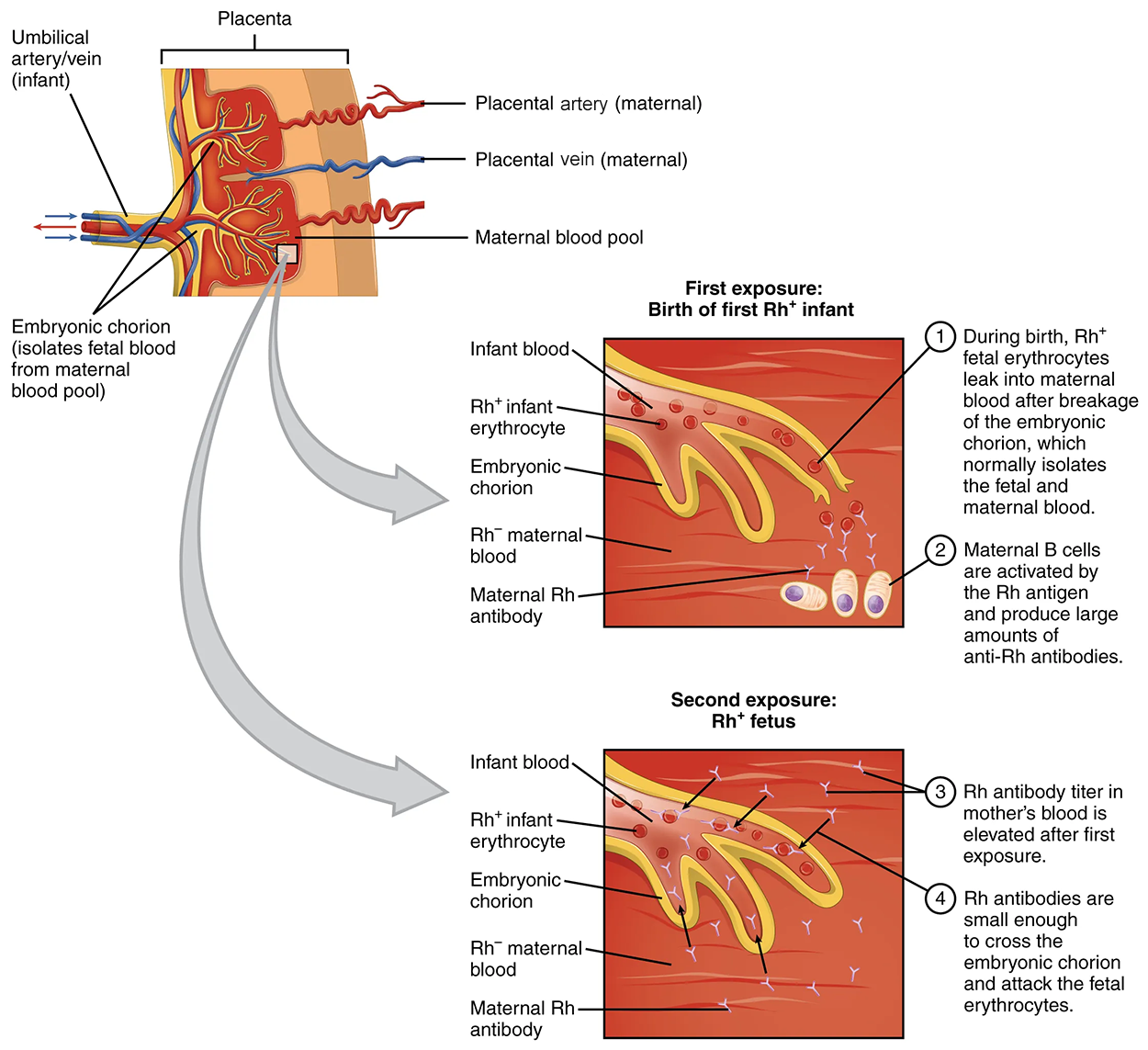

This figure shows an umbilical artery and vein passing through the placenta on the top left. The top right panel shows the first exposure to Rh⁺ antibodies in the mother. The bottom right panel shows the response when the second exposure in the form of another fetus takes place. Textboxes detail the steps in each process. Step 1: During birth, Rh⁺ fetal erythrocytes leak into maternal blood after breakage of the embryonic chorion, which normally isolates the fetal and maternal blood. Step 2: Maternal B cells are activated by the Rh antigen and produce large amounts of anti-Rh antibodies. Step 3: Rh antibody tiler in the mother’s blood is elevated after first exposure. And Step 4: Rh antibodies are small enough to cross the embryonic chorion and attack the fetal erythrocytes.
Erythroblastosis Fetalis - The first exposure of an Rh⁻ person to Rh⁺ erythrocytes during pregnancy induces sensitization. Anti-Rh antibodies begin to circulate in the pregnant person's bloodstream. A second exposure occurs with a subsequent pregnancy with an Rh⁺ fetus in the uterus. During that subsequent pregnancy, the pregnant person's anti-Rh antibodies may cross the placenta and enter the fetal bloodstream, causing agglutination and hemolysis of fetal erythrocytes.

did you know
A drug known as RhoGAM or RhIG, short for Rh immune globulin, can temporarily prevent the development of Rh antibodies in the Rh⁻ parent, thereby averting this potentially serious disease for the fetus. RhoGAM antibodies destroy any fetal Rh⁺ erythrocytes that may cross the placental barrier. RhoGAM is normally administered to Rh⁻ pregnant people during weeks 26−28 of pregnancy and within 72 hours following birth. It is even given during the first pregnancy in many cases to protect from any potential blood exposure, even if at low risk. Overall, it has proven remarkably effective in decreasing the incidence of HDN. Earlier we noted that the incidence of HDN in an Rh⁺ subsequent pregnancy to an Rh⁻ person is about 13–14% without preventive treatment. Since the introduction of RhoGAM in 1968, the incidence has dropped to about 0.1% in the United States.

watch
Please watch the following video for more information on this topic.

terms to know
Rh Blood Group
A classification system for blood types based on the presence or absence of antigen Rh on the erythrocyte surface.
Hemolytic Disease of the Newborn (HDN)
A disorder causing agglutination and hemolysis in an Rh⁺ fetus or newborn of an Rh⁻ person due to the production of anti-Rh antibodies.

4. Blood Typing

Clinicians are able to determine a patient’s blood type quickly and easily using commercially prepared antibodies. An unknown blood sample is allocated into separate wells. Into one well a small amount of anti-A antibody is added, and to another a small amount of anti-B antibody. If the antigen is present, the antibodies will cause visible agglutination (clumping) of the cells. The blood should also be tested for Rh antibodies.
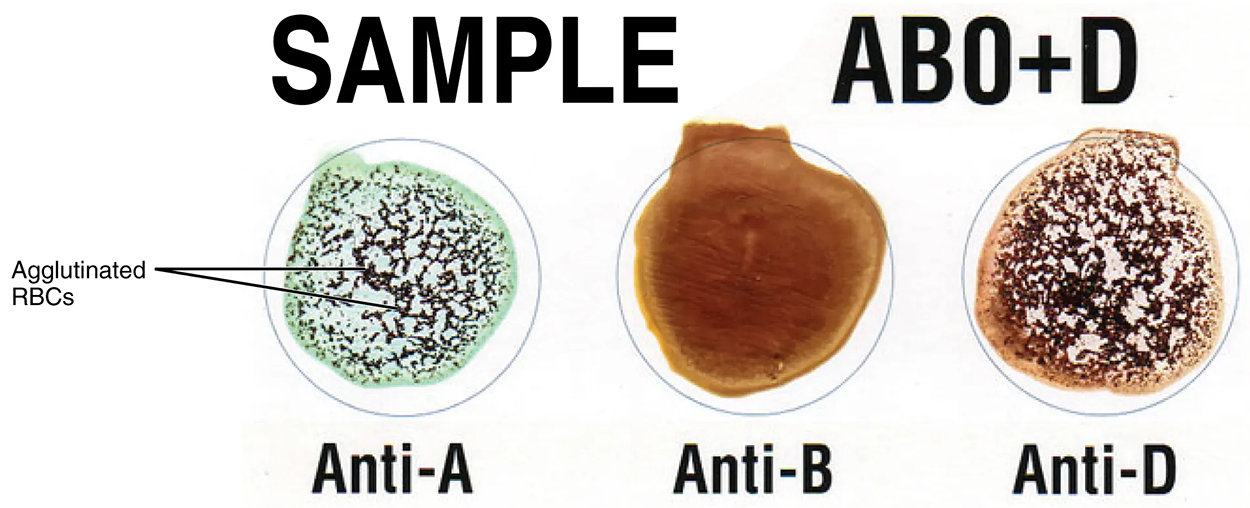

The three reaction sites are visible each coated as captioned.
Cross Matching Blood Types - This sample of a commercially produced “bedside” card enables quick typing of both a recipient’s and donor’s blood before transfusion. The card contains three reaction sites or wells. One is coated with an anti-A antibody, one with an anti-B antibody, and one with an anti-D antibody (tests for the presence of Rh factor D). Mixing a drop of blood and saline into each well enables the blood to interact with a preparation of type-specific antibodies, also called anti-seras. Agglutination of RBCs in a given site indicates a positive identification of the blood antigens, in this case, A and Rh antigens for blood type A⁺. For the purpose of transfusion, the donor’s and recipient’s blood types must match.

Summary of Blood Type Testing Results

Blood Type Anti-A Anti-B Anti-D
A⁺ Clumping No Clumping Clumping
A⁻ Clumping No Clumping No Clumping
B⁺ No Clumping Clumping Clumping
B⁻ No Clumping Clumping No Clumping
AB⁺ Clumping Clumping Clumping
AB⁻ Clumping Clumping No Clumping
O⁺ No Clumping No Clumping Clumping
O⁻ No Clumping No Clumping No Clumping


5. Blood Transfusion Protocols

To avoid transfusion reactions, it is best to transfuse only matching blood types; that is, a type B⁺ recipient should ideally receive blood only from a type B⁺ donor, and so on. That said, in emergency situations, when acute hemorrhage threatens the patient’s life, there may not be time for cross-matching to identify blood type. In these cases, blood from a universal donor—an individual with type O⁻ blood—may be transfused. Recall that type O erythrocytes do not display A or B antigens. Thus, anti-A or anti-B antibodies that might be circulating in the patient’s blood plasma will not encounter any erythrocyte surface antigens on the donated blood and therefore will not be provoked into a response.

One problem with this designation of the universal donor is an O⁻ individual produces anti-A and anti-B antibodies and depending on their prior exposure, may also produce anti-Rh antibodies. This may cause problems for the recipient, but because the volume of blood transfused is much lower than the volume of the patient’s own blood, the adverse effects of the relatively few infused plasma antibodies are typically limited. Although it is always preferable to cross-match a patient’s blood before transfusing, in a true life-threatening emergency situation, this is not always possible, and these procedures may be implemented.

A patient with blood type AB⁺ is known as the universal recipient. This patient can theoretically receive any type of blood because the patient’s own blood—having both A, B, and Rh antigens on the erythrocyte surface—does not produce anti-A, anti-B, or anti-Rh antibodies. However, keep in mind that the donor’s blood will contain circulating antibodies, again with possible negative implications. The table below summarizes the blood types and compatibilities.

Blood Types Compatibilities

Blood Type Antigens Antibodies Can Receive From… Can Give To…
A⁺ A, Rh B A⁺, A⁻, O⁺, O⁻ A⁺, AB⁺
A⁻ A B, Rh A⁻, O⁻ A⁺, A⁻, AB⁺, AB⁻
B⁺ B, Rh A B⁺, B⁻, O⁺, O⁻ B⁺, AB⁺
B⁻ B A, Rh B⁻, O⁻ B⁺, B⁻, AB⁺, AB⁻
AB⁺ A, B, Rh - A⁺, A⁻, B⁺, B-, AB⁺, AB⁻, O⁺, O⁻ AB⁺
AB⁻ A, B Rh A⁻, B⁻, AB⁻, O⁻ AB⁺, AB⁻
O⁺ Rh A, B O⁺, O⁻ A⁺, B⁺, AB⁺, O⁺
O⁻ - A, B, Rh O⁻ A⁺, A⁻, B⁺, B⁻, AB⁺, AB⁻, O⁺, O⁻

key concept
At the scene of multiple-vehicle accidents, military engagements, and natural or human-caused disasters, many victims may suffer simultaneously from acute hemorrhage, yet type O blood may not be immediately available. In these circumstances, medics may at least try to replace some of the volume of blood that has been lost. This is done by intravenous administration of a saline solution that provides fluids and electrolytes in proportions equivalent to those of normal blood plasma. Research is ongoing to develop a safe and effective artificial blood that would carry out the oxygen-carrying function of blood without the RBCs, enabling transfusions in the field without concern for incompatibility. These blood substitutes normally contain hemoglobin- as well as perfluorocarbon-based oxygen carriers.

make the connection
If you're taking the Anatomy & Physiology II Lab course simultaneously with this lecture, it's a good time to review the first Unit of that course. Not taking the course and want to know more? See the Anatomy and Physiology II Lab course in Sophia's catalog.

Once you have had a chance to review the first Unit, try the following Labs in Unit 2; Lab Safety will help you understand some of the basics you will need to have a successful lab experience, and the Lab Antibodies: Why are some blood types incompatible? (also in Unit 2 of the Lab course) directly relates to this lesson. Review the lab-to-lecture crosswalk if you need more information. Good luck!

terms to know
Universal Donor
An individual with type O⁻ blood.
Universal Recipient
An individual with type AB⁺ blood.

summary
In this lesson, you explored blood types. You first learned about antigens and antibodies which determine a person’s blood type. Then, you learned about the two blood groups, the ABO blood groups and the Rh blood groups, their individual antigens and antibodies, and their compatibility. Lastly, you learned how a blood typing test is performed and why that plays a big part in blood transfusion protocols.

Source: THIS TUTORIAL HAS BEEN ADAPTED FROM OPENSTAX "ANATOMY AND PHYSIOLOGY 2E" ACCESS FOR FREE AT OPENSTAX.ORG/DETAILS/BOOKS/ANATOMY-AND-PHYSIOLOGY-2E. LICENSE: CREATIVE COMMONS ATTRIBUTION 4.0 INTERNATIONAL

REFERENCES

Yoham AL, Casadesus D. Rho(D) Immune Globulin. [Updated 2022 May 23]. In: StatPearls [Internet]. Treasure Island (FL): StatPearls Publishing; 2023 Jan-. Available from: www.ncbi.nlm.nih.gov/books/NBK557884/


Terms to Know
ABO Blood Group

A classification system for blood types based on the presence or absence of antigens A and B on the erythrocyte surface.

Antibody

A protein produced by plasma cells in response to a specific antigen stimulus.

Antigen

Substances that may trigger an immune response.

Foreign Antigen

An antigen that the body will react to.

Hemolytic Disease of the Newborn (HDN)

A disorder causing agglutination and hemolysis in an Rh⁺ fetus or newborn of an Rh⁻ person due to the production of anti-Rh antibodies.

Rh Blood Group

A classification system for blood types based on the presence or absence of antigen Rh on the erythrocyte surface.

Self-Antigen

An antigen that the body is programmed to not react to.

Universal Donor

An individual with type O⁻ blood.

Universal Recipient

An individual with type AB⁺ blood.
