In this lesson, you will explore how fluids behave when they are in motion and how energy is conserved within flowing systems. These concepts help explain real-world phenomena, such as water flow, blood circulation, and how airplanes generate lift. Specifically, this lesson will cover:
Have you ever stopped to think about how airplanes manage to fly through the sky, or why rooftops sometimes get torn off during powerful storms? These events might seem very different, but they’re both connected by one key idea: moving air, or fluid in motion.
So far, we've mostly explored the behavior of fluids that are still, like water sitting in a glass or air trapped in a balloon. However, what happens when fluids start to move?
In this lesson, we’ll shift our focus from stationary fluids to flowing fluids. We’ll look at how fluids move, what affects their speed and direction, and how that movement can create forces strong enough to lift a plane or damage buildings. Understanding fluid motion helps explain not just everyday things like wind and water flow, but also how engines work, how blood travels through the body, and how weather shapes our world.
1a. Flow Rate
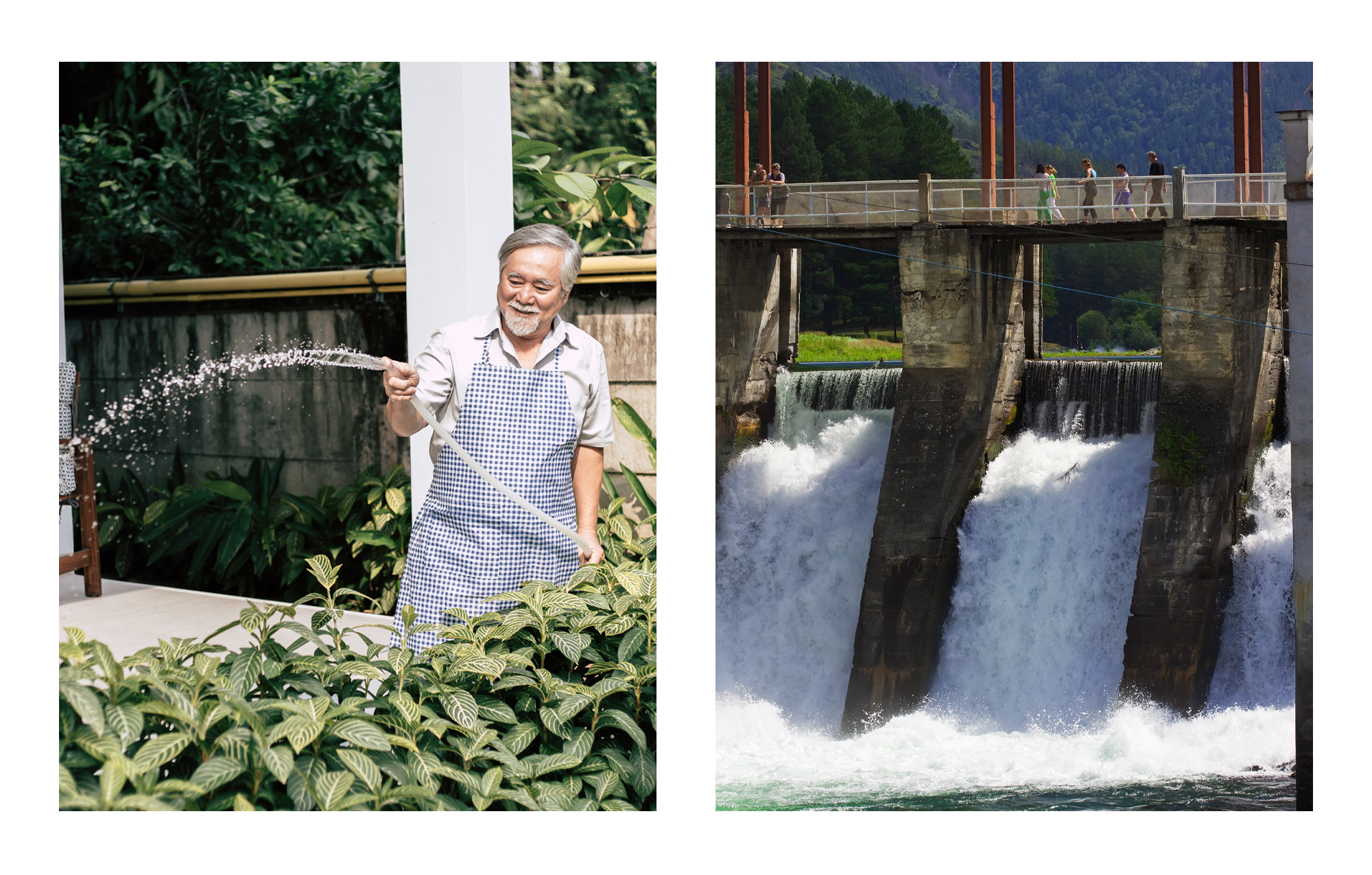
Imagine water rushing through a garden hose on a hot day. You can see how quickly it flows, but how could you measure exactly how much water passes through each second?
Flow rate is the amount of fluid that passes through a specific point or area in a system per unit of time. When a fluid moves through a pipe or channel with a consistent cross-sectional area, the flow rate tells us how much fluid is moving and how fast.
Flow rates can differ a lot.
Understanding flow rate helps engineers and scientists describe the volume of fluid transported every second—a key factor in systems like water supply lines, where maintaining steady flow ensures consistent pressure and delivery.
By analyzing flow rate, we connect the motion of a fluid (its speed and direction) with the quantity being transferred. This relationship is essential for designing efficient systems, from plumbing and irrigation to energy production and environmental monitoring.
IN CONTEXT Flow, Forests, and the Work of Wangarĩ Maathai
Dr. Wangarĩ Maathai receives the Nobel Peace Prize in 2004.
In Kenya, environmentalist Dr. Wangarĩ Maathai noticed that deforestation was changing how water flowed across the land. Without trees to slow rainfall and absorb water, streams flooded during storms and dried up during droughts. Through her Green Belt Movement, she led communities in planting millions of trees to restore the natural flow of water through soil and rivers. By slowing the rate of surface runoff and increasing groundwater absorption, her work helped prevent erosion and sustain local agriculture.
For this groundbreaking connection between environmental restoration, community well-being, and peace, Dr. Maathai (also known as the Queen of the Trees) received the Nobel Peace Prize in 2004. She was the first African woman to earn the honor. Her legacy shows that understanding and managing how water flows through the environment isn’t just physics- it’s a key to a healthier, more sustainable planet.
Flow rate is the amount of fluid that passes through a given point or area per unit of time.
formula to know
Flow Rate
Where Q is the volume flow rate, and V is the total volume of fluid that flows within a given time, t.
Flow rate is usually measured in units like liters per second (L/s) in everyday applications. However, the SI unit for flow rate is cubic meters per second (m³/s), which is used in scientific and engineering contexts for greater precision.
EXAMPLE
Now, let’s calculate just how fast water is flowing out of that hose. You place a bucket under the hose, and after 10 seconds, the bucket has collected 0.005 m³ (five liters) of water. What is the flow rate?
The flow rate of water coming out of the hose is cubic meters per second.
Flow rate can also be expressed using the fluid’s velocity and the cross-sectional area of the tube.
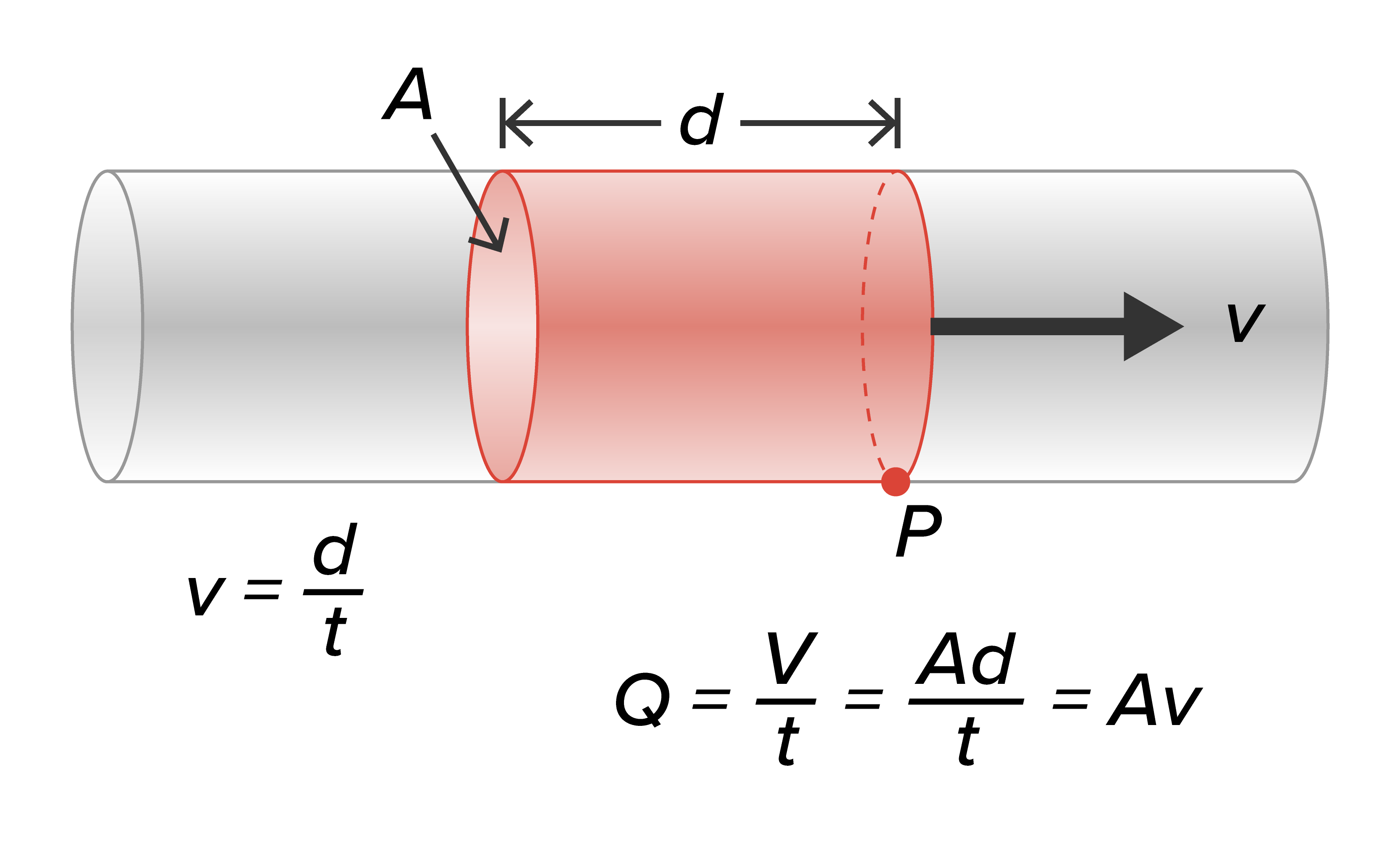
When a fluid flows through a tube with a uniform cross-sectional area, the total volume of fluid that flows in a time interval t is equal to the area of the cross-section multiplied by the distance the fluid travels in that time.
A liquid flowing with velocity v through a tube of cross-sectional area A travels a distance d in time t.
Since the distance traveled in time t is related to velocity v, the volume can be written as:
Dividing both sides by time t, we get the flow rate:
Flow rate is the product of the cross-sectional area A and the velocity v of the fluid.
formula to know
Flow Rate in Terms of Velocity
Where Q is the volume flow rate, A is the cross-sectional area, and v is the velocity.
This form of equation is especially useful in systems like water pipes, air ducts, and blood vessels, where both area and velocity can vary.
EXAMPLE
Consider the same scenario of watering your garden using a hose. You have solved the flow rate, and it is If the cross-sectional area of the hose is Calculate the velocity at which the water flows out of the hose.
The velocity of the water flowing out of the hose is 2.5 meters per second.
When a fluid flows through a pipe or channel, it might move through sections that are wide, narrow, or somewhere in between. Yet, unless fluid is added or removed, the amount entering one end must equal the amount leaving the other. Fluids don’t just vanish or pile up along the way.
To explore this, let’s focus on incompressible fluids, like water, whose density stays constant no matter how much pressure is applied or how fast they move. This assumption helps simplify our analysis and leads to one of the most important ideas in fluid dynamics: the continuity equation.
The continuity equation comes from the principle of conservation of mass, which states that matter cannot be created or destroyed. For an incompressible fluid, this means the product of the cross-sectional area and the velocity of the fluid remains the same at every point along the flow.
In other words, when a pipe narrows, the fluid must speed up; when it widens, the fluid slows down. The same amount of fluid passes through every section per second—it just moves differently to make it happen.
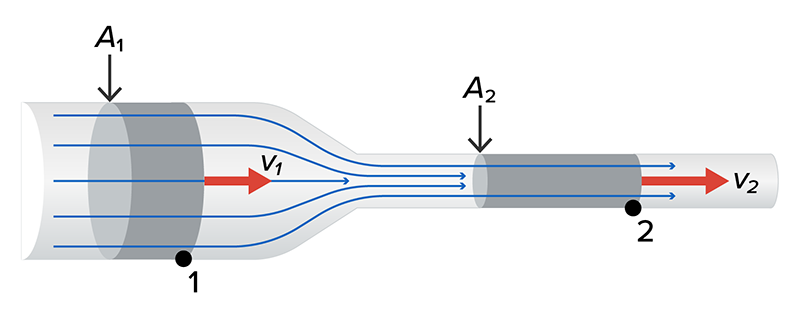
An incompressible fluid flows through a tube with a varying cross-sectional area, adjusting its velocity to maintain constant flow.
According to the continuity equation, the product of the cross-sectional area and the velocity at point one equals the product of the cross-sectional area and the velocity at point two.
formula to know
Continuity Equation
Where is the cross-sectional area at point one, is the velocity at point one, is the cross-sectional area at point two, and is the velocity at point two.
try it
A firefighter is using a hose to put out a fire. The hose has a wide section with a radius of 8 cm, and the water flows through it at a speed of 2 m/s. The nozzle at the end of the hose narrows to a radius of 4 cm.
Water exits at 8 m/s because the cross-sectional area of the nozzle is smaller. For incompressible fluids, narrower paths result in faster flow to conserve mass.
terms to know
Flow Rate
The amount of fluid that passes through a specific point or area in a system per unit of time.
Incompressible Fluids
The fluids whose density stays the same, no matter how much pressure you apply or how fast they flow.
1b. Bernoulli’s Equation
To visualize how fluid moves, we use streamlines, which are imaginary lines that show the path a fluid particle follows. If you watched a tiny drop of water or a puff of smoke move through the air, the trail it leaves behind would be a streamline.
When a fluid flows, it carries energy in several forms: pressure energy, kinetic energy, and potential energy.
Pressure energy is the energy stored in a fluid due to its pressure. It represents the fluid’s ability to do work because of the force it exerts.
Kinetic energy comes from the fluid’s motion. The faster it moves, the more kinetic energy it has.
Potential energy is related to the fluid’s height or position in a gravitational field.
All these forms of energy are connected through Bernoulli’s Principle, which states that as a fluid moves along a streamline. Its total mechanical energy remains constant, assuming no energy is lost to friction or other forces:
Imagine water rushing through a narrowing pipe. As the pipe gets tighter, the water speeds up; its kinetic energy increases. However, energy can’t simply appear out of nowhere. So, where does this extra energy come from? It comes from a drop in pressure. The fluid converts some of its pressure energy into kinetic energy as it accelerates. Likewise, if the fluid rises to a higher level, part of its energy is transformed into potential energy due to gravity.
Bernoulli’s Equation captures this beautiful balance, a statement of energy conservation in fluid motion that helps explain everything from how airplanes generate lift to why a shower curtain gets pulled inward when the water’s running.
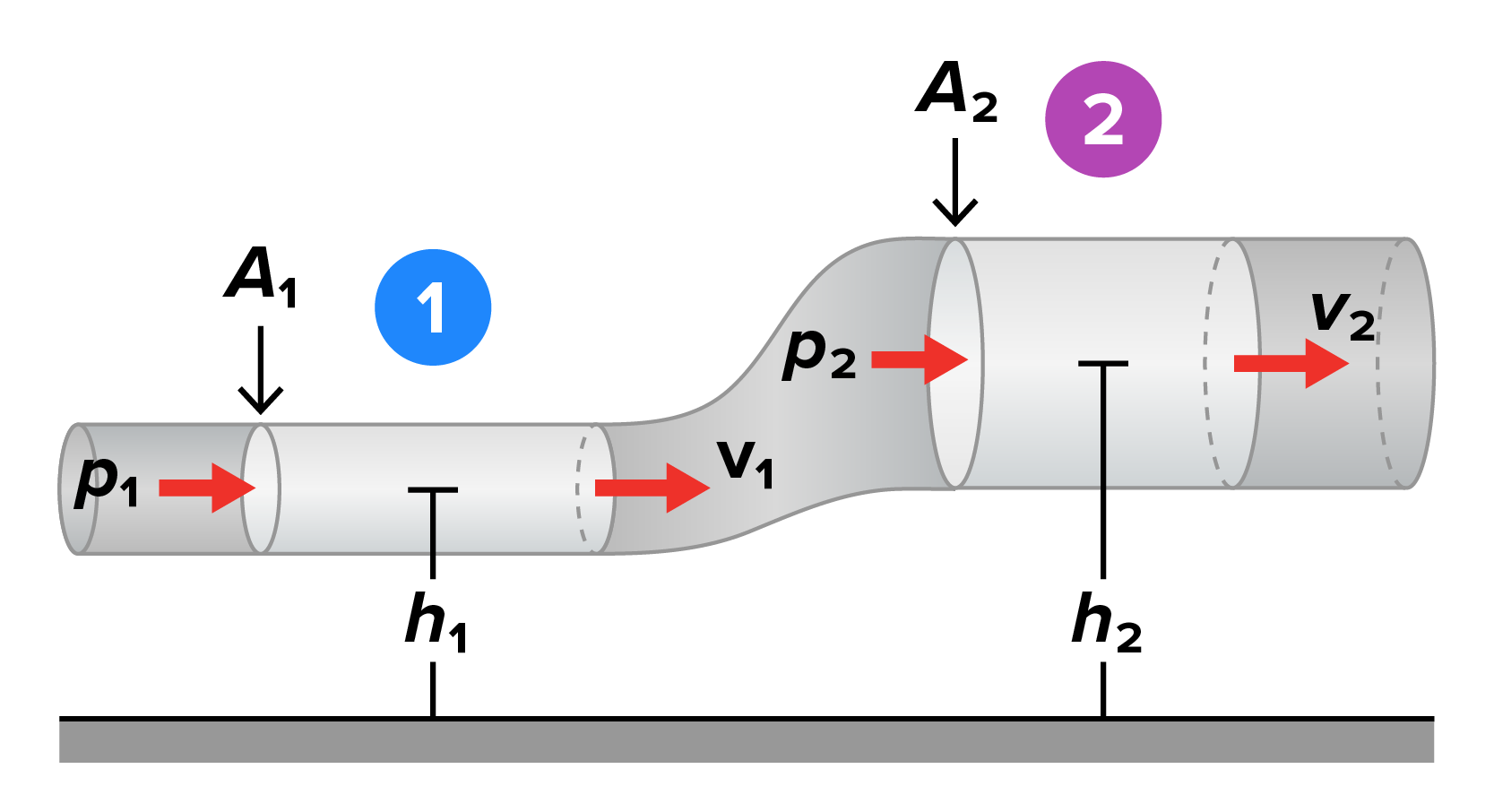
Flow of fluid at two points, 1 and 2. Bernoulli’s Principle connects the energy terms in a flowing fluid—pressure energy, kinetic energy, and potential energy—to the principle of conservation of energy.
formula to know
Bernoulli’s Principle
(for two given points in the fluid) Where is the pressure at point 1, d is the density of the fluid, is the velocity at point 1, is the height of the point 1 from the ground level, g is the acceleration due to gravity, is the pressure at point 2, is the velocity at point 2, and is the height of the point 2 from the ground level.
Flow of fluid at equal depth when
When a fluid flows at a constant depth, there's no change in height. So, Bernoulli's equation is simplified as shown below.
formula to know
Bernoulli’s Equation at Constant Depth
(for two given points in the fluid) Where is the pressure at point 1, d is the density of the fluid, is the velocity at point 1, is the pressure at point 2, and is the velocity at point 2.
According to the simplified Bernoulli’s Equation at constant depth, when a fluid’s speed increases, its kinetic energy rises. To conserve total energy, the pressure must decrease, creating an inverse relationship between fluid speed and pressure. This means that faster-moving fluids exert less pressure than slower-moving ones—a principle that explains why airplane wings generate lift and why the stream of water from a hose narrows as it speeds up.
IN CONTEXT Bernoulli’s Principle in Action: How Airplanes Fly
Bernoulli’s Equation has powerful real-world applications, especially in understanding how changes in fluid speed create differences in pressure: low speed produces high pressure, while high speed results in low pressure.
Airplane wings are carefully designed to take advantage of this relationship to generate lift, the upward force that allows flight. The upper surface of a wing is curved and longer, while the underside is flatter and shorter.
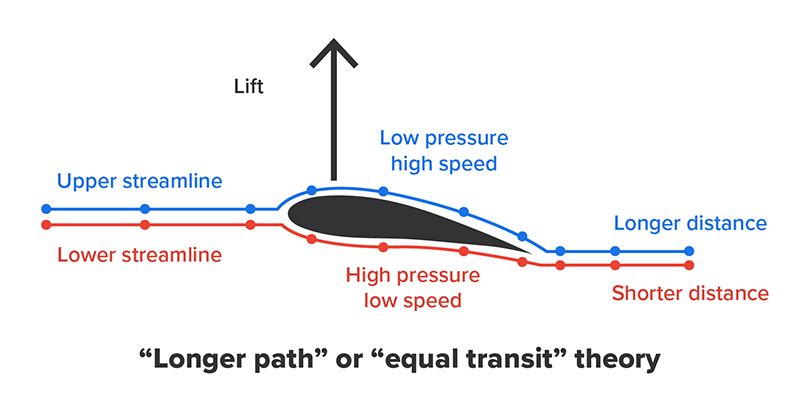
As shown in the video below, air moving over an airplane wing follows two different paths. The air traveling over the longer, curved upper surface must reach the trailing edge at the same time as the air flowing beneath the flatter lower surface. To make this happen, the air above the wing moves faster than the air below. Because of this unique design, the airflow over the top of the wing has a higher speed, while the airflow underneath moves more slowly—a difference that creates lift.
According to Bernoulli’s Equation, the faster-moving air above the wing produces lower pressure, while the slower-moving air below maintains higher pressure. The resulting pressure difference between the upper and lower surfaces generates an upward lift force—the key principle that allows airplanes to rise, stay aloft, and soar through the sky.
Variation in velocity and pressure over the surface of an airplane wing, illustrating how airflow speed differences generate lift
terms to know
Streamlines
Imaginary lines that show the path a fluid particle follows.
Pressure Energy
The energy stored in a fluid due to its pressure.
Bernoulli’s Principle
States that as a fluid moves along a streamline, its total mechanical energy remains constant, assuming no energy is lost to friction or other forces.
summary
In this lesson, you learned how motion of fluid is governed by principles of energy and conservation. In Flow Rate, you discovered how to calculate the volume of fluid passing through a system per unit time. You also explored how the continuity equation ensures that incompressible fluids maintain consistent flow across varying cross-sectional areas. In Bernoulli’s Equation, you examined how pressure, kinetic energy, and potential energy are interrelated in a flowing fluid, and how changes in velocity affect pressure. You saw how this principle applies to real-world systems, including airplane wings. These ideas reveal the powerful role of fluid dynamics in both nature and technology.
States that as a fluid moves along a streamline, its total mechanical energy remains constant, assuming no energy is lost to friction or other forces.
Flow Rate
The amount of fluid that passes through a specific point or area in a system per unit of time.
Incompressible Fluids
The fluids whose density stays the same, no matter how much pressure you apply or how fast they flow.
Pressure Energy
The energy stored in a fluid due to its pressure.
Streamlines
Imaginary lines that show the path a fluid particle follows.
Formulas to Know
Bernoulli’s Equation at Constant Depth
(for two given points in the fluid) Where is the pressure at point 1, d is the density of the fluid, is the velocity at point 1, is the pressure at point 2, and is the velocity at point 2.
Bernoulli’s Principle
(for two given points in the fluid) Where is the pressure at point 1, d is the density of the fluid, is the velocity at point 1, is the height of the point 1 from the ground level, g is the acceleration due to gravity, is the pressure at point 2, is the velocity at point 2, and is the height of the point 2 from the ground level.
Continuity Equation
Where is the cross-sectional area at point 1, is the velocity at point 1, is the cross-sectional area at point 2, and is the velocity at point 2.
Flow Rate
Where Q is the volume flow rate, and V is the total volume of fluid that flows within a given time, t.
Flow Rate in Terms of Velocity
Where Q is the volume flow rate, A is the cross-sectional area, and v is the velocity.



 cubic meters per second.



 If the cross-sectional area of the hose is
  Calculate the velocity at which the water flows out of the hose.




 is the cross-sectional area at point one,
  is the velocity at point one,
  is the cross-sectional area at point two, and
  is the velocity at point two.




 (for two given points in the fluid)
  is the pressure at point 1, d is the density of the fluid,
  is the height of the point 1 from the ground level, g is the acceleration due to gravity,
  is the pressure at point 2,
  is the height of the point 2 from the ground level.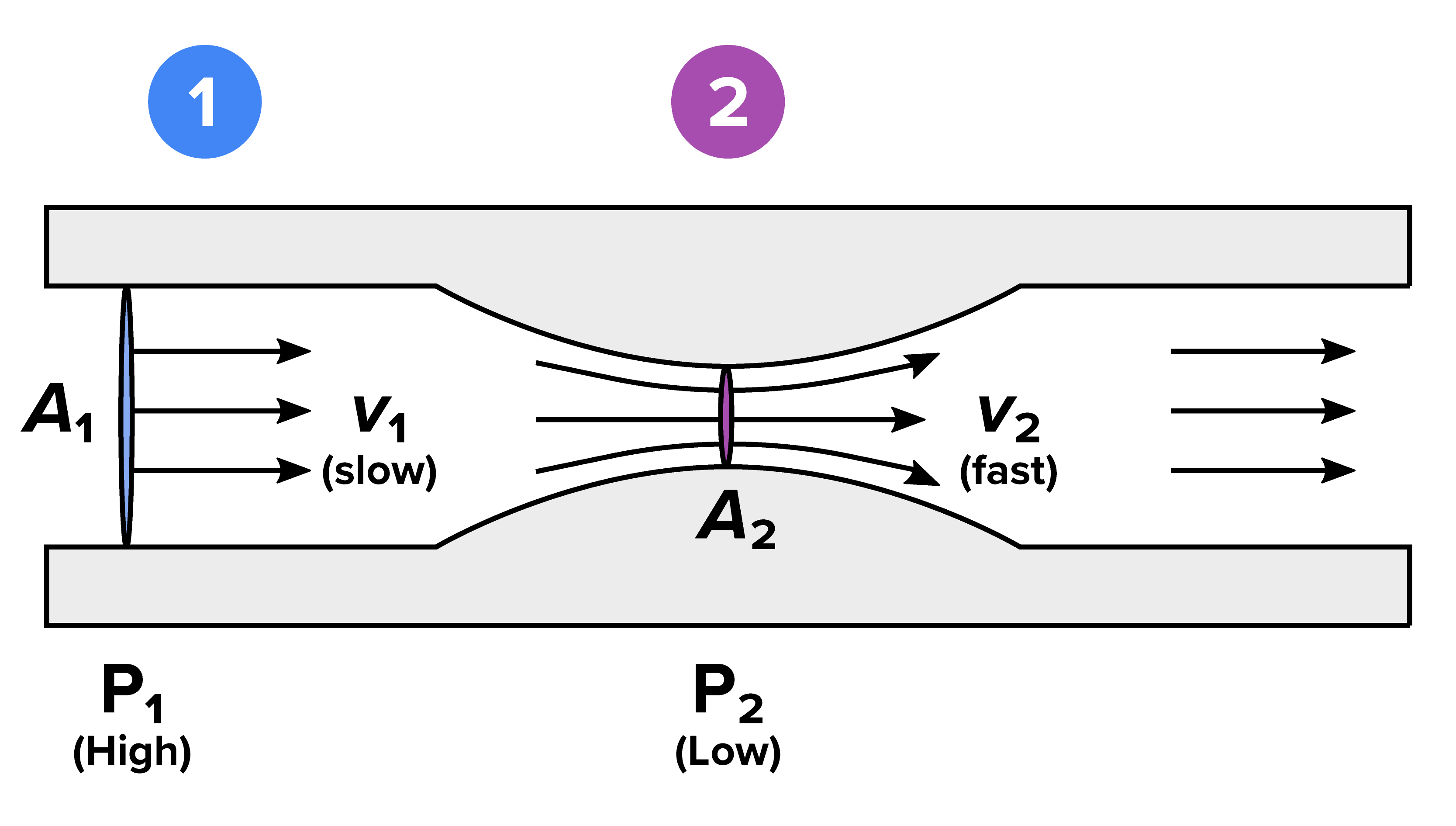


 (for two given points in the fluid)