Table of Contents |
Behavior Learning is a focus on learning as a permanent change in behavior that occurs as a result of experience. That is, a person is said to have learned something when they consistently exhibit a new behavior over time. Several aspects of this theory are noteworthy.
EXAMPLE
Hamish begins a new position at a mortgage company. He realizes that many people in the office, including his supervisor, leave early on Fridays and come in late on Monday. He starts to test this himself by leaving a bit earlier on Friday and coming in a bit later on Monday. This is not necessarily a good habit but can be considered learning because it leads to a permanent change in behavior. If the change is reinforced, that is, he gets the reward of extra time to himself without penalty, it will become permanent. Conversely, Hamish might continue to keep to his official work schedule of 8:00 AM - 4:30 PM. This behavior, too, must be reinforced, such as noticed and praised by higher-ups. Either way, we can only observe his behavior, not the mental process itself that forms these habits.We can best understand the learning process by looking at four stages in the development of research on learning. Scientific interest in learning dates from the early experiments of Pavlov and others around the turn of the 20th century. The focus of this research was on stimulus-response relationships and the environmental determinants of observable behaviors.
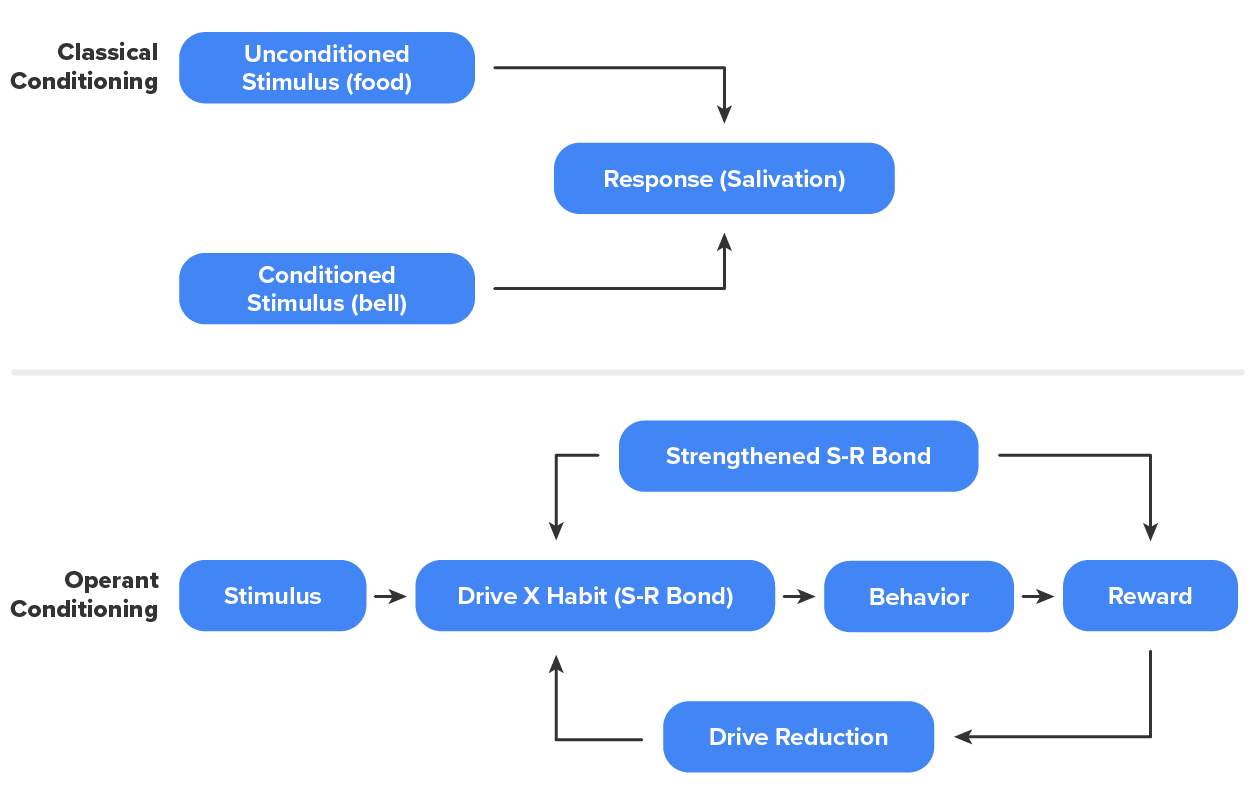
Classical conditioning is the process whereby a human or animal is conditioned to respond to a stimulus with no natural response by linking it to a stimulus with a natural response. The classic example of “Pavlov’s Dogs” illustrates this process. As you may know, Pavlov would ring a bell every time he presented some dogs with meat. The dogs would salivate as a natural response to getting the meat. But over time, the dogs would salivate in response to the ringing of the bell even when no meat was present. If you’ve had a pet cat or dog that came hurrying into the kitchen every time you used a can opener, this is a familiar scenario.
In scientific terms, the dogs salivating at the sight or smell of food was an unconditioned response, a response that is natural and not learned, to an unconditioned stimuli, anything which elicits an innate response. Before the conditioning begins, the bell was a neutral stimulus, or any stimulus that elicits no natural response.
Over time, a learned linkage developed for the dog between the bell and meat, ultimately resulting in a bond between the conditioned stimulus, an otherwise neutral stimulus with a learned response (like the bell), and that response (salivating), which is called the conditioned response. The dog will salivate at the sound of the bell even when there is no meat present.
This linkage is called the S-R Bond (for stimulus-response). Evidence emerged that learning had occurred and that this learning resulted from conditioning the dogs to associate two normally unrelated objects, the bell and the meat. An important aspect of such conditioning is that it involves a subconscious, even unwilling, response to stimuli.
Although Pavlov’s experiments are the best-known illustration of classical conditioning, from the perspective of organizational behavior, we might ask how this process relates to people at work. In the 20th century, applications of classical conditioning to work-related behaviors were explored by researchers in the U.S. like John Ivancevich, Andrew Szilagyi, and Marc Wallace.
An illustration of classical conditioning in a work setting would be an airplane pilot learning how to use a newly installed warning system. In this case, the behavior to be learned is to respond to a warning light that indicates that the plane has dropped below a critical altitude on an assigned glide path. The proper response is to increase the plane’s altitude. The pilot already knows how to appropriately respond to the trainer’s warning to increase altitude (in this case, we would say the trainer’s warning is an unconditioned stimulus and the corrective action of increasing altitude is an unconditioned response). The training session consists of the trainer warning the pilot to increase altitude every time the warning light goes on. Through repeated pairings of the warning light with the trainer’s warning, the pilot eventually learns to adjust the plane’s altitude in response to the warning light even though the trainer is not present. Again, the unit of learning is a new S-R Bond.
Although classical conditioning clearly has applications to work situations, particularly in the area of training and development, it has been criticized as explaining only a limited part of total human learning. Psychologist B. F. Skinner argued that classical conditioning focuses on respondent, or reflexive, behaviors; that is, it concentrates on explaining largely involuntary responses that result from stimuli. More complex learning cannot be explained solely by classical conditioning. As an alternative explanation, Skinner and others have proposed the operant conditioning model of learning.
The major focus of operant conditioning is on the effects of reinforcements, or rewards, on desired behaviors. One of the first psychologists to examine such processes was J. B. Watson, a contemporary of Pavlov, who argued that behavior is largely influenced by the rewards one receives as a result of actions. Simply put, those behaviors that are accompanied or closely followed by punishment will be less likely to recur.
In other words, it posits that behavior that leads to positive or pleasurable outcomes tends to be repeated, whereas behavior that leads to negative outcomes or punishment tends to be avoided. This is sometimes called Thorndike's Law of Effect.
In this manner, individuals learn appropriate, acceptable responses to their environment. In a simple example, if an employee repeatedly is late delivering projects for clients and is talked to about it with threats of possible demotion, it might be more likely that they will work harder to meet deadlines. Of course, we need to understand there may be other factors present, such as the fact the employee isn’t given enough time to begin with or doesn’t have the appropriate tools to complete the project in a timely manner. For purposes of this illustration, the important takeaway is that people who are rewarded tend to want to exhibit that behavior, and when people are punished, they attempt to avoid that behavior.
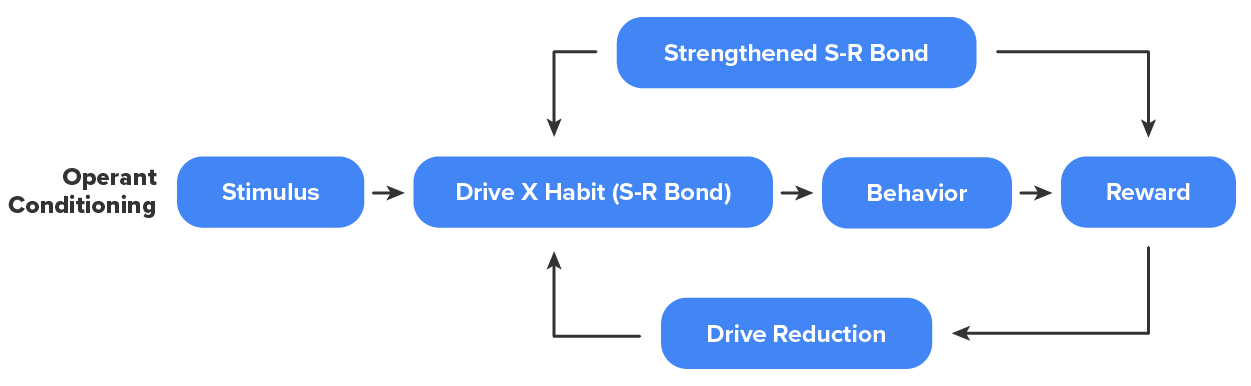
A basic operant model of learning is presented below.
There are three important concepts of this model, and we will look at them with an example. Let’s suppose you’re a manager and you just hired Jamal. How might we see these concepts occur during his training?
| Concept | Definition | Example |
|---|---|---|
| Drive | An internal state of disequilibrium; it is a felt need. It is generally believed that drive increases with the strength of deprivation. A drive, or desire, to learn must be present for learning to take place. | Jamal is interested in being promoted and earning a raise as soon as possible; therefore, he has the drive to learn the new skills you’ll be teaching him. |
| Habit | The observable bond or connection between stimulus and response, or learned behavior. Habits determine the behaviors, or courses of action, we choose. | After a few weeks of training, Jamal is an expert at using the internal IT system and is easily able to click around and find what he needs. In this case, Jamal has developed a habit. |
| Reinforcement | The feedback that encourages or discourages a behavior. Reinforcements can be positive (rewards) or negative (punishments). | A month later, you pull Jamal aside and compliment him on being such a fast learner and ask if he is ready for additional training. This feedback and reinforcement teaches Jamal there are rewards (positive feedback) for doing a good job. |
A stimulus activates an individual’s motivation through its impact on drive and habit. The stronger the drive and habit (S-R bond), the stronger the motivation to behave in a certain way. As a result of this behavior, two things happen. First, the individual receives feedback that reduces the original drive. Second, the individual strengthens his or her belief in the veracity of the S-R bond to the extent that it proved successful. That is, if one’s response to the stimulus satisfied one’s drive or need, the individual would come to believe more strongly in the appropriateness of the particular S-R connection and would respond in the same way under similar circumstances. In the case of Jamal, he was motivated to begin with, because he wanted to earn a promotion. He learned quickly, so his job became a habit, and he was rewarded for it. So, we can say Jamal had a strong S-R connection.
Another example will clarify this point. Several recent attempts to train chronically unemployed workers have used a daily pay system instead of weekly or monthly systems. The primary reason for this is that the workers, who do not have a history of working, can more quickly see the relationship between coming to work and receiving pay. An S-R bond develops more quickly because of the frequency of the reinforcement, or reward.
Operant conditioning can be distinguished from classical conditioning in at least two ways. First, the two approaches differ in what is believed to cause changes in behavior. In classical conditioning, changes in behavior are thought to arise through changes in stimuli—that is, a transfer from an unconditioned stimulus to a conditioned stimulus. In operant conditioning, on the other hand, changes in behavior are thought to result from the consequences of previous behavior. When behavior has not been rewarded or has been punished, we would not expect it to be repeated. For example, if Pavlov had only waved meat in front of the dogs after ringing a bell, but not let them eat, operant conditioning posits that there would theoretically be no conditioned response of salivating when a bell rings.
Second, the two approaches differ in the role and frequency of rewards. In classical conditioning, the unconditioned stimulus, acting as a sort of reward, is administered during every trial. In contrast, in operant conditioning, the reward results only when individuals choose the correct response. That is, in operant conditioning, individuals must correctly operate on their environment before a reward is received. The response is instrumental in obtaining the desired reward.
Let’s consider our earlier example of Jamal. Under the definition of operant conditioning, since Jamal was rewarded by a compliment and asked to take on more work (which could lead to a promotion, which is his desire), we would expect his behavior to be repeated. Using the opposite approach, if you as the manager said nothing to Jamal and just let him keep doing his job without compliments (rewards) or punishment, he probably would not continue to do what he is doing.
This doesn’t mean that either theory is “right” or “wrong,” just that they apply to different situations. One is an unconscious and immediate response to stimuli that has been developed over time; the other is a learned habit in response to stimuli.
Source: THIS TUTORIAL HAS BEEN ADAPTED FROM OPENSTAX "ORGANIZATIONAL BEHAVIOR". ACCESS FOR FREE AT OPENSTAX.ORG/BOOKS/ORGANIZATIONAL-BEHAVIOR/PAGES/1-INTRODUCTION. LICENSE: CREATIVE COMMONS ATTRIBUTION 4.0 INTERNATIONAL.