Table of Contents |
Plagiarism is the act of presenting someone else’s writing or ideas as your own. Plagiarism is most often associated with academic dishonesty, such as submitting papers that you didn’t write or copying another student's work. But plagiarism also occurs in business writing, public speaking, and other occasions. In most scenarios, intentional plagiarism is considered an ethical violation—after all, it is also known as “stealing” someone's work—and may be severely punished.
Most people know that they shouldn't steal, whether the theft is of their colleague's lunch or of their writing. But plagiarism is not always committed with the intention of taking credit for someone else’s work; it could also happen accidentally, such as through carelessness in note-taking, or incorrect assumptions about what constitutes plagiarism. Someone who would never hand in someone else's paper with their own name on it might not consider it to be plagiarism to “borrow” several slides in a presentation or to include a colleague's inspiring anecdote in their own speech. Other times, people have heard advice that if they change one out of every three words (or a similar trick), the work becomes “theirs,” which is incorrect. With diligence and awareness of what constitutes plagiarism, though, it is easy to avoid accidental theft of someone else's work.
You should avoid reusing any material without citation. Citation is when you include the original author’s name and the source context of any writing or ideas that heavily influenced your work, even if it is not a direct quote. You should also strive to only make occasional use of other material in your own writing or presentations. Instead, for example, ask yourself why someone else's anecdote is effective, and try to think of a similar one that is genuinely drawn from your own experience.
EXAMPLE
Audrey wants to begin a lesson from a management book she has read. She uses the same content, and puts into her own words so she doesn’t feel she has plagiarized it. However, by using the same main ideas and not citing the source, she is still committing plagiarism. She can avoid that by simply telling her audience that she has adapted it and telling them the original title and author.There are three basic rules to guarding against plagiarism:
It is also important to avoid using material that was plagiarized by someone else, and to investigate the source of suspicious texts. But it is not always plagiarism when someone signs their name to writing produced by another person: sometimes this is an ordinary part of a job.
EXAMPLE
Most politicians employ speechwriters, whose job is to write the speeches and statements delivered by the politician. It is understood that when a politician makes a speech, the speech is attributed to them even though the words might have been written by someone on their staff. Likewise, many business leaders will have staff draft official communications in their name. When material is written with the clear understanding that it will be delivered by or attributed to someone else, that is not plagiarism.Copyright infringement is not the same as plagiarism, although the two both involve using others’ work. Plagiarism is passing off someone else’s work as your own. Copyright infringement is using copyrighted work without permission, even if you do give them credit, because you literally do not have the right to copy it. Using too much of an original work without permission is unethical and can get you into legal trouble regardless of whether you try to take credit for it. You won’t go to jail for copyright infringement, but you can be sued, and it will damage your reputation.
EXAMPLE
Copying Robert Louis Stevenson’s novel Treasure Island word-for-word and passing it off as your own work is plagiarism, because you are taking credit for someone else’s work. However, it is not copyright infringement, because the work is in the public domain, meaning that it is no longer protected by copyright laws and anybody who wants can create a copy.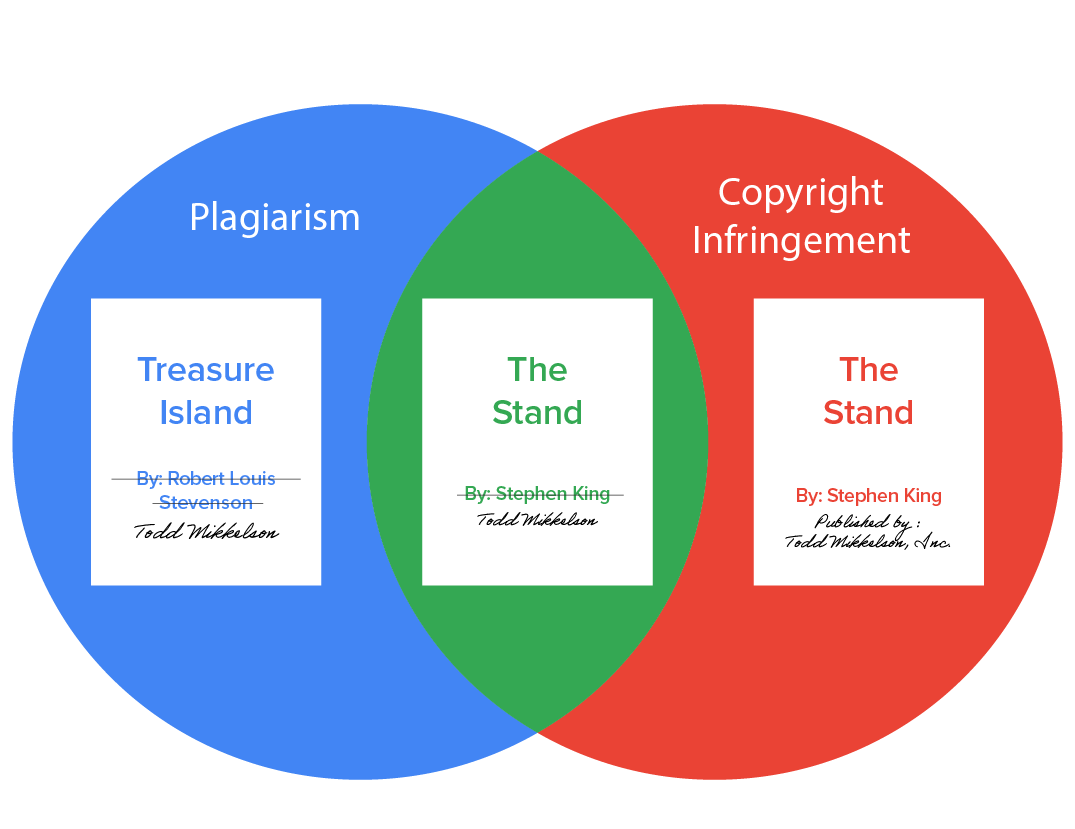
Copyright infringement in the workplace, like plagiarism, often occurs due to carelessness or confusion about the law, rather than intentional cheating. One of the most common abuses of copyright infringement at work is the use of images found on the web to decorate your own website or brochure. Another is using music as a background for a video. Because the images and music feel like a small part of the whole, and because the audience for these websites and videos are small, the person using them might think it is a small transgression. But, as with plagiarism, even if you are never taken to court, it might negatively impact your reputation.
One way to avoid copyright infringement is to search for materials that are available under a Creative Commons license. Creative Commons is a non-profit organization that provides free licensing for creators to use when they want to make their work available to the public for free. A Creative Commons license means that other people can use the licensed work without permission if their usage meets the criteria specified under the license. Some will only allow their work for non-commercial use with credit, others don’t even require that you give credit. There are also many services with photography, clip-art, music and video clips that are available for small fees for one-time use, or which have monthly licensing fees to have access to their entire library.
EXAMPLE
Miguel needs to illustrate a brochure with some photographs of people at work, so he searches for images on the Internet and incorporates them into the brochure. He has been told that anything on the Internet is in the public domain. This is false, and his use of the images without permission might get his employer in trouble, especially if the photographer happens to see the brochure! Miguel would be better off paying for stock photography or searching for photographs that are licensed under Creative Commons.EXAMPLE
Marianne is making a video showcasing her office’s achievements for the year, which will be available to the public on the company website. It is a montage of videos and photos taken by various staff members. She knows that using music in her personal library without permission will be a problem, and that getting rights for hit songs is likely to be expensive and take more time than she has. Instead she asks a musician friend if she can provide some short, original clips to incorporate into the video. The friend is willing to do so for a reasonable fee and credit.There are some scenarios where you may use copyrighted material without permission. These exceptions to copyright restrictions are known as fair use exceptions. There are four factors to fair use exceptions, and all four are unfortunately vague. There is also no legal clarity about how many of these criteria a work must meet to qualify for fair use. It might be one, and it might be all four. If you have in-house counsel (a lawyer on staff), you should consult with them on any decisions. The four factors are:
1. The purpose and character of the use, including whether such use is of commercial nature or is for nonprofit educational purposes. The most common allowances are for transformative works, such as parodies, small samples of songs worked into completely new pieces, or memes that take one or more photographs and add captions. Samples from movies or quotes from books included in critical reviews or scholarly works are also permitted. In some legal cases there will be long legal arguments about whether a new work is substantially transformative enough to be eligible for Fair Use.
EXAMPLE
If you take a popular song and strip the vocal track to add your own, this is likely to get you in trouble even if you change the lyrics. But if you also record new music that is similar but distinctive, it is more likely to pass.Note that if you are in a corporate, for-profit business of any kind and are not doing creative transformation of the work, you have not met this requirement and should ask for permission or not use the work!
2. The nature of the copyrighted work. It is hard to claim copyright ownership in court for recipes, trivia questions and answers, lists of instructions, jokes, and other specific kinds of content that two people can come up with independently, or for which the original source may be hard to determine. This doesn’t mean that such work is fair game to steal, but it does mean you can worry less if you discover your fun quiz about 90s boy bands shares a lot of similarities with trivia questions from the 1999 edition of Trivial Pursuit.
3. The amount and substantiality of the portion used in relation to the copyrighted work as a whole. This is among the most misunderstood and misused of the Fair Use criteria, leading to myths about what percentage or how many words from a work you can use when, in fact, it is not specified in the law. It is generally considered “safe” to use a small quote or sample from something, if correctly attributed, but there is no legal standard for how much is too much. For example, only a few seconds of a song might be too much, if it’s considered the “heart” of the piece. Even a few seconds can be enough if it is the “heart of the piece.”
EXAMPLE
Rapper Vanilla Ice used a five second sample from the 1981 song “Under Pressure” by David Bowie and Queen for his 1990 hit song “Ice Ice Baby.” In court it was determined that though the sample was only a few seconds, it was the heart of the original song. Bowie and Queen eventually received songwriting credit and royalties.4. The effect of the use upon the potential market for, or value of, the copyrighted work. This is the most important criteria in court, since it determines whether you are depriving the artist of compensation. Photographers, artists, and musicians are largely sustained by selling permissions for re-use of their work, which is why the occasional insertion of a sound clip or photograph in a completely different form feels harmless, but could get you in hot water! At the same time, use of still images from movies or book jackets to embellish a review are considered fair use, because they do not deprive the artist of compensation. In some cases, like the gameplay videos you see on YouTube, the creators know that they can get free publicity from use of their content and encourage it.
Knowing the four factors of Fair Use can help you determine if your use is fair. It is best to err on the side of caution and either ask for permission or use media that is clearly labeled as OK to use. The old adage, “It is easier to ask for forgiveness than permission,” definitely does not apply!
EXAMPLE
Elizabeth is writing a guidebook to her city that will be published by her company and sold to the public. For background information on her city's history, she is using an older guidebook that was published under a Creative Commons (CC) license, which gives Elizabeth permission to freely copy ideas and text from the older book. But while she is reading the old guidebook, she notices that it includes some material that sounds like it was written by a different person than the rest. She searches online for the suspicious material, and discovers that the older guidebook had actually plagiarized historical material from an even older guidebook, which was still under copyright. Even though she had first found this content in a CC licensed guidebook, because that guidebook had plagiarized another source, it would be a copyright violation if Elizabeth continued to use the material.While it may seem new, artificial intelligence (AI), computer software that simulates human thinking, has been around since the 1960s.
Large language models, also called chatbots or generative AI, are a form of AI that simulates human interactions or creativity, often in verbal form. In the early 2020s, the generative AI program ChatGPT became enormously popular, and soon people were using it to write social media posts, compose emails to clients, and (as you probably know) to write college papers. Indeed, it is exciting to see how AI can generate text and images with a few words, and sometimes the results are astounding. But the power of generative AI raises a new set of ethical issues.
Firstly, using AI may be plagiarism, by the common definition of "passing off someone else's work as your own." That the "somebody" is a program, not a person, doesn't change that. Using AI might also lead to inadvertent plagiarism of real people. Large language models are built on existing texts, meaning that AI-generated content borrows from existing copyrighted sources.
EXAMPLE
An AI-generated paper might have entire paragraphs listed from journal articles.Secondly, it’s important to know that AI-generated content is often of poor quality; once you get past the grammatically correct sentences, there may be factually inaccurate information or little substance. Algorithms can generate text but not self-evaluate for quality.
EXAMPLE
Many academic papers generated by AI cite nonexistent sources.Thirdly, consider the harm to your professional image and relationships if you’re discovered using AI to write emails or other communications to colleagues or clients. It is likely to be perceived by many that you don't value the relationship.
However, there are appropriate and ethical uses of AI. People use AI to help generate ideas, create outlines, and provide feedback on a piece of writing. These are all legal and usually in compliance with workplace or academic policy.
If you plan to use AI at work or school, check the standards at that organization. Many workplaces will now have an AI policy, as do most educational institutions (including Sophia), which can help you get the maximum benefit from these tools.
Source: This tutorial has been adapted from Lumen Learning's "Business Communication Skills for Managers." Access for free at https://courses.lumenlearning.com/wm-businesscommunicationmgrs. License Creative Commons Attribution 4.0 International.



