Table of Contents |
The artwork covered in this lesson dates from 1912 to 1950. Modernist sculptures explored the representation of forms and nontraditional materials, such as sheet metal, raw iron, and wire. Modernist sculptors came from all over the world.
In this lesson, you will explore sculptures from the following geographical regions:
Capri, Italy
In this lesson, we will delve into Modernist sculptures that predominantly fall into the Cubist or Abstract categories, utilizing techniques such as assemblage art or casting. As we explore these innovative forms, we’ll examine specific examples to better understand how Modernist sculptors challenged traditional aesthetics and embraced new materials and methods of construction. This exploration will provide a comprehensive view of how Modernist sculptures developed, highlighting the creative and diverse approaches these artists used to express their visions. Let’s begin our detailed walkthrough of these compelling artistic expressions in Modernist sculptures.
The Cubist sculpture Bather is an interpretation of a classical subject. It is that of a female bather either stepping into or out of the water, clutching a garment and looking back over her shoulder.
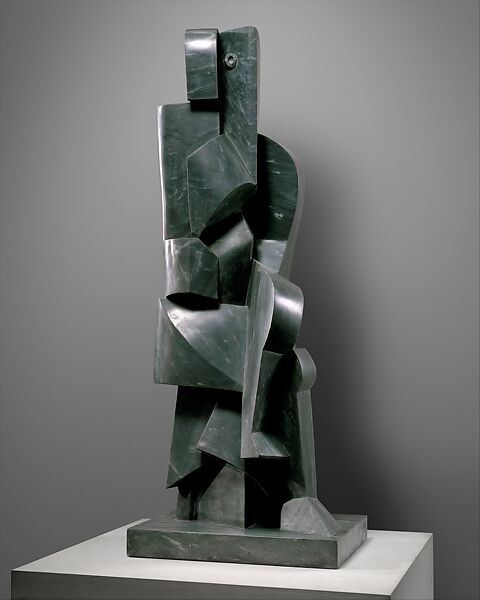
Bather
Philadelphia Museum of Art
Modeled in 1917; cast by 1961
Bronze
Here, Lipchitz has reduced the figure to its most basic and abstract elements. He has then fractured those parts into geometric protrusions that move in different directions. Essentially, Lipchitz has taken a two-dimensional Cubist work of art and made it round, or three-dimensional, as shown above.
Picasso, the cofounder of Cubism, also turned his extraordinary talent toward sculpting. While Lipchitz’s Bather is an example of bronze casting, Picasso’s Guitar is an example of assemblage.
 View Guitar.
In this sculpture, Picasso masterfully manipulates cardboard and metal wire, assembling these materials into a complex object. His technique of layering his materials cleverly creates an illusion of depth that surpasses the actual physical dimensions of the work, challenging and distorting the viewer’s expectations of form and space. A particularly striking example of this is the sound hole of the guitar, which, rather than receding into the instrument as one might expect, protrudes outward from the sculpture’s surface instead. This unexpected inversion adds a dynamic element to the work, emphasizing Picasso’s innovative approach to redefining traditional perceptions of sculptures and physicality.
Alexander Archipenko’s Woman Combing Her Hair is another example of a Modernist interpretation of a classical subject.
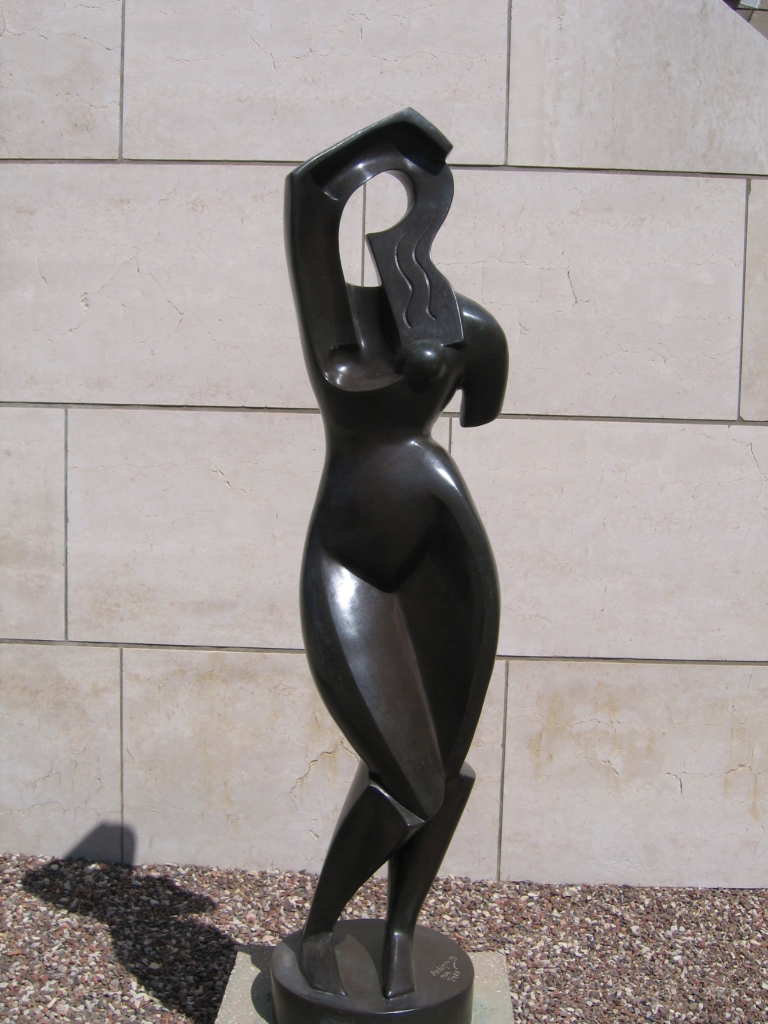
Woman Combing Her Hair
Israel Museum, Jerusalem
1914 or 1915
Bronze
Archipenko’s bronze sculpture brilliantly showcases his ability to distill a form to its essential elements without sacrificing the core theme of the piece. He includes just enough detail to convey the narrative, skillfully balancing reduction with expression. The lower body of the sculpture adopts a contrapposto stance, realistically depicting the shift in weight—a testament to his understanding of human anatomy. As the eye moves upward, however, the sculpture’s forms become increasingly more abstract. The upper portion simplifies to merely an arm, perhaps a hint of a comb and a subtle indication of hair, leaving much to the viewer’s interpretation. Significantly, the head and left arm are omitted, deemed nonessential by the artist for conveying the intended message. This selective abstraction underscores Archipenko’s mastery in merging minimalist form with expressive content.
Compare the image of Woman Combing Her Hair #1 with this image below.
 View Woman Combing Her Hair.
This assemblage sculpture by Julio González exemplifies his adeptness at reducing form to its most essential elements—a technique also mastered by other artists despite their works’ initial differences in appearance. González’s sculpture acts as a framework, inviting viewers to use their imagination to fill in the missing details and complete the visual narrative. This interaction highlights the minimalist nature of his work and engages the audience in an active interpretation and visualization process.
British artist Henry Moore’s Family Group is an abstract interpretation of the traditional family group portrait.
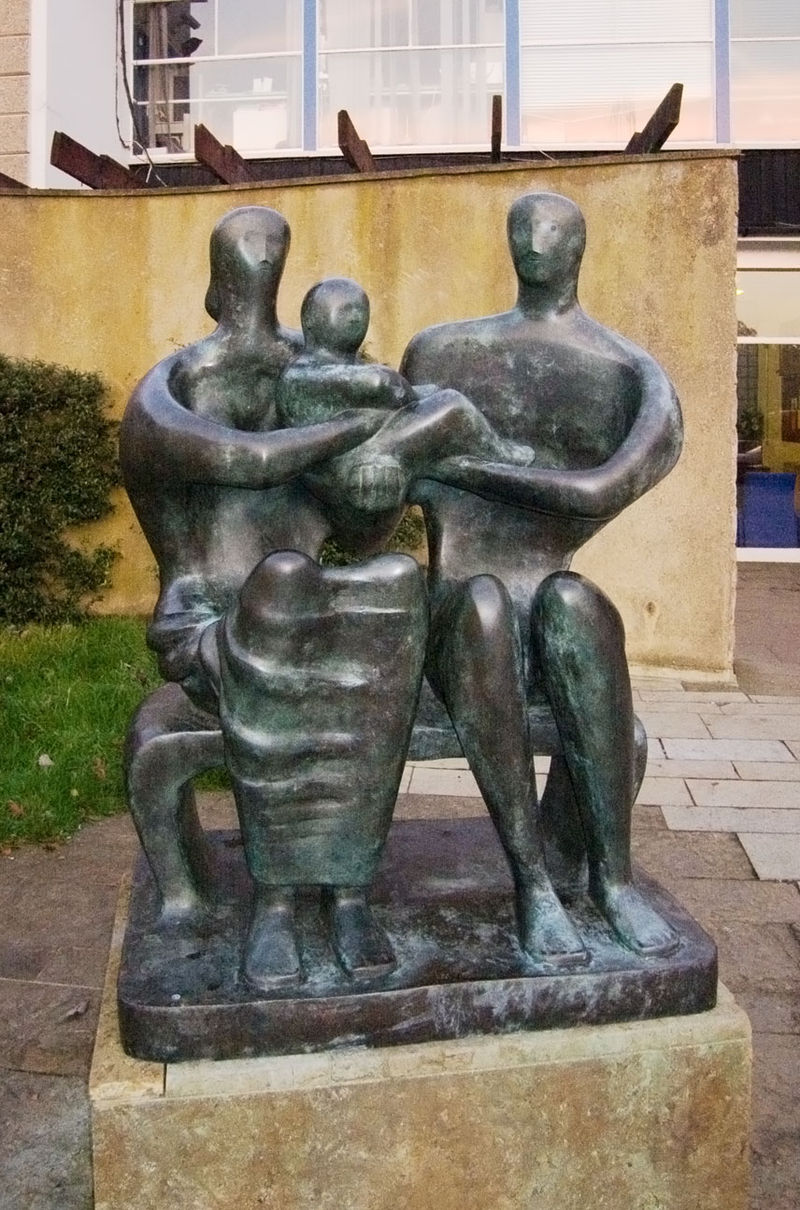
Family Group
Barclay School, Stevenage, Hertfordshire, England
1950
Bronze
Family Group was produced after World War II, a time when the themes of rebirth, family, and community were especially poignant. The devastation of the war influenced Moore to focus on more intimate, human subjects as opposed to the broader, sometimes abstract forms he had previously emphasized.
Family Group greatly influenced the development of modern sculptures, particularly in how it combined abstract forms with humanist themes. Moore’s approach influenced subsequent generations of sculptors to explore similar themes and to think about sculpting in terms of its social and environmental contexts.
Henry Moore’s Family Group not only marks a significant development in his artistic trajectory but also contributes to the narrative of modern sculptures as mediums through which deeply human and universally relevant themes are explored and expressed.
At times, some works of art get overlooked by the average individual when modern art is critiqued. This may be the case with the sculpture below.
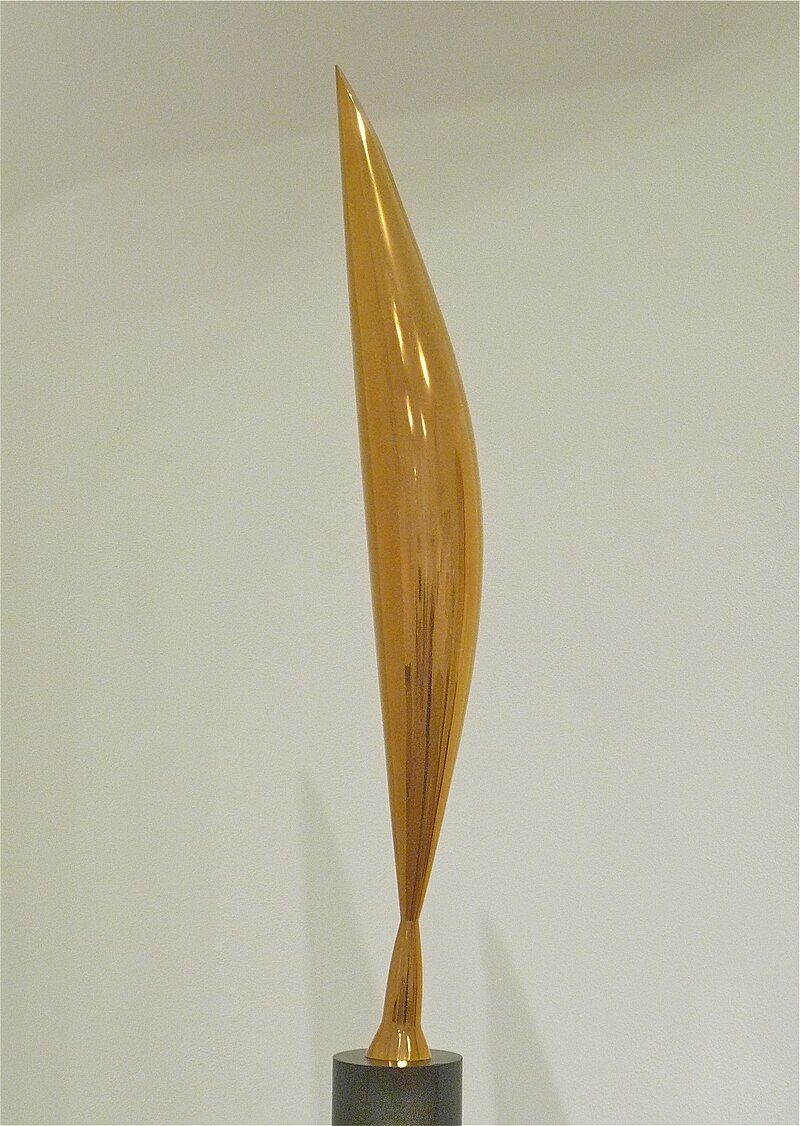
Bird in Space
Philadelphia Museum of Art
1923–1940
Marble or bronze (originals; multiple copies)
The sculpture above embodies simplicity. Many view it as having a timeless appeal—elegant, beautiful, and visually accessible. The subject matter is distilled to its essence, teetering on the edge of abstraction without losing the artist’s intended depiction. Some may interpret the form as reminiscent of a bird—particularly its beak—slicing through space, nearly enveloped by a cloak of wind and streaks of speed, akin to something entering the atmosphere.
The images in this lesson were arranged on the basis of their level of abstraction rather than in chronological order. They are ordered to show the reduction of form to pure abstraction, and as the lesson has gone on, the images have become more and more abstract.
 View Three Forms.
Barbara Hepworth’s Three Forms, shown above, is an example of pure abstraction. There is no discernible human form or object. It’s simply three spherical and elongated shapes placed in proximity to each other. But there’s something appealing about it. Hepworth hasn’t simply glued three rocks to a slab. The forms are carefully shaped with dimensions that are proportional to each other and situated within a triangular arrangement that is also proportional in its dimensions. Hepworth has completely removed the color. It’s a monochromatic experience of pure shape and pure form that truly exemplifies Modernism as well as abstraction.
Source: THIS TUTORIAL WAS AUTHORED BY IAN MCCONNELL AND TAMORA KOWALSKI FOR SOPHIA LEARNING. PLEASE SEE OUR TERMS OF USE.



