Use Sophia to knock out your gen-ed requirements quickly and affordably. Learn more
×

Area

Author: Sophia

what's covered
In this lesson, you will find areas by using formulas and approximation methods. So far, we have been using differential calculus to solve problems by finding rates of change. We are now moving into integral calculus, in which areas are used as a visual to solve problems. In this section, we will start by finding areas that involve combining simpler areas. Specifically, this lesson will cover:

Table of Contents

1. Finding the Area by Using Geometric Formulas

Before we get into the connection between areas and calculus, let’s get some practice finding areas of some shapes using basic geometric formulas.

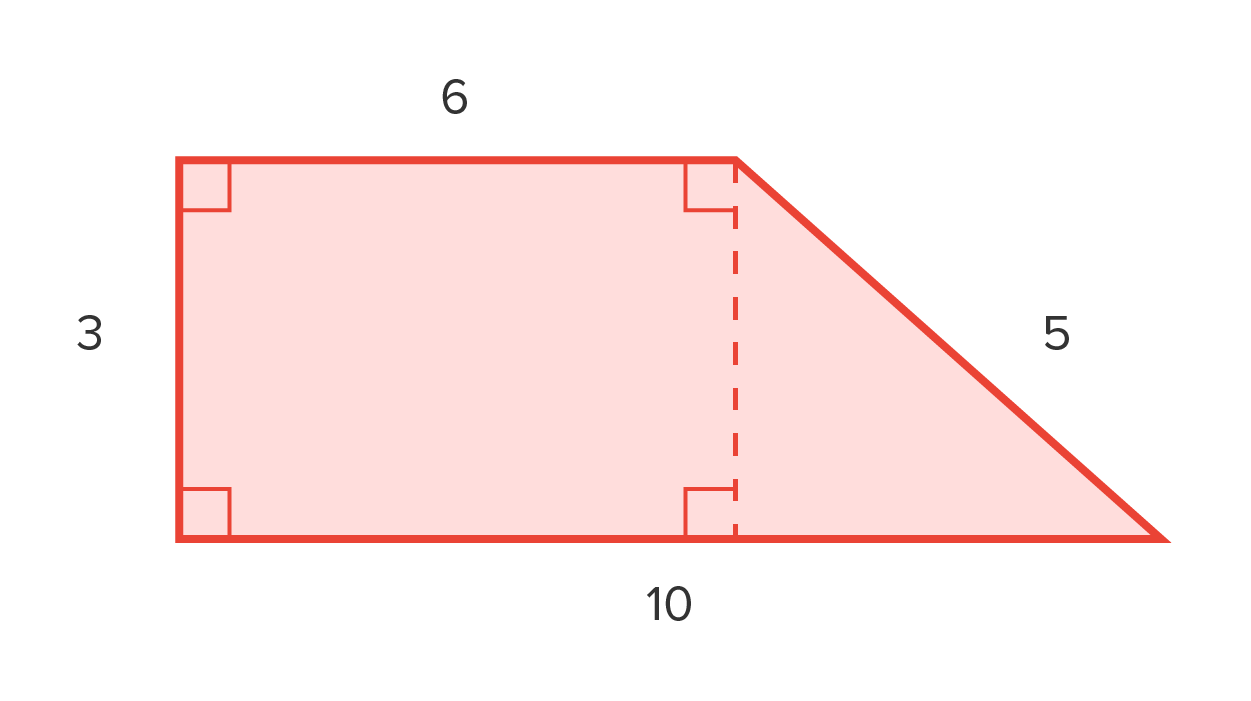
Consider the figure shown here.
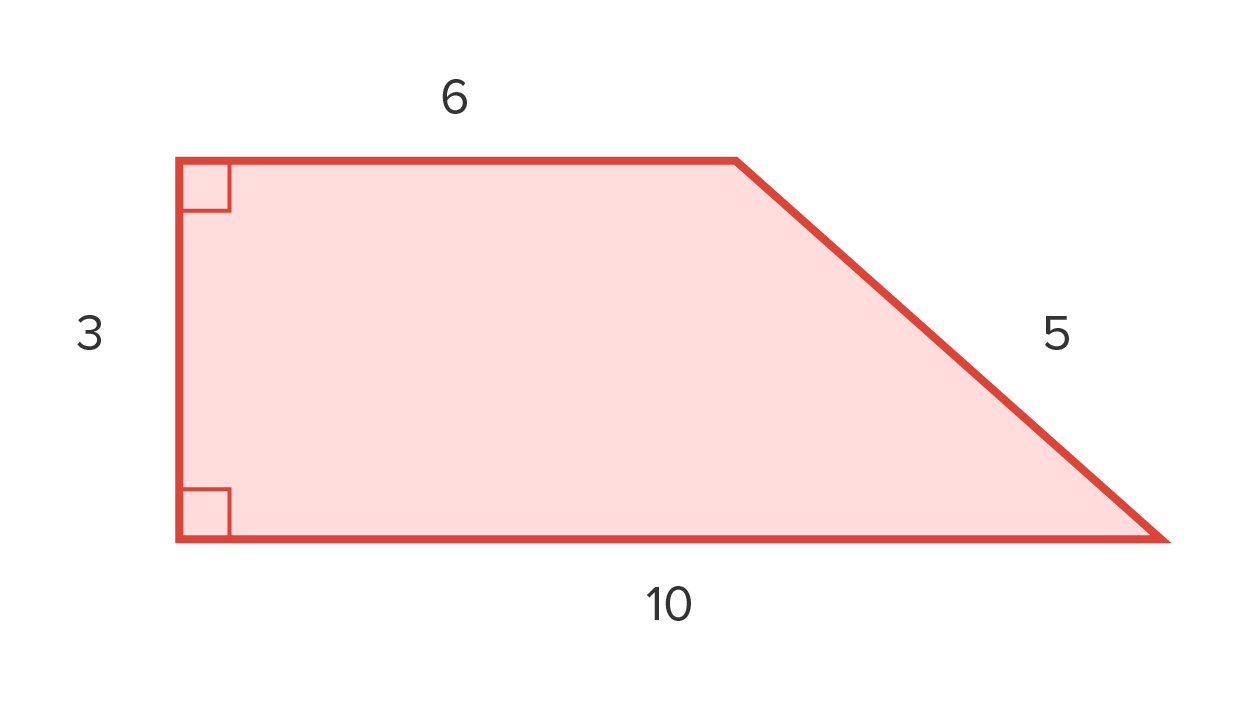
A trapezoid with horizontal sides labeled ‘6’ and ‘10’ represents parallel bases: the vertical side labeled ‘3’, representing height, and the slanted side labeled ‘5’. Two small squares at the intersections of the vertical side with the horizontal sides represent right angles. The area of the trapezoid is shaded.

There are three ways to find the area.

  • Method I: This is a trapezoid, with area formula A equals 1 half h open parentheses b subscript 1 plus b subscript 2 close parentheses comma where h is the height and b subscript 1 and b subscript 2 are the lengths of the parallel bases.

    Then, A equals 1 half open parentheses 3 close parentheses open parentheses 10 plus 6 close parentheses equals 24 space units squared.
  • Method II: Split the trapezoid into a rectangle and a triangle, as shown in the figure below.

    The area of the rectangle is 3 open parentheses 6 close parentheses equals 18 space units squared.

    The triangle has base 4 (found by 10 – 6) and height 3.

    The area of the triangle is 1 half open parentheses 4 close parentheses open parentheses 3 close parentheses equals 6 space units squared.

    A trapezoid with horizontal sides labeled ‘6’ and ‘10’ represents parallel bases: the vertical side labeled ‘3’, representing height, and the slanted side labeled ‘5’. A dashed vertical line extends from the end of the shorter base to the corresponding point on the longer base, forming a right-angled triangle with the slanted line. The right angles between the vertical and horizontal sides are represented by two small squares. Additionally, the right angles between the horizontal sides and the dashed line are represented by two small squares. The area of the trapezoid is shaded.

    The combined area is 18 plus 6 equals 24 space units squared.
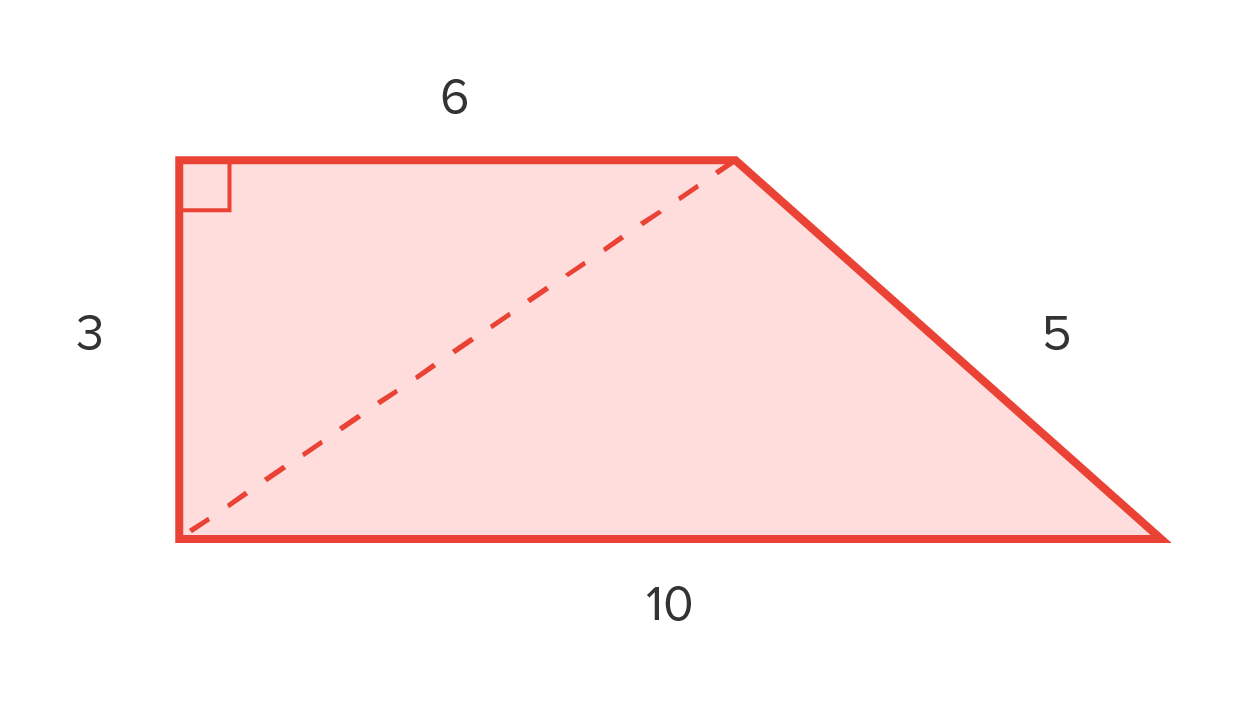
  • Method III: Split the trapezoid into two triangles, as shown in the figure below.

    A trapezoid with horizontal sides labeled ‘6’ and ‘10’ represents parallel bases: the vertical side labeled ‘3’, representing height, and the slanted side labeled ‘5’. The right angle between the vertical side and the horizontal side labeled ‘6’ is represented by a small square. A dashed line runs diagonally from the vertex where the vertical side labeled ‘3’ meets the horizontal side labeled ‘10’ to the vertex where the horizontal side labeled ‘6’ meets the slanted line labeled ‘5’. The area of the trapezoid is shaded.

    The area of the triangle on the left is A equals 1 half open parentheses 6 close parentheses open parentheses 3 close parentheses equals 9 space units squared.

    The area of the triangle on the right is A equals 1 half open parentheses 10 close parentheses open parentheses 3 close parentheses equals 15 space units squared.

    Once again, the combined area is 9 plus 15 equals 24 space units squared.
hint
Even though the trapezoid formula was the most straightforward method to find the area, most people are more comfortable with rectangles and triangles.

try it
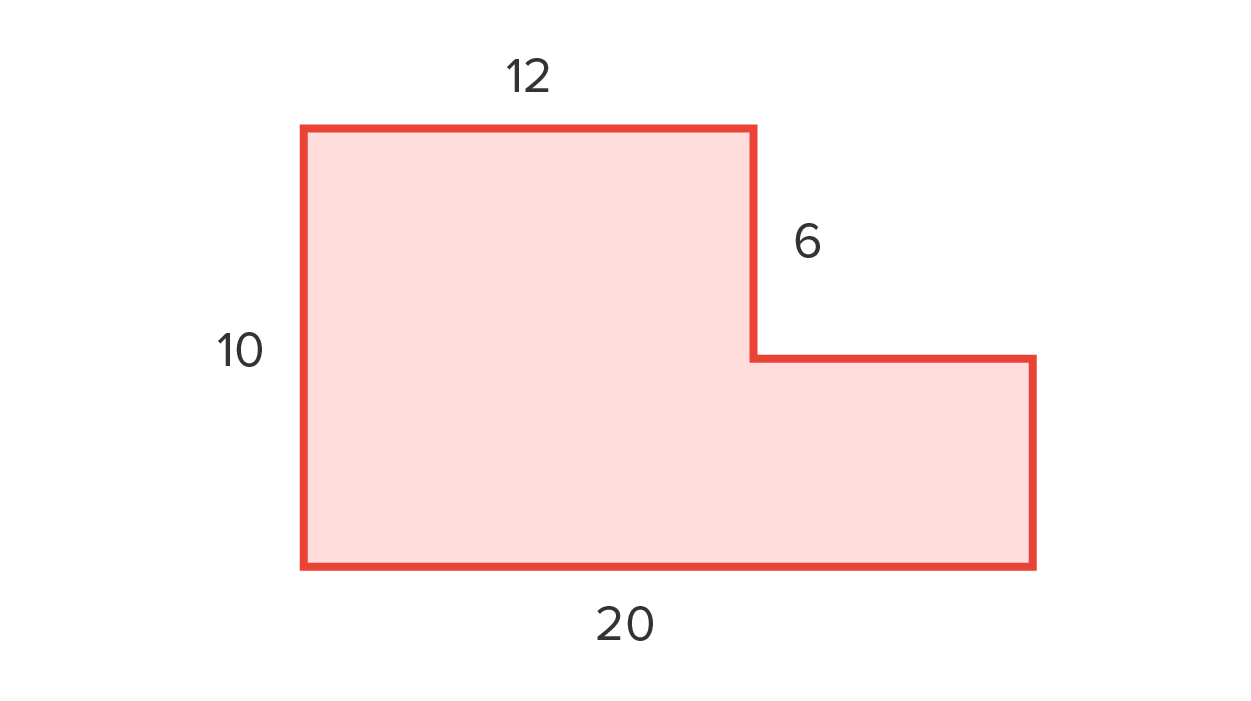
Consider the shape below:

A composite ‘L-shaped’ polygon that looks like a smaller rectangle on top of a longer rectangle, leaving a gap in the top right. The left vertical side is labeled ‘10’, and the top horizontal side is labeled ‘12’. The right vertical side is labeled ‘6’, and the bottom horizontal side is labeled ‘20’. The shape can be divided into two rectangles.
Find the area of this shape.
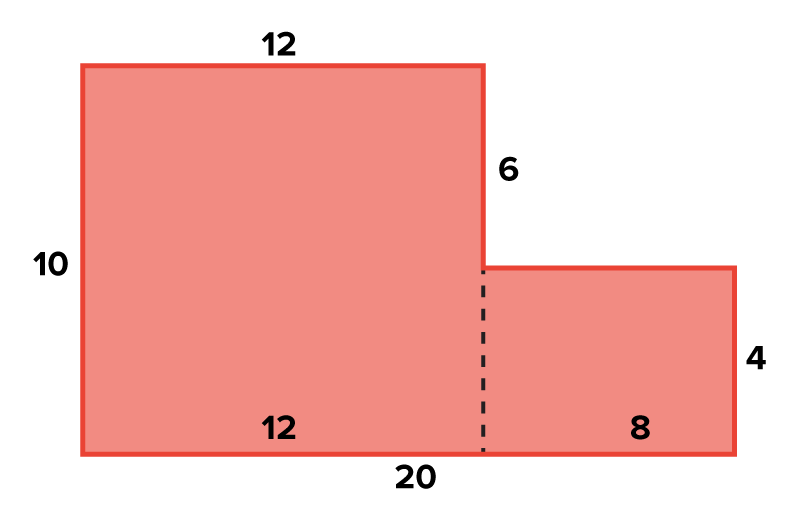
Split the figure into two rectangles and label as follows:

A composite L-shaped polygon made up of two rectangles joined together. The larger rectangle on the left has a height labeled ‘10’ and a width labeled ‘12’. The smaller rectangle on the right has a height labeled ‘4’ and a width labeled ‘8’. The total width of the combined shape is 20 units. A vertical dashed line separates the two rectangles. The vertical distance between the top of the larger rectangle and the top of the smaller rectangle is labeled ‘6’.

The area of the left-hand rectangle is 10 open parentheses 12 close parentheses equals 120 space units squared.
The area of the right-hand rectangle is 8 open parentheses 4 close parentheses equals 32 space units squared.

The total area is 120 plus 32 equals 152 space units squared.

Let’s look at an example where there is a “hole” in the shape.

EXAMPLE

Find the area of the shape (represented by the shaded region), assuming each side is measured in inches.
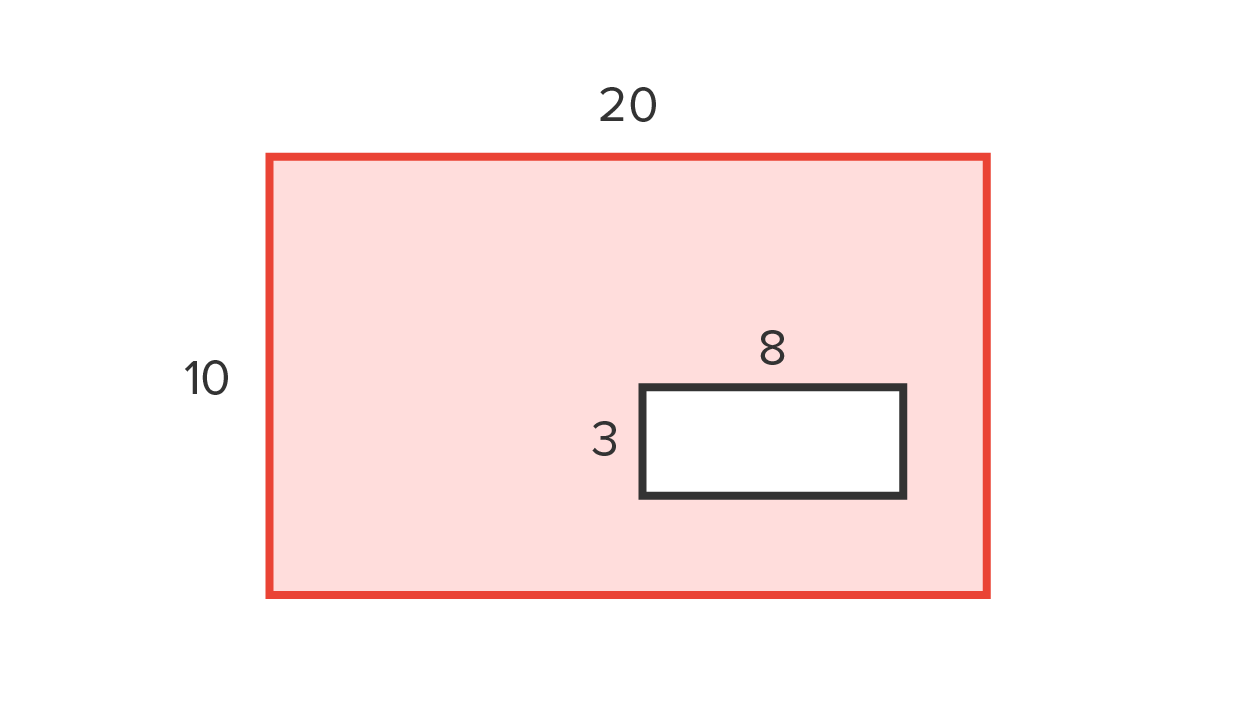

A bigger rectangle of length labeled ‘20’ and width labeled ‘10’. A smaller rectangle of length labeled ‘8’ and width labeled ‘3’ lies to the right within the bigger rectangle. The area enclosed by the smaller rectangle is unshaded and the area enclosed by the bigger rectangle is shaded.

The outer rectangle has area 10 open parentheses 20 close parentheses equals 200 space in squared. The hole, also in the shape of a rectangle, has area 24 space units squared. Then, the area of the shape is the difference between the areas: 200 minus 24 equals 176 space in squared.

We can also find areas when certain graphs are used, since they are familiar shapes. Before diving in, here is a summary of equations that, when graphed, could form areas we know from formulas:

Forms Equation
Horizontal line y equals b
Slanted line y equals m x plus b
Circle with radius r x squared plus y squared equals r squared
Semicircle with radius r y equals square root of r squared minus x squared end root

EXAMPLE

Find the area of the region bounded by the x-axis, the line x equals 5, and the line y equals 2 x. The graph of the region is shown in the figure below.
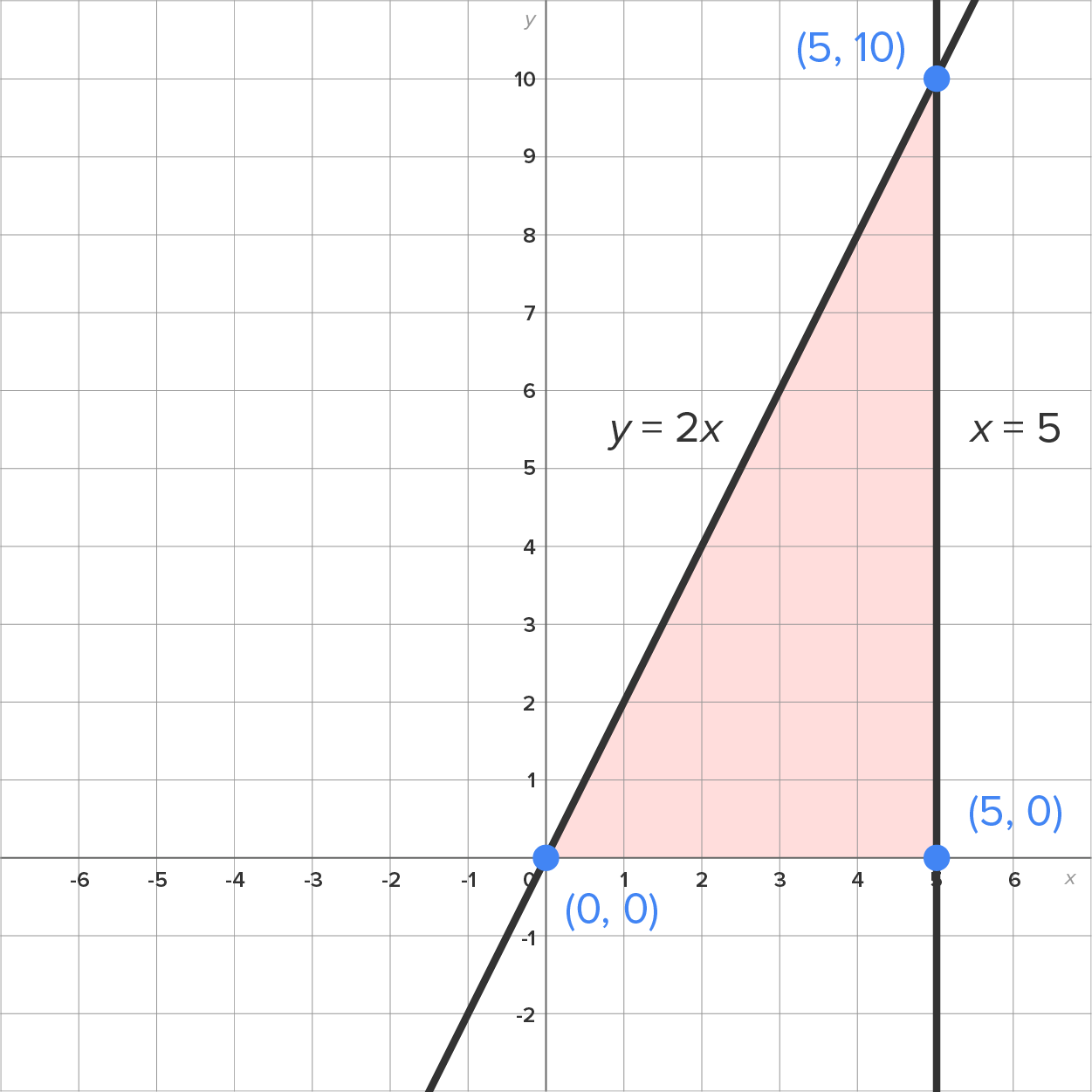
A graph with an x-axis ranging from –6 to 6 and a y-axis ranging from –2 to 10. A line labeled ‘y equals 2x’ slants upward from the third quadrant to the first quadrant by passing through the marked points at (0, 0) and (5, 10). A vertical line labeled ‘x equals 5’ runs upward from the fourth quadrant to the first quadrant by passing through the marked point at (5, 0) and intersecting the first line at the marked point (5, 10). The area enclosed by the two slanted lines above the x-axis is shaded.

The region is triangular, with base 5 and height 10.

Thus, the area of the region is A equals 1 half open parentheses 5 close parentheses open parentheses 10 close parentheses equals 25 space units squared.

EXAMPLE

The figure below shows the graph of the region between f open parentheses x close parentheses equals square root of 4 minus x squared end root and the x-axis. What is the area of this region?

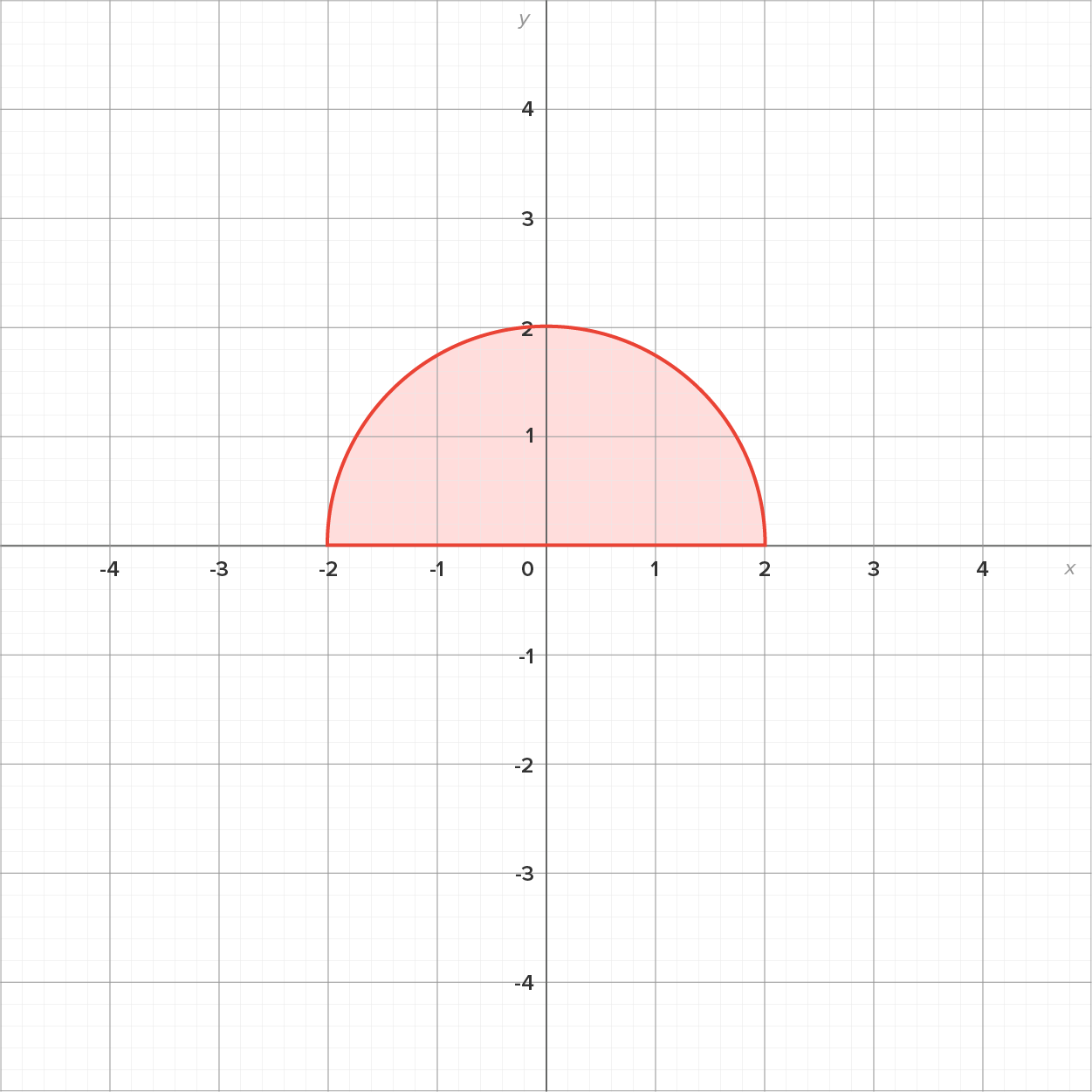
A graph with an x-axis and a y-axis ranging from –4 to 4. A semicircle starts from the point (–2, 0) and ends at the point (2, 0) by passing through its high point (0, 2) on the y-axis. The area enclosed by the semicircle is shaded up to the x-axis.

This region is a semicircle whose radius is 2. Recall the area of a circle is A equals πr squared.

The area of the region is 1 half times straight pi open parentheses 2 close parentheses squared equals 2 straight pi space units squared.

try it
Consider the graph below:

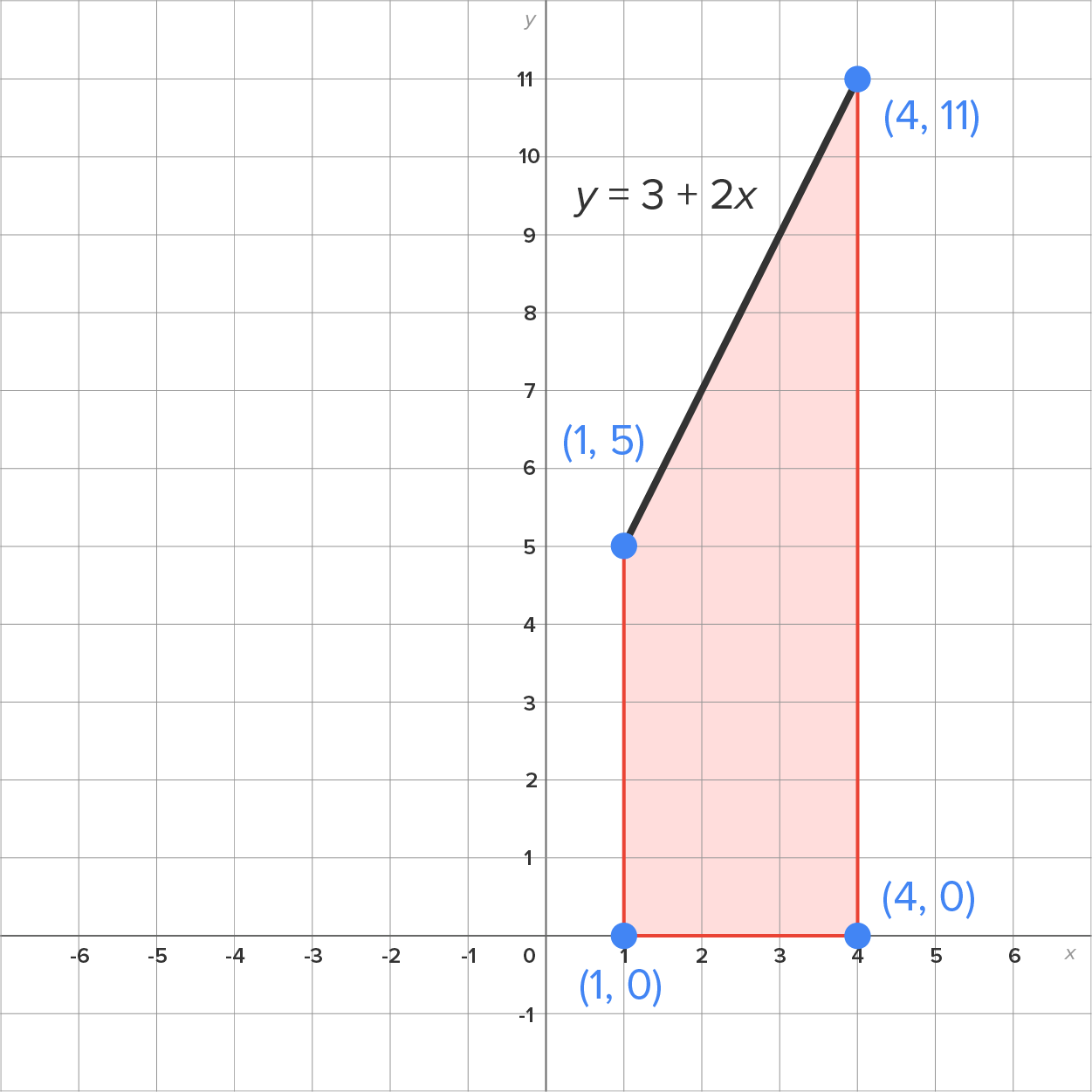
A graph with an x-axis ranging from –6 to 6 and a y-axis ranging from –1 to 11. A line ‘y equals 3 + 2x’ slants upward from the marked point at (1, 5) to the marked point (4, 1). A line rises from the marked point at (1, 0) to join the slanted line at the marked point (1, 5). A vertical line rises from the marked point at (4, 0) to join the slanted line at the marked point (4, 11). The area bounded by the slanted line between x equals 1 and x equals 4 above the x-axis is shaded.

Find the area of the region in the graph.
The figure is in the shape of a trapezoid. The parallel bases have lengths 5 and 11; while the height (which is along the x-axis) has length 3.

The area of the trapezoid is h over 2 open parentheses b subscript 1 plus b subscript 2 close parentheses equals 3 over 2 open parentheses 5 plus 11 close parentheses equals 24 space units squared.

hint
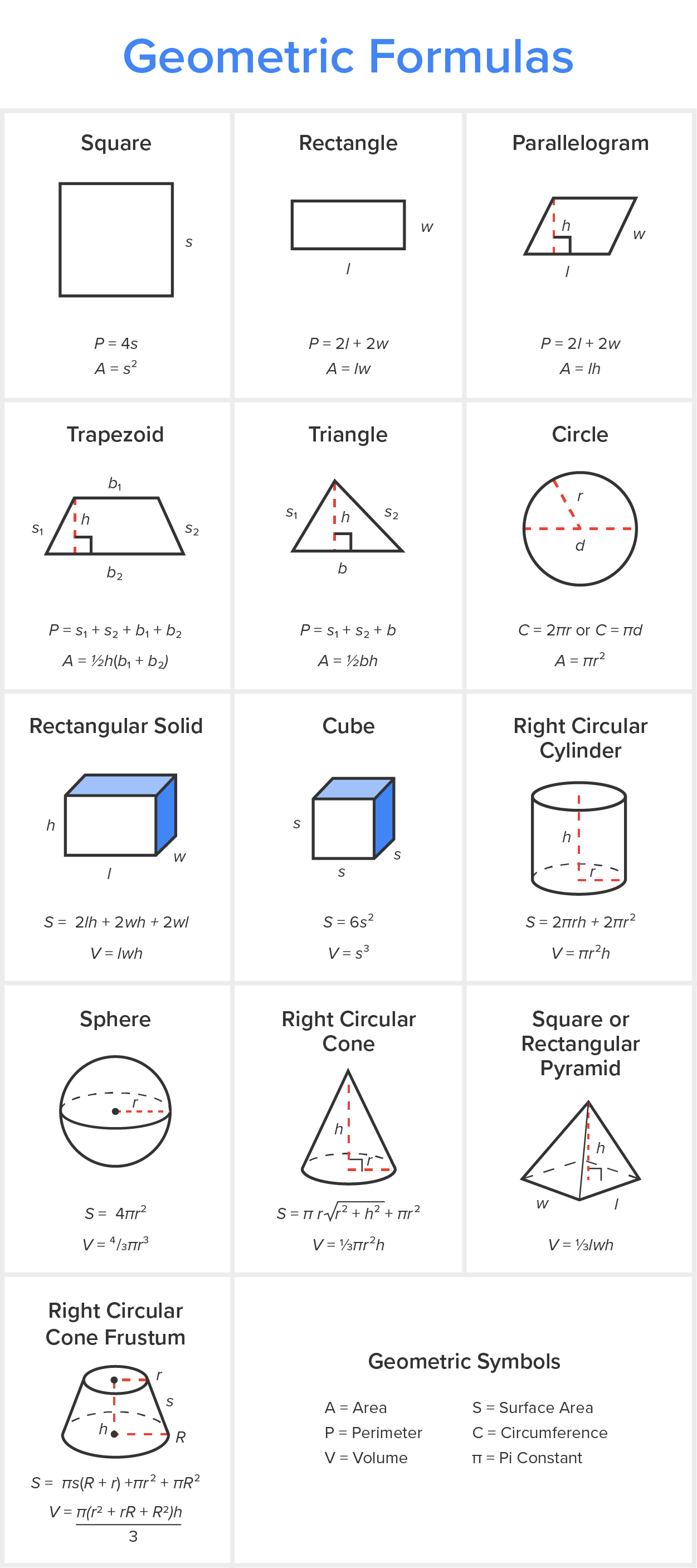
Since you will be using areas to solve problems in this unit, refer to this sheet which contains formulas for areas of various shapes (circles, trapezoids, etc.). This is also available as a PDF file at the end of this tutorial.

A table providing details on ‘Geometric Formulas’ and ‘Geometric Symbols.’ The geometric symbols are as follows: A equals Area, P equals Perimeter, V equals Volume, S equals Surface area, C equals Circumference, π equals Pi constant. The geometric formulas are as follows: The formulas for a square are P equals 4s and A equals s squared, where s represents the length of each side.  The formulas for a rectangle are P equals 2l + 2w and A equals lw, where l represents the length and w represents the width. The formulas for a parallelogram are P equals 2l + 2w and A equals lh, where l represents the length, w represents the width, and h represents the height. The formulas for a trapezoid are P equals s1 + s2 + b1 + b2 and A equals 1/2h(b1 + b2), where b sub 1 and b sub 2 are the parallel sides, s sub 1 and s sub 2 are the nonparallel sides, and h is the height. The formulas for a triangle are P equals s1 + s2 + b and A equals 1/2bh, where s sub 1 and s sub 2 are the sides, b is the base, and h is the height. The formulas for a circle are C equals 2πr or C equals πd and A equals πr2, where r is the radius and d is the diameter. The formulas for a rectangular solid are S equals 2lh + 2 wh + 2wl and V equals lwh, where l represents the length, w represents the width, and h represents the height. The formulas for a cube are S equals 6 s squared and V equals s cubed, where s represents the length of each side. The formulas for a right circular cylinder are S equals 2πrh + 2πr2 and V equals πr2h, where r represents the radius and h represents the height. The formulas for a sphere are S equals 4πr squared and V equals 4/3πr cubed, where r represents the radius. The formulas for a right circular cone are S equals πr multiplied by the square root of (r squared + h squared) + πr squared and V equals 1/3πr squared times h, where r represents the radius and h represents the height. The formula for a square or rectangular pyramid is V equals 1/3lwh, where l represents the length, w represents the width, and h represents the height. The formulas for a sphere are S equals πs (R + r) + πr squared+ πR squared and V equals π(r squared + r time R + R squared)h/3, where r and R are the radii of the top and bottom circles, h is the height, and s is the slant height.


2. Approximating Areas by Using Rectangles and Graphs

There are some regions, particularly those which come from a graph, which cannot be found using formulas.

For example, consider the region bounded by the graphs of y equals x squared plus 3, the x-axis, x = 1, and x = 3. The region is shown below.
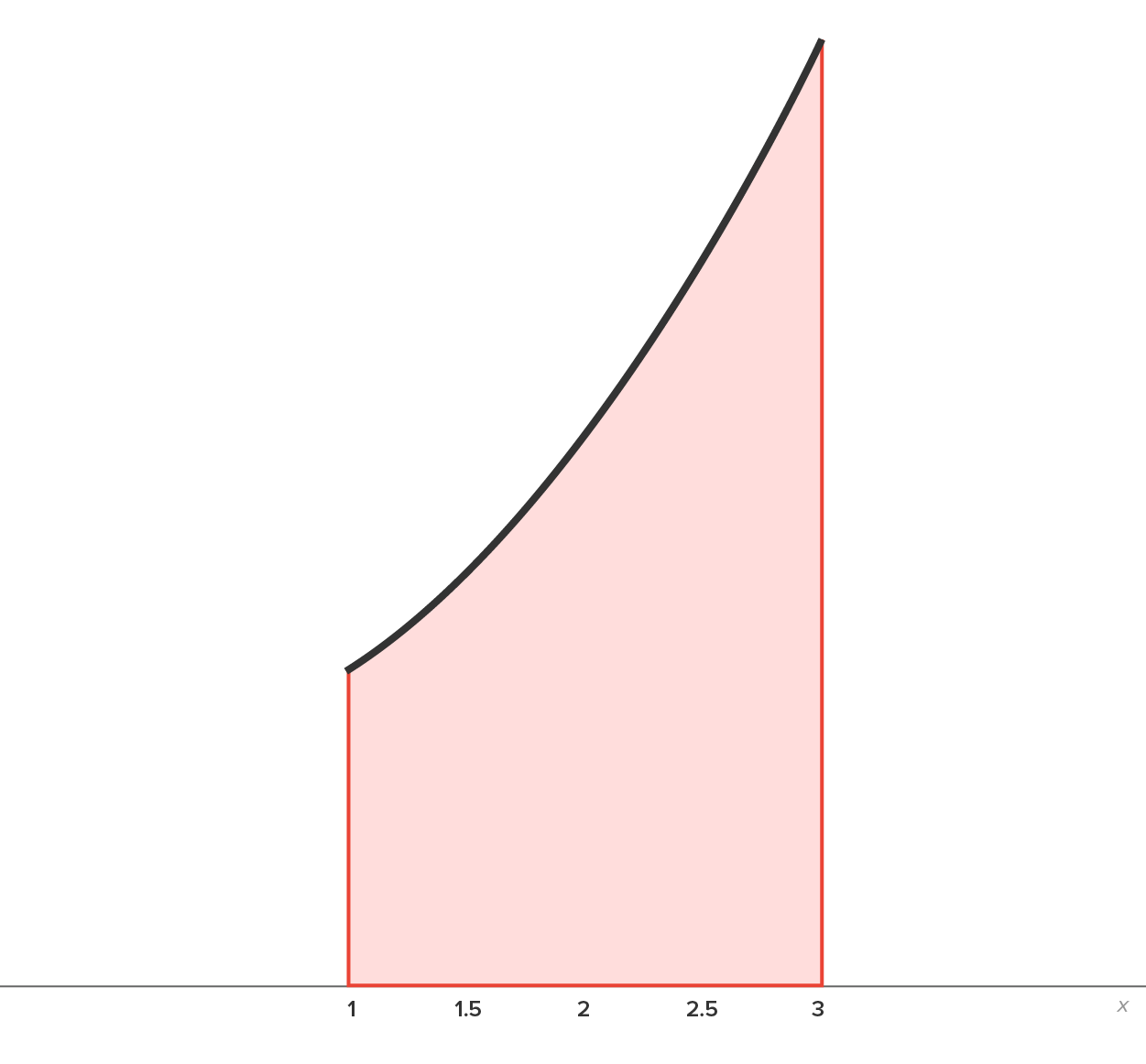
A graph with an x-axis ranging from 1 to 3 at intervals of 0.5. Two vertical lines at x equals 1 and x equals 3 rise from the x-axis; the line x equals 3 is taller than the line x equals 1. A curve opens upward, starts from the top of the line x equals 1, and ends at the top of the line x equals 3. The area under the curve between x equals 1 and x equals 3 is shaded.

A major focus of integral calculus is being able to find areas of regions like this. For now, we need to come up with a way to estimate the area.

The most convenient way is to use rectangles whose bases are along the x-axis. This is illustrated in the next few examples.

EXAMPLE

Approximate the area of the region bounded by y equals x squared plus 3, the x-axis, x = 1, and x = 3, as shown in the graph below:
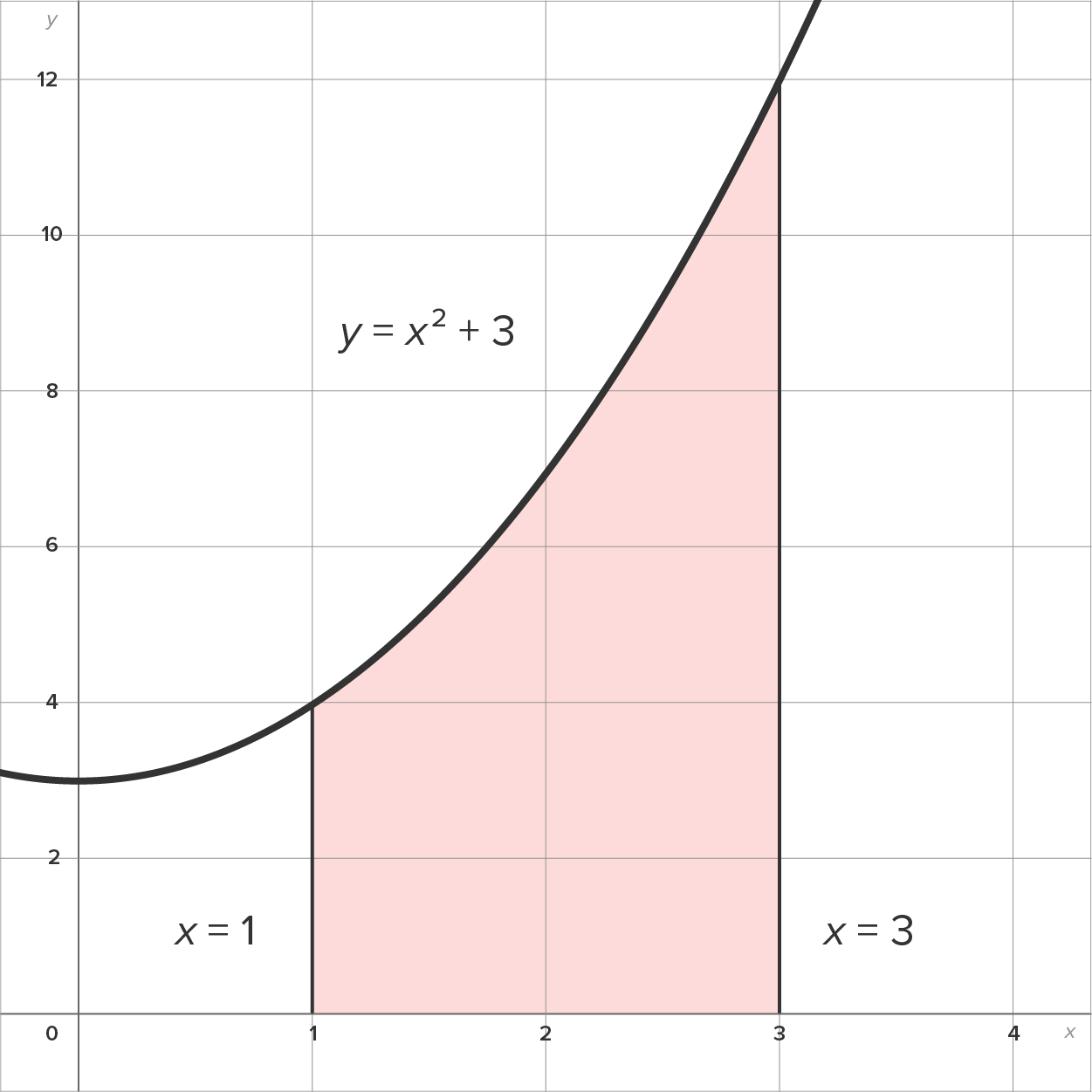
A graph with an x-axis ranging from 0 to 4 and a y-axis ranging from 0 to 12 at intervals of 2. A curve, y equals x squared + 3, opens upward, starts from the left of the y-axis, and rises in the first quadrant by passing through the points (0, 3), (1, 4), and (3, 12). Two lines at x equals 1 and x equals 3 rise from the x-axis to meet the curve at the points (1, 4) and (3, 12), respectively. The area under the curve from x equals 1 to x equals 3 is shaded.

To find this area, first find the combined area of the rectangles, as shown in each figure.

Graph Description
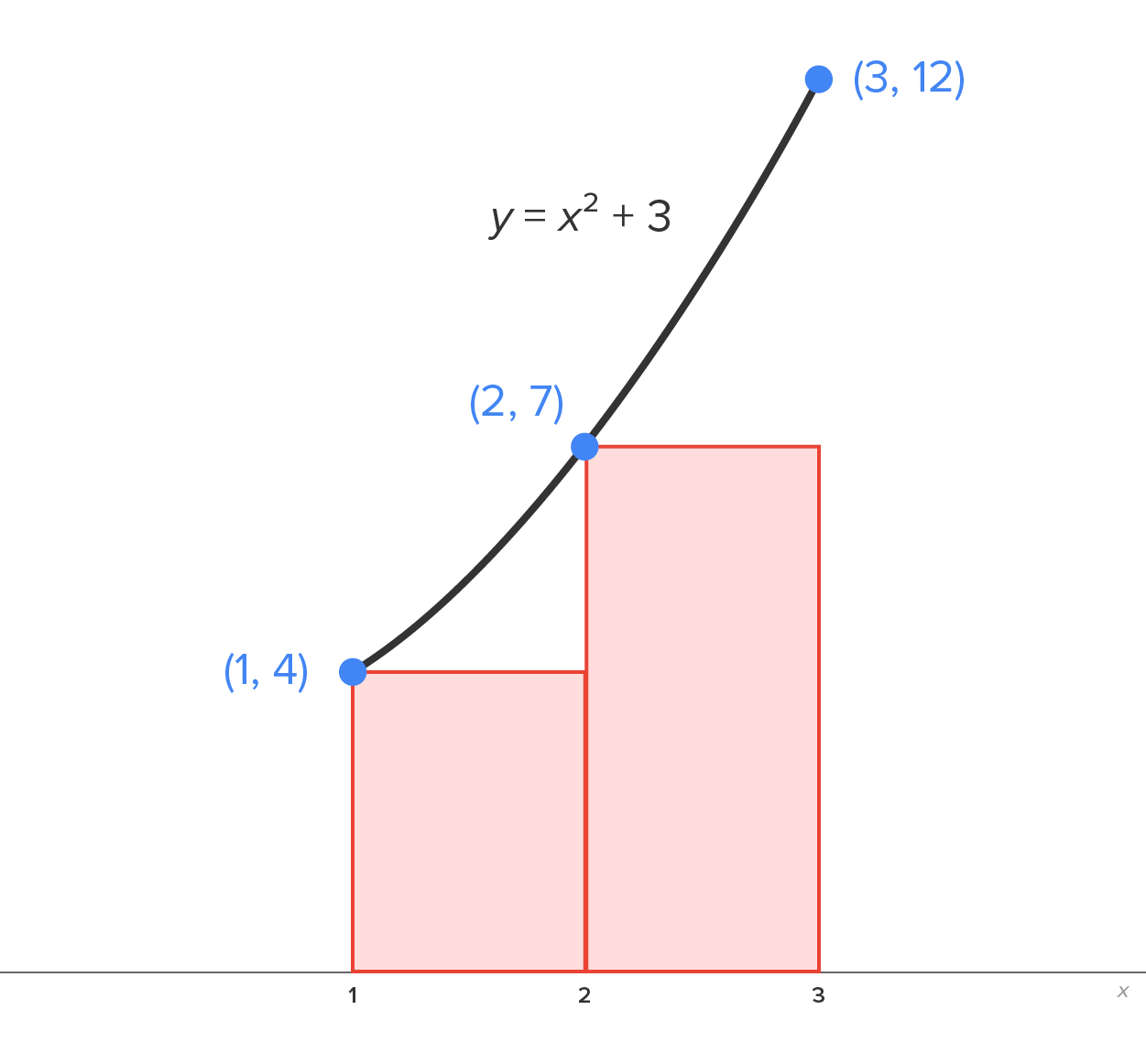
A graph with an x-axis ranging from 1 to 3. Two rectangular bars correspond to subintervals 1–2 and 2–3, respectively, on the x-axis. The bars increase in height as ‘x’ increases. A curve ‘y equals x squared + 3’ rises from the marked point (1, 4) at the top left corner of the first rectangular bar to the marked point (3, 12) by passing through the marked point (2, 7) at the top left corner of the second rectangular bar. The total area of the rectangular bars is shaded. The rectangles used here are inscribed, meaning the largest possible rectangle drawn within the region. Notice how one corner of each rectangle is also on the curve.

  • Each rectangle is 1 unit wide.
  • The rectangle on the left has a height of 4 units.
  • The area of the first rectangle is open parentheses 1 close parentheses open parentheses 4 close parentheses equals 4 space units squared.
  • The rectangle on the right has a height of 7 units.
  • The area of the second rectangle is open parentheses 1 close parentheses open parentheses 7 close parentheses equals 7 space units squared.
The combined area is 11 space units squared. We know this is an underestimate of the actual area since the rectangles are inscribed.
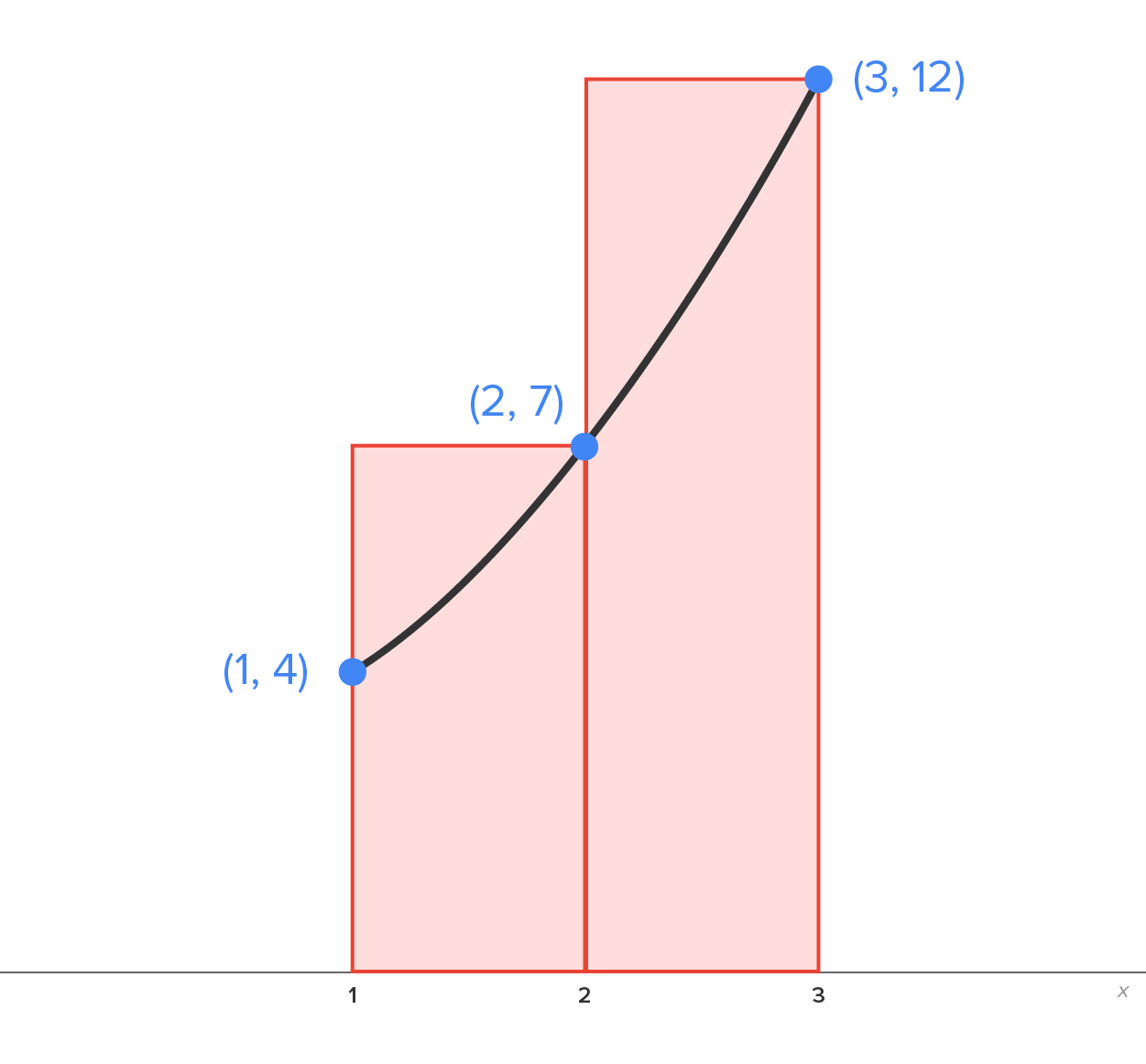
A graph with an x-axis ranging from 1 to 3. Two rectangular bars correspond to subintervals 1–2 and 2–3, respectively, on the x-axis. The bars increase in height as ‘x’ increases. There are three marked points labeled ‘(1, 4)’, ‘(2, 7),’ and ‘(3, 12)’. The marked point (1, 4) is about 2/3 of the way up the left side of the first bar, the marked point (2, 7) is at the top right corner of the first bar, and the marked point (3, 12) is at the top right corner of the second bar. A curve rises from the marked point (1, 4) to the marked point (3, 12) by passing through the marked point (2, 7). The total area of the rectangular bars is shaded. The rectangles used here are circumscribed, meaning drawn in such a way that the rectangle completely encloses the region, but is as small as possible. Notice how one corner of each rectangle is also on the curve.

  • Each rectangle is 1 unit wide.
  • The rectangle on the left has a height of 7 units.
  • The area of the first rectangle is open parentheses 1 close parentheses open parentheses 7 close parentheses equals 7 space units squared.
  • The rectangle on the right has a height of 12 units.
  • The area of the second rectangle is open parentheses 1 close parentheses open parentheses 12 close parentheses equals 12 space units squared.
The combined area is 19 space units squared. We know this is an overestimate of the actual area since the rectangles are circumscribed.

Since one estimate is an underestimate and one is an overestimate, one way to get a better approximation is to average them.

Using this logic, an estimate for the actual area is fraction numerator 11 plus 19 over denominator 2 end fraction equals 15 space units squared.

try it
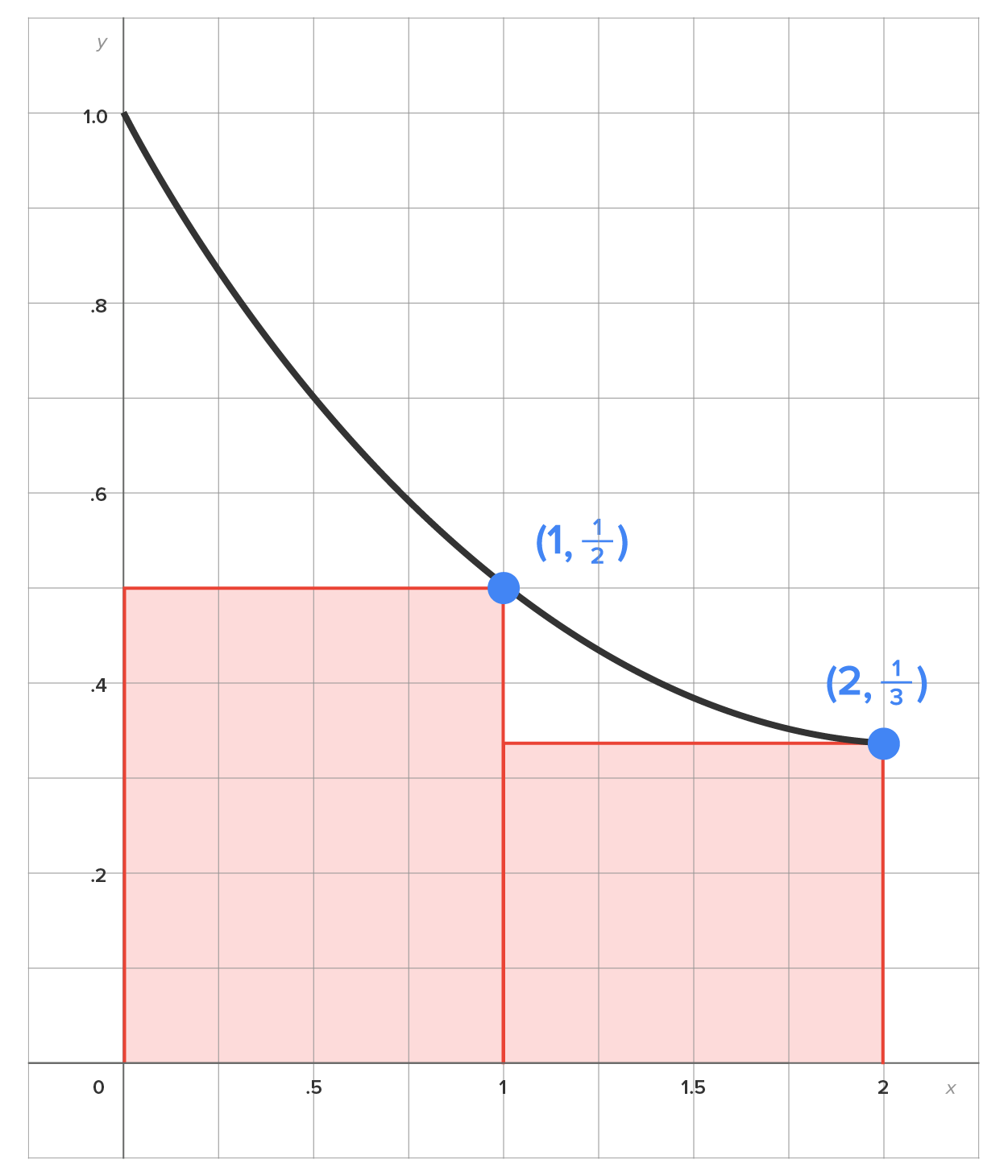
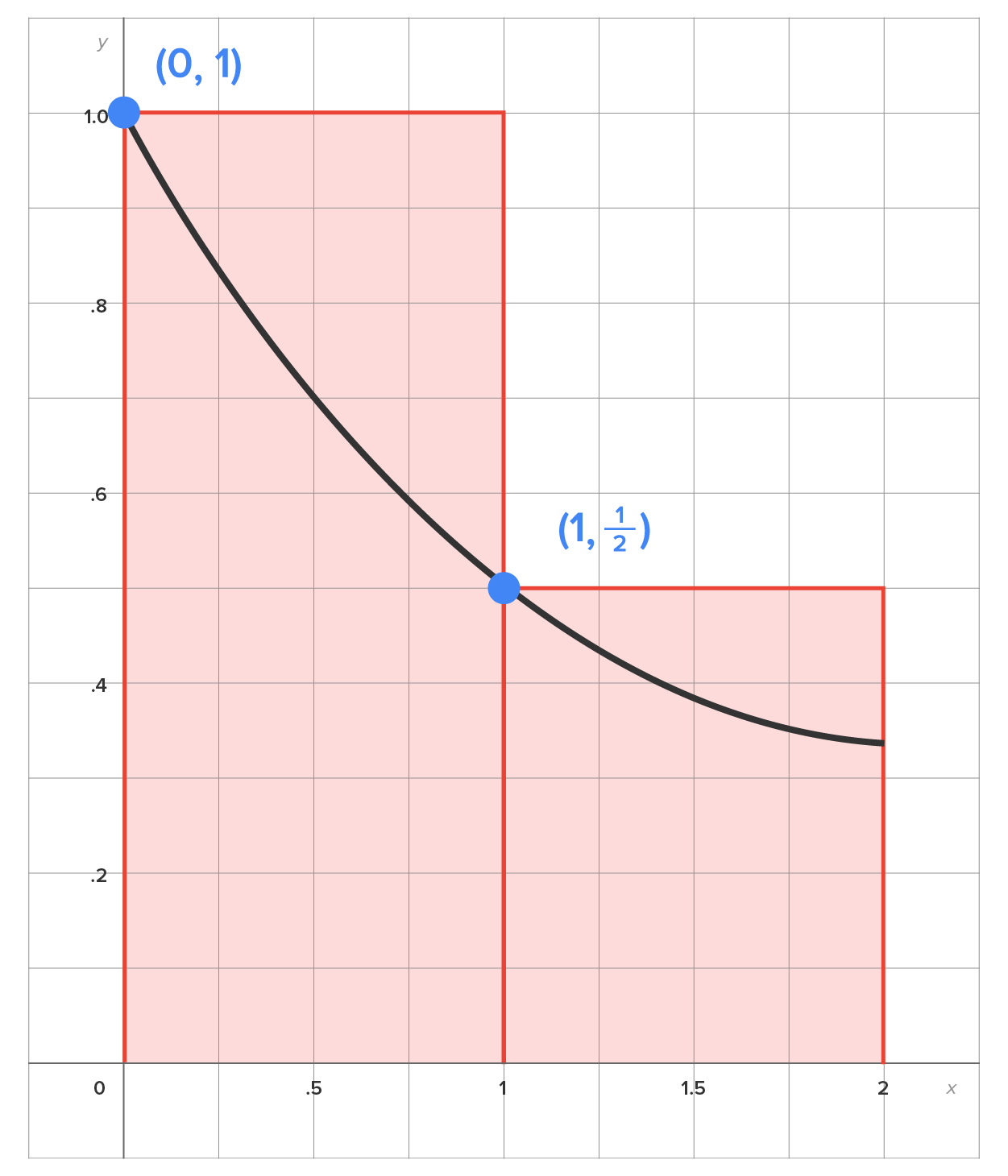
Approximate the area of the region bounded by y equals fraction numerator 1 over denominator x plus 1 end fraction, the x-axis, x equals 0, and x equals 2 by finding the combined area of the rectangles, as shown in each figure. Then, find the average of the estimates.

Figure 1 Figure 2
A graph with an x-axis ranging from 0 to 2 at intervals of 0.5 and a y-axis ranging from 0 to 1 at intervals of 0.2. Two rectangular bars correspond to subintervals 0–1 and 1–2, respectively, on the x-axis. The bars decrease in height as ‘x’ increases. A curve descends from the point (0, 1), passing through the marked points (1, 1/2) and (2, 1/3) at the top right corners of the rectangular bars, respectively. The total area of the rectangular bars is shaded. A graph with an x-axis ranging from 0 to 2 at intervals of 0.5 and a y-axis ranging from 0 to 1 at intervals of 0.2. Two rectangular bars correspond to subintervals 0–1 and 1–2, respectively, on the x-axis. A curve descends from the marked points (0, 1) and (1, 1/2) at the top left corners of the rectangular bars and ends at the point (2, 1/3).


Here is a final example that uses more rectangles.

EXAMPLE

Suppose we wish to estimate the area between the x-axis and the graph of y equals 60 over x on the interval open square brackets 1 comma space 3 close square brackets. The graph of the region is shown below.
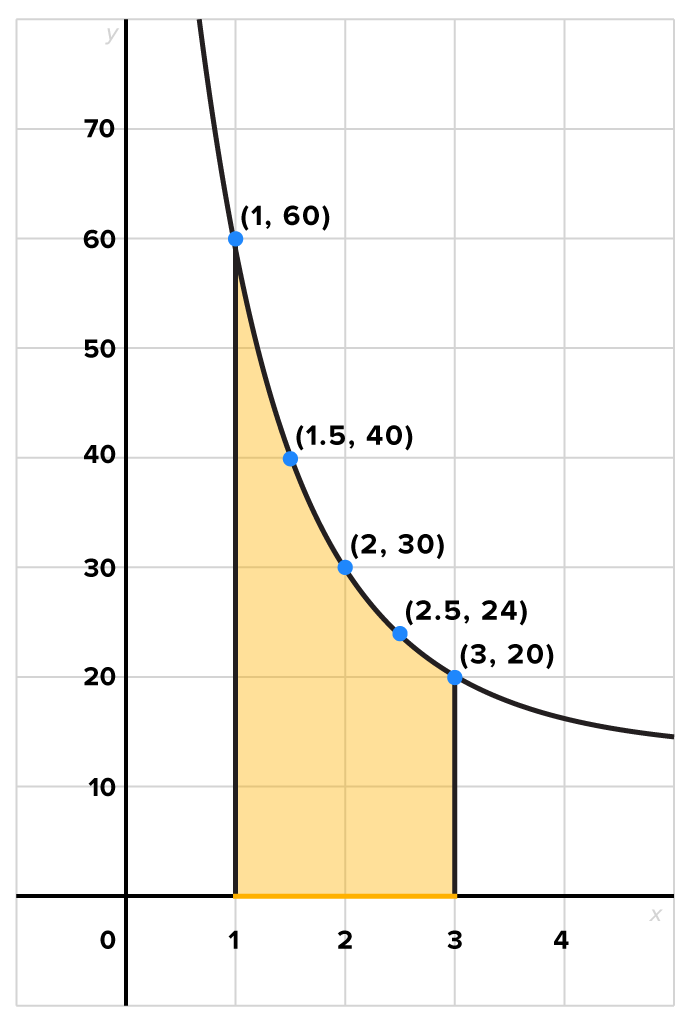
A graph with an x-axis ranging from 0 to 4 and a y-axis ranging from 0 to 70, at intervals of 10. A curve starts near the upper limit of the y-axis, passes through the marked points at (1, 60), (1.5, 40), (2, 30), (2.5, 24), and (3, 20), and then continues extending to the right. A vertical line extends upward from x equals 1 to the point (1, 60), and another vertical line extends from x equals 3 to the point (3, 20). The area below the curve and above the horizontal axis and between the lines x equals 1 and x equals 3 is shaded.

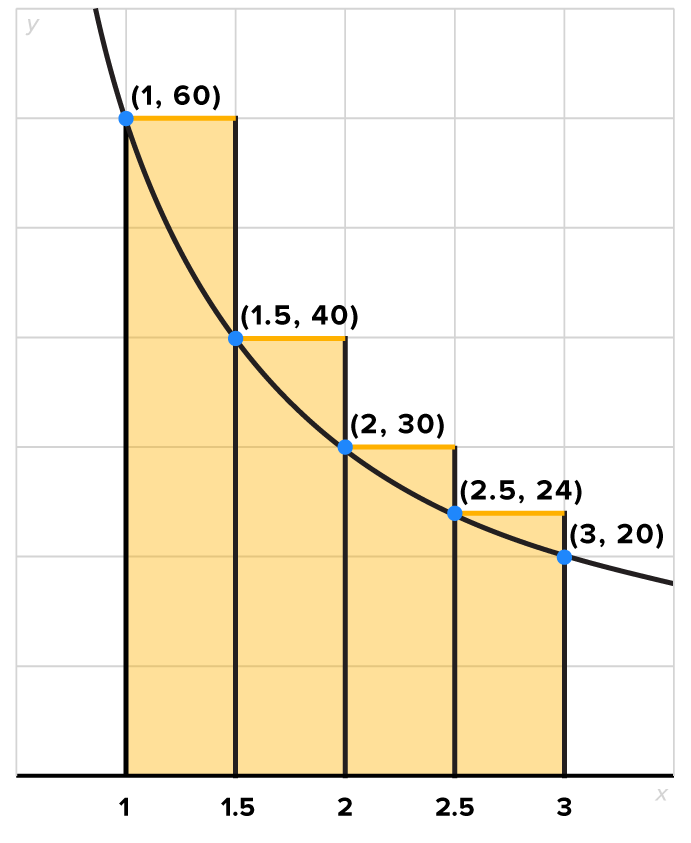
To estimate the area, we’ll find the combined area of the rectangles, as shown in each figure.

Graph Description
A graph with an x-axis ranging from 0 to 3, at intervals of 0.5, and a y-axis. Four rectangular bars correspond to subintervals (1–1.5), (1.5–2), (2–2.5), and (2.5–3), respectively, on the x-axis. A curve starts near the upper limit of the y-axis, passes through the marked points (1, 60), (1.5, 40), (2, 30), (2.5, 24), and (3, 20) at the top left corners of the rectangular bars, and then extends to the right. The total area of the rectangular bars is shaded. The rectangles used here are circumscribed, meaning that the rectangle encloses the region, but is the smallest rectangle possible. Notice how one corner of each rectangle is also on the curve.

Note that each rectangle is ½ unit wide.

Going from left to right, find the area of each rectangle:

  • 1st rectangle: Area equals open parentheses 1 divided by 2 close parentheses open parentheses 60 close parentheses equals 30 space units squared
  • 2nd rectangle: Area equals open parentheses 1 divided by 2 close parentheses open parentheses 40 close parentheses equals 20 space units squared
  • 3rd rectangle: Area equals open parentheses 1 divided by 2 close parentheses open parentheses 30 close parentheses equals 15 space units squared
  • 4th rectangle: Area equals open parentheses 1 divided by 2 close parentheses open parentheses 24 close parentheses equals 12 space units squared
The combined area is 77 space units squared. We know this is an overestimate of the actual area since the rectangles encompass the region and have additional area.
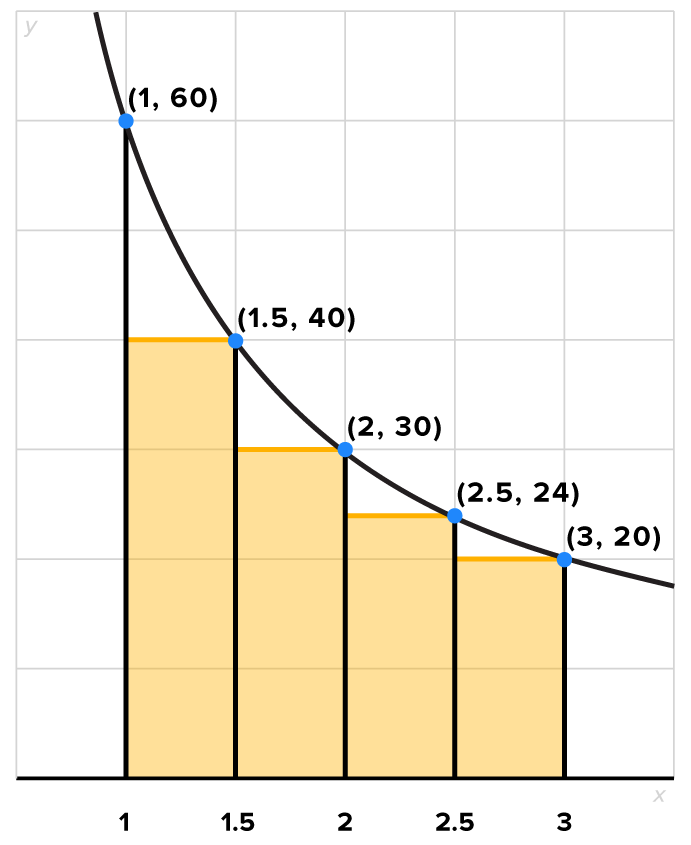
A graph with an x-axis ranging from 0 to 3, at intervals of 0.5, and a y-axis. Four rectangular bars correspond to subintervals (1–1.5), (1.5–2), (2–2.5), and (2.5–3), respectively, on the x-axis. A curve starts near the upper limit of the y-axis, passes through the marked points (1, 60), (1.5, 40), (2, 30), (2.5, 24), and (3, 20) at the top right corners of the rectangular bars, and then extends to the right. The total area of the rectangular bars is shaded. The rectangles used here are inscribed, meaning that the rectangle is within the region, but is the largest rectangle possible. Notice how one corner of each rectangle is also on the curve.

Note that each rectangle is ½ unit wide.

Going from left to right, find the area of each rectangle:

  • 1st rectangle: Area equals open parentheses 1 divided by 2 close parentheses open parentheses 40 close parentheses equals 20 space units squared
  • 2nd rectangle: Area equals open parentheses 1 divided by 2 close parentheses open parentheses 30 close parentheses equals 15 space units squared
  • 3rd rectangle: Area equals open parentheses 1 divided by 2 close parentheses open parentheses 24 close parentheses equals 12 space units squared
  • 4th rectangle: Area equals open parentheses 1 divided by 2 close parentheses open parentheses 20 close parentheses equals 10 space units squared
The combined area is 57 space units squared. We know this is an underestimate of the actual area since the rectangles are all within the region.

Since 77 is an overestimate and 57 is an underestimate, the average is likely a better estimate of the actual area.

Using this logic, our estimate for the actual area is fraction numerator 77 plus 57 over denominator 2 end fraction equals 67 space units squared.

Note: Later in this course, we will earn techniques to find the exact area. In this case, the actual area is 65.1967 space units squared.

terms to know
Inscribed (Rectangles)
A rectangle is inscribed inside a region if it is the largest rectangle that stays inside the region.
Circumscribed (Rectangles)
A rectangle is circumscribed outside a region if it is the smallest rectangle that encompasses the region.

summary
In this lesson, you learned that area can be found using basic geometric formulas, by combining areas, or by subtracting areas. For example, when finding the area of a trapezoid, you could use the trapezoid area formula, or you could split the trapezoid into a rectangle and a triangle and combine their respective areas. You also learned that when there is no area formula available, you can approximate areas by using rectangles and graphs.

Source: THIS TUTORIAL HAS BEEN ADAPTED FROM CHAPTER 4 OF "CONTEMPORARY CALCULUS" BY DALE HOFFMAN. ACCESS FOR FREE AT WWW.CONTEMPORARYCALCULUS.COM. LICENSE: CREATIVE COMMONS ATTRIBUTION 3.0 UNITED STATES.


/
Terms to Know
Circumscribed (Rectangles)

A rectangle is circumscribed outside a region if it is the smallest rectangle that encompasses the region.

Inscribed (Rectangles)

A rectangle is inscribed inside a region if it is the largest rectangle that stays inside the region.