Use Sophia to knock out your gen-ed requirements quickly and affordably. Learn more
×

Approximating Definite Integrals

Author: Sophia

what's covered
In this lesson, you will use approximation methods for evaluating definite integrals by using other shapes to approximate said areas. Specifically, this lesson will cover:

Table of Contents

1. Approximating a Definite Integral Using Rectangles

When you combine our knowledge of antiderivatives with the tables of integrals from the last tutorial, there are still functions for which we do not know antiderivatives.

EXAMPLE

integral subscript 0 superscript 2 e to the power of short dash x squared end exponent d x cannot be evaluated exactly since the antiderivative of f open parentheses x close parentheses equals e to the power of short dash x squared end exponent can’t be written in terms of the functions we are familiar with in calculus.

Recall in challenge 5.2, we approximated definite integrals by using rectangles of equal width along the x-axis.

Consider a nonnegative function y equals f open parentheses x close parentheses on the interval open square brackets a comma space b close square brackets. Break the interval open square brackets a comma space b close square brackets into n equal subintervals; then, each subinterval has width increment x equals fraction numerator b minus a over denominator n end fraction.

Note, these approximation methods can be used whether f open parentheses x close parentheses is positive, negative, or both on the interval open square brackets a comma space b close square brackets. We are considering only nonnegative functions for now to make the visual connection with the area between y equals f open parentheses x close parentheses and the x-axis on open square brackets a comma space b close square brackets.

The graph below shows the interval open square brackets a comma space b close square brackets broken into 4 subintervals, where the left-hand endpoints are used to determine the height of each rectangle.
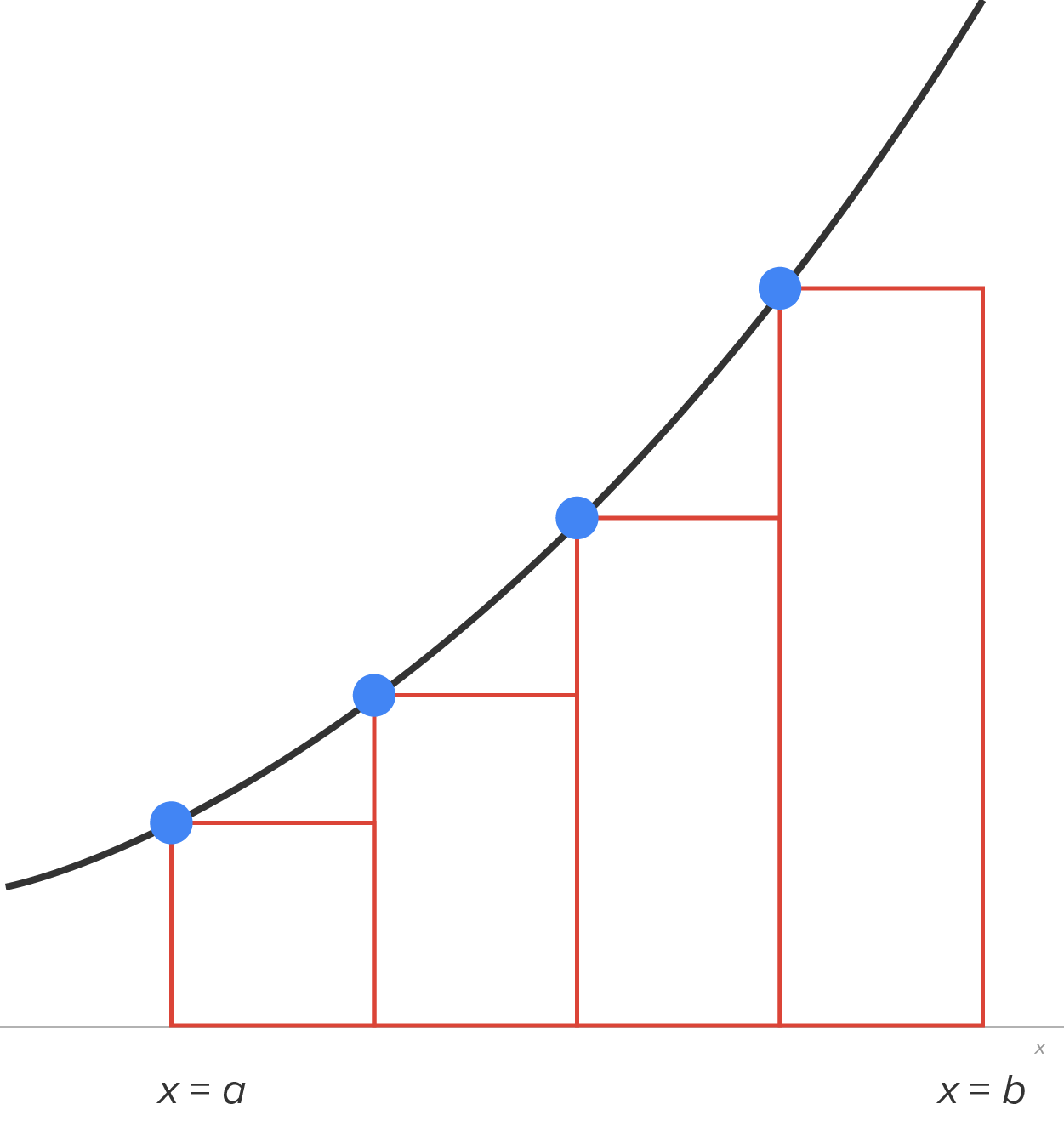
A graph with an x-axis ranging from the point labeled ‘x equals a’ to the point labeled ‘x equals b’, representing the interval (a, b), which is divided into four subintervals. Four rectangular bars at equal subintervals increase in height as x increases from a to b. A curve rises upward from the left of x equals a, passes through the marked points located at the top left corner of each bar, and rises to a point corresponding to x equals b, forming an ascending stair-like pattern.

Naturally, as the number of rectangles (subintervals), n, gets larger, the approximation gets closer to the actual area (in this case, also the definite integral).

Now that we have our framework, let’s look at an example where we use all three approximation methods.

EXAMPLE

Estimate the value of integral subscript 0 superscript 2 e to the power of short dash x squared end exponent d x by using n equals 4 subintervals of equal width using (a) left-hand endpoints, (b) right-hand endpoints, and (c) midpoints of each subinterval.
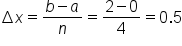
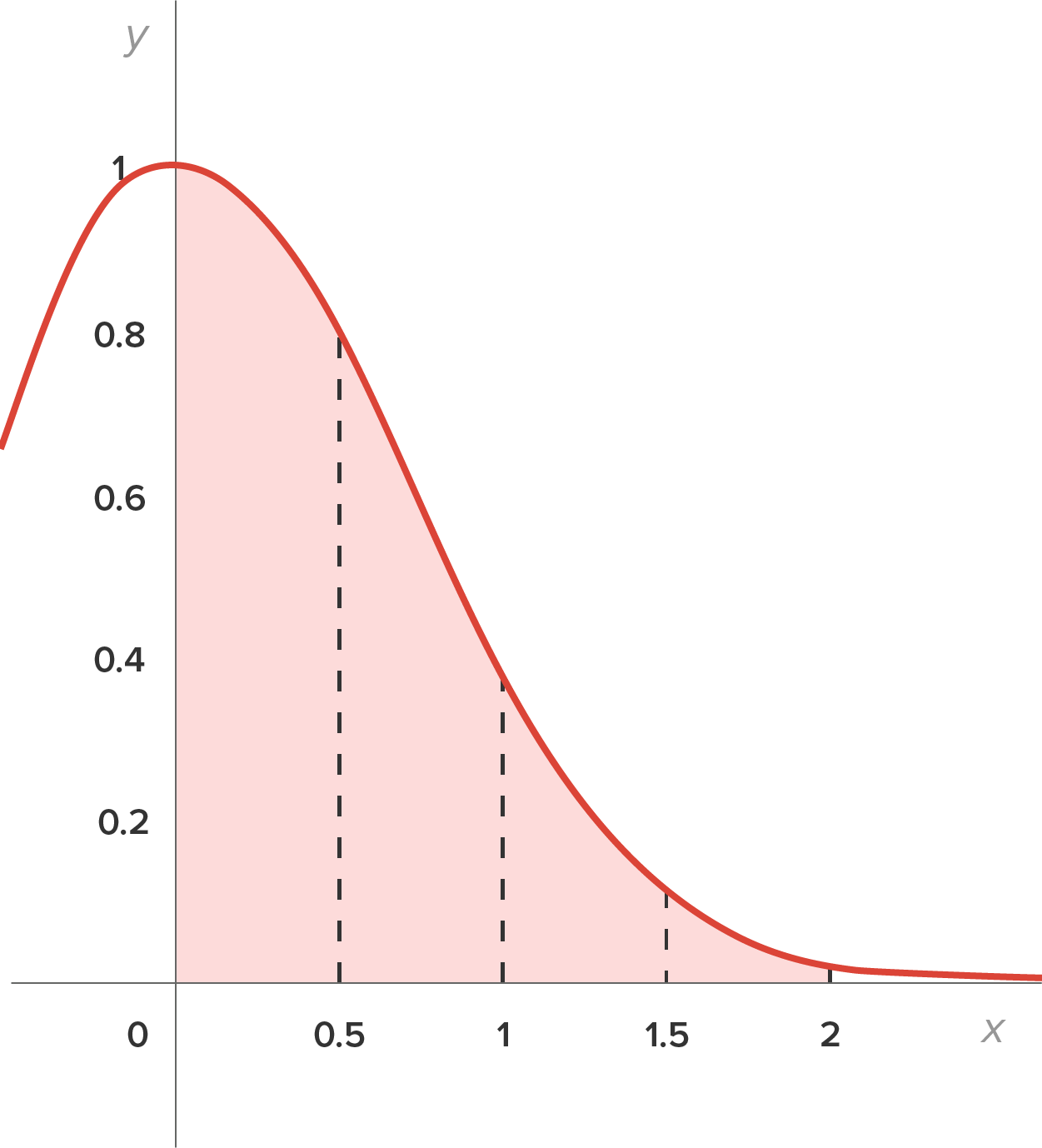
The graph of the region is shown in the figure below. Note: increment x equals fraction numerator b minus a over denominator n end fraction equals fraction numerator 2 minus 0 over denominator 4 end fraction equals 0.5 This means the subintervals are open square brackets 0 comma space 0.5 close square brackets comma open square brackets 0.5 comma space 1 close square brackets comma open square brackets 1 comma space 1.5 close square brackets comma and open square brackets 1.5 comma space 2 close square brackets.

A graph with an x-axis ranging from 0 to 2 at intervals of 0.5 and a y-axis ranging from 0 to 1 at intervals of 0.2. A curve begins in the second quadrant, reaches its peak at the point (1, 0), and then descends through the first quadrant, joining the x-axis beyond the point (2, 0). Vertical dashed lines from the points 0.5, 1, 1.5, and 2 on the x-axis rise to meet the curve at the points (0.5, 0.8), (1, 0.35), (1.5, 0.1), and (2, 0.01), respectively. The area below the curve down to the x-axis is shaded from x equals 0 to x equals 2.

Points Value
Left-hand endpoints Using the left-hand endpoint of each interval, this means the x-values are 0, 0.5, 1, and 1.5.

Then, the estimate for the definite integral is 0.5 f open parentheses 0 close parentheses plus 0.5 f open parentheses 0.5 close parentheses plus 0.5 f open parentheses 1 close parentheses plus 0.5 f open parentheses 1.5 close parentheses.

Note that we can factor out 0.5:

0.5 open square brackets f open parentheses 0 close parentheses plus f open parentheses 0.5 close parentheses plus f open parentheses 1 close parentheses plus f open parentheses 1.5 close parentheses close square brackets
0.5 open square brackets e to the power of short dash 0 squared end exponent plus e to the power of short dash 0.5 squared end exponent plus e to the power of short dash 1 squared end exponent plus e to the power of short dash 1.5 squared end exponent close square brackets

After using a calculator, this is approximately 1.12604 (to five decimal places).
Right-hand endpoints Using the right-hand endpoint of each interval, this means the x-values are 0.5, 1, 1.5, and 2.

Then, the estimate for the definite integral is 0.5 f open parentheses 0.5 close parentheses plus 0.5 f open parentheses 1 close parentheses plus 0.5 f open parentheses 1.5 close parentheses plus 0.5 f open parentheses 2 close parentheses.

Note that we can factor out 0.5:

0.5 open square brackets f open parentheses 0.5 close parentheses plus f open parentheses 1 close parentheses plus f open parentheses 1.5 close parentheses plus f open parentheses 2 close parentheses close square brackets
0.5 open square brackets e to the power of short dash 0.5 squared end exponent plus e to the power of short dash 1 squared end exponent plus e to the power of short dash 1.5 squared end exponent plus e to the power of short dash 2 squared end exponent close square brackets

After using a calculator, this is approximately 0.63520 (to five decimal places).
Midpoints Using the midpoint of each interval, this means the x-values are 0.25, 0.75, 1.25, and 1.75.

Then, the estimate for the definite integral is 0.5 f open parentheses 0.25 close parentheses plus 0.5 f open parentheses 0.75 close parentheses plus 0.5 f open parentheses 1.25 close parentheses plus 0.5 f open parentheses 1.75 close parentheses.

Note that we can factor out 0.5:

0.5 open square brackets f open parentheses 0.25 close parentheses plus f open parentheses 0.75 close parentheses plus f open parentheses 1.25 close parentheses plus f open parentheses 1.75 close parentheses close square brackets
0.5 open square brackets e to the power of short dash 0.25 squared end exponent plus e to the power of short dash 0.75 squared end exponent plus e to the power of short dash 1.25 squared end exponent plus e to the power of short dash 1.75 squared end exponent close square brackets

After using a calculator, this is approximately 0.88279 (to five decimal places).

Looking at the region, the left-hand endpoints produce an overestimate and the right-hand endpoints produce an underestimate. It is more difficult to tell if the midpoint estimate is higher or lower than the actual value, but one thing is for sure: it is closer to the actual than the others.

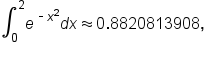
For your reference, integral subscript 0 superscript 2 e to the power of short dash x squared end exponent d x almost equal to 0.8820813908 comma so the midpoint estimate was very close!
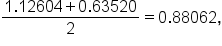
To account for the left-hand and right-hand endpoints providing overestimates or underestimates, sometimes the average of the left-hand and right-hand estimates is used.

In this case, this average is fraction numerator 1.12604 plus 0.63520 over denominator 2 end fraction equals 0.88062 comma which is indeed closer.

try it
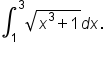
Consider integral subscript 1 superscript 3 square root of x cubed plus 1 end root d x.

Using n equals 4 subintervals, estimate the definite integral using left-hand endpoints, right-hand endpoints, and midpoints of each subinterval. Round each estimate to 5 decimal places.
Estimate using left-hand endpoints.
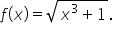
Let f open parentheses x close parentheses equals square root of x cubed plus 1 end root.

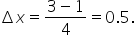
With n equals 4 subintervals, increment x equals fraction numerator 3 minus 1 over denominator 4 end fraction equals 0.5.

Breaking the interval into 4 equal pieces, the endpoints are 1, 1.5, 2, 2.5, and 3.

The left-hand endpoints of each subinterval are x equals 1 comma space 1.5 comma space 2 comma space and space 2.5.

Then, the estimate of the definite integral using left-hand endpoints is:

0.5 open square brackets f open parentheses 1 close parentheses plus f open parentheses 1.5 close parentheses plus f open parentheses 2 close parentheses plus f open parentheses 2.5 close parentheses close square brackets
equals 0.5 open square brackets square root of open parentheses 1 close parentheses cubed plus 1 end root plus square root of open parentheses 1.5 close parentheses cubed plus 1 end root plus square root of open parentheses 2 close parentheses cubed plus 1 end root plus square root of open parentheses 2.5 close parentheses cubed plus 1 end root close square brackets
almost equal to 5.29162
Estimate using right-hand endpoints.
Let f open parentheses x close parentheses equals square root of x cubed plus 1 end root.

With n equals 4 subintervals, increment x equals fraction numerator 3 minus 1 over denominator 4 end fraction equals 0.5.

Breaking the interval into 4 equal pieces, the endpoints are 1, 1.5, 2, 2.5, and 3.

The right-hand endpoints of each subinterval are x equals 1.5 comma space 2 comma space 2.5 comma space and space 3.

Then, the estimate of the definite integral using right-hand endpoints is:

0.5 open square brackets f open parentheses 1.5 close parentheses plus f open parentheses 2 close parentheses plus f open parentheses 2.5 close parentheses plus f open parentheses 3 close parentheses close square brackets
equals 0.5 open square brackets square root of open parentheses 1.5 close parentheses cubed plus 1 end root plus square root of open parentheses 2 close parentheses cubed plus 1 end root plus square root of open parentheses 2.5 close parentheses cubed plus 1 end root plus square root of open parentheses 3 close parentheses cubed plus 1 end root close square brackets
almost equal to 7.23026
Estimate using midpoints.
Let f open parentheses x close parentheses equals square root of x cubed plus 1 end root.

With n equals 4 subintervals, increment x equals fraction numerator 3 minus 1 over denominator 4 end fraction equals 0.5.

Breaking the interval into 4 equal pieces, the endpoints are 1, 1.5, 2, 2.5, and 3.

The midpoints of each subinterval are x equals 1.25 comma space 1.75 comma space 2.25 comma space and space 2.75.

Then, the estimate of the definite integral using midpoints is:

0.5 open square brackets f open parentheses 1.25 close parentheses plus f open parentheses 1.75 close parentheses plus f open parentheses 2.25 close parentheses plus f open parentheses 2.75 close parentheses close square brackets
equals 0.5 open square brackets square root of open parentheses 1.25 close parentheses cubed plus 1 end root plus square root of open parentheses 1.75 close parentheses cubed plus 1 end root plus square root of open parentheses 2.25 close parentheses cubed plus 1 end root plus square root of open parentheses 2.75 close parentheses cubed plus 1 end root close square brackets
almost equal to 6.21450


2. Approximating a Definite Integral Using Trapezoids (Trapezoidal Rule)

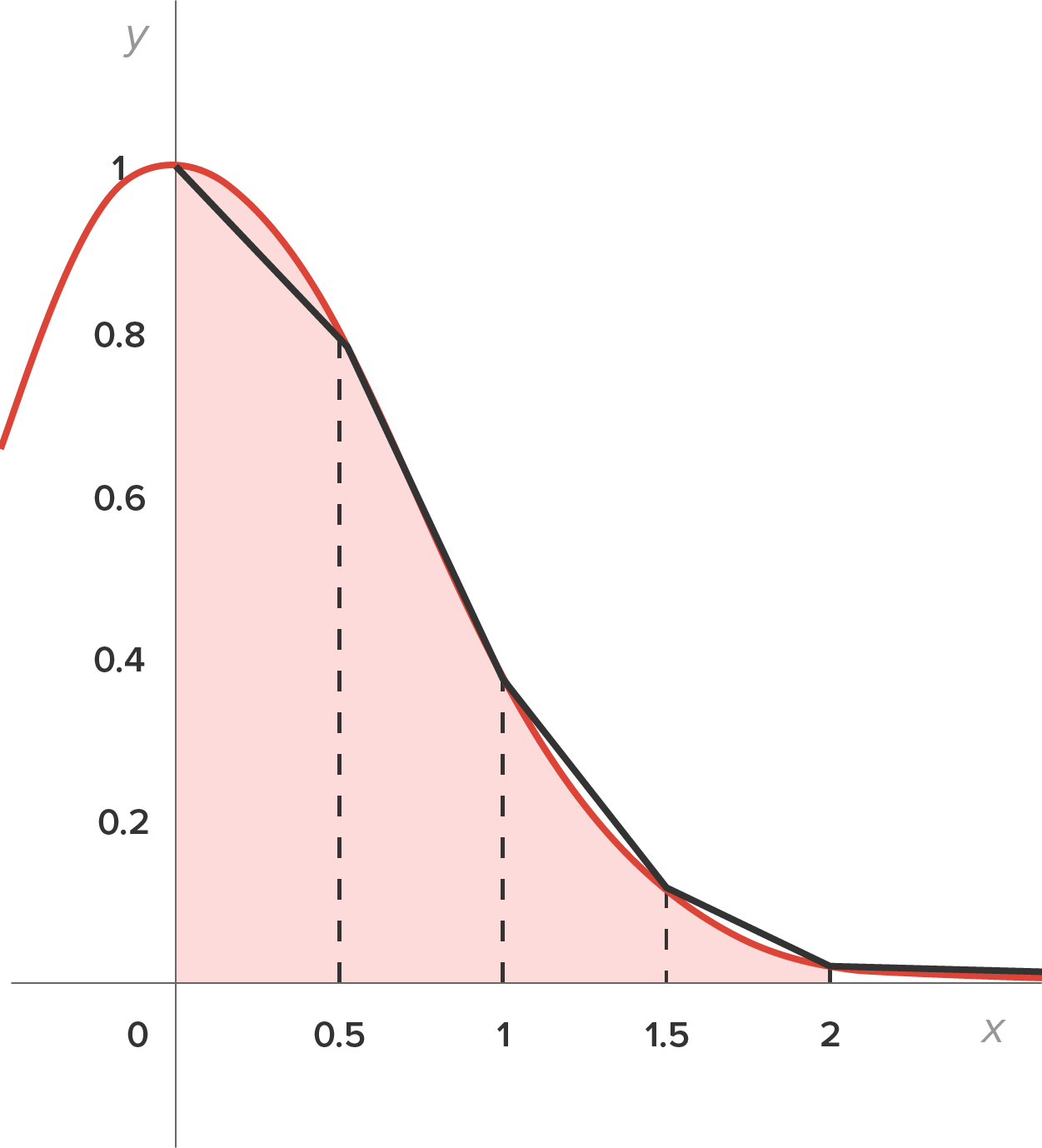
Consider the region shown in the figure, this time connecting consecutive points with a line.
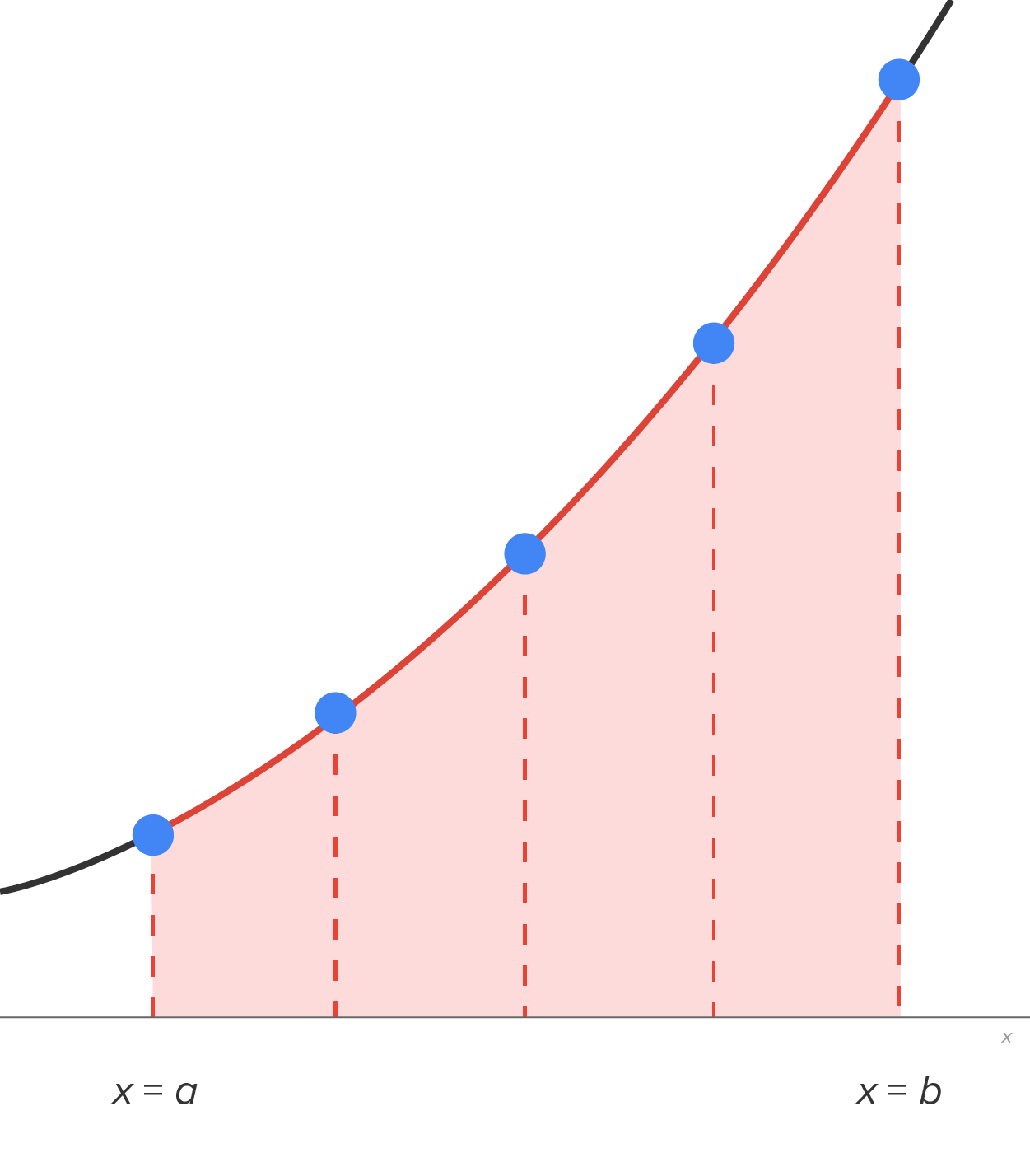
A graph with an x-axis ranging from x equals a to x equals b, representing the interval (a, b), which is divided into four subintervals. Five vertical dashed lines at equal subintervals rise from the x-axis, and each line ends at a marked point. The lines increase in height as x increases from a to b. A curve rises upward from the left of the line x equals a, passes through the marked points, and rises to a point beyond the line x equals b. The area below the curve down to the x-axis from x equals a to x equals b is shaded.

This means that trapezoids are used to approximate the area of the region in each subinterval. Recall that the area of a trapezoid is 1 half h open parentheses b subscript 1 plus b subscript 2 close parentheses comma where h is the height (the distance between the parallel sides) and b subscript 1 and b subscript 2 are parallel bases.

In this case, the height is the width of each trapezoid open parentheses increment x close parentheses comma and the bases are the function values on both sides.

Let x subscript 0 equals a comma x subscript k equals the right-hand endpoint of each subinterval, and x subscript n equals b.

Trapezoid Bases Height Area
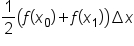
First trapezoid on the interval open square brackets x subscript 0 comma space x subscript 1 close square brackets f open parentheses x subscript 0 close parentheses and f open parentheses x subscript 1 close parentheses increment x 1 half open parentheses f open parentheses x subscript 0 close parentheses plus f open parentheses x subscript 1 close parentheses close parentheses increment x
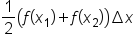
Second trapezoid on the interval open square brackets x subscript 1 comma space x subscript 2 close square brackets f open parentheses x subscript 1 close parentheses and f open parentheses x subscript 2 close parentheses increment x 1 half open parentheses f open parentheses x subscript 1 close parentheses plus f open parentheses x subscript 2 close parentheses close parentheses increment x
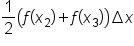
Third trapezoid on the interval open square brackets x subscript 2 comma space x subscript 3 close square brackets f open parentheses x subscript 2 close parentheses and f open parentheses x subscript 3 close parentheses increment x 1 half open parentheses f open parentheses x subscript 2 close parentheses plus f open parentheses x subscript 3 close parentheses close parentheses increment x
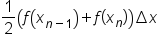
Last trapezoid on the interval open square brackets x subscript n minus 1 end subscript comma space x subscript n close square brackets f open parentheses x subscript n minus 1 end subscript close parentheses and f open parentheses x subscript n close parentheses increment x 1 half open parentheses f open parentheses x subscript n minus 1 end subscript close parentheses plus f open parentheses x subscript n close parentheses close parentheses increment x

Notice that the endpoints (a and b) are only used in one trapezoid each. All the interior values of x are used in two trapezoids.

To estimate integral subscript a superscript b f open parentheses x close parentheses d x (assuming f open parentheses x close parentheses is nonnegative), add all the areas together:

1 half open parentheses f open parentheses x subscript 0 close parentheses plus f open parentheses x subscript 1 close parentheses close parentheses increment x plus fraction numerator begin display style 1 end style over denominator begin display style 2 end style end fraction open parentheses f open parentheses x subscript 1 close parentheses plus f open parentheses x subscript 2 close parentheses close parentheses increment x plus fraction numerator begin display style 1 end style over denominator begin display style 2 end style end fraction open parentheses f open parentheses x subscript 2 close parentheses plus f open parentheses x subscript 3 close parentheses close parentheses increment x plus horizontal ellipsis plus fraction numerator begin display style 1 end style over denominator begin display style 2 end style end fraction open parentheses f open parentheses x subscript n minus 1 end subscript close parentheses plus f open parentheses x subscript n close parentheses close parentheses increment x

Notice that each quantity has a factor of 1 half increment x. We’ll factor this out:

1 half increment x open square brackets f open parentheses x subscript 0 close parentheses plus f open parentheses x subscript 1 close parentheses plus f open parentheses x subscript 1 close parentheses plus f open parentheses x subscript 2 close parentheses plus f open parentheses x subscript 2 close parentheses plus f open parentheses x subscript 3 close parentheses plus horizontal ellipsis plus f open parentheses x subscript n minus 1 end subscript close parentheses plus f open parentheses x subscript n close parentheses close square brackets

There are some like terms within the brackets. Combine them:

1 half increment x open square brackets f open parentheses x subscript 0 close parentheses plus 2 f open parentheses x subscript 1 close parentheses plus 2 f open parentheses x subscript 2 close parentheses plus 2 f open parentheses x subscript 3 close parentheses plus horizontal ellipsis plus 2 f open parentheses x subscript n minus 1 end subscript close parentheses plus f open parentheses x subscript n close parentheses close square brackets

Note: we know that the f open parentheses x subscript n minus 1 end subscript close parentheses term will show up twice since it is a base in each of the last two trapezoids.

This leads to a formula for estimating integral subscript a superscript b f open parentheses x close parentheses d x using trapezoids. This method is aptly named the trapezoidal rule.

formula to know
Trapezoidal Rule
integral subscript a superscript b f open parentheses x close parentheses d x can be approximated by the sum fraction numerator increment x over denominator 2 end fraction open square brackets f open parentheses x subscript 0 close parentheses plus 2 f open parentheses x subscript 1 close parentheses plus 2 f open parentheses x subscript 2 close parentheses plus 2 f open parentheses x subscript 3 close parentheses plus horizontal ellipsis plus 2 f open parentheses x subscript n minus 1 end subscript close parentheses plus f open parentheses x subscript n close parentheses close square brackets comma where increment x equals fraction numerator b minus a over denominator n end fraction and a equals x subscript 0 comma space x subscript 1 comma space x subscript 2 comma space horizontal ellipsis comma space x subscript n minus 1 end subscript comma space x subscript n equals b are the endpoints of each equally spaced subinterval.

big idea
The estimate obtained from the trapezoidal rule is actually the average of the left- and right-hand endpoint rules. Thus, if you have the left- and right-hand estimates already calculated, the trapezoidal estimate follows quickly.

EXAMPLE

Estimate the value of integral subscript 0 superscript 2 e to the power of short dash x squared end exponent d x by using n equals 4 subintervals of equal width using the trapezoidal rule. Check that this is equal to the average of the left- and right-hand endpoint estimates.
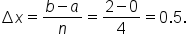
The graph of the region (with trapezoids drawn) is shown in the figure below. Note: increment x equals fraction numerator b minus a over denominator n end fraction equals fraction numerator 2 minus 0 over denominator 4 end fraction equals 0.5. This means the subintervals are open square brackets 0 comma space 0.5 close square brackets comma open square brackets 0.5 comma space 1 close square brackets comma open square brackets 1 comma space 1.5 close square brackets comma and open square brackets 1.5 comma space 2 close square brackets.

A graph with an x-axis ranging from 0 to 2 at intervals of 0.5 and a y-axis ranging from 0 to 1 at intervals of 0.2. A curve begins in the second quadrant, reaches its peak at the point (1, 0), and then descends through the first quadrant, running closer to the x-axis beyond the point (2, 0). Vertical dashed lines from the points 0.5, 1, 1.5, and 2 rise from the x-axis to meet the curve at the points (0.5, 0.8), (1, 0.35), (1.5, 0.1), and (2, 0.01), respectively. Solid line segmants join the points (0, 1), (0.5, 0.8), (1, 0.35), (1.5, 0.1), and (2, 0.01). The area below the curve up to the x-axis is shaded from x equals 0 to x equals 2.

The x-values used are x = 0, 0.5, 1, 1.5, and 2.

Then, the estimate for the definite integral is:

fraction numerator 0.5 over denominator 2 end fraction open square brackets f open parentheses 0 close parentheses plus 2 f open parentheses 0.5 close parentheses plus 2 f open parentheses 1 close parentheses plus 2 f open parentheses 1.5 close parentheses plus f open parentheses 2 close parentheses close square brackets
equals 0.25 open square brackets e to the power of short dash 0 squared end exponent plus 2 e to the power of short dash 0.5 squared end exponent plus 2 e to the power of short dash 1 squared end exponent plus 2 e to the power of short dash 1.5 squared end exponent plus e to the power of short dash 2 squared end exponent close square brackets

After using a calculator, this is approximately 0.88062 (to five decimal places).

In an earlier example, we also computed the average of the left- and right-hand estimates, and this was also approximately 0.88062. (If you look beyond the third decimal place in each, the estimates should be identical.)

try it
Consider integral subscript 1 superscript 3 square root of x cubed plus 1 end root d x.
Using n = 4 subintervals, estimate the definite integral using the trapezoidal rule. Round your answer to 5 decimal places.
Let f open parentheses x close parentheses equals square root of x cubed plus 1 end root.

With n equals 4 subintervals, increment x equals fraction numerator 3 minus 1 over denominator 4 end fraction equals 0.5.

Breaking the interval into 4 equal pieces, the endpoints are 1, 1.5, 2, 2.5, and 3.

By the trapezoidal rule, the integral estimate is:

fraction numerator 0.5 over denominator 2 end fraction open square brackets f open parentheses 1 close parentheses plus 2 f open parentheses 1.5 close parentheses plus 2 f open parentheses 2 close parentheses plus 2 f open parentheses 2.5 close parentheses plus f open parentheses 3 close parentheses close square brackets
equals 0.25 open square brackets square root of open parentheses 1 close parentheses cubed plus 1 end root plus 2 square root of open parentheses 1.5 close parentheses cubed plus 1 end root plus 2 square root of open parentheses 2 close parentheses cubed plus 1 end root plus 2 square root of open parentheses 2.5 close parentheses cubed plus 1 end root plus square root of open parentheses 3 close parentheses cubed plus 1 end root close square brackets
almost equal to 6.26094


3. Approximating a Definite Integral Using Parabolas (Simpson’s Rule)

While the methods discussed so far seem to do a fair job of approximating integral subscript 0 superscript 2 f open parentheses x close parentheses d x comma it makes more sense to approximate f open parentheses x close parentheses with a curve rather than a straight line (if f open parentheses x close parentheses is a straight-line function, there is no need to approximate the definite integral). To that end, we can also use parabolas, but not before we establish a rule for the definite integral of a parabola.

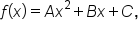
If f open parentheses x close parentheses equals A x squared plus B x plus C comma then integral subscript a superscript b f open parentheses x close parentheses d x equals fraction numerator b minus a over denominator 6 end fraction open square brackets f open parentheses a close parentheses plus 4 f open parentheses fraction numerator a plus b over denominator 2 end fraction close parentheses plus f open parentheses b close parentheses close square brackets.
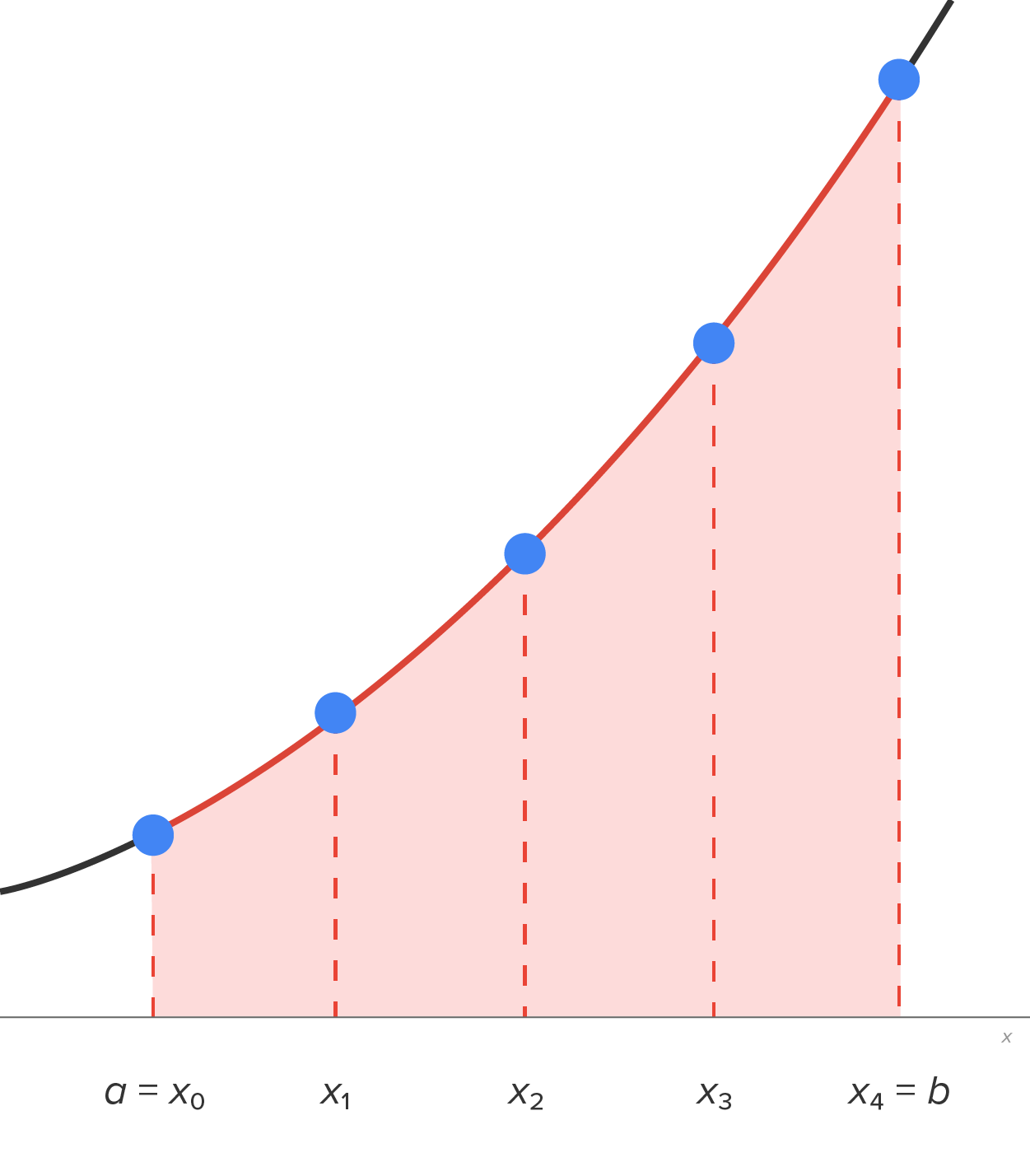
Now, consider this region.

A graph with an x-axis labeled a equals x sub 0, x sub 1, x sub 2, x sub 3, and x sub 4 equals b, dividing the x-axis into four subintervals. Five vertical dashed lines at a equals x sub 0, x sub 1, x sub 2, x sub 3, and x sub 4 equals b increase in height as x increases from a equals x sub 0 to x sub 4 equals b, and each line ends at a marked point. A curve rises upward from the left of the line a equals x sub 0, passes through the marked points, and rises to a point beyond x sub 4 equals b. The area below the curve up to the x-axis from a equals x sub 0 to x sub 4 equals b is shaded.

If we want to approximate f open parentheses x close parentheses by using a parabola, we would have integral subscript x subscript 0 end subscript superscript x subscript 2 end superscript f open parentheses x close parentheses d x almost equal to fraction numerator x subscript 2 minus x subscript 0 over denominator 6 end fraction open square brackets f open parentheses x subscript 0 close parentheses plus 4 f open parentheses fraction numerator x subscript 0 plus x subscript 2 over denominator 2 end fraction close parentheses plus f open parentheses x subscript 2 close parentheses close square brackets.

Note: fraction numerator x subscript 0 plus x subscript 2 over denominator 2 end fraction equals x subscript 1 (that is, since the x-values are evenly spaced, x subscript 1 is the average of x subscript 0 and x subscript 2).

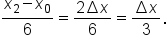
Also, consider the quantity fraction numerator x subscript 2 minus x subscript 0 over denominator 6 end fraction. Since increment x is the distance between two consecutive x-values, it follows that x subscript 2 minus x subscript 0 equals 2 increment x comma which means fraction numerator x subscript 2 minus x subscript 0 over denominator 6 end fraction equals fraction numerator 2 increment x over denominator 6 end fraction equals fraction numerator increment x over denominator 3 end fraction.
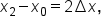
Thus, we can write integral subscript x subscript 0 end subscript superscript x subscript 2 end superscript f open parentheses x close parentheses d x almost equal to fraction numerator increment x over denominator 3 end fraction open square brackets f open parentheses x subscript 0 close parentheses plus 4 f open parentheses x subscript 1 close parentheses plus f open parentheses x subscript 2 close parentheses close square brackets.

Then, considering the interval open square brackets x subscript 2 comma space x subscript 4 close square brackets comma we have integral subscript x subscript 2 end subscript superscript x subscript 4 end superscript f open parentheses x close parentheses d x almost equal to fraction numerator increment x over denominator 3 end fraction open square brackets f open parentheses x subscript 2 close parentheses plus 4 f open parentheses x subscript 3 close parentheses plus f open parentheses x subscript 4 close parentheses close square brackets.

Then, the approximation for integral subscript x subscript 0 end subscript superscript x subscript 4 end superscript f open parentheses x close parentheses d x is the sum of the previous two approximations:

That is, integral subscript x subscript 0 end subscript superscript x subscript 4 end superscript f open parentheses x close parentheses d x almost equal to fraction numerator increment x over denominator 3 end fraction open square brackets f open parentheses x subscript 0 close parentheses plus 4 f open parentheses x subscript 1 close parentheses plus f open parentheses x subscript 2 close parentheses close square brackets plus fraction numerator increment x over denominator 3 end fraction open square brackets f open parentheses x subscript 2 close parentheses plus 4 f open parentheses x subscript 3 close parentheses plus f open parentheses x subscript 4 close parentheses close square brackets.

Factoring out fraction numerator increment x over denominator 3 end fraction comma this becomes fraction numerator increment x over denominator 3 end fraction open square brackets f open parentheses x subscript 0 close parentheses plus 4 f open parentheses x subscript 1 close parentheses plus f open parentheses x subscript 2 close parentheses plus f open parentheses x subscript 2 close parentheses plus 4 f open parentheses x subscript 3 close parentheses plus f open parentheses x subscript 4 close parentheses close square brackets.

Combining like terms, this becomes fraction numerator increment x over denominator 3 end fraction open square brackets f open parentheses x subscript 0 close parentheses plus 4 f open parentheses x subscript 1 close parentheses plus 2 f open parentheses x subscript 2 close parentheses plus 4 f open parentheses x subscript 3 close parentheses plus f open parentheses x subscript 4 close parentheses close square brackets.

Note: since each parabola uses two subintervals, the number of subintervals must be even.

If this process were to continue, notice the following:

  • f open parentheses x subscript 0 close parentheses and f open parentheses x subscript n close parentheses would have coefficients of 1.
  • f open parentheses x subscript 1 close parentheses comma f open parentheses x subscript 3 close parentheses comma ... would have coefficients of 4 (odd-numbered subscripts).
  • f open parentheses x subscript 2 close parentheses comma f open parentheses x subscript 4 close parentheses comma ... would have coefficients of 2 (even-numbered subscripts, but not the endpoints).
This means that the pattern in the coefficients is 1, 4, 2, 4, 2, 4, …, 2, 4, 1.

This approximation method is known as Simpson’s rule.

formula to know
Simpson's Rule
The value of integral subscript a superscript b f open parentheses x close parentheses d x is approximated by fraction numerator increment x over denominator 3 end fraction open square brackets f open parentheses x subscript 0 close parentheses plus 4 f open parentheses x subscript 1 close parentheses plus 2 f open parentheses x subscript 2 close parentheses plus 4 f open parentheses x subscript 3 close parentheses plus 2 f open parentheses x subscript 4 close parentheses plus horizontal ellipsis plus 2 f open parentheses x subscript n minus 2 end subscript close parentheses plus 4 f open parentheses x subscript n minus 1 end subscript close parentheses plus f open parentheses x subscript n close parentheses close square brackets where increment x equals fraction numerator b minus a over denominator n end fraction and a equals x subscript 0 comma space x subscript 1 comma space x subscript 2 comma space horizontal ellipsis comma space x subscript n minus 1 end subscript comma space x subscript n equals b are the endpoints of each equally spaced subinterval. Note: n must be even.

EXAMPLE

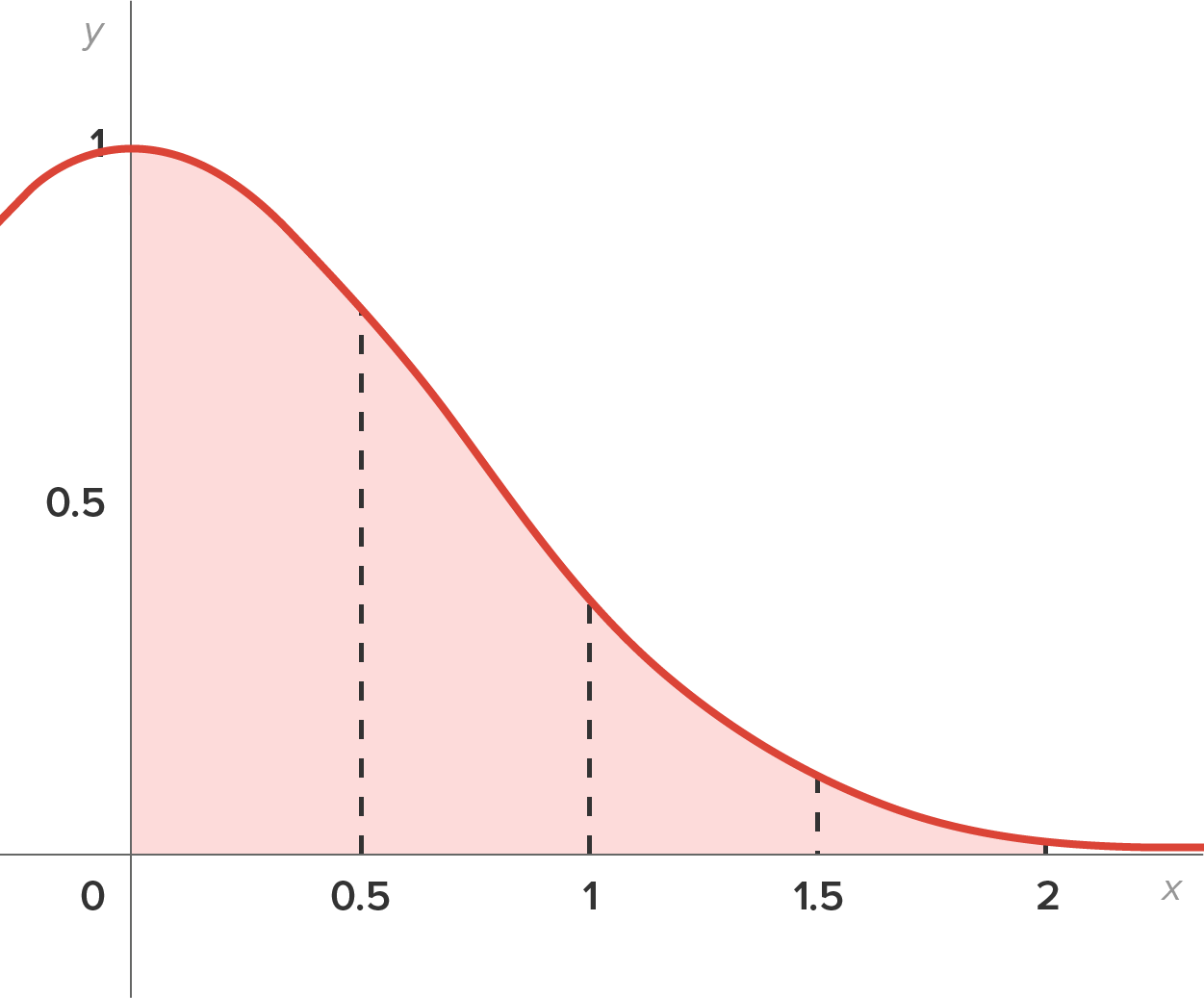
Estimate the value of integral subscript 0 superscript 2 e to the power of short dash x squared end exponent d x by using n equals 4 subintervals of equal width using Simpson’s rule.

The graph of the region is shown in the figure. Note: increment x equals fraction numerator b minus a over denominator n end fraction equals fraction numerator 2 minus 0 over denominator 4 end fraction equals 0.5. This means the subintervals are open square brackets 0 comma space 0.5 close square brackets comma open square brackets 0.5 comma space 1 close square brackets comma open square brackets 1 comma space 1.5 close square brackets comma and open square brackets 1.5 comma space 2 close square brackets.

A graph with an x-axis ranging from 0 to 2 and a y-axis ranging from 0 to 1 at intervals of 0.5. A curve begins in the second quadrant, reaches its peak at the point (0, 1), and then descends through the first quadrant, running along the positive x-axis beyond the point (2, 0). Vertical dashed lines from the points 0.5, 1, 1.5, and 2 on the x-axis rise to meet the curve at the points (0.5, 1.5), (1, 0.35), (1.5, 0.1), and (2, 0.01), respectively. The area below the curve up to the x-axis is shaded from x equals 0 to x equals 2.

The x-values used are x = 0, 0.5, 1, 1.5, and 2.

Then, the estimate for the definite integral is:

fraction numerator 0.5 over denominator 3 end fraction open square brackets f open parentheses 0 close parentheses plus 4 f open parentheses 0.5 close parentheses plus 2 f open parentheses 1 close parentheses plus 4 f open parentheses 1.5 close parentheses plus f open parentheses 2 close parentheses close square brackets equals 1 over 6 open square brackets e to the power of short dash 0 squared end exponent plus 4 e to the power of short dash 0.5 squared end exponent plus 2 e to the power of short dash 1 squared end exponent plus 4 e to the power of short dash 1.5 squared end exponent plus e to the power of short dash 2 squared end exponent close square brackets

After using a calculator, this is approximately 0.88181 (to five decimal places).

Comparing this to the left-hand, right-hand, midpoint, and trapezoidal estimates, these are all very close, but it turns out that Simpson’s rule gives the closest approximation for this function on this interval. In general, Simpson’s rule usually gives the best estimate out of the five we discussed, but there are exceptions.

try it
Consider integral subscript 1 superscript 3 square root of x cubed plus 1 end root d x.
Using n = 4 subintervals, estimate the definite integral using Simpson’s rule.
Let f open parentheses x close parentheses equals square root of x cubed plus 1 end root.

With n equals 4 subintervals, increment x equals fraction numerator 3 minus 1 over denominator 4 end fraction equals 0.5.

Breaking the interval into 4 equal pieces, the endpoints are 1, 1.5, 2, 2.5, and 3.

By Simpson’s rule, the integral estimate is:

fraction numerator 0.5 over denominator 3 end fraction open square brackets f open parentheses 1 close parentheses plus 4 f open parentheses 1.5 close parentheses plus 2 f open parentheses 2 close parentheses plus 4 f open parentheses 2.5 close parentheses plus f open parentheses 3 close parentheses close square brackets
equals fraction numerator 0.5 over denominator 3 end fraction open square brackets square root of open parentheses 1 close parentheses cubed plus 1 end root plus 4 square root of open parentheses 1.5 close parentheses cubed plus 1 end root plus 2 square root of open parentheses 2 close parentheses cubed plus 1 end root plus 4 square root of open parentheses 2.5 close parentheses cubed plus 1 end root plus square root of open parentheses 3 close parentheses cubed plus 1 end root close square brackets
almost equal to 6.23030

The approximation methods shown in this challenge are all used to approximate the value of a definite integral. Using that connection, these methods can be used to approximate the area of an irregularly shaped region, as we’ll see in the next part.


4. Application: Approximating Area

EXAMPLE

Suppose the measurements of a park are shown below. What is the approximate area of the park? As the figure suggests, the measurements were taken every 30 feet.
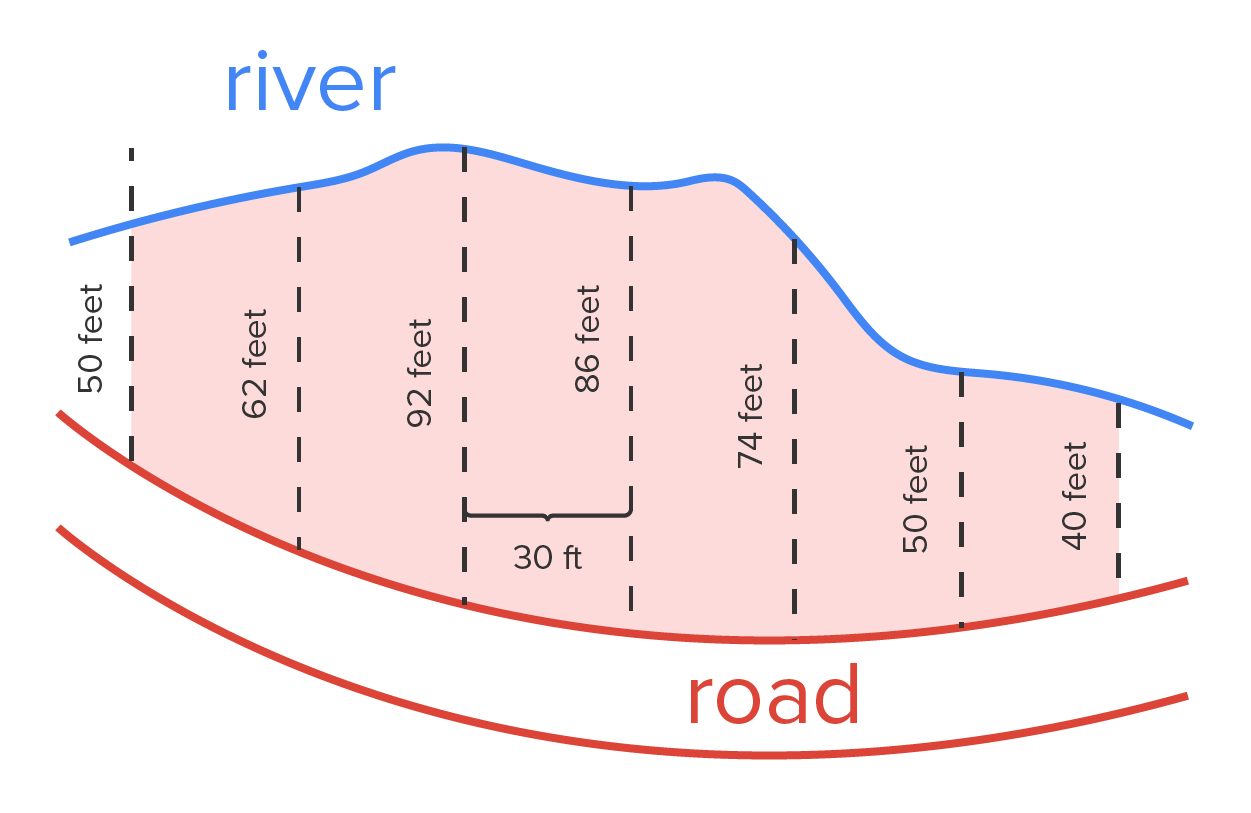
The figure has two uniform curves one above the other, opening upward and labeled ‘road’. Seven dashed lines labeled ‘50 feet’, ‘62 feet’, ‘92 feet’, ‘86 feet’, ‘74 feet’, ‘50 feet’, and ‘40 feet’, respectively, from left to right rise from the road to meet an irregular curve labeled ‘river’. A horizontal curly bracket joins the dashed lines labeled ‘92 feet’ and ‘86 feet’, with 30 feet mentioned below the bracket, representing the width of each subinterval. The area below the curved line labeled ‘river’ up to the inner curve of the road from the ‘50 feet’ dashed line to the ‘40 feet’ dashed line is shaded.

Let f open parentheses x close parentheses equals the length of the park at a distance of x feet from the left-hand side (as shown). Then, the area of the park is integral subscript 0 superscript 180 f open parentheses x close parentheses d x (there are 6 widths of 30 feet, for a total of 180 feet).

Since we don’t have an expression for f open parentheses x close parentheses comma we’ll need to use the approximation techniques learned in this section to estimate the area.

Using increment x equals 30 with n equals 6 subintervals, we can easily use the left-hand and right-hand endpoints, the trapezoidal rule and Simpson’s rule to approximate the area. (Since we don’t know the values of f open parentheses x close parentheses in the middle of each interval, the midpoint method cannot be used.)

Here is a table of values for all the values of x.

bold italic a bold equals bold italic x subscript bold 0 bold italic x subscript bold 1 bold italic x subscript bold 2 bold italic x subscript bold 3 bold italic x subscript bold 4 bold italic x subscript bold 5 bold italic x subscript bold 6 bold equals bold italic b
bold italic x 0 30 60 90 120 150 180
Length 50 62 92 86 74 50 40

Below is a table that shows the various approximations for the area. Notice that the estimates are fairly close to each other.

Method Estimation for the Area
Left-Hand Endpoints 30 open parentheses 50 plus 62 plus 92 plus 86 plus 74 plus 50 close parentheses equals 12 comma 420 space f t squared
Right-Hand Endpoints 30 open parentheses 62 plus 92 plus 86 plus 74 plus 50 plus 40 close parentheses equals 12 comma 120 space f t squared
Trapezoids 30 over 2 open square brackets 50 plus 2 open parentheses 62 close parentheses plus 2 open parentheses 92 close parentheses plus 2 open parentheses 86 close parentheses plus 2 open parentheses 74 close parentheses plus 2 open parentheses 50 close parentheses plus 40 close square brackets equals 12 comma 270 space f t squared
Simpson's Rule 30 over 3 open square brackets 50 plus 4 open parentheses 62 close parentheses plus 2 open parentheses 92 close parentheses plus 4 open parentheses 86 close parentheses plus 2 open parentheses 74 close parentheses plus 4 open parentheses 50 close parentheses plus 40 close square brackets equals 12 comma 140 space f t squared

try it
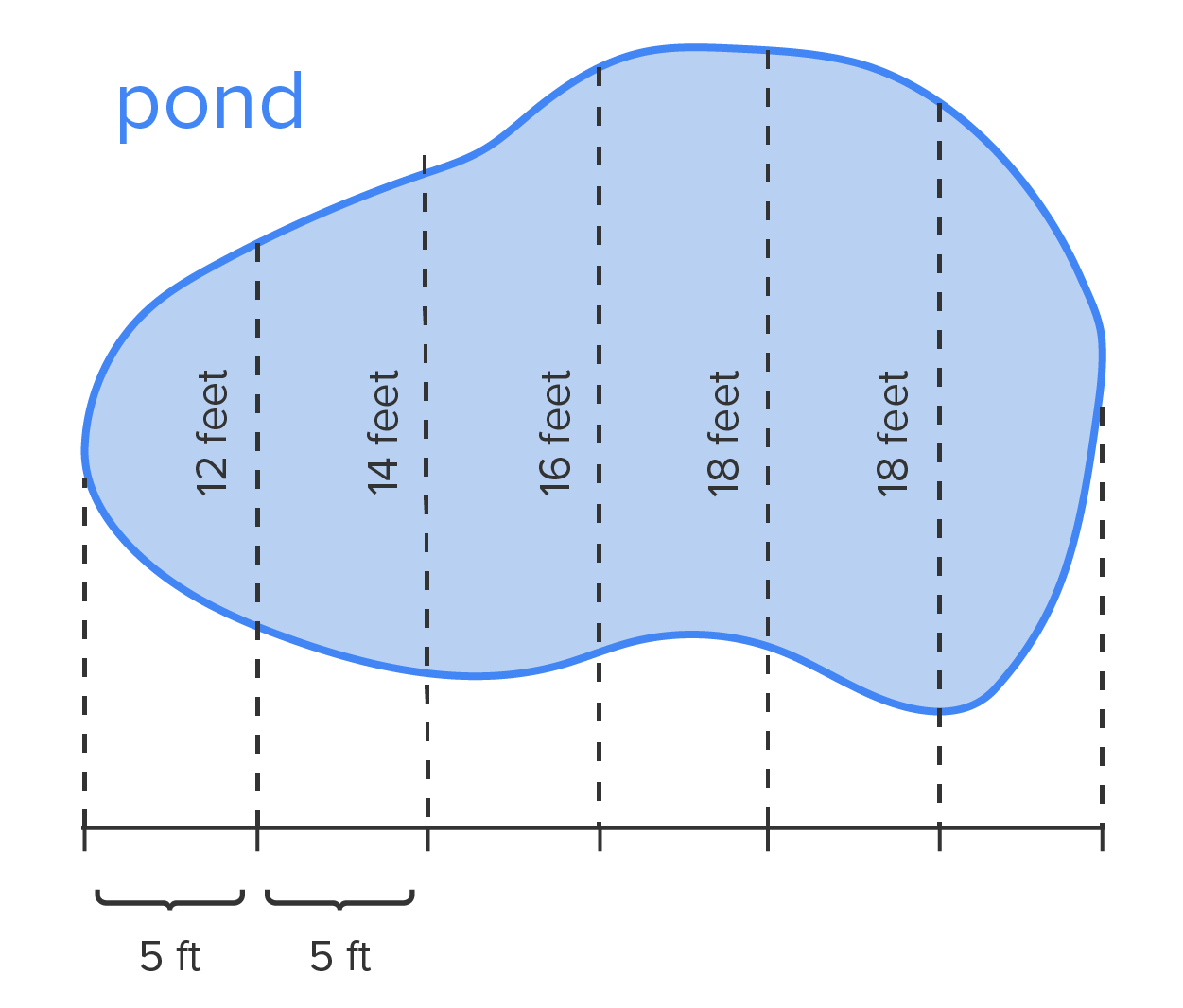
Consider the pond shown in the figure below. Assume each subinterval is 5 feet wide and that the distance across at the endpoints is 0 feet.

An irregular closed curve representing a pond. Seven dashed lines, each 5 feet apart, rise from a horizontal solid line below the closed curve and meet the curve at different points. The dashed lines on the extreme left and extreme right join the outer edge of the closed curve. The other five dashed lines are labeled ‘12 feet’, ‘14 feet’, ‘16 feet’, ‘18 feet’, and ‘18 feet’ from left to right and run across the curve, each intersecting the curve at two different points. The area of the closed curve is shaded.

Use left- and right-hand endpoints, the trapezoidal rule, and Simpson’s rule to estimate the surface area of the pond.
Let f open parentheses x close parentheses equals the length of the lake at a distance of x feet from the left-hand side.

Then, integral subscript 0 superscript 30 f open parentheses x close parentheses d x gives the area of the lake.

To approximate this integral, we are using 6 equal subintervals of width 5. This means n equals 6 and increment x equals 5.

The lengths of the lake at each given point can be summarized by the table:

x 0 5 10 15 20 25 30
f  (x  ) 0 12 14 16 18 18 0

Left-hand estimate:

5 open square brackets f open parentheses 0 close parentheses plus f open parentheses 5 close parentheses plus f open parentheses 10 close parentheses plus f open parentheses 15 close parentheses plus f open parentheses 20 close parentheses plus f open parentheses 25 close parentheses close square brackets
equals 5 open parentheses 0 plus 12 plus 14 plus 16 plus 18 plus 18 close parentheses
equals 390 space ft squared

Right-hand estimate:

5 open square brackets f open parentheses 5 close parentheses plus f open parentheses 10 close parentheses plus f open parentheses 15 close parentheses plus f open parentheses 20 close parentheses plus f open parentheses 25 close parentheses plus f open parentheses 30 close parentheses close square brackets
equals 5 open parentheses 12 plus 14 plus 16 plus 18 plus 18 plus 0 close parentheses
equals 390 space ft squared

Trapezoidal estimate:

5 over 2 open square brackets f open parentheses 0 close parentheses plus 2 f open parentheses 5 close parentheses plus 2 f open parentheses 10 close parentheses plus 2 f open parentheses 15 close parentheses plus 2 f open parentheses 20 close parentheses plus 2 f open parentheses 25 close parentheses plus f open parentheses 30 close parentheses close square brackets
equals 5 over 2 open parentheses 0 plus 2 open parentheses 12 close parentheses plus 2 open parentheses 14 close parentheses plus 2 open parentheses 16 close parentheses plus 2 open parentheses 18 close parentheses plus 2 open parentheses 18 close parentheses plus 0 close parentheses
equals 390 space ft squared

Simpson’s Rule Estimate:

5 over 3 open square brackets f open parentheses 0 close parentheses plus 4 f open parentheses 5 close parentheses plus 2 f open parentheses 10 close parentheses plus 4 f open parentheses 15 close parentheses plus 2 f open parentheses 20 close parentheses plus 4 f open parentheses 25 close parentheses plus f open parentheses 30 close parentheses close square brackets
equals 5 over 3 open parentheses 0 plus 4 open parentheses 12 close parentheses plus 2 open parentheses 14 close parentheses plus 4 open parentheses 16 close parentheses plus 2 open parentheses 18 close parentheses plus 4 open parentheses 18 close parentheses plus 0 close parentheses
almost equal to 413.33 space ft squared

summary
In this lesson, you learned that when approximating definite integrals, there are several methods that can be used: using rectangles, using trapezoids (trapezoidal rule), and using parabolas (Simpson's rule). The key takeaway here is the progression. Using rectangles is simpler, but doesn’t give as good an estimate as trapezoids, which still has flaws since a line is used to approximate a curve. Simpson’s rule, using parabolas, seems to be the best match for a curve y equals f open parentheses x close parentheses comma but since not all curves are parabolic, there is still room for some error. In all cases, the estimate is improved by increasing the number of subintervals. Finally, you were able to apply the techniques learned in this section to approximate the area in several examples.

Source: THIS TUTORIAL HAS BEEN ADAPTED FROM CHAPTER 4 OF "CONTEMPORARY CALCULUS" BY DALE HOFFMAN. ACCESS FOR FREE AT WWW.CONTEMPORARYCALCULUS.COM. LICENSE: CREATIVE COMMONS ATTRIBUTION 3.0 UNITED STATES.

Formulas to Know
Simpson's Rule

The value of integral subscript a superscript b f open parentheses x close parentheses d x is approximated by fraction numerator increment x over denominator 3 end fraction open square brackets f open parentheses x subscript 0 close parentheses plus 4 f open parentheses x subscript 1 close parentheses plus 2 f open parentheses x subscript 2 close parentheses plus 4 f open parentheses x subscript 3 close parentheses plus 2 f open parentheses x subscript 4 close parentheses plus horizontal ellipsis plus 2 f open parentheses x subscript n minus 2 end subscript close parentheses plus 4 f open parentheses x subscript n minus 1 end subscript close parentheses plus f open parentheses x subscript n close parentheses close square brackets where increment x equals fraction numerator b minus a over denominator n end fraction and a equals x subscript 0 comma space x subscript 1 comma space x subscript 2 comma space horizontal ellipsis comma space x subscript n minus 1 end subscript comma space x subscript n equals b are the endpoints of each equally spaced subinterval. Note: n must be even.

Trapezoidal Rule

integral subscript a superscript b f open parentheses x close parentheses d x can be approximated by the sum  fraction numerator increment x over denominator 2 end fraction open square brackets f open parentheses x subscript 0 close parentheses plus 2 f open parentheses x subscript 1 close parentheses plus 2 f open parentheses x subscript 2 close parentheses plus 2 f open parentheses x subscript 3 close parentheses plus horizontal ellipsis plus 2 f open parentheses x subscript n minus 1 end subscript close parentheses plus f open parentheses x subscript n close parentheses close square brackets comma where increment x equals fraction numerator b minus a over denominator n end fraction and a equals x subscript 0 comma space x subscript 1 comma space x subscript 2 comma space horizontal ellipsis comma space x subscript n minus 1 end subscript comma space x subscript n equals b are the endpoints of each equally spaced subinterval.