Table of Contents |
Virtue-based ethics is an approach that evaluates actions based on how they reflect and shape the moral character of the agent. Rather than asking, “What should I do?” virtue ethics asks, “What kind of person should I be?” This shift in focus emphasizes the lifelong cultivation of virtues such as courage, honesty, and generosity.
Aristotle defines virtue as “a state of character concerned with choice, lying in a mean … determined by reason” (Aristotle, ca. 350 B.C.E/1908, 1106b36–1107a2). In simple terms, a virtue is a balanced quality, as how courage is the middle ground between cowardice and recklessness. Virtues are developed through habituation: “We become just by doing just acts, temperate by doing temperate acts, brave by doing brave acts” (Aristotle, ca. 350 B.C.E/1908, 1103a33–1103b1). Think of it like working out: you build honesty, kindness, and courage by exercising them daily.
Contemporary virtue ethicists such as Rosalind Hursthouse affirm this developmental view, stating that “a virtue is a character trait a human being needs for eudaimonia, to flourish or live well” (Hursthouse, 2001, p. 20). In other words, virtues are habits that help us thrive as people.
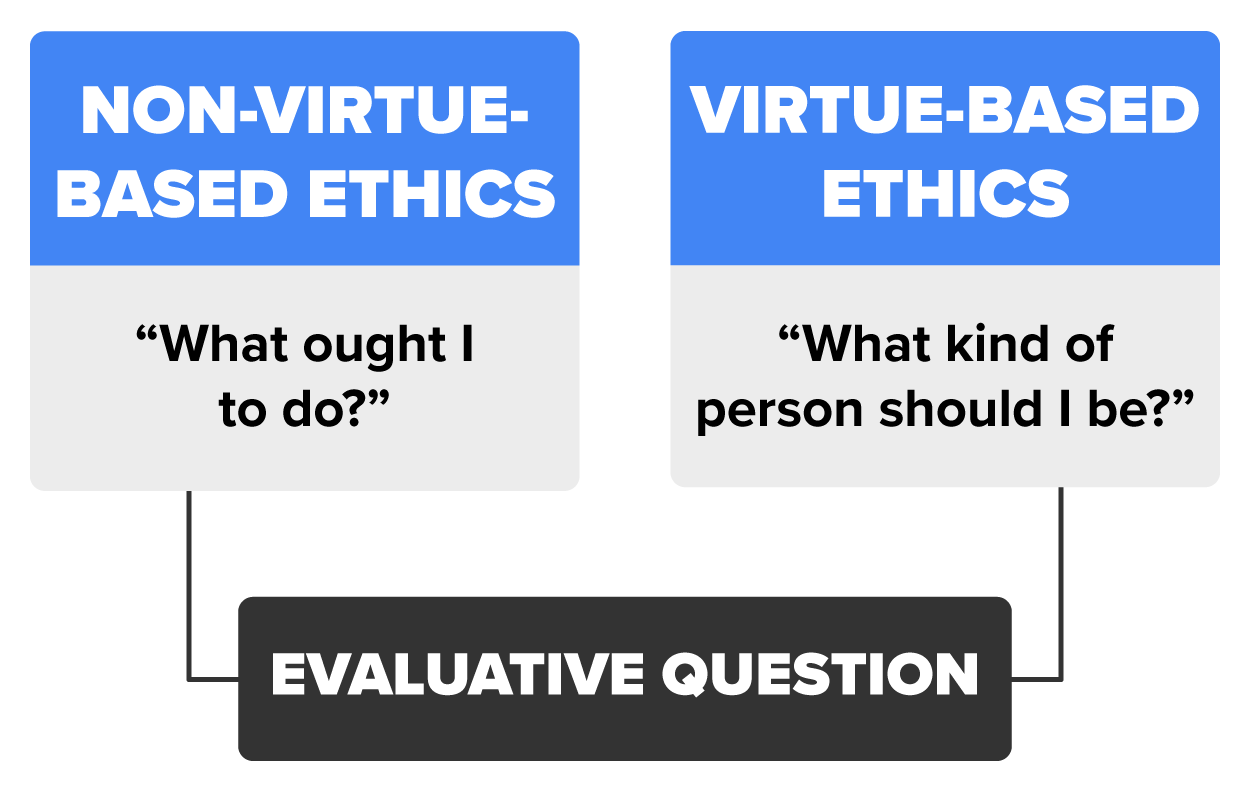
Virtue ethics often lines up with our everyday sense of what’s good. For example, most of us value honesty, generosity, and friendliness. Virtue ethics says these are signs of a healthy character. However, sometimes the virtue ethics theory surprises us. Virtue ethics may diverge from common views when it comes to traits not typically considered moral obligations. Most of us think we should be friendly to people, rather than rude or dismissive. Friendliness is a virtue, so being friendly to people is obligatory. Helping out your friends is generally seen as a good thing. Virtue-based ethics agrees with this when it’s a manifestation of the virtue of friendship or generosity.
Sometimes wit or good humor is listed as a virtue. Being a good conversationalist entails being neither a buffoon nor austere, but knowing how to share a joke and listen well to other people. Most of us appreciate a witty person, but we don’t usually think that it’s a moral obligation to be like this. Aristotle includes wittiness among the virtues, noting that “the witty person is a sort of law unto himself in conversation” (Aristotle, ca. 350 B.C.E/1908, 1128a21). Yet most people don’t see being witty as a moral duty. Today, most people don’t think being funny is a moral duty, but Aristotle did!
Something similar can be said of virtues such as confidence. Again, you might think this is a good trait to have for many reasons, but you probably don’t see it as a morally obligatory trait. A person who consistently shares uplifting content, avoids gossip, and engages respectfully in discussions might be seen as virtuous. This reflects temperance, kindness, and respect. Conversely, someone who posts inflammatory or misleading content may be cultivating vice, such as arrogance or recklessness.
EXAMPLE
A student who chooses not to cheat on an exam, even when others are doing so, demonstrates integrity and courage.Virtue ethics praises this not just as a good action but as a sign of a developing virtuous character.
Ambition and confidence are often celebrated in modern culture. Yet virtue ethics asks: “Is this confidence rooted in humility and competence or in arrogance and self-promotion?” A confident leader who listens and empowers others may embody the virtue of magnanimity, while one who dominates and seeks personal glory may be cultivating vice. Remember: In virtue ethics, the moral weight of an action depends on whether it reflects and reinforces virtuous character.
Virtue ethics can be difficult to apply when motivations are unclear or when actions are ambiguous. This is especially true in complex social situations.
As you can see, if you don’t know the reason for the action, it’s difficult to know if it really does indicate a certain character trait. We certainly tend to think charity is good, but if we can’t be sure that it expresses a virtue, then it can’t be said to be good from the perspective of virtue-based ethics.
There are many other similar cases where this kind of ambiguity comes up.
EXAMPLE
A student volunteers at a local shelter and posts about it frequently on social media.Is this generosity, or self-promotion? Virtue ethics would ask: Is the act part of a genuine commitment to helping others, or is it driven by a desire for praise?
EXAMPLE
An employee exposes unethical practices at their company.This could be an act of courage and integrity, or it could be motivated by revenge or career advancement. Virtue ethics requires us to look beyond the act to the character of the agent.
EXAMPLE
Participating in online campaigns to call out bad behavior can be seen as standing up for justice, but if done with cruelty or self-righteousness, it may reflect vice.Virtue ethics would ask whether the person is acting from a place of moral concern or from a desire to punish or elevate themselves.
Remember that virtue ethics emphasizes the development of character over time. A single action may not reveal much, but patterns of behavior and motivation do. As Hursthouse puts it, “The right action is the one a virtuous person would do in the same circumstances” (Hursthouse, 2001, p. 20). Virtue ethics asks us to look beyond the act and focus on the character behind it.
Virtue ethics offers a distinctive lens for evaluating complex moral issues. It examines ethics not by thinking about rules or consequences but by asking what kind of character is cultivated through certain actions, such as:
| Action | Position | Contemporary Application |
|---|---|---|
| Suicide | If suicide stems from despair or cowardice, it reflects vice. Aristotle writes, “To die to escape poverty or love or pain is not brave but cowardly” (Aristotle, ca. 350 B.C.E/1908, 1116a12). However, if the act is one of self-sacrifice (such as a soldier shielding others from an exploding grenade), it may reflect courage and altruism. | A firefighter who dies while rescuing others may be seen as embodying courage and selflessness. Virtue ethics would honor this as a virtuous act, not because of the outcome but because of the character it reveals. |
| War | War pursued for glory or revenge reflects vice. However, a war fought to protect the vulnerable or uphold justice may reflect virtues such as honor, courage, and loyalty. Aristotle praises the “brave man” who fights “for the sake of the noble” (Aristotle, ca. 350 B.C.E/1908, 1115b17). | A humanitarian intervention to stop genocide may be seen as virtuous if it reflects a commitment to justice and compassion, rather than national interest or pride. |
| Torture | Torture cultivates several vices: cruelty, callousness, and indifference. Even if it yields information, the character of the torturer is degraded. Engaging in torture reinforces through practice some of the deficiencies that are the vices to the virtues of compassion, gentleness, and empathy. | A government official who authorizes torture may be seen as fostering vice, regardless of the intelligence gained. Virtue ethics would ask: What kind of person does this practice create? |
Reminder: Virtue ethics focuses on the kind of person one becomes through repeated choices. It asks whether actions cultivate virtues or vices over time, not just whether they achieve results. If you disagree with these ethical judgments, you may not think virtue-based ethics is the best ethical framework for judging which actions are right and wrong.
Source: THIS TUTORIAL WAS AUTHORED BY SOPHIA LEARNING. PLEASE SEE OUR TERMS OF USE.
REFERENCES
Aristotle. (1999). Nicomachean Ethics (T. Irwin, Trans.). Hackett Publishing Company. (Original work published ca. 350 B.C.E.)
Hursthouse, R. (2001). On Virtue Ethics. Oxford University Press.



