Table of Contents |
In the previous lesson, you learned about each of the employability skills and how having those skills impacts the future of work. It’s time to see how people might apply these skills in the workplace.
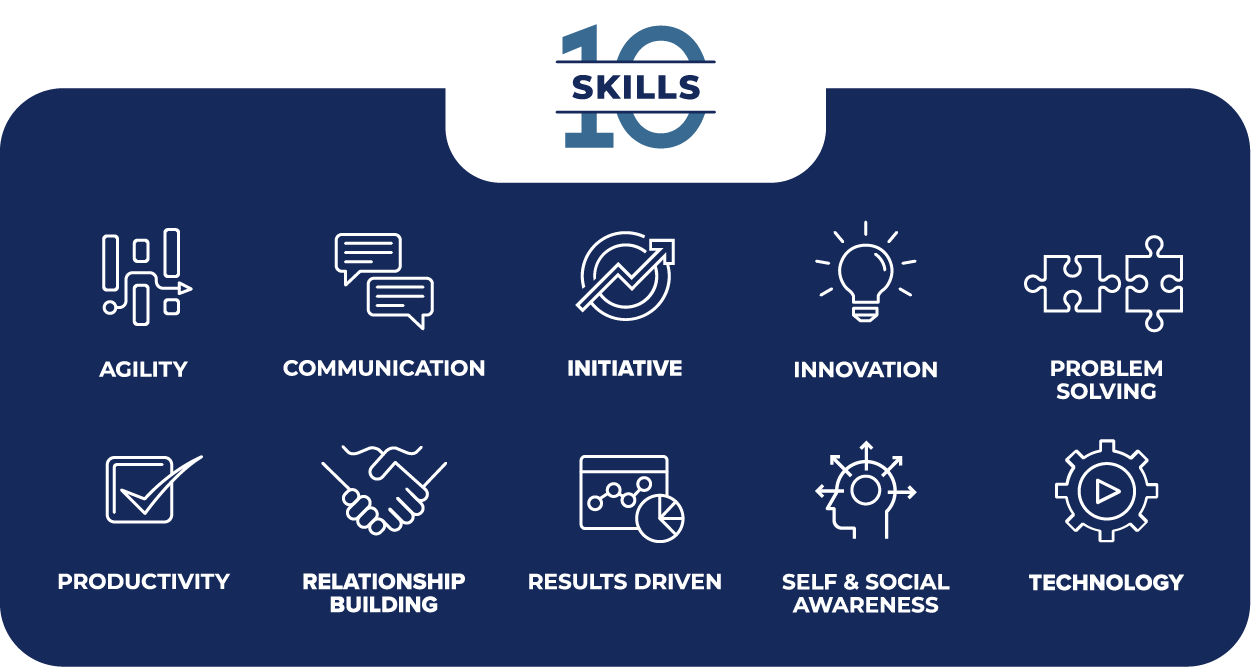
Occupations can differ widely from one another. Just as there are many types of jobs, there are many ways you can apply these employability skills to help you excel in those jobs. Let’s start with two examples.
Innovation is the ability to envision, ideate around, and generate creative ideas and solutions outside of routine perspectives. Here’s one example:
IN CONTEXT
Anika works as a physician’s assistant. She would like to improve patient satisfaction by allowing each patient more time to voice concerns during their appointments. But time is scarce. In the past, Anika relayed basic, routine health habits verbally with her patients, which took up considerable time. But now she’s reversed course. She’s decided to focus more on patient concerns and place any routine information in handouts and on the clinic’s website. Patients are feeling valued to have more “me” time to talk about their health issues.
This example shows us that innovations do not always have to be earth-shattering discoveries. They occur in many forms and on many different levels. All types of innovations work to save time, conserve resources, or improve quality (or quality of life).
Relationship building is the ability to connect with others by establishing trust, respect, and mutual support. Consider this example:
IN CONTEXT
Sean works as a blog writer for a content development agency. The agency recently hired Janelle to be Sean’s new supervisor. Janelle is going through the company’s training program, but it isn’t going very smoothly. There are many complex systems to learn, new team members to meet, and Janelle has fallen behind in her training schedule. Sean decides to block time on his calendar for the next few afternoons to see if he can help get Janelle back on track since he knows the details of each system.
Relationship building is a cornerstone of life and work. Sean saw an opportunity to help Janelle with her productivity and to build a professional connection. Although Janelle is Sean’s acting manager, he knows that being mutually supportive has no boundaries.
To maximize your contributions on the job and improve job satisfaction, it’s useful to start with a self-evaluation of your skills. Getting to know your strengths and work tendencies is an important first step.
Now imagine working in an occupation where you get to exercise your three strongest skills each day. It’s likely that you would not only enjoy the work but also excel at what you do, leading to positive results for you, your employer, and society. Consider the following example.
IN CONTEXT
In two weeks, Garry will begin his apprenticeship as a maintenance mechanic. He’s excited about the opportunity to continue working while he earns college credits. Garry has always been a tinkerer and has a natural ability to fix things. He’s familiar with the most advanced tools and approaches problems from unique perspectives. Garry never settles for the status quo when he designs a new widget. He’s an innovator who wants to find new ways of doing things. He’s big on details and doing a job right the first time. The apprenticeship will teach Garry the necessary math skills he needs to complement his deep hands-on knowledge of machines and mechanisms.
In this example, Garry shows an aptitude for technology, innovation, and problem-solving. He’s excited about his apprenticeship and rightfully so. The opportunity gives him a platform to stretch these three skills, and much more. He’s made a wise choice regarding his future career.
You might be thinking to yourself, “Has anyone ever mastered all ten employability skills?” The answer is easy… no way! Regardless of how well someone performs a task or how much knowledge they acquire, there is always room for improvement. We are all lifelong learners even when it comes to these employability skills.
There are many ways you can go about improving one or more of your employability skills. Here are just a few ideas:
When we identify a gap in our skills, a reasonable next step is to develop a plan for filling the gap. Let’s see an example of how this is accomplished.
IN CONTEXT
Mateo just had his annual review at work. His manager revealed that he’s concerned about Mateo's productivity. Mateo isn’t getting things done as quickly as his team needs and it’s starting to affect their budget. Mateo suspected he might get this type of feedback because he's been distracted by personal issues at home. He explained the situation to his manager and came up with this multi-part strategy to eliminate the distractions:
- Set three main goals each day to prioritize my work.
- Work in 25-minute intervals to rebuild my work stamina.
- Make a mental note when I’m distracted and refocus on the work at hand.
- Check in with an accountability partner at the end of each day to share my accomplishments.
Mateo hatched a thoughtful plan to improve his productivity skill. To ensure he follows the plan, Mateo agreed to meet with an accountability partner to track any improvements. When we make our improvement goals measurable, we have a much better chance at achieving them.
The ten employability skills are transferable skills. This means they can be used in a variety of roles, occupations, and situations. While the previous examples largely represented situations at work, these employability skills have application at school and home as well.
Anytime you set out to accomplish a task, these employability skills can help. They provide a useful framework to save time, leverage resources, and improve quality, no matter what the environment. We’ll look at some real-life examples in more detail in an upcoming lesson.
Source: THIS TUTORIAL WAS AUTHORED BY SOPHIA LEARNING. PLEASE SEE OUR TERMS OF USE.



