Use Sophia to knock out your gen-ed requirements quickly and affordably. Learn more
×

Applications of Sinusoidal Functions

Author: Sophia

what's covered
In this lesson, you will apply trigonometric functions to real-life situations such as Ferris wheels and harmonic motion. Specifically, this lesson will cover:

Table of Contents

1. Modeling Motion Around a Circle

If a quantity oscillates between two values at regular intervals indefinitely, its motion can be described by a sinusoidal function.

EXAMPLE

A circle with radius 3 feet is mounted with its center 4 feet off the ground. The point closest to the ground is labeled P, as shown in the figure. We’ll use this information to do two things:

  • Sketch the graph of the height, H, that point P is above the ground as the circle is rotated after undergoing an angle of rotation, t, in radians.
  • Find a function that gives the height in terms of the angle of rotation.
Here is the figure:

A circle with a radius of 3 feet and a vertical support structure in the form of an inverted ‘V’ extends from the center of the circle to the ground. A point labeled ‘P’ is on lowest point of the circle between the legs of the support structure. A vertical line labeled ‘4 ft’ is drawn outside the circle, indicating the distance from the center of the circle to the ground.

To get the graph, let’s first make a table of values for different angles of rotation.

t = Angle of Rotation H = Height Explanation
0 1 The center of the circle is 4 feet above the ground, which means the closest that P is to the ground is 4 minus 3 equals 1 foot.
straight pi over 2 4 Point P is at the same height as its center, on its way up.
straight pi 7 Point P is three feet above the center, which is 4 plus 3 equals 7 feet above the ground.
fraction numerator 3 straight pi over denominator 2 end fraction 4 Point P is at the same height as its center, on its way down.
2 straight pi 1 Point P returns to its starting position.

Translating this information into ordered pairs, the graph will contain the points open parentheses 0 comma space 1 close parentheses comma open parentheses straight pi over 2 comma space 4 close parentheses comma open parentheses straight pi comma space 7 close parentheses comma open parentheses fraction numerator 3 straight pi over denominator 2 end fraction comma space 4 close parentheses comma and open parentheses 2 straight pi comma space 1 close parentheses comma and continue the same pattern.

Then, the graph of H open parentheses t close parentheses, along with its midline, is shown in the figure.
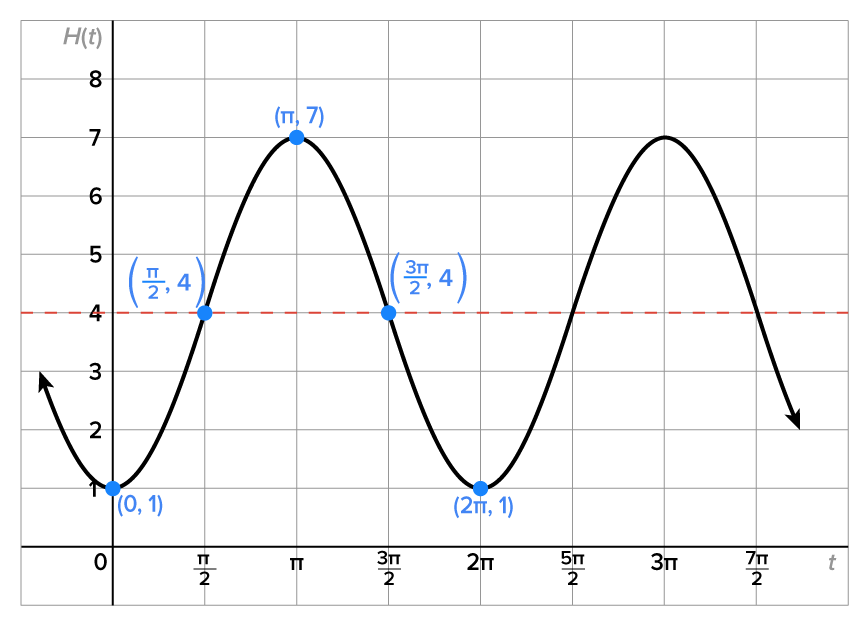
A graph with an x-axis ranging from 0 to 7pi/2 and a y-axis ranging from 0 to 8. A sinusoidal curve moves horizontally from the second quadrant to the first quadrant, passes through the marked points at (0,1), (pi over 2, 4), (pi, 7), (3pi over 2, 4), (2pi, 1), and through the points (5 pi over 2, 4), (3pi, 7), and (7pi over 2, 4). The curve has two peaks at (pi, 7) and (3pi, 7) and two valleys at (0, 1) and (2pi, 1). A horizontal dashed line extends across the curve by passing through the points (0, 4), (pi over 2, 4), (3pi over 2, 4), (5pi over 2, 4), and (7pi over 2, 4).

Since the y-intercept of the graph is the minimum point, a cosine function is convenient. We seek a model of the form H equals a   cos open parentheses b t minus c close parentheses plus d.

The midline is y equals 4 comma which indicates that the graph is a vertical shift from the basic cosine graph. Therefore, d equals 4.

Since the y-intercept is the minimum value, there is no phase shift, meaning c equals 0.

The period is 2 straight pi. Solving fraction numerator 2 straight pi over denominator b end fraction equals 2 straight pi comma b equals 1.

The amplitude is 3 since the minimum and maximum values are each a vertical distance of 3 units from the midline. Since the y-intercept is the minimum value, the graph is reflected. This means a equals short dash 3.

Substituting the values of a comma b, c, and d, the equation for the height in feet above the ground is H open parentheses t close parentheses equals short dash 3   cos   t plus 4.

Notice that the figure in the last example resembles a Ferris wheel. Let’s take a look at the circular motion of a Ferris wheel, but this time as a function of time rather than the rotation angle.
watch
In this video, we’ll find a function that describes the height of a person who boards a Ferris wheel.

try it
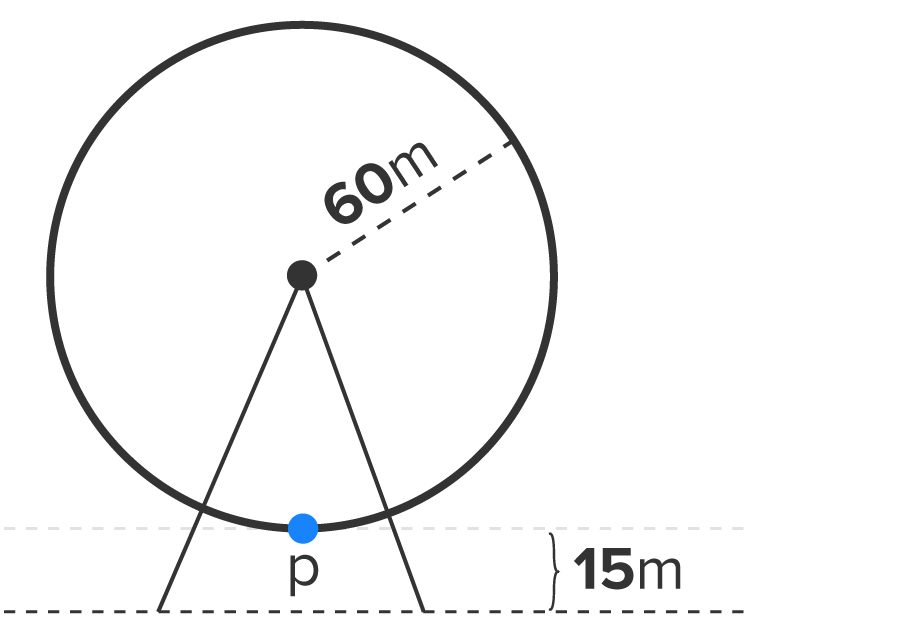
The London Eye is a large Ferris wheel with a diameter of 120 meters. It completes one rotation every 30 minutes. Riders board from a platform 15 meters above the ground.
Express a rider’s height H, in feet, above the ground as a function of time, t, in minutes.
Below is a diagram that represents this Ferris wheel:

A circle with radius 60 meters has center point marked. An upside-down V has its vertex at the center of the circle and opens downward to a horizontal dashed line that represents the ground. A point with label ‘p’ is marked at the bottom of the circle, which is 15 meters above the ground.

To get the equation, let’s first make a table of values for different values in the rotation. Since the wheel makes one full rotation every 30 minutes, we know the heights at each quarter of a rotation, namely t equals 0 comma 7.5, 15, 22.5, and 30 minutes. Note also that the radius is 60 meters since the diameter is 120 meters.

t = time (minutes) bold italic H open parentheses bold t close parentheses = height (in meters) Explanation
0 15 At the start, the rider is on the platform, which is 15 meters above the ground.
7.5 75 The rider is at the same height as the center, which is 15 plus 60 equals 75 meters.
15 135 The rider is at the maximum height, which is the height of the platform plus the diameter (15 plus 120 equals 135 meters).

22.5 75 Once again, the rider is at the same height as the center.
30 15 The rider returns to the platform.

Note that the y-intercept (when t equals 0) is the lowest point, which means that the model y equals a   cos open parentheses b t minus c close parentheses plus d is the most convenient to use.

Now, let’s connect the information to values of a comma b, c, and d in the equation:

  • The y-intercept is the lowest point, which means there is no phase shift, meaning c equals 0.
  • Since the wheel is 120 meters in diameter, the maximum height is 15 plus 120 equals 135 meters.
  • The midline is fraction numerator 135 plus 15 over denominator 2 end fraction equals 75 comma which is also the vertical shift of this function. Therefore, d equals 75.
  • The amplitude is the vertical distance between the midline and either the minimum or maximum value: 135 minus 75 equals 60.
  • Since the initial value of this function is its lowest point, a less than 0 comma which means a equals short dash 60.
  • Lastly, the period of this function is 30 minutes. This means fraction numerator 2 straight pi over denominator b end fraction equals 30 comma which means b equals straight pi over 15.
Putting this all into the equation y equals a   cos open parentheses b t minus c close parentheses plus d comma the equation for the height of the rider of this Ferris wheel is H open parentheses t close parentheses equals short dash 60   cos open parentheses straight pi over 15 t close parentheses plus 75.


2. Modeling Simple Harmonic Motion

For the following situation, assume that a greater than 0.

Suppose a spring is attached to the ceiling or some other horizontal surface. If the weight is pulled down a units and released (Part B), the weight will rise to a height a units above its equilibrium position (Part C), then continue to oscillate about its equilibrium position. If friction is neglected, then the motion can be described by a sinusoid.
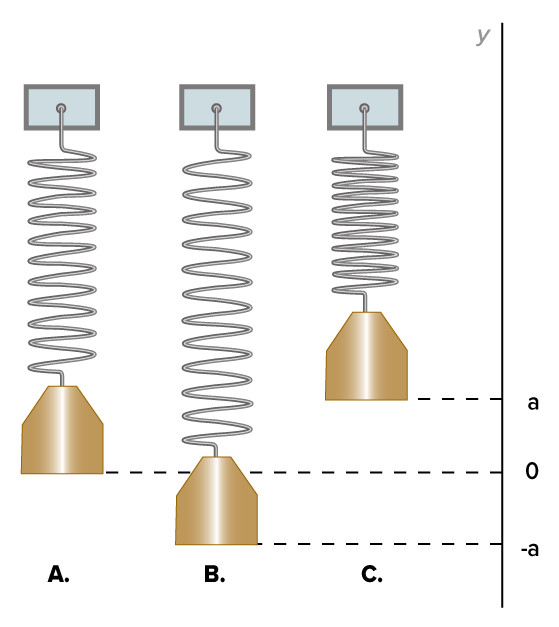
Three springs attached to a ceiling or a horizontal surface are labeled ‘A’, ‘B’, and ‘C’. The positions or heights of each spring correspond to values on the y-axis.  Spring A is at the height labeled ‘0’, indicating it is at equilibrium. Spring ‘B’ is at the height labeled ‘−a’, indicating it is below equilibrium, and spring ‘C’ is at the height labeled ‘a’ indicating it is above equilibrium.

The oscillatory motion of the weight on the spring is an example of simple harmonic motion.

We use the function s open parentheses t close parentheses to describe the object’s position relative to equilibrium.

  • For values of t where s open parentheses t close parentheses greater than 0 comma the object is above equilibrium.
  • For values of t where s open parentheses t close parentheses equals 0 comma the object is at equilibrium.
  • For values of t where s open parentheses t close parentheses less than 0 comma the object is below equilibrium.
watch
To establish the equations for simple harmonic motion, consider an object on a circular path with constant angular speed omega comma where the circle has radius a.

The angle swept out by the motion is theta comma and is equal to the angular speed times the time elapsed, which means theta equals omega t.

This means that the x- and y-coordinates at any time t are x equals a   cos theta equals a   cos open parentheses omega t close parentheses and x equals a   sin theta equals a   sin open parentheses omega t close parentheses. As the point moves around the circle, the x- and y-coordinates oscillate indefinitely between a and short dash a.

This leads to the two possible equations that are used to describe simple harmonic motion.

formula to know
Equations for Harmonic Motion
  • When the object is pulled and released open vertical bar a close vertical bar units from its equilibrium position, the equation used to describe the motion is s open parentheses t close parentheses equals a   cos open parentheses omega t close parentheses.

  • When the initial displacement is set into motion with an initial velocity at equilibrium position, the equation used to describe the motion is s open parentheses t close parentheses equals a   sin open parentheses omega t close parentheses.

Notice that omega is used in place of b in the other trigonometric functions we’ve used earlier. This means that the period of motion is fraction numerator 2 straight pi over denominator omega end fraction.

EXAMPLE

An object is attached to a coiled spring. It is pulled down a distance of 5 inches from its equilibrium position, then released. The time for one complete oscillation is 4 seconds.

Since one oscillation occurs in 4 seconds, this is the period of motion. Then, fraction numerator 2 straight pi over denominator omega end fraction equals 4 comma which means omega equals straight pi over 2.

The object starts at 5 inches below equilibrium, so the model s open parentheses t close parentheses equals a   cos open parentheses omega t close parentheses is used to model the motion. This also means that s open parentheses 0 close parentheses equals short dash 5.

s open parentheses 0 close parentheses equals short dash 5 This is the initial position of the oscillating object.
a   cos open parentheses omega times 0 close parentheses equals short dash 5 Replace t with 0.
a   cos open parentheses 0 close parentheses equals short dash 5 Simplify.
a equals short dash 5 cos open parentheses 0 close parentheses equals 1

Substituting a equals short dash 5 and omega equals straight pi over 2 into the equation s open parentheses t close parentheses equals a   cos open parentheses omega t close parentheses comma the equation of the simple harmonic motion in this situation is s open parentheses t close parentheses equals short dash 5   cos open parentheses straight pi over 2 t close parentheses.

big idea
Note that the value of a in this model is the same as the object's initial position. This is always the case when the cosine model is used.

Sometimes we are not only concerned about the period of motion, but also its frequency.

Since the period is the length of time for one cycle, the frequency is related to the period.

formula to know
Frequency of Motion
Given that an object follows simple harmonic motion with period P units of time per oscillation, its frequency is 1 over P oscillations per unit of time.

In the previous example, the period was 4 seconds per oscillation, which means that the object’s frequency is 1 fourth oscillation per second.

EXAMPLE

A weight on a spring has an maximum displacement 2 inches above equilibrium at t equals 0 and a period of 0.5 seconds.

Since the initial position is nonzero, the equation s open parentheses t close parentheses equals a   cos open parentheses omega t close parentheses is used to describe the motion. Since the initial position is 2, a equals 2.

Since the period is 0.5, fraction numerator 2 straight pi over denominator omega end fraction equals 0.5 comma which means omega equals 4 straight pi.

Substituting a and omega into the equation, the model for the position is s open parentheses t close parentheses equals 2   cos open parentheses 4 straight pi t close parentheses.

We can also use the period to determine the frequency. Since the period is 0.5 seconds, the frequency is fraction numerator 1 over denominator 0.5 end fraction equals 2 oscillations per second.

try it
A note on a piano has a frequency of 110 oscillations per second. Its maximum displacement is s open parentheses 0 close parentheses equals 0.11 inches.
Find the period of the motion.
Using the formula frequency equals 1 over P comma set 1 over P equals 110 comma which means the period is 1 over 110 seconds per oscillation.
Find the equation for s   (t  ).
Since the maximum displacement is s open parentheses 0 close parentheses equals 0.11 inches, the function has the form s open parentheses t close parentheses equals a   cos open parentheses omega t close parentheses comma where omega is determined by the period.

  • The maximum displacement is s open parentheses 0 close parentheses equals 0.11 inches, which means that a equals 0.11.
  • The period of this motion is fraction numerator 2 straight pi over denominator omega end fraction comma which is 1 over 110 seconds. Solving fraction numerator 2 straight pi over denominator omega end fraction equals 1 over 110 comma we have omega equals 220 straight pi.
Thus, the equation for the displacement is s open parentheses t close parentheses equals 0.11   cos open parentheses 220 straight pi t close parentheses.

terms to know
Harmonic Motion
Repetitive motion back and forth through some equilibrium position.
Frequency
The number of oscillations (or cycles) per unit time.

summary
In this lesson, you learned that if a quantity oscillates between two values at regular intervals indefinitely, its motion can be modeled by a sinusoidal graph. You explored this application of trigonometric functions to real-world phenomena such as modeling motion around a circle, like a Ferris wheel, and modeling simple harmonic motion, like the oscillatory motion of a weight on a spring.

SOURCE: THIS TUTORIAL HAS BEEN ADAPTED FROM OPENSTAX "PRECALCULUS” BY JAY ABRAMSON. ACCESS FOR FREE AT OPENSTAX.ORG/DETAILS/BOOKS/PRECALCULUS-2E. LICENSE: CREATIVE COMMONS ATTRIBUTION 4.0 INTERNATIONAL.

Terms to Know
Frequency

The number of oscillations (or cycles) per unit time.

Harmonic Motion

Repetitive motion back and forth through some equilibrium position.

Formulas to Know
Equations for Harmonic Motion

When the object is pulled and released open vertical bar a close vertical bar units from its equilibrium position, the equation used to describe the motion is s open parentheses t close parentheses equals a   cos open parentheses omega t close parentheses.

When the initial displacement is set into motion with an initial velocity at equilibrium position, the equation used to describe the motion is s open parentheses t close parentheses equals a   sin open parentheses omega t close parentheses.

Frequency of Motion

Given that an object follows simple harmonic motion with period P units of time per oscillation, its frequency is 1 over P oscillations per unit of time.