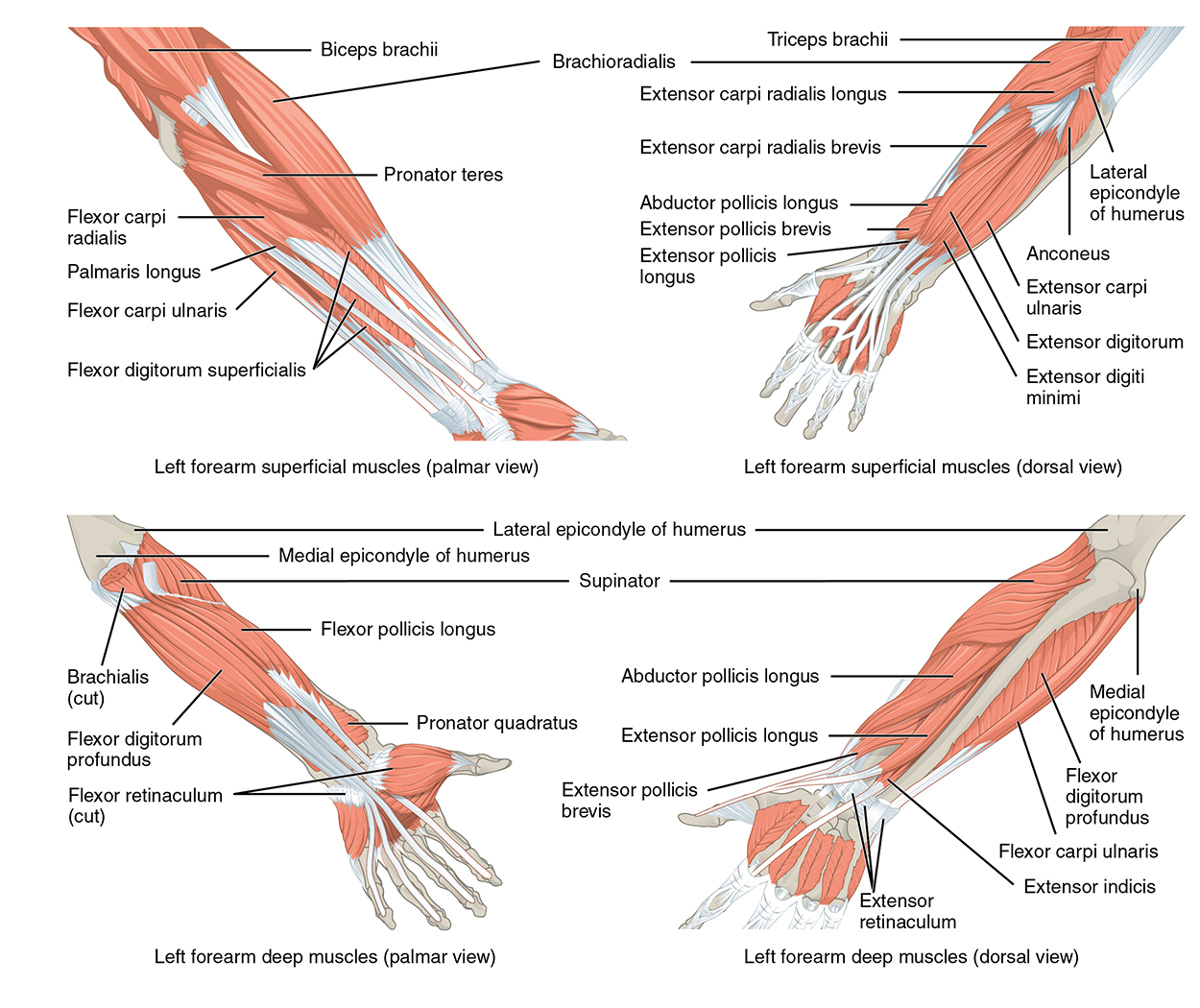
Hand and finger movements are facilitated by a large group of muscles that are named for their location, anatomical structure, or action. The following list covers most of the terms used in naming the muscles in this region.
Superficialis = Superficial
Profundus = Deep
Brevis = Short
Longus = Long
Carpi = Carpal region (wrist)
Digiti Minimi = Little digit (pinky)
Digitorum = Digital region (fingers)
Pollicis = Pollex region (thumb)
Palmaris = Palm of the hand
Flexor = Causes flexion
Extensor = Causes extension
Abductor = Causes abduction
Adductor = Causes adduction
Muscles That Move the Hands and Fingers - The muscles originating in the forearm move the hands and fingers.
did you know
One way to categorize these muscles is by their action—do they cause flexion or extension?
The flexors and extensors can be further divided by whether they move the hand or fingers. The flexors of the hand all originate at the medial epicondyle of the humerus, are located in the anterior forearm, and are listed below.
The flexor carpi radialis flexes the wrist (carpi) by its insertion into the radius (radialis). It also performs abduction of the wrist.
The flexor carpi ulnaris flexes the wrist by its insertion into the ulna (ulnaris). It also performs adduction of the wrist.
The palmaris longus is located between the other two muscles in this group and flexes the wrist by its insertion into the flexor retinaculum, a connective tissue band over the anterior portion of the wrist. The posterior portion of the wrist is covered by the extensor retinaculum.
The flexors of the fingers originate from the humerus, ulna, or radius and are listed below.
The flexor digitorum superficialis is a superficial (superficialis) muscle of the anterior forearm which causes flexion of digits 2–5. This muscle flexes the metacarpophalangeal joint and the proximal interphalangeal joint.
The flexor digitorum profundus is a deep (profundus) muscle of the anterior forearm which causes flexion of digits 2–5. This muscle flexes the distal interphalangeal joint.
The flexor pollicis longus is the flexor of the thumb (pollicis).
The flexor digitorum superficialis flexes the hand as well as the digits at the knuckles, which allows for rapid finger movements, as in typing or playing a musical instrument. However, poor ergonomics can irritate the tendons of these muscles as they slide back and forth within the carpal tunnel formed by the flexor retinaculum. This irritation can cause the median nerve to be pinched inside the tunnel, causing Carpal Tunnel Syndrome.
The extensors of the hand all originate at the lateral epicondyle of the humerus, are located in the posterior forearm, and are listed below.
The extensor carpi radialis brevis is a short (brevis) extensor of the wrist (carpi) which inserts into the radius (radialis). This muscle also performs abduction of the wrist. The extensor carpi radialis longus performs the same actions but is slightly longer (longus).
The extensor carpi ulnaris extends the wrist. Due to its insertion into the fifth metacarpal and origin on the proximal ulna, it also performs adduction of the wrist.
The extensors of the fingers originate from a variety of points on the humerus, radius, or ulna and are listed below.
The extensor digitorum is a middle layer muscle that inserts into the phalanges on digits 2–5 performing extension of these fingers.
The extensor digiti minimi is a middle layer muscle that inserts into the proximal phalanx of digit 5 only. This muscle performs extension of the pinky only.
The extensor pollicis brevis is a deep layer muscle that inserts into the proximal phalanx of the first digit, the thumb (pollicis). This muscle performs extension of the thumb.
The extensor pollicis longus is a deep layer muscle that inserts into the distal phalanx of the first digit, the thumb (pollicis). This muscle performs extension of the thumb.
The extensor indicis is a deep layer muscle that inserts into the phalanges for digit 2, the index finger, performing extension and adduction of this digit only.
As indicated above, some flexor and extensor muscles do perform abduction and adduction of the hand and fingers. However, there is one forearm muscle that only performs abduction.
The abductor pollicis longus connects the proximal ulna and radius to the fifth metacarpal and performs abduction of the thumb (pollicis). A short (brevis) version of this does exist but is only located within the hand.
Table: Muscles that Move the Hand and Fingers
Muscle
Action
Origin
Insertion
Flexors of the Hand
Flexor Carpi Radialis
Flexes and abducts the wrist
Medial epicondyle of humerus
Base of 2nd & 3rd metacarpals
Flexor Carpi Ulnaris
Flexes and adducts the wrist
Medial epicondyle of humerus, olecranon of ulna
Pisiform, hamate, base of 5th metacarpal
Palmaris Longus
Flexes the wrist
Medial epicondyle of humerus
Flexor retinaculum, palmar aponeurosis
Extensors of the Hand
Extensor Carpi Radialis Brevis
Extends and abducts the wrist
Lateral epicondyle of humerus
Base of 3rd metacarpal
Extensor Carpi Radialis Longus
Extends and abducts the wrist
Lateral epicondyle of humerus
Base of 2nd metacarpal
Extensor Carpi Ulnaris
Extends and adducts the wrist
Lateral epicondyle of humerus, posterior surface of ulnar shaft
Base of 5th metacarpal
Flexors of the Fingers
Flexor Digitorum Profundus
Flexes distal interphalangeal joints
Shaft and coronoid process of ulna
Distal phalanges of digits 2–5
Flexor Digitorum Superficialis
Flexes metacarpophalangeal and proximal interphalangeal joints
Medial epicondyle of humerus, anterior proximal radius and ulna
Middle phalanges of digits 2–5
Flexor Pollicis Longus
Flexes digit 1 (thumb)
Shaft of radius
Distal phalanx of digit 1
Extensors of the Fingers
Extensor Digiti Minimi
Extends the digit 5 (pinky)
Lateral epicondyle of humerus
Proximal phalanx of digit 5
Extensor Digitorum
Extends digits 2–5
Lateral epicondyle of humerus
Phalanges of digits 2–5
Extensor Indicis
Extends and adducts digit 2 (index finger)
Posterior surface of ulna
Phalanges of digit 2
Extensor Pollicis Brevis
Extends digit 1 (thumb)
Shaft of radius
Proximal phalanx of digit 1
Extensor Pollicis Longus
Extends digit 1 (thumb)
Shaft of ulna
Distal phalanx of digit 1
Abductor of the Fingers
Abductor Pollicis Longus
Abducts digit 1 (thumb)
Posterior shaft of proximal ulna and radius
Lateral margin of 5th metacarpal bone
watch
View the following video for more information on this topic.
learn more
To see more in-depth and additional appendicular muscles, please visit the supplemental Appendicular Muscles.pdf.
terms to know
Flexor Carpi Radialis
A forearm muscle that flexes and abducts the wrist.
Flexor Carpi Ulnaris
A forearm muscle that flexes and adducts the wrist.
Palmaris Longus
A forearm muscle that flexes the wrist.
Flexor Retinaculum
A band of connective tissue which extends over the anterior wrist.
Extensor Retinaculum
A band of connective tissue which extends over the posterior wrist.
Flexor Digitorum Superficialis
A forearm muscle that flexes the proximal joints of digits 2–5.
Flexor Digitorum Profundus
A forearm muscle that flexes the distal joints of digits 2–5.
Flexor Pollicis Longus
A forearm muscle that flexes digit 1.
Carpal Tunnel Syndrome
A condition in which a nerve is compressed in the anterior wrist causing pain, numbness, and tingling sensations in the hand.
Extensor Carpi Radialis Brevis
A forearm muscle that extends the wrist.
Extensor Carpi Radialis Longus
A forearm muscle that extends and abducts the wrist.
Extensor Carpi Ulnaris
A forearm muscle that extends and adducts the wrist.
Extensor Digitorum
A forearm muscle that extends digits 2–5.
Extensor Digiti Minimi
A forearm muscle that extends digit 5.
Extensor Pollicis Brevis
A forearm muscle that extends the proximal joint of digit 1.
Extensor Pollicis Longus
A forearm muscle that extends the distal joint of digit 1.
Extensor Indicis
A forearm muscle that extends and adducts the joints of digit 2.
Abductor Pollicis Longus
A forearm muscle that abducts the thumb.
summary
In this lesson, you learned to identify muscles of the upper limb. Specifically, you learned the muscles that move the hand and fingers. You learned the location and action of each of these muscles.