Table of Contents |
The path of classical philosophy begins in North Africa, reaches Greece and Rome, jumps back across the Mediterranean, and spreads from Persia to Spain before it emerges to support what is frequently called the birth of modernity.
In The Histories of Herodotus, the ancient Greek historian Herodotus (c. 484-425 BCE) traces Greek beliefs about the gods, religious practices, and the understanding of the natural world to Egypt. Herodotus claims that the ancient Greeks adopted practices and ideas as diverse as solemn processions to temples, the belief in an immortal soul, and the knowledge of geometry and astrology from the Egyptians. Herodotus notes that the people of Heliopolis, one of the largest cities in ancient Egypt, “are said to be the most learned in records of the Egyptians” (Herodotus, 1890, p. 116). Plato spent 13 years in Heliopolis, and Pythagoras (c. 570-495 BCE) studied mathematics in Heliopolis for more than two decades. In written accounts of Socrates’ conversations, he is known for using the exclamation “by the dog!” (referring to the Egyptian god Anubis) in order to emphasize a point.
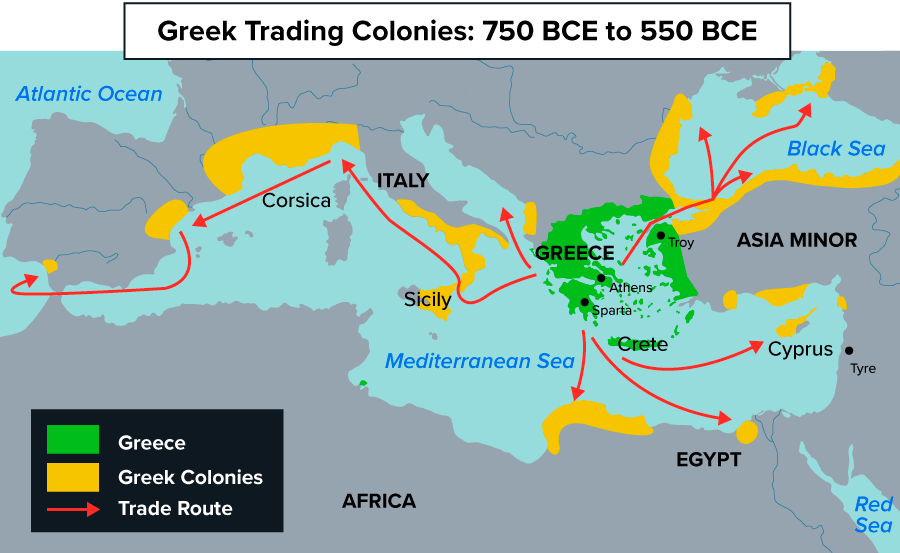
The emergence of philosophy in the southern Greek city-states has, in part, been linked to their geographic connection to trade. The Aegean people were well known for their naval prowess, which led in part to both colonies and trade routes. The Greek islands and Athens (with its natural deep harbor) became major connection points between Africa (through Egypt), Europe, and near-East. This trade in not only goods but also ideas led to the possibility of multiple different understandings of the world to mingle, combine, and come into conversation.
Researching the pre-Socratics is difficult because so little of their work has survived. Still, based on the work that is available, we can characterize the pre-Socratics as interested in questions of metaphysics and natural philosophy, with many of them proposing that nature consisted of one or more basic substances.
The pre-Socratic philosopher Pythagoras (570-490 BCE) and his followers, known as the Pythagoreans, comprised a rational yet mystical sect of learned men. The Pythagoreans had a reputation for learning and were legendary for their knowledge of mathematics, music, and astronomy as well as for their dietary practices and other customs. Among the Pythagoreans’ key beliefs was the idea that the solution to the mysteries of the universe was numerical and that these numerical mysteries could be revealed through music. A reminder of their mathematical legacy can be found in the Pythagorean theorem, which students continue to learn in school. Pythagoreans also believed in the transmigration of souls, an idea that Plato would adopt. According to this doctrine, the soul outlives the body, and individuals are reborn after death in another human body or even in the body of a nonhuman animal.
Another important pre-Socratic philosopher who produced novel theological ideas is Xenophanes (c. 570–478 BCE). Xenophanes, who was fascinated by religion, rejected the traditional accounts of the Olympian gods. He sought a rational basis for religion and was among the first to claim that gods are actually projections of the human mind. He argued that the Greeks anthropomorphized divinity, and like many later theologians, he held that there is a God whose nature we cannot grasp.
As you have learned, though Socrates did not write anything down, we have depictions of his methods of doing philosophy from multiple sources, most prominently the writings of Plato. Plato wrote a series of “dialogues” between Socrates and others, exploring multiple ideas and concepts. It is generally accepted that large portions of these dialogues accurately reflect conversations that Socrates had. By his last works, Plato had largely stopped using historically accurate depictions of Socrates, turning instead to the character of “the Athenian” to lead the conversations.
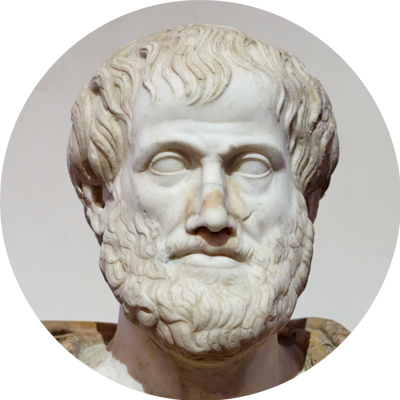 Another Ancient Greek philosopher, Plato’s student Aristotle, defined human beings as “rational animals.” We are like all other animals and come equipped with nervous systems that enable us to perceive what is happening around us and respond in real time. Animal nervous systems are the product of hundreds of millions of years of evolution and are extremely useful for helping animals survive and flourish in a complex and constantly changing environment. But what is distinctive about the human nervous system is the degree to which the constant stream of information coming into it through our senses is integrated and organized. It is integrated in an experience which is, as far as we can tell, more fully conscious than that of other creatures. And it can be more explicitly examined and critically reflected on, enabling us to reason about how reliable it is and whether what it presents us with is really true. We can make explicit to ourselves our own thought processes and subject them to critical analyses.
This is a point that is hard to overemphasize but also easy to miss since we take it so much for granted. By asking ourselves about the reasons we have for believing that some aspect of our experience is true, we are asking ourselves not only about the way things seem to us but also about the way things should appear; not just what we happen to believe about things based on their appearance to us, but about what we should believe about them because it reflects their true reality. And by asking ourselves such questions, we are asking what philosophers call normative questions, questions that have to do with values, with concepts like right, wrong, good, bad, true, false, beautiful, and ugly. We not only perceive and think but also judge our own perceptions and thoughts according to standards that are more general and weighty, going by the lofty names of Reason, Truth, Reality and so on.
The first sentence of his famous work Metaphysics states, “Philosophy begins in wonder.” He exemplified this claim in his writing. His works ranged widely across all the main areas of philosophy, including logic, metaphysics, and ethics. In addition, he investigated natural philosophy, the fields of study that eventually gave rise to science. Aristotle also researched topics that would today be classified as biology and physics. At the center of Aristotle’s work was his doctrine of the four causes. He believed that the nature of any single thing could be understood by answering four basic questions:
EXAMPLE
Using Aristotle’s four causes, we could explain a clay pot: it’s made of clay (material cause), shaped on a wheel (formal cause), formed by a potter (efficient cause), and used to hold water (final cause).”Where Plato’s writings used the dialogue form to provide a narrative in which an idea was explored, what we have, to capture Aristotle’s thoughts, are largely the notes that his students took during lectures. Imagine if, hundreds of years from now, scholars had to use your notes on this class to understand the material you learned. That we are reading notes is also complicated by the fact that Aristotle tended to attempt to understand things by categorizing them into component parts.
This excerpt from Aristotle’s Politics gives you a sense of how dense his work is:
"There is no difficulty in distinguishing the various kinds of authority; they have been often defined already in discussions outside the school. The rule of a master, although the slave by nature and the master by nature have in reality the same interests, is nevertheless exercised primarily with a view to the interest of the master, but accidentally considers the slave, since, if the slave perish, the rule of the master perishes with him. On the other hand, the government of a wife and children and of a household, which we have called household management, is exercised in the first instance for the good of the governed or for the common good of both parties, but essentially for the good of the governed, as we see to be the case in medicine, gymnastic, and the arts in general, which are only accidentally concerned with the good of the artists themselves. For there is no reason why the trainer may not sometimes practice gymnastics, and the helmsman is always one of the crew. The trainer or the helmsman considers the good of those committed to his care. But, when he is one of the persons taken care of, he accidentally participates in the advantage, for the helmsman is also a sailor, and the trainer becomes one of those in training. And so in politics: when the state is framed upon the principle of equality and likeness, the citizens think that they ought to hold office by turns. Formerly, as is natural, every one would take his turn of service; and then again, somebody else would look after his interest, just as he, while in office, had looked after theirs. But nowadays, for the sake of the advantage which is to be gained from the public revenues and from office, men want to be always in office. One might imagine that the rulers, being sickly, were only kept in health while they continued in office; in that case we may be sure that they would be hunting after places. The conclusion is evident: that governments which have a regard to the common interest are constituted in accordance with strict principles of justice, and are therefore true forms; but those which regard only the interest of the rulers are all defective and perverted forms, for they are despotic, whereas a state is a community of freemen."
We see here Aristotle thinking about the various ways that power or authority can be used. He includes a consideration of master/slave relationships, household relationships, and those in governmental structures. Across all of these varieties, he holds that instances in which power is used for the benefit of the ruler instead of the greater good, this is an inappropriate use of authority.
The contrast between writing styles is not all that separates Platonic texts from Aristotelian ones. It is generally true to say that Plato tended to be more focused on the transcendental world of the forms, while Aristotle and his followers were more focused on this worldly existence. They shared a belief that the universe was comprehensible and that reason should serve as a guide to ordering our lives.
In the wake of the giants of Greek philosophy, Socrates, Plato, and Aristotle, some philosophers turned away from Plato’s ideal forms and toward materialism. In this, they can be seen as furthering a trend already present in the thinking of Aristotle. For Aristotle, there can be no immaterial forms: Everything that exists has some material basis, though he allows an exception for his first cause, the unmoved mover.
The Epicureans rejected the existence of immaterial forms, unmoved movers, and immaterial souls. The Epicureans, like Aristotle, embraced empiricism, which means that they believed that all knowledge was derived from sense experience. They believed in an ethical naturalism that held that in order to live a good life, we must properly understand human nature. The ultimate goal of life is to pursue pleasure. Despite their disagreements with Plato and, to a lesser extent, Aristotle, the Epicureans agreed with their predecessors that human existence ought to be guided by reason.
The two principal Greek Epicureans were Epicurus himself (341–270 BCE) and his Roman disciple Lucretius (c. 99–55 BCE). Although Epicurus’s views are characterized as hedonistic, this does not mean that he believed that we ought to be indiscriminate pleasure-seekers. Instead, he proposed that people could achieve fulfilling lives if they were self-sufficient and lived free from pain and fear. Of course, complete self-sufficiency is just as impossible as a life utterly free from pain and fear, but Epicurus believed that we should strive to minimize our dependence upon others while limiting the pain in our lives. Epicureans thought that the best way to do this was to retire from society into philosophical communities far from the hustle and bustle of the crowd. Epicurus and Lucretius saw the fear of death as our most debilitating fear, and they argued that we must overcome this fear if we were going to live happy lives.
Lucretius developed Epicurean philosophy in a poem called De Rerum Natura (on the nature of things). This poem discusses ethical ideas, but physics provides its focus. Lucretius adopts a material atomism that holds that things are composed of atoms in motion. Rejecting religious explanations, he argues that the universe is governed by chance and exemplified by these atoms in motion.
Source: This tutorial has been adapted from OpenStax “Introduction to Philosophy.” Access for free at OpenStax. License: Creative commons attribution 4.0 international.
REFERENCES
Aristotle. (350 B.C.E.). Politics (B. Jowett, Trans.). classics.mit.edu/Aristotle/politics.3.three.html
Herodotus. (1890). The history of Herodotus (G. C. Macaulay, Trans.). archive.org/details/HerodotusHistory2019/Herodotus_History_2019/



