In this lesson, you will learn about the process of digesting food. Specifically, this lesson will cover:
1. The Digestive System
All living organisms need nutrients to survive. While plants can obtain nutrients from their roots and the energy molecules required for cellular function through the process of photosynthesis, animals obtain their nutrients by the consumption of other organisms. The conversion of the food consumed to the nutrients required is a multistep process involving digestion and absorption. During digestion, food particles are broken down to smaller components which are later absorbed by the body. This happens by both physical means such as chewing and by chemical means such as enzymatic processes.
-
One of the challenges in human nutrition is maintaining a balance between food intake, storage, and energy expenditure. Taking in more food energy than is used in activity leads to storage of the excess in the form of fat deposits.
The rise in obesity and the resulting diseases like type 2 diabetes makes understanding the role of diet and nutrition in maintaining good health all the more important.
In this tutorial, we will first discuss the anatomy of the digestive tract and then later we will learn about how digestion and absorption work.
-
- Digestive Tract
- Organs that food and liquids travel through when they are swallowed, digested, absorbed, and leave the body as feces. It includes the mouth, pharynx (throat), esophagus, stomach, small intestine, large intestine, rectum, and anus.
2. The Digestive Tract
The job of the digestive tract is to turn the food we eat into nutrients our bodies can use. The digestive system is made up of the gastrointestinal tract—also called the GI tract or digestive tract—and the liver, pancreas, and gallbladder. The GI tract is a series of hollow organs joined in a long, twisting tube from the mouth to the anus. The hollow organs that make up the GI tract are the mouth, esophagus, stomach, small intestine, large intestine, and anus. The liver, pancreas, and gallbladder are the solid organs of the digestive system.
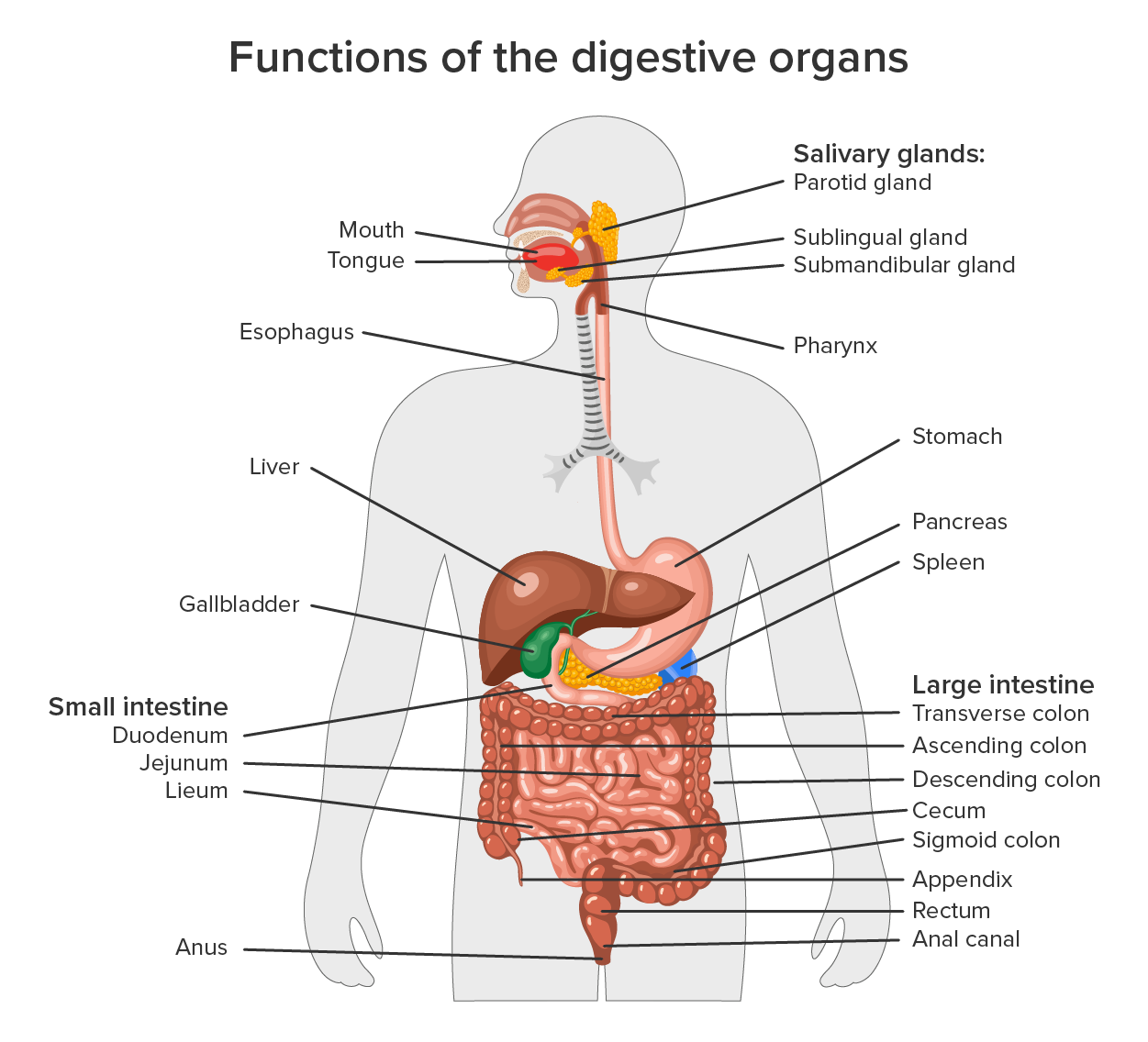
The mouth is actually the beginning of the digestive tract and digestion starts in the mouth as soon as you take a bite of food. Let’s take a look at how food goes through your digestive system.
-
- The tongue, which is skeletal muscle, and the smooth muscles of the pharynx and esophagus swallow the food (now called a bolus), which then enters the esophagus.
- Within the esophagus, muscular contraction, known as peristalsis, pushes the bolus and liquid from the mouth into the stomach.
- Once the bolus has gotten to the top of the stomach, it must first pass through the lower esophageal sphincter. This is a muscle that controls food entering the stomach and exiting the stomach back into the esophagus.
- The lower esophageal sphincter relaxes, letting the bolus into the upper portion of the stomach, and will contract again to prevent food from flowing back into the esophagus.
- Through this process, the food begins to mix through peristalsis from the fundus, the upper portion of the stomach to the corpus, the midportion, and then to the antrum and pylorus, the lower portion of the stomach.
- The food is now mixed into chyme. This mixture of chyme continuously mixes and is slowly released in small quantities into the small intestine through the lower pyloric sphincter. The lower pyloric sphincter is a muscle that relaxes to slowly release small amounts of the contents of the stomach and then contracts to help prevent backflow into the stomach.
- The contents next enter the small intestine, which is broken down into three parts, the duodenum, the jejunum, and the ileum. When the chyme enters the duodenum, the pancreas, gallbladder, and duodenal epithelium secrete more enzymes that contain sodium bicarbonate. Most of the digestion occurs within the duodenum and upper part of the jejunum.
-
Bile is released into the small intestine from the gallbladder. Bile contains bile salts that promote digestion and absorption of fats, cholesterol, and fat-soluble vitamins. A large number of enzymes are released that play a large part in hydrolyzing different parts of the makeup of food. The enzymes are pancreatic lipase and amylase, trypsin, chymotrypsin, carboxypeptidase, aminopeptidase, ribonuclease, and deoxyribonuclease. These enzymes do a combination of hydrolysis, forming monoglycerides, fatty acids, esters, dextrins, maltose, peptide bonds, amino acids, and mononucleotides. At this point, the ileocecal valve is a muscle that is helping control the amount of chyme that is leaving the small intestine and goes into the large intestine.
Leaving the small intestine going into the large intestine (or colon) is chyme, which has been broken down into smaller particles from the enzymes in the small intestine, the mixture still contains complex starches and ingested fiber. The large intestine is a 5- to 6-foot-long muscular tube that connects the cecum, ascending colon, transverse colon, descending colon, and sigmoid colon as it connects to the rectum. The chyme enters the large intestine, and absorption, as well as bacterial fermentation, begins. Most of the fluid that was consumed is absorbed through the large intestine, and the rest is excreted out. The colon ferments the rest of the carbohydrates and amino acids and synthesizes some vitamins. Whatever contents are not reabsorbed back into the body, are later excreted out through the anal tract. So the food that was consumed at the beginning was chewed, broken down, digested, absorbed, and excreted out, all throughout the digestive tract.
-
- Gastrointestinal Tract
- Organs that food and liquids travel through when they are swallowed, digested, absorbed, and leave the body as feces. These organs include the mouth, pharynx (throat), esophagus, stomach, small intestine, large intestine, rectum, and anus. It is part of the digestive system. Also called the alimentary tract and digestive tract.
- Liver
- A large, vascular, glandular organ of vertebrates that produces bile and causes important changes in many of the substances contained in the blood which passes through it. It is in the upper right portion of the abdominal cavity, below the diaphragm.
- Pancreas
- A large gland of vertebrates that produces digestive enzymes and the hormones insulin and glucagon.
- Gallbladder
- A muscular sac that stores bile from the liver.
- Mouth
- Opening through which food passes into the body. It is bounded externally by lips and internally by the pharynx. It encloses the tongue, gums, and teeth.
- Esophagus
- A tube that transfers food from the mouth to the stomach. It is about nine inches long.
- Stomach
- A saclike expansion of the digestive tract that is located between the esophagus and duodenum. It normally consists of a simple curved sac with an outer serous covering, a strong muscular wall that contracts rhythmically, and an inner mucous membrane lining that contains gastric glands.
- Small Intestine
- The narrow part of the intestine that is between the stomach and colon. It consists of duodenum, jejunum, and ileum. It produces digestive enzymes, and is the primary site of the digestion of food into small molecules which are absorbed into the body.
- Large Intestine
- The more terminal division of the vertebrate intestine that is wider and shorter than the small intestine, typically divided into cecum, colon, and rectum.
- Anus
- The rear opening of the digestive tract.
- Peristalsis
- Consecutive waves of involuntary contraction passing along the walls of a hollow muscular structure (such as the esophagus or intestine) and forcing the contents onward.
- Lower Esophageal Sphincter
- Bands of muscles at the top and bottom of the esophagus that open and close to let food move through.
- Chyme
- The semifluid mass of partly digested food expelled by the stomach into the duodenum.
- Lower Pyloric Sphincter
- A muscular valve at the bottom of the stomach that opens to allow food to pass from the stomach to the top of the small intestine.
- Duodenum
- The first part of the small intestine expanding from the pylorus to the jejunum.
- Jejunum
- The section of the small intestine that contains the first two fifths beyond the duodenum and that is larger, thicker-walled, and more vascular and has more circular folds than the ileum.
- Ileum
- The last part of the small intestine extending between the jejunum and large intestine.
- Bile
- A fluid formed by the liver and stored in the gallbladder. It is ejected into the small intestine, where it helps digest fat.
- Ileocecal Valve
- The valve created by two folds of mucous membrane at the opening of the ileum into the large intestine.
3. The Food Digestion Process
The food digestion process utilizes many parts of the body, such as different organs, muscles, and enzymes. This process can begin with even the smell, sight, or taste of food. The digestion process begins at the mouth and goes through the gastrointestinal tract, and ends at the anus. The gastrointestinal tract starts at the mouth, and then goes through the esophagus, into the stomach, small intestine, large intestine, and anus, all while utilizing the liver, pancreas, and gallbladder as well. Each organ plays an essential role in breaking down the food through movement, producing enzymes, or moving the food through the digestive system.
As we just discussed, many parts of our body work together to digest our food. Let’s see if you know how each part works.
-
Where in your body is bile produced?Your liver makes a digestive fluid called bile that helps digest fats and some vitamins. Bile ducts carry bile from your liver to your gallbladder for storage, or to the small intestine for use.
Where in your body does the primary breakdown of proteins, carbohydrates, and fats occur?Your small intestine makes digestive juice, which mixes with bile and pancreatic juice to complete the breakdown of proteins, carbohydrates, and fats. Bacteria in your small intestine make some of the enzymes you need to digest carbohydrates. Your small intestine moves water from your bloodstream into your GI tract to help break down food. Your small intestine also absorbs water with other nutrients.
Where in your body is stool (or feces) formed?In your large intestine, more water moves from your GI tract into your bloodstream. Bacteria in your large intestine help break down remaining nutrients and make vitamin K. Waste products of digestion, including parts of food that are still too large, become stool.
In this lesson, you learned about the digestive system and the digestive tract which turns the food we eat into nutrients our bodies can use. Many organs play an essential role in the food digestion process, breaking down our food through movement, producing enzymes, or moving the food through the digestive system.



