Table of Contents |
As you learned in the last tutorial, reading for analysis involves questioning, evaluating, and connecting. When you are reading and processing evidence as part of your own writing, you’ll need to determine if your source’s reasoning is sound and the evidence is appropriate, accurate, and relevant to your own thesis. In this section, we'll explore two advanced strategies to use: assessing logic and organization, and spotting fallacies and weak support. These techniques help you revise your draft to ensure that any incorporated outside research is analytically solid and rhetorically effective.
Strong analytical readers examine how an argument is built. This includes evaluating whether the structure of reasoning makes sense and whether the evidence supports the main point in a logical sequence. While it might be tempting to assume that all published writing is well organized and logical, that's not always the case. Ask these questions as you read a source:
EXAMPLE
You're reading an article on income inequality that argues for raising the minimum wage to reduce poverty. The author presents personal testimonies from two workers but does not include any data showing national trends. Analytical reading would help you see that while the anecdotes are emotionally powerful, the lack of data weakens the logical foundation of the argument. This might cause you to either revise your reliance on the source or find stronger sources.Remember that logical fallacies, or errors in reasoning, can often go unnoticed unless you're reading with an analytical lens. Including a source that relies on weak logic can undermine your credibility as a writer, even if your own argument is solid.
EXAMPLE
Suppose a source argues, “If we regulate AI now, all future technological innovation will come to a halt.” That’s a slippery slope: an exaggerated consequence not supported by evidence. If you’re using this article in a research paper on ethical tech development, you’d need to either qualify how you reference it or replace it with a more supported viewpoint.Once you’ve practiced annotating for structure, identifying rhetorical strategies, and evaluating evidence, the next step is to apply those skills to your own writing. Analytical reading becomes even more powerful when used to strategically guide revision: not just for fixing errors, but for enhancing meaning, clarity, and persuasiveness.
A revision reading checklist is a tool for diagnosing strengths and weaknesses in your draft using analytical reading techniques. It guides you through a layered, focused rereading process. Here’s a structured checklist you can adapt for your own revision sessions.
1. Thesis and Purpose
Let’s examine a short excerpt from a student’s research paper and walk through how analytical reading can inform your revision.
IN CONTEXT
Using Reading for Analysis During Revision
Here is an excerpt of a student draft before revision:
According to a recent article, online learning platforms have become popular in schools. This is because they offer flexibility and can be accessed anywhere. However, some students find them less engaging. Technology is important in education, but it's not perfect.
Some initial observations of this excerpt, based on passive reading:
- The paragraph mentions sources and makes general statements.
- It sounds like it supports the paper’s argument, but does it?
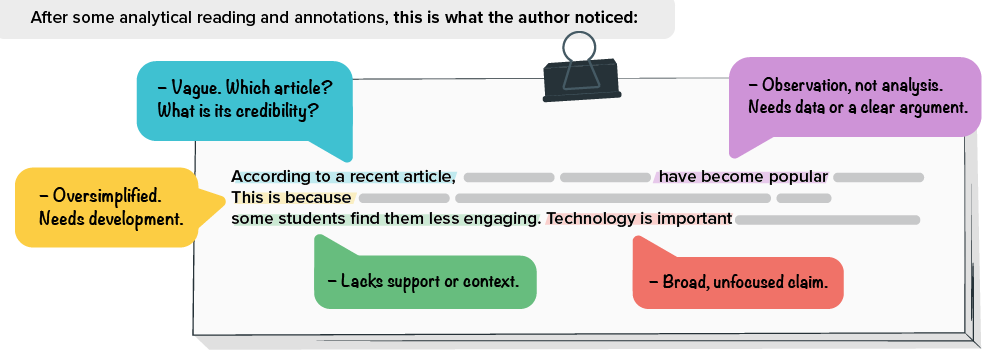
The author then revised the excerpt after the analytical reading and annotations:
A 2022 study by the Pew Research Center found that 73% of high school students used online platforms weekly for class assignments. These tools offer flexibility, allowing learners to engage with material on their own schedule. However, a National Education Association report noted that 45% of students surveyed felt less connected to peers in virtual classrooms. This suggests that while online learning can enhance access, it may also reduce social engagement—an important factor to consider when designing hybrid curricula.
Let’s look at how this improves the original:
- The revised paragraph names credible sources, enhancing trust.
- The analysis balances the benefits and limitations of technology use.
- The student goes beyond description, offering an interpretive insight (reduced engagement) that connects directly to their research question.
Reading for analysis transforms revision into a strategic, layered process. Rather than fixing surface errors, you’ll engage deeply with both your sources and your writing to sharpen your argument, improve clarity, and strengthen your overall paper.
Source: This tutorial has been adapted from OpenStax "Writing Guide". Access for free at openstax.org/books/writing-guide/pages/1-introduction . License: Creative commons attribution 4.0 international. Accessed by January 2025.