Table of Contents |
The Amarna Period occurred during the reign of the pharaoh Akhenaten, which began in 1353 BCE and ended with his death in 1336 BCE.
This lesson explores the locations of Amarna and Thebes. Akhenaten’s father, Amenhotep III, had chosen Thebes as Egypt’s capital, and it still was the capital when Akhenaten came to power. Interestingly, when things started to change, Akhenaten decided to move the capital to a new location, which he named Amarna.
So, what influenced the Amarna Period? It began with Amenhotep III, who was pharaoh in the 18th dynasty. His son, Amenhotep IV, was eventually his successor.
This shift in power caused major changes politically, religiously, and stylistically. Amenhotep IV changed his name to Akhenaten, which was a nod to his favorite deity, Aton (or Aten). Aton, who took the form of the sun disk, was a minor deity in this region. Aton is not to be confused with Ra, who is the sun god. Under Akhenaten, Aton became the principal deity of a new sect within the Egyptian religion created by Akhenaten himself.
The reason for this change? Nobody could say for sure. But this is an example of early monotheism or henotheism. Monotheism is a belief in one god. Henotheism is a belief that there is a principal god, but there also may be other minor gods.
Amenhotep IV, now named Akhenaten, moved the capital of the Egyptian Empire from Thebes to Amarna. This move broke the tradition of having the burial sites, or the Acropolis for Akhenaten, on the west side of the Nile. Because of the location of the new capital, these burial sites were now on the east.
This was all substantial for several reasons. They were bold moves, to say the least, not met with overwhelming enthusiasm, particularly from the priestly class. At this time, the priests associated with the worship of Amun at Thebes had become extremely powerful. One argument is that Akhenaten forced a move to Amarna in order to undermine their authority.
Adding fuel to the fire, Akhenaten altered the stylistic elements of Egyptian art significantly by eliminating the traditional canon. Some of the stylistic changes that we can observe included:
One of the most debated questions regarding the Amarna Period is the degree to which we can consider portraits of Akhenaten to be accurate representations of his appearance. Keeping in mind the highly political nature of the move to Amarna, it is quite possible that Akhenaten did not resemble his portraits that much. Rather, the difference in appearance signals a difference in values, both political and religious.
As you look at examples from the Amarna Period, you can see the stylistic changes that took place during this time.
Below is a sunken relief of Akhenaten with Queen Nefertiti and their children. Sunken relief was popular during the Amarna Period.
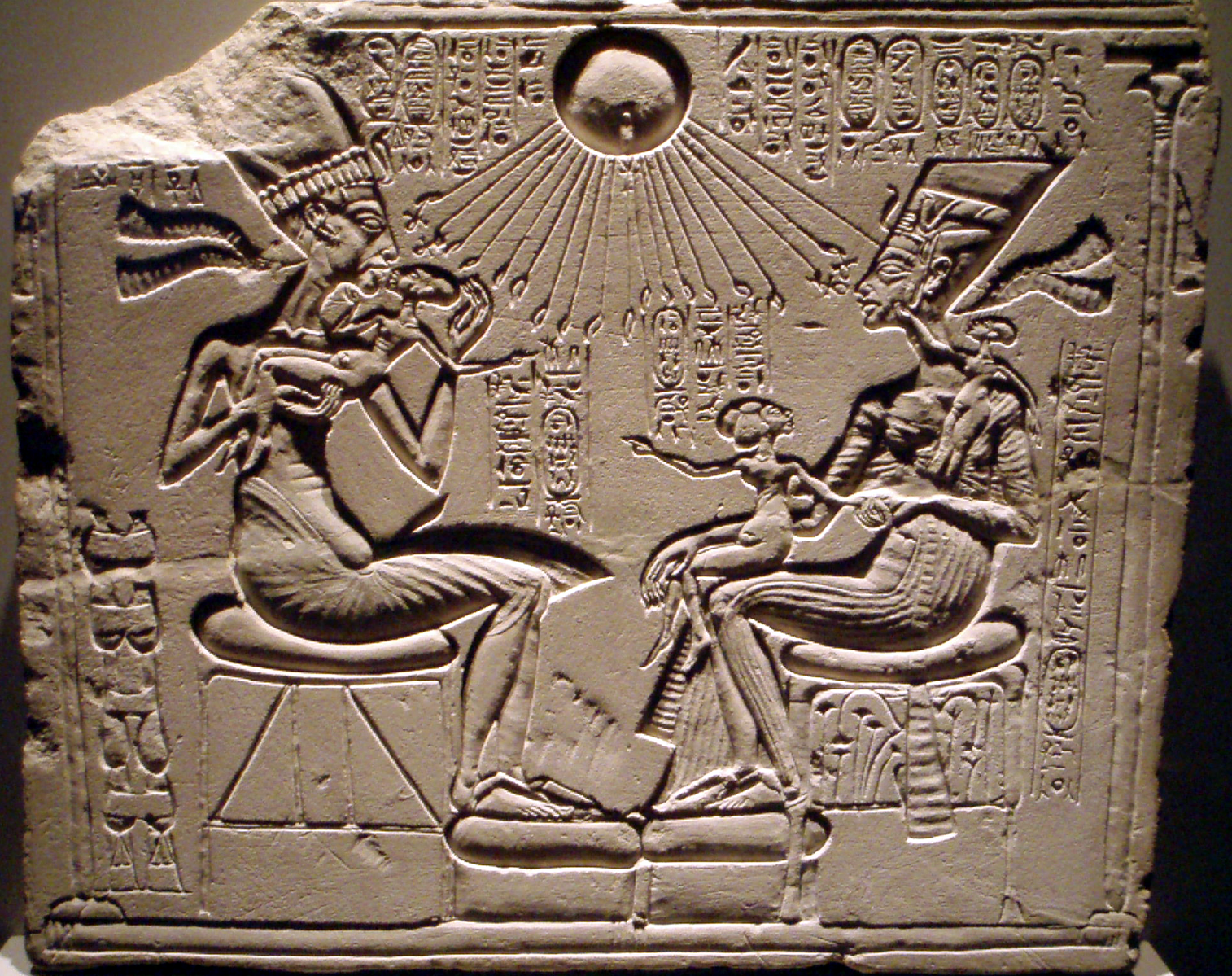
House altar depicting Akhenaten, Nefertiti, and their three daughters under the Strahlenaton
Berlin, Germany
1351–1334 BCE, 19th Dynasty
Limestone
Most interesting is the unusual subject matter in the piece above. Notice that it lacks formality. This is an intimate scene of a family moment. Two of the kids are swarming around on the queen, while the third is being petted on the head by Akhenaten and pulling him in for a kiss. The event takes place under the watchful gaze of Aton, the sun disk, sending rays of light upon the family, each one ending in an ankh, the symbol of life.
Here is an image of Akhenaten.
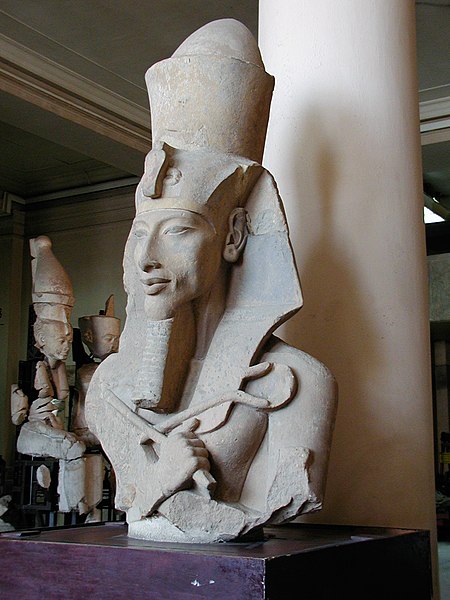
Statue of Pharaoh Akhenaten
Egyptian Museum, Bulaq, Cairo, Egypt
1353–1336 BCE, 18th dynasty
Limestone
Notice, in the above image, the unusual stylistic elements referred to in this lesson; it is a very different sculpture of the pharaoh. The large ear, depicted here, is another physical abnormality of Marfan syndrome.
Next is an image of a bust of Queen Nefertiti.
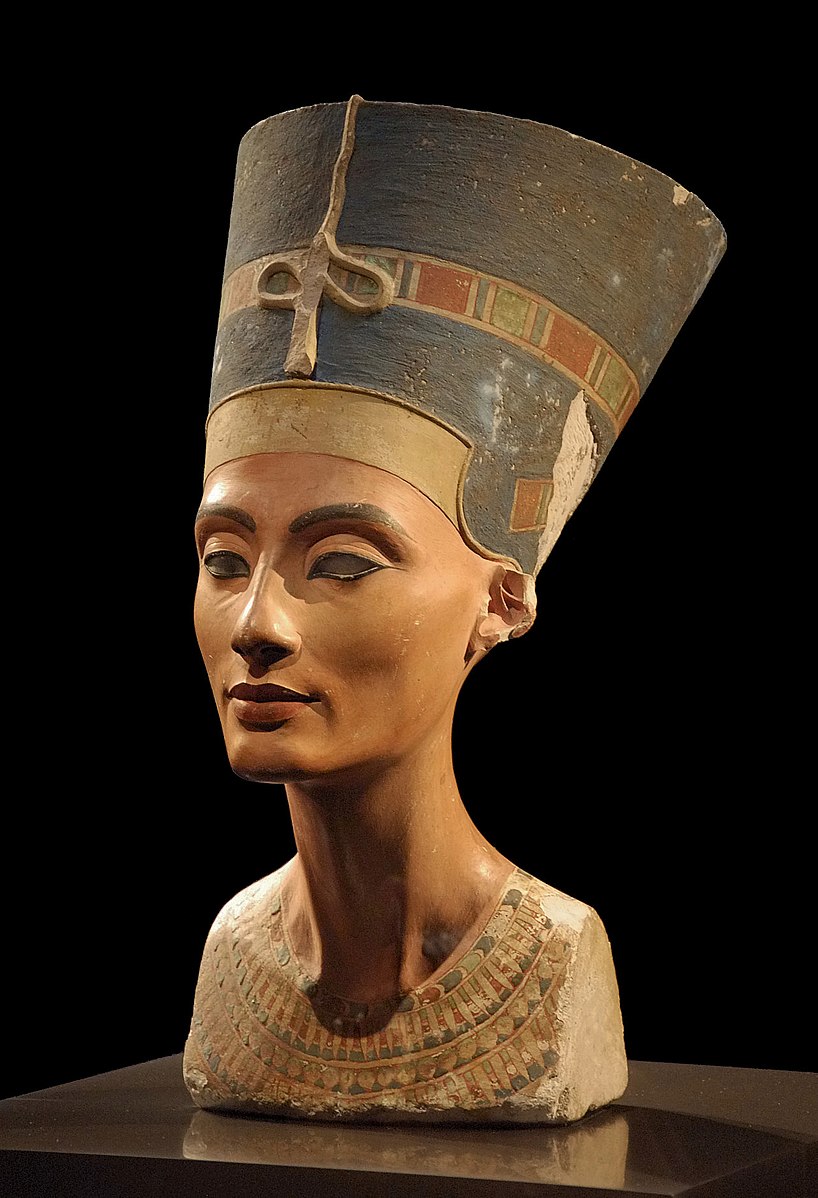
Bust of Queen Nefertiti
Amarna, Egypt
1345 BCE
Painted stucco-coated limestone
Notice above, the striking contrast to the representations of Pharaoh Akhenaten. We have no way to know what Nefertiti actually looked like; however, it is likely that this bust is an idealized likeness. Her neck is long and extremely thin, and her face is exactly symmetrical. There is some thought that maybe this bust functioned as a model for artists to make other artistic works portraying the queen.
With the eventual secession of Akhenaten’s son, Tutankhamun, informally known as King Tut, the major changes of the Amarna Period began to fade away. The royal court was moved back to Thebes, and there was a shift in stylistic elements of artwork that began to return to traditional ways. Tut’s reign, however, was short-lived. He died when he was only 18 years old.
The mask of Tutankhamun is one of the most recognizable artifacts from ancient Egypt. It was discovered in the early 20th century. The tomb was largely untouched, which gives us a fantastic opportunity to see the burial chamber of the pharaoh the way it would’ve looked in its time.
Below is an image of the mask of Tutankhamun.
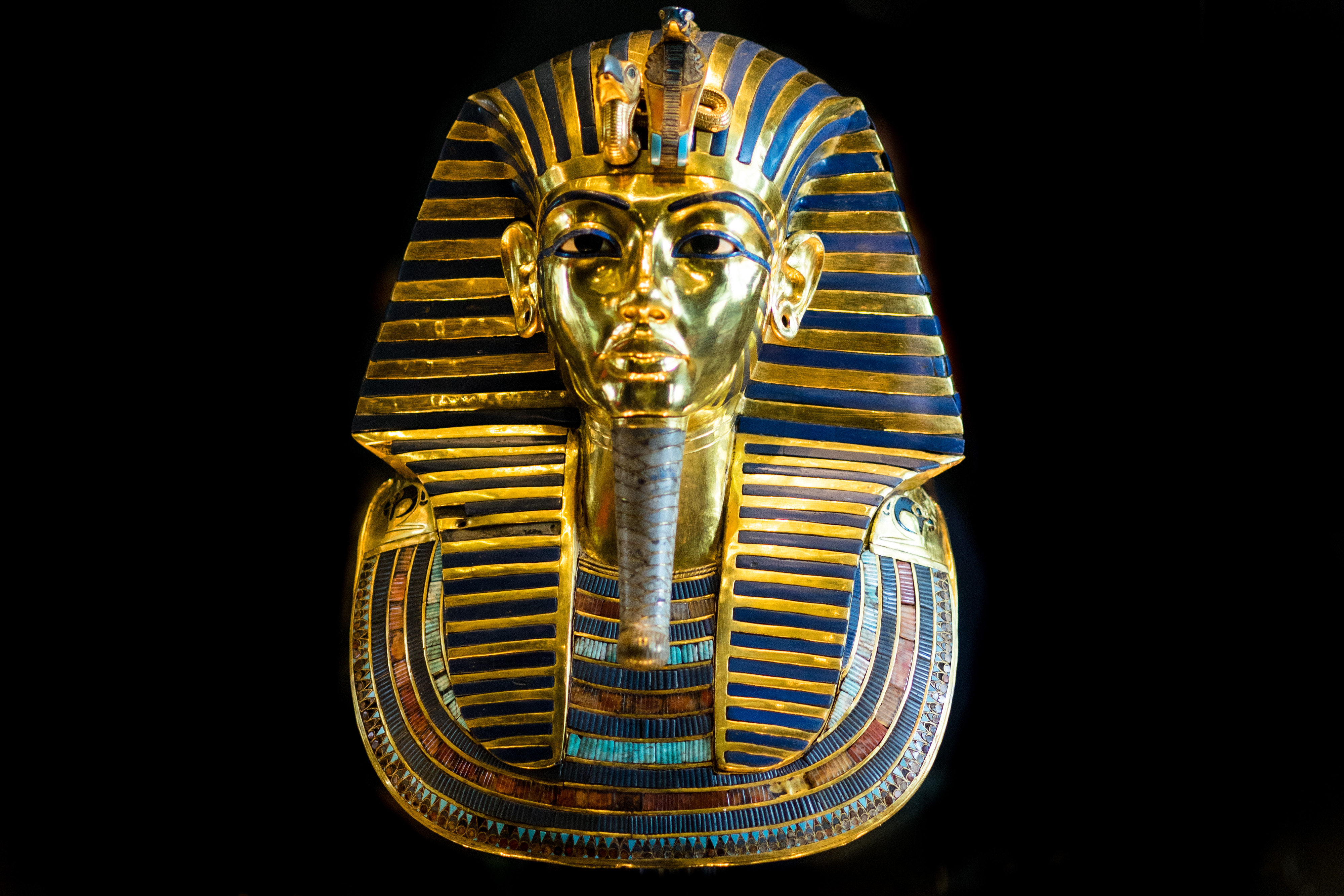
Mask of Tutankhamun
Egyptian Museum, Bulaq, Cairo, Egypt
c. 1323 BCE
Gold, lapis lazuli, carnelian, obsidian, turquoise and glass paste
This mask and chest piece give us a stylized interpretation of the young pharaoh’s appearance. Notice the following characteristics in the mask and painted chest:
Source: THIS TUTORIAL WAS AUTHORED BY SOPHIA LEARNING. PLEASE SEE OUR TERMS OF USE.