Table of Contents |
To begin with, recall that virtue-based ethics is a theory of ethics that maintains that an action is to be evaluated based on how that action informs aspects of the agent’s character.
The character traits of an agent are seen as either morally good or bad; they are called virtues and vices, respectively. Traditionally, traits such as patience, courage, generosity, and honesty are seen as virtues; while traits such as impatience, cowardice, greed, and dishonesty are seen as vices.
Because of the emphasis on character, the kind of question you would ask yourself in virtue-based ethics is different from the kind that you would ask if you were primarily concerned with evaluating actions.
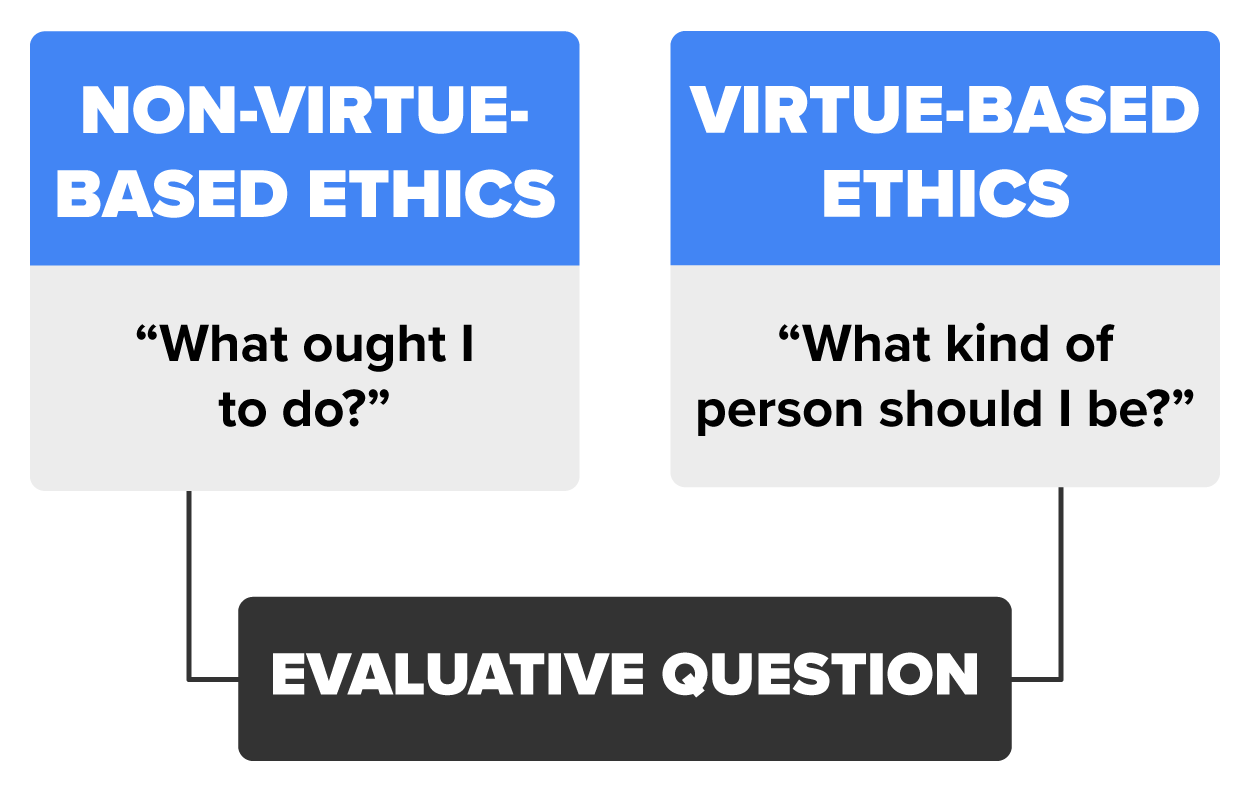
Virtue-based ethics is appealing because it fits with many of our ideas about what ethics should be about. For instance, it’s intuitive to think that being ethical entails striving to be the best kind of person you can be.
One reason we feel ethics should have this focus is that we think ethics should be about more than merely doing good things. Virtue isn’t something you can achieve overnight—it’s something you’re always striving for. For this reason, it’s a lifelong project.
This means that you need to be consistent in your actions if you want to pursue virtue.
Not only do virtues need to be pursued consistently, but this pursuit should be done by everyone because virtues are supposed to be objective. So, this ethical theory also fits the ideal of systematicity.
There are some drawbacks to basing ethics on character, though. Firstly, it means that ethical evaluation is directed more at our own development and less at how our actions affect others. This makes virtue-based ethics seem self-centered.
EXAMPLE
A virtue like prudence may bring you various benefits, such as providing for your future. But the development of this virtue doesn’t necessarily help anyone else.Another problem is that the focus on character means there isn’t much guidance for action.
Maybe you start by reading wise authors or listening to wise people so that you have role models. But even then, this is quite vague. What’s more, it’s not clear how we can decide which character traits are virtues and which are vices in the first place.
Finally, it’s difficult to evaluate actions from the perspective of virtue-based ethics.
IN CONTEXT
Imagine you’re with some friends and you’re introduced to someone who strikes you as very insightful and appears to display a nuanced judgment of things.
They look like they’re wise. But how can you be sure? Perhaps they're just repeating what they read in a book or what they heard on the news.
As you can see, it’s difficult to determine if what someone says is really a manifestation of a virtue or not. Therefore, it’s difficult to decide if their action is morally praiseworthy.



