Use Sophia to knock out your gen-ed requirements quickly and affordably. Learn more
×

Addition and Subtraction of Fractions

Author: Sophia

what's covered
In this lesson, you will learn how to add and subtract fractions and simplify your answers as needed. You will also see how the addition and subtraction of fractions strengthens your problem solving skill. Specifically, this lesson will cover:

Table of Contents

1. Adding and Subtracting Fractions with Common Denominators

If you remember from an earlier lesson, you learned that fractions were a part of a whole and are called “rational” numbers.
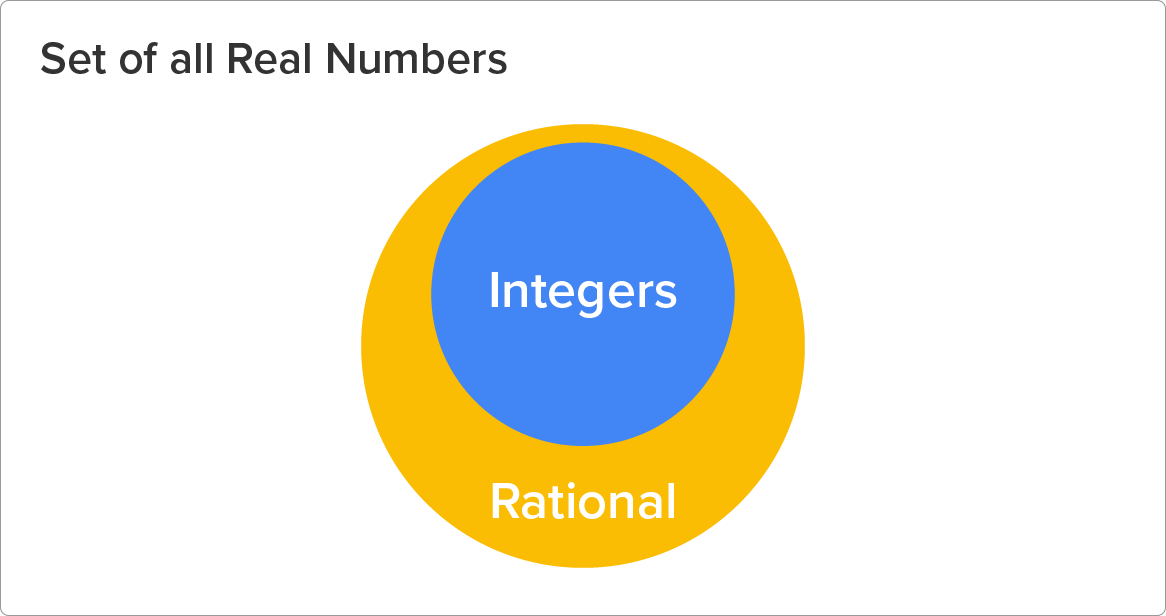
A rectangular box with plain background labeled ‘Set of All Real Numbers’, with two nested circles inside the box: a smaller circle labeled ‘Integers’ inside a larger circle labeled ‘Rational’.

We had explained that fractions can be thought of as pieces of a pizza and showed the following example:

The total amount of pieces the pizza was cut into is called the denominator. The amount of pieces you ate is called the numerator. So for this example, the pizza was cut into 8 pieces and you ate 3. The fraction for pieces eaten would be 3 over 8.

Now, what if you ate 3 pieces of pizza on the first night and 4 pieces of pizza the next night? How much of the pizza have you eaten now? To solve this question, we can now discuss how to add or subtract fractions.

When you add or subtract fractions with the same, or common, denominators—like our pizza example—you simply add or subtract the numerators (or pieces of pizza eaten).

EXAMPLE

Consider the equation 3 over 8 plus 4 over 8 equals 7 over 8

You’ll notice that the denominators stayed the same. Why didn’t we add them too to make 16? This is because the denominator represents how many pieces the pizza was cut into. Just because you ate 7 pieces of pizza doesn’t mean you started cutting the pizza into smaller pieces before you ate it, right? The pizza slice sizes and amount cut into the pizza remained the same. The only thing that changed was how many pieces of the pizza you ate.

EXAMPLE

Of course, we don’t always need to use pizzas to think about fractions. In the example below, you are adding two fractions with common, or the same, denominators (the 5s). Therefore, you simply add the numerators of each fraction (2 and 1), which equals 3. The denominators stay the same.
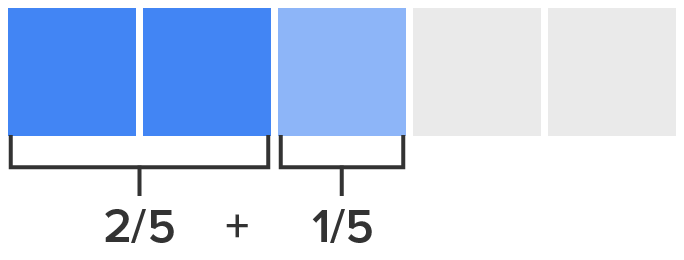
2 over 5 plus 1 fifth equals 3 over 5

To think about this problem in a different way, look at the picture representation below. The bar is split into five pieces, which matches the 5 in the denominator. The pieces are all the same size because the denominators are all the same size. You start with 2/5, or 2 out of 5 pieces, shaded in, and then you add 1/5, or 1 piece, which equals a total of 3/5, or 3 out of 5 pieces, shaded in.


You can subtract the two fractions in the same way. When you subtract fractions, you subtract the numerators.

EXAMPLE

Referring to our original equation, 2 minus 1 is 1. Again, the denominators stay the same.
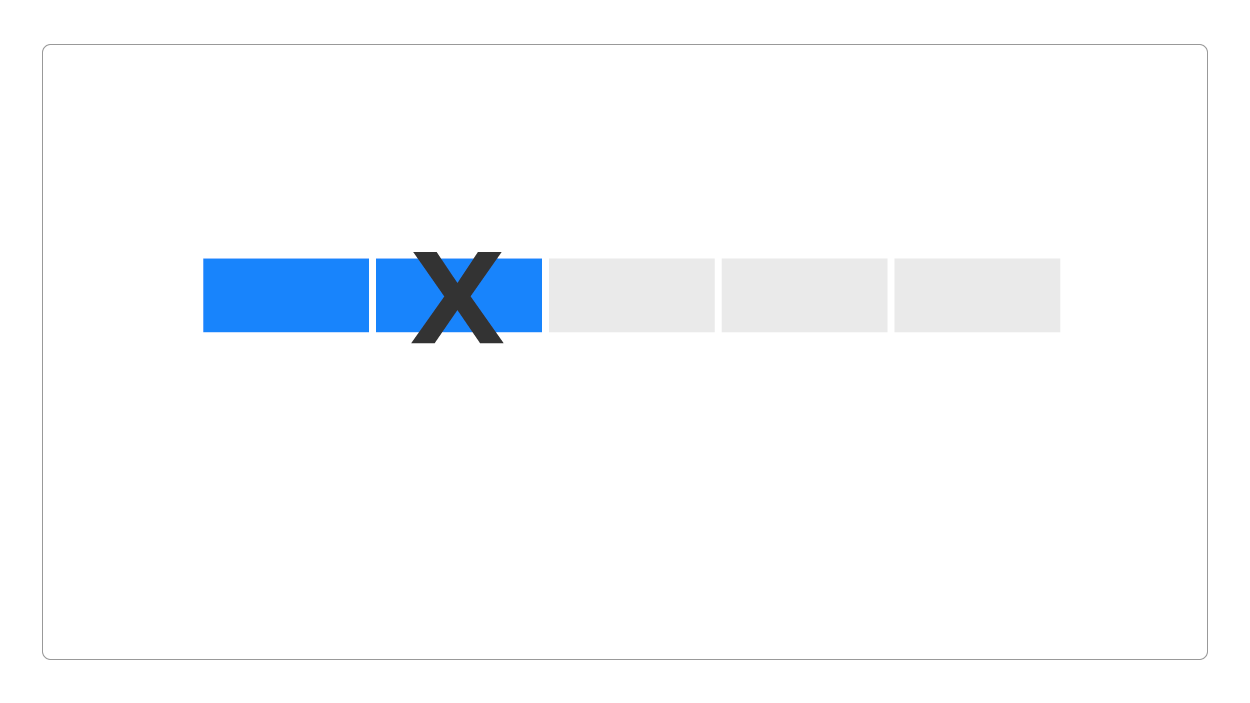
2 over 5 minus 1 fifth equals 1 fifth

Looking at the bar representation, you start with 2 out of 5 pieces, or 2/5, shaded in, then subtract 1 piece (1/5), leaving 1 piece, or 1/5 of the bar, shaded in.


2. Adding and Subtracting Fractions with Uncommon Denominators

But what if you want to add or subtract two fractions that do not have the same denominator.

EXAMPLE

Suppose you want to add 1/2 and 1/4. Looking at the picture representation of these two fractions, you can see that there is a problem.

A bar representation of the fractions 1/4 and 1/2. One bar is divided into four equal pieces, with one piece shaded and the remaining three unshaded, representing 1/4. The other bar is divided into two equal pieces, with one piece shaded and the other unshaded, representing 1/2.

You can’t simply combine the pieces together as you did in the last example because the pieces are different sizes. However, if the denominators were the same, the pieces would be the same size, and you could add or subtract your numerators.

big idea
When adding or subtracting fractions with uncommon denominators, you need to convert them into equivalent fractions with common denominators.

Consider the last example again to see how you can find the least common denominator.

EXAMPLE

Let's keep our original addition problem.

1 half plus 1 fourth The expression
fraction numerator 1 cross times 2 over denominator 2 cross times 2 end fraction plus 1 fourth The multiples of our first denominator (2) are 2, 4, 6, etc. The multiples of our second denominator (4) are 4, 8, 12, etc. The smallest common multiple is 4, so we can rewrite our fractions using 4 as our common denominator. To convert the denominator of 1/2 to 4, you multiply by 2 in the denominator and numerator. The second fraction can stay the same, as it already has a denominator of 4.
2 over 4 plus 1 fourth The first fraction 1 half is equivalent to 2 over 4.
3 over 4 Finally, add together your numerators; 2 and 1 equals 3.

try it
Consider the expression 1 third minus 1 fifth.
Evaluate the expression to find the solution.
1 third minus 1 fifth The expression
fraction numerator 1 cross times 5 over denominator 3 cross times 5 end fraction minus fraction numerator 1 cross times 3 over denominator 5 cross times 3 end fraction Find the least common denominator. The multiples of our first denominator (3) are 3, 6, 9, 12, 15, etc. The multiples of our second denominator (5) are 5, 10, 15, 20, 25, etc. The smallest common multiple is 15, so we can rewrite our fractions using 15 as our common denominator. To convert the denominator of 1/3 to 15, you multiply by 5 in the denominator and numerator. To convert the denominator of 1/5 to 15, you multiply by 3 in the denominator and numerator.
5 over 15 minus 3 over 15 The first fraction 1 third can be rewritten as 5 over 15 and the second fraction 1 fifth can be rewritten as 3 over 15.
2 over 15 Finally, subtract your numerators. 5 minus 3 equals 2.

hint
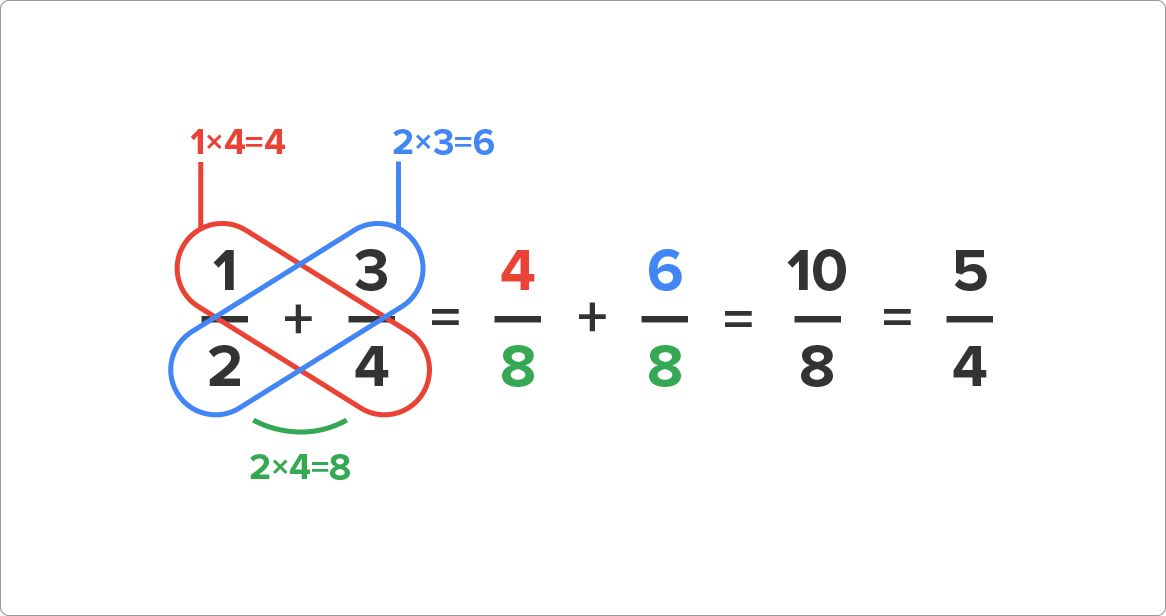
Do you have a panic attack whenever you hear “least common denominator?” When in doubt, you can always just multiply your denominators together and then simplify your answer. To do this, we can use the Butterfly Method to add or subtract fractions with unlike denominators.

Suppose you were evaluating 1 half plus 3 over 4.

A representation of how the fractions 1/2 and 3/4 can be added using the butterfly method. The numerator 1 is multiplied diagonally by 4, resulting in 4, while the numerator 3 is multiplied diagonally by 2, resulting in 6. The denominators 2 and 4 are multiplied to get 8. This gives 4/8 plus 6/8 equals 10/8, which simplifies to 5/4.

With the Butterfly Method, you would first multiply the denominators of the two fractions together (2 x 4). This will be your common denominator (8). Then, you multiply the numerator of the first fraction with the denominator of the second fraction (1 x 4). This will be the numerator of your first common denominator fraction. To find the numerator of the second common denominator fraction, multiply the denominator of the first fraction with the numerator of the second fraction (2 x 3). You will now have two new fractions with a common denominator (4/8) and (6/8).

Remember, this method of finding a common denominator will always work, but it may not give you the least or smallest common denominator, and some simplification might be necessary at the end, which you will learn in this next section.


3. Simplifying Fractions

So far, we’ve been adding or subtracting smaller fractions, but there are times once we’re done with our math that we could come up with a fraction like 50/100. That’s really large and could be simplified into a smaller number. Think about it this way. This means you have sliced a pizza into 100 slices and then ate 50 of them...and nobody would believe you ate 50 slices. Simply put, a simplified fraction means you’ve cut the pizza into as few pieces as possible. Mathematically, this means that a simplified fraction is a fraction in which the numerator and the denominator have no common factors other than 1.

You always want to write fractions in their simplest form so they are easier to compare and calculate with. And you may remember from your school days that a solution that has not been simplified is considered wrong, so let’s cover how we can simplify.

EXAMPLE

50/100 can be simplified to 1/2, because both the numerator and the denominator are divisible by 50. It’s much easier to say that you ate half of your pizza rather than fifty-hundredths of your pizza!

50 over 100 equals fraction numerator 50 divided by 50 over denominator 100 divided by 50 end fraction equals 1 half

EXAMPLE

Simplify the fraction 6 over 8.

6 over 8 The fraction
fraction numerator 2 cross times 3 over denominator 2 cross times 2 cross times 2 end fraction See if the numerator and denominator have any common factors. Expand both numbers into their prime factors. In this case, the prime factors of 6 are 3 and 2. The prime factors of 8 are 2, 2, and 2.
fraction numerator up diagonal strike 2 cross times 3 over denominator up diagonal strike 2 cross times 2 cross times 2 end fraction Since there is at least one 2 in both the numerator and the denominator, you can cancel them out.
fraction numerator 3 over denominator 2 cross times 2 end fraction This leaves 3 in the numerator, and 2 times 2 in the denominator.
3 over 4 Evaluate 2 times 2, which is 4. 3 over 4 is the simplest form of 6 over 8.

hint
If the number is really large and you’re struggling to reduce your fraction to its simplest form, use the following tricks:
  • Are both the numerator and denominator even numbers? You can always keep dividing each by 2 until one of the values is no longer even.
  • Can you divide the numerator and denominator by 3? What about 5?
  • Or, list out the factors of your denominator and numerator (i.e., 10 is 1, 2, 5, and 10) and see if your numerator and denominator have any of the same factors. If they do, divide by that value.

try it
Consider the following table of fractions:
Fraction Simplified Fraction
12 over 36 ?
40 over 92 ?
17 over 31 ?

Find the simplified form of each of the above fractions.
Fraction Simplified Fraction Explanation
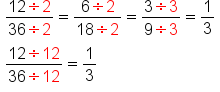
12 over 36 table attributes columnalign left end attributes row cell fraction numerator 12 divided by 2 over denominator 36 divided by 2 end fraction equals fraction numerator 6 divided by 2 over denominator 18 divided by 2 end fraction equals fraction numerator 3 divided by 3 over denominator 9 divided by 3 end fraction equals 1 third end cell row cell fraction numerator begin display style 12 divided by 12 end style over denominator begin display style 36 divided by 12 end style end fraction equals 1 third end cell end table The numbers 12 and 36 share many factors: 2, 3, 4, 6, 12. You can start by dividing each by the smaller factors, like 2 or 3, but since we know they share 12, we can divide them both by this number and end up with the most simplified form.
40 over 92 fraction numerator 40 divided by 4 over denominator 92 divided by 4 end fraction equals 10 over 23 Both 40 and 92 share a factor of 4, so you can divide by this number. We know this is the most simplified form because 10 and 23 do not share any factors.
17 over 31 17 over 31 This is the most simplified form because 17 and 31 do not share any factors.

think about it
Did you notice anything weird about our answer in the Butterfly Method example? The solution was 5/4. Thinking back to fractions as pizzas, what does 5/4 mean?
  • Numerator: number of pieces eaten
  • Denominator: number of pieces a pizza is cut into
So 5/4 means that you’ve eaten 5 pieces, but you only cut the pizza into 4 pieces. How did you get that other piece?! Well, this means you ate all of your pizza, and some of someone else’s.

A plain background with two pizzas, each cut into four equal pieces. In the first pizza, all four pieces are eaten. In the second pizza, only one piece is eaten.

We can see that you’ve eaten 1 whole pizza and ¼ of another, or in other words: 1 ¼. But we’re not always going to draw out a pizza to see how to convert what we call an improper fraction (a numerator that is larger than the denominator) into a mixed fraction (a whole number and a fraction). To simplify an improper fraction into a mixed fraction, all you have to do is divide.

space space space space 1 space R 1 space or space 1 1 fourth
4 long division enclose 5 space space space space space space space end enclose
space space space stack space 4 with bar below
space space space space 1

You have a remainder of 1 after you’ve divided. That 1 is our numerator and what we divided by (4) is our denominator. So, we have 1 ¼.

Let’s try some other problem where we can put all of our tips and tricks together by adding or subtracting fractions and making sure we have a simplified fraction as the answer.

EXAMPLE

You have a 1 inch ribbon. You cut off a ¼-inch piece of ribbon and then cut off a ⅜-inch piece of ribbon. How much ribbon did you cut? How much of your 1 inch ribbon do you have left?

1 fourth plus 3 over 8 We need to add ¼ and ⅜ together to determine how much ribbon has been cut off.
2 over 8 plus 3 over 8 The least common denominator for both fractions is 8. We multiply the numerator and denominator of the first fraction (¼) by 2 to equal 2/8. Now both fractions have the same denominator.
5 over 8 We add the numerators of the fractions to get ⅝. So, ⅝ inches was cut from the ribbon.
1 minus 5 over 8 To find out how much ribbon is left, we would subtract ⅝ inch from 1 inch.
1 over 1 minus 5 over 8 We can rewrite the whole number 1 as a fraction, by placing the whole number over 1. So, 1 becomes 1/1.
8 over 8 minus 5 over 8 We will find a common denominator between 1 and 8. This will be 8. We multiply the numerator and denominator of the first fraction by 8.
3 over 8 Now that both fractions have the same denominator, we can subtract the numerators. There is ⅜ inch of our 1 inch of ribbon left.

try it
You have 1 half pound of sugar and your friend gives you 2 over 3 pounds of sugar.
How much sugar do you have (in pounds)?
1 half plus 2 over 3 You will need to add 1 half and 2 over 3 together.
3 over 6 plus 4 over 6 The least common factor of the two fractions is 6. We can use the butterfly method or multiply the numerator of the first fraction by 3 and the numerator and the denominator of the second fraction by 2.
fraction numerator 3 plus 4 over denominator 6 end fraction equals 7 over 6 Adding the numerators together gives us the fraction 7 over 6. This solution is an improper fraction.
space space space space 1 space R 1 space or space 1 1 over 6
6 long division enclose 7 space space space space space space space end enclose
space space space stack space 6 with bar below
space space space space 1

We can simplify this by converting our solution into a mixed fraction. We do this by dividing 6 into 7. We get 1 with a remainder of 1.
1 1 over 6 We now have 1 ⅙ pounds of sugar.

Problem Solving: Apply Your Skill
Adding and subtracting fractions is another skill that we frequently use. For instance, you may want to determine how many hours you drove on a road trip. On day one, you drove 4.25 hours (or 4 hours and 15 minutes), and on day two you drove 3.5 hours (or 3 hours and 30 minutes). You can determine that all together you drove 7.75 hours, or 7 hours and 45 minutes. In instances such as these, adding and subtracting fractions strengthens your problem solving skill.

summary
Today you learned about adding and subtracting fractions, and that to do so, fractions must have the same or common denominator. You also learned that to find a common denominator for fractions with uncommon denominators, you can always multiply the denominators together using the butterfly method, but you may need to simplify your answer. Solutions that are improper fractions, where the numerator is greater than the denominator, should be simplified as a mixed fraction. Practicing these types of problems enhances your problem solving skill.

Best of luck in your learning!

Source: THIS TUTORIAL WAS AUTHORED BY SOPHIA LEARNING. PLEASE SEE OUR TERMS OF USE.