Table of Contents |
Abstract Expressionism is regarded as the first major American art movement to emerge after World War II. Characterized by its antifigurative nature, rebellious spirit, and intense emotionality, Abstract Expressionism represents a significant shift in the art world, focusing on the experience of art as a visual and emotional journey rather than a depiction of reality.
Arshile Gorky’s work serves as a crucial link between Surrealism and Abstract Expressionism. Gorky was deeply influenced by the artistic approaches of Picasso and Juan Gris as well as by the concept of automatism—a process in which art is created spontaneously and without premeditation. This idea, rooted in the practices of Dada and Surrealist artists, posited that by bridging the unconscious and conscious mind, one could tap into deeper, more meaningful forms of expression. Gorky’s exploration of psychic automatism allowed him to break away from traditional representational art and move toward a more abstract, intuitive approach, laying the groundwork for the Abstract Expressionist movement.
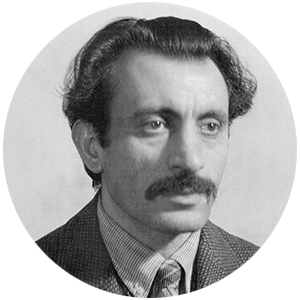 View The Liver Is the Cock’s Comb.
In this way, Gorky’s work not only reflects the transition from Surrealism to Abstract Expressionism but also embodies the broader artistic and philosophical currents that defined the mid-20th century, where the act of creation itself became a means of accessing profound, often unconscious, emotional truths.
The artist Willem de Kooning, a close friend of Gorky’s, shared a similar approach where what might initially seem like a chaotic or amateurish depiction was, in fact, carefully considered and deliberate. Abstract Expressionist painters rarely featured any recognizable figures in their works; however, De Kooning regularly returned to depictions of the female form, opening up his work to complicated interpretations. De Kooning was a leading figure in the New York avant-garde circle and was, perhaps, the most influential artist of the 1950s.
Consider this example:
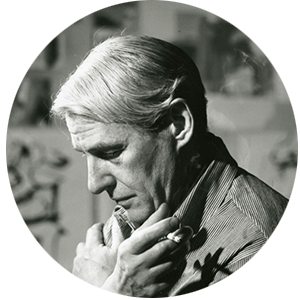 View Woman V.
This painting called Woman V was a carefully and skillfully painted depiction of what has been described as humanity’s simultaneous esteem for and fear of feminine power. By choosing one of the most common themes in the history of art—the female body—and then applying his expressive brushwork, De Kooning challenges convention, much like Picasso did with Les Demoiselles d’Avignon.
Unlike Willem de Kooning’s long and productive life, Gorky’s was tragically short. It spiraled downward into a series of emotional and physically damaging events before he took his own life at the age of 44. His passing cleared the way for his rival, Jackson Pollock, to become even more renowned in the artistic community and beyond.
Jackson Pollock is most renowned for his pioneering role in the development of action painting—a dynamic and revolutionary style that redefined the boundaries of abstract art. Pollock’s approach to painting was deeply influenced by several key sources, each contributing to the development of his distinctive technique:
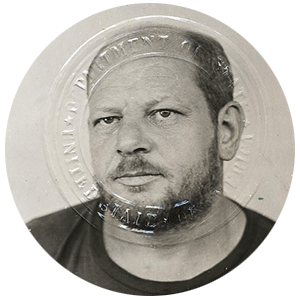 View Autumn Rhythm (Number 30).
The influential art critic Clement Greenberg was a passionate advocate of Abstract Expressionism and championed the work of Jackson Pollock. Greenberg’s critical writings, particularly his seminal 1939 essay Avant-Garde and Kitsch, were instrumental in defining the boundaries between what he considered to be “important art” (avant-garde) and “low art” (kitsch, a German word meaning “commonplace”).
Greenberg argued that avant-garde art, which he associated with movements like Abstract Expressionism, demands a higher level of engagement from its audience. Avant-garde art, he believed, was a form of artistic innovation that pushed the boundaries of tradition and challenged conventional aesthetics, thereby elevating it above more accessible forms of art.
On the other hand, Greenberg described kitsch as a form of popular culture that caters to the masses. He viewed kitsch as art that is easily digestible, requiring little critical thought from its audience. For Greenberg, kitsch was formulaic and superficial, appealing to basic tastes rather than encouraging deeper reflection or intellectual engagement. In his view, kitsch was not just inferior to avant-garde art but was also a threat to it as it diluted the cultural value of artistic innovation.
Greenberg’s distinction between avant-garde and kitsch became a foundational concept in the analysis of modern art, influencing how critics and historians viewed the emerging trends of the 20th century. His support for Abstract Expressionism helped to solidify its status in the art world. Greenberg’s ideas also sparked ongoing debates about the role of art in society, the nature of artistic merit, and the relationship between art and popular culture—discussions that continue to resonate in contemporary critiques of art and culture.
The artists Mark Rothko and Barnett Newman actively challenged and resisted the dominant influence of critics like Clement Greenberg as they developed a new form of painting known as Color Field Painting. While Greenberg was a strong proponent of Abstract Expressionism, with its emphasis on gestural brushwork and dynamic compositions, Rothko and Newman took a different approach that sought to move beyond these conventions.
Color Field Painting, pioneered by Rothko, Newman, and others, focused on large expanses of color applied in subtle, flat areas across the canvas. Unlike action painters, whose works were characterized by vigorous brushstrokes and expressive forms, Color Field painters aimed for a quieter, more meditative aesthetic. Their works often featured simple compositions with few elements, allowing color itself to become the primary subject.
The following artwork by Mark Rothko is an example of Color Field Painting:
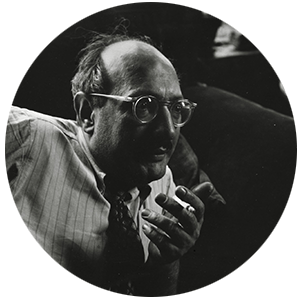 View No. 61 (Rust and Blue).
Newman and Rothko drew inspiration from the writings of the philosopher Friedrich Nietzsche, particularly his concept of the tragically divided self. This philosophical idea influenced their development of Color Field Painting, where expansive fields of color coexist within the same canvas yet remain distinct from one another. Though markedly different from action painting, Color Field Painting is still a form of Abstract Expressionism that is reinterpreted through a modern lens. It seeks to express the themes of transcendence and the infinite, using color to evoke deep emotional and spiritual experiences.

Who’s Afraid of Red, Yellow, and Blue?
Private collection
1966
Oil on canvas
Antoni Tàpies, a Spanish artist, was closely associated with the Tachisme movement—a French variation of Abstract Expressionism. Tachisme incorporates gestural brushwork, handwriting, and often graffiti-like imagery, making it a significant influence in both European and Latin American art circles.
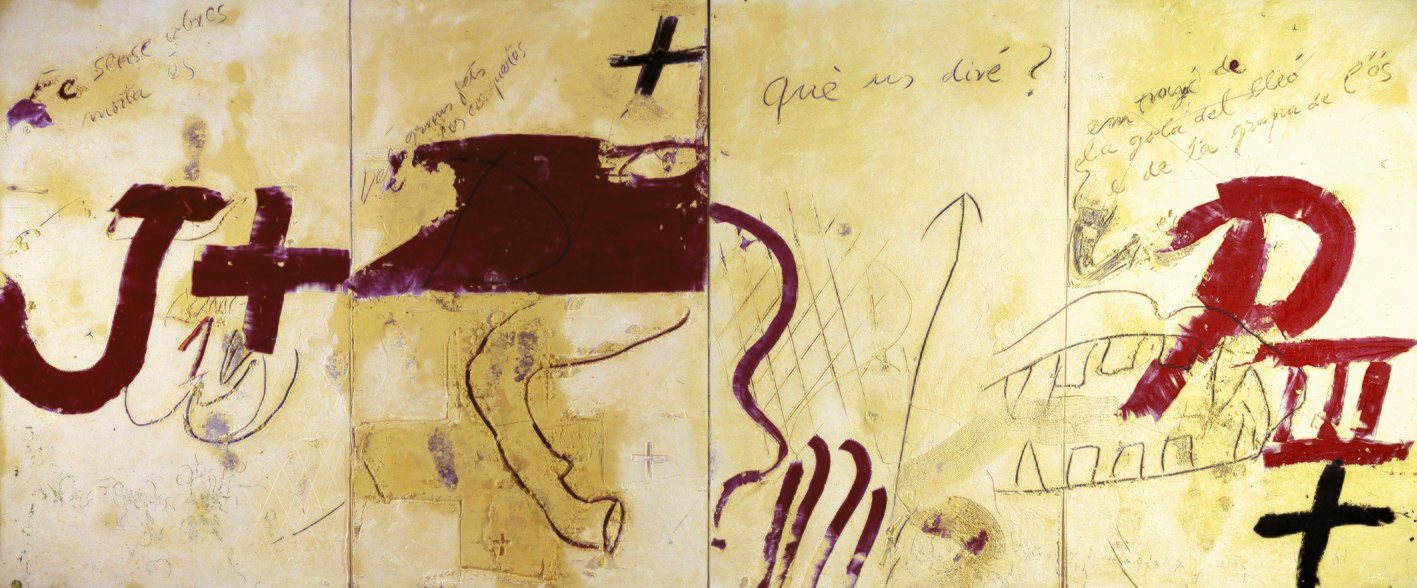
Les Quatres Cròniques
Tarradellas Room, Palace of the Generalitat of Catalonia, Spain
1990
Frieze
Tàpies’ work is imbued with a deep sense of symbolism and often explores the themes of spirituality, human suffering, and the passage of time. His use of simple, primitive symbols—such as crosses, letters, and numbers—suggests a connection to the universal and the timeless. These symbols, combined with his rugged, earth-toned palettes, evoke a sense of the sacred and the eternal, giving his work a contemplative quality.
Unlike Abstract Expressionism and Color Field Painting, Tàpies’ work was also shaped by the political climate of Spain during his lifetime. Living under the repressive Franco regime, he often embedded subtle critiques of authoritarianism and social injustice within his art. His use of earthy, raw materials can be seen as a metaphor for the resilience and endurance of the human spirit in the face of oppression.
Source: THIS TUTORIAL WAS AUTHORED BY IAN MCCONNELL AND TAMORA KOWALSKI FOR SOPHIA LEARNING. PLEASE SEE OUR TERMS OF USE.



