Table of Contents |
Throughout the digestive tract, there are multiple organs, and secretions of enzymes, hormones, and acids, that help promote absorption. Although the digestive system and process begins in the mouth and goes all the way through to the anus, there are only a few spots along the way that are the main areas that provide absorption.
Absorption is a process in which the proper nutrients are extracted from the broken-down food and transported to the proper organ. The small intestine is the primary organ for absorption within the digestive system.
When food first enters into the digestive tract through the mouth, it is pushed down into the esophagus and then enters the stomach. While in the stomach, the food is broken down by enzymes, hydrochloric acid, and the process of churning. Minimal absorption occurs within the stomach, mostly just water is absorbed here.
The contents of the stomach then slowly enter the small intestine. Most absorption takes place in the small intestine, one of the most interestingly and functionally designed organ systems in the body. The small intestine has a 10-foot length, which provides a surface area equivalent to 1.5 bowling lanes. To remove the absorbed molecules rapidly and provide room for more to be absorbed, a rush of circulating blood continuously washes the underside of this surface, carrying the absorbed nutrients away to the liver and other parts of the body. Absorption of nutrients into intestinal cells typically occurs by simple diffusion, facilitated diffusion, or active transport.
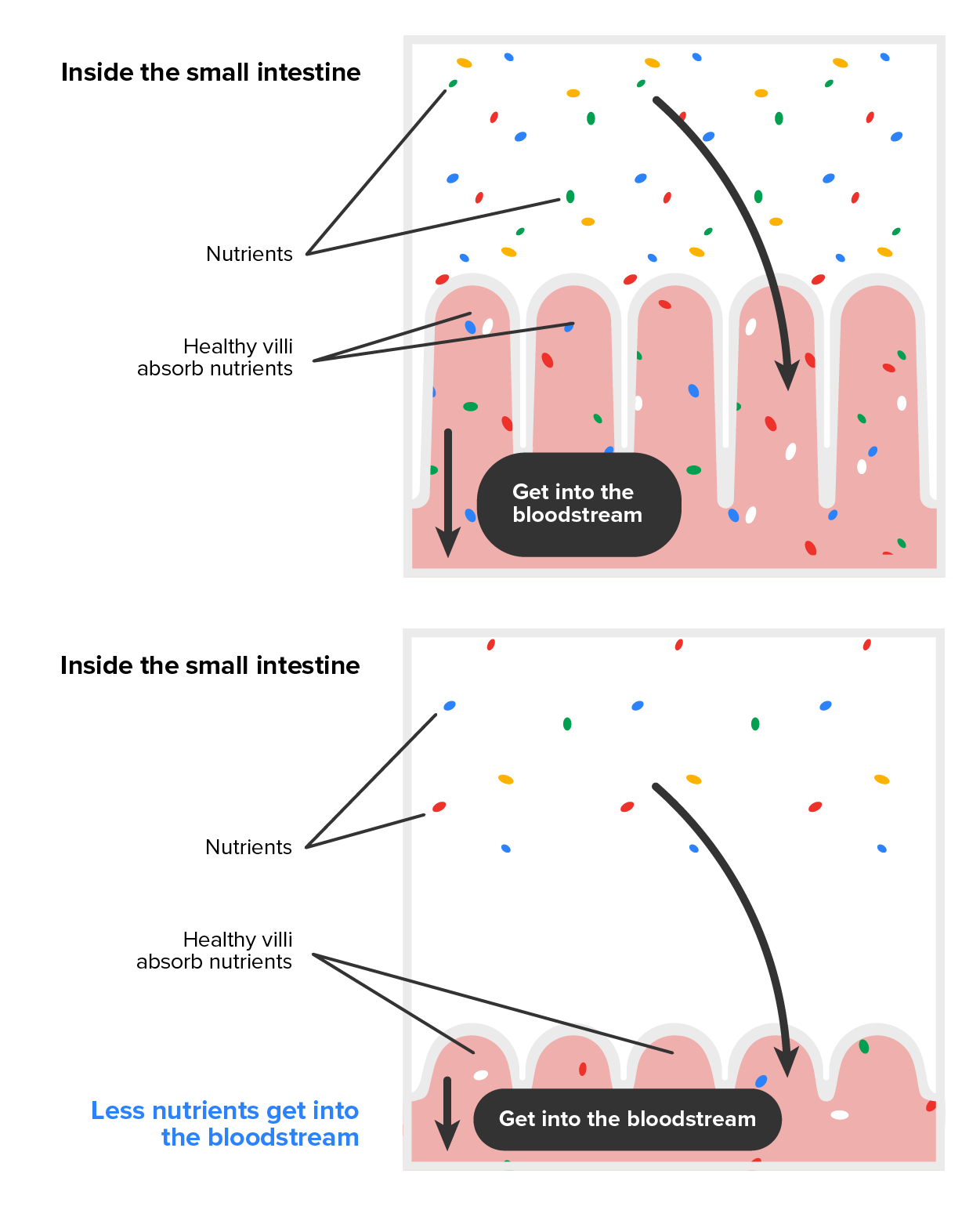
The small intestine is separated into three sections, the duodenum, the jejunum, and the ileum. The inner surface of the small intestine looks smooth and slippery but is actually wrinkled into hundreds of folds. Each fold has thousands of fingerlike projections, known as villi. Each villi has hundreds of cells covered with microvilli. Within the spaces between villi are crypts. Crypts are glands that secrete intestinal juices into the small intestine whereas the goblet cells secrete mucus.
IN CONTEXT
Most of the absorption occurs within the jejunum portion of the stomach except for iron, which is absorbed in the duodenum, and vitamin B12 and bile salts are absorbed in the ileum. The small intestine has a large amount of surface area and a mucus lining that helps create an ideal environment for absorption. The microvilli have epithelial cells, which play a large part in the absorption. The epithelial cells transport the nutrients digested in the small intestine into the capillaries and lacteals. The lacteals are lymphatic vessels that receive the lipids from the epithelial cells. The epithelial cells transport the amino acids and carbohydrates from the small intestine into the capillaries. When a nutrient molecule has been absorbed and has crossed into the cell of a villus, it enters either the bloodstream or the lymphatic system. The water-soluble nutrients and the smaller products of fat digestion are released directly into the bloodstream and guided directly to the liver. Once a nutrient has entered the bloodstream, it may be transported to any of the cells in the body.
Nutrients are absorbed and transported through either active transport or passive transport. Active transport is when nutrients are being transported to an area within the body that has a concentration differing or against the nutrient's concentration. Due to the resistance of transportation because of the varying concentrations, a transporter protein and adenosine triphosphate energy are required. Passive transport is when nutrients are moving from an area of high concentration to a lower concentration. Passive transport does not always require any transport proteins or adenosine triphosphate. If the passive transport utilizes a transport protein this is passive diffusion, and if the transport protein assists the nutrients in crossing the brush border membrane, this is facilitated diffusion. Once properly transported, the nutrients can go to their respective organ to be used.
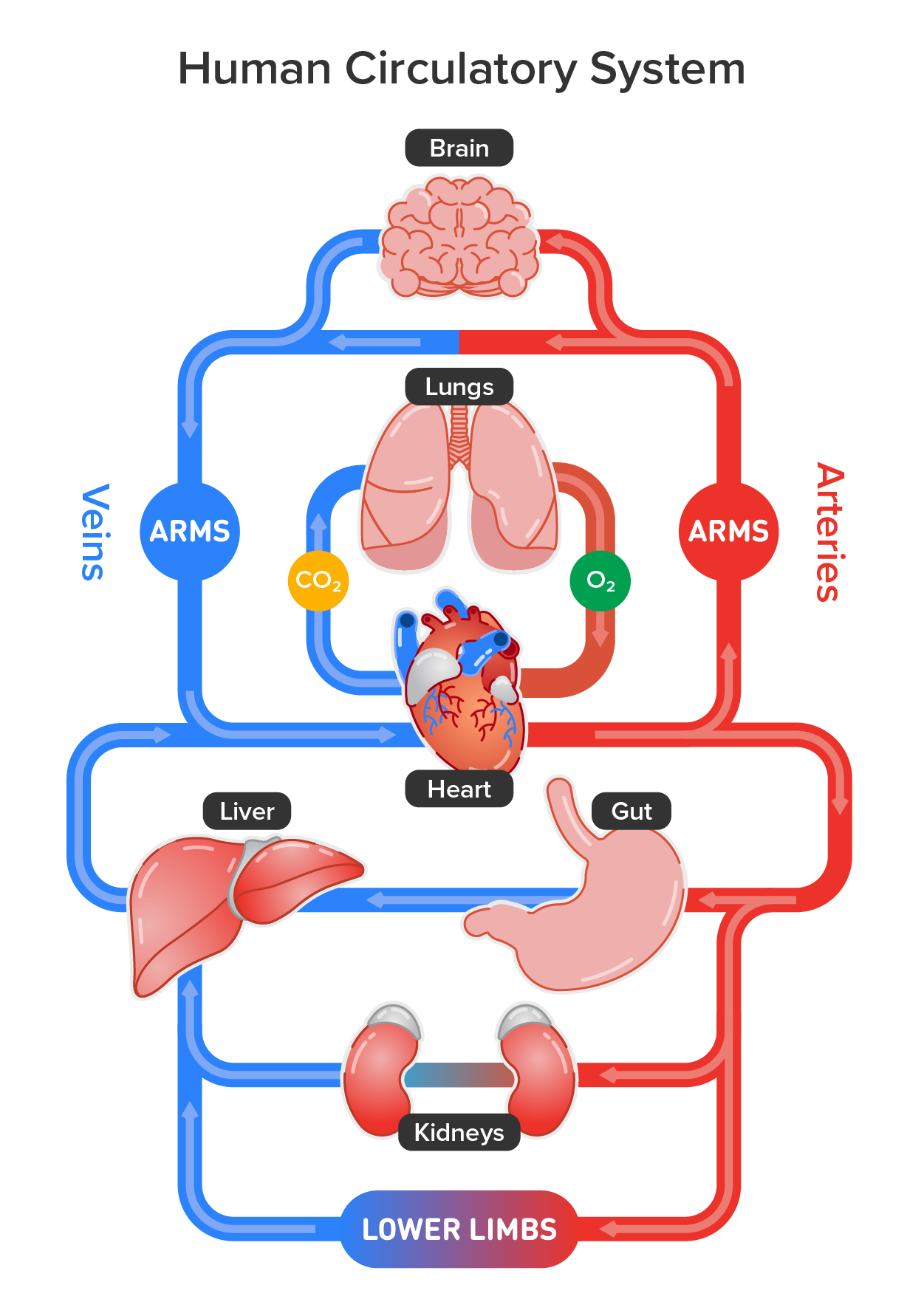
All body tissues get nutrients and oxygen from the blood and deposit carbon dioxide and other wastes back into the blood. The digestive system provides nutrients and the lungs exchange oxygen and carbon dioxide. The kidneys filter wastes out of the blood to be excreted in the urine.
Blood leaving the right side of the heart circulates through the lungs and then back to the left side of the heart. The left side of the heart then pumps the blood out of the aorta through arteries. Capillaries are where blood exchanges nutrients and waste and then collects into veins. The veins return the blood to the right side of the heart. Blood is carried to the digestive system by way of an artery, which branches into capillaries to reach every cell. Blood leaving the digestive system is transported by the hepatic portal vein to the liver. This vein branches into a network of large capillaries so that every cell of the liver has access to the blood. Blood leaving the liver then collects into the hepatic vein, which returns blood to the heart.
After the food is finished absorption through the small intestine, it passes through the large intestine. While in the large intestine, the food is fermented and formed into waste to be later excreted. The only absorption that occurs within the large intestine is remaining water and electrolytes.
Source: THIS TUTORIAL HAS BEEN ADAPTED FROM LUMEN LEARNING’S “NUTRITION FLEXBOOK”. ACCESS FOR FREE AT https://courses.lumenlearning.com/suny-nutrition/. LICENSE: creative commons attribution 4.0 international.
REFERENCE
U.S. Department of Health and Human Services. (n.d.). Your digestive system & how it works. National Institute of Diabetes and Digestive and Kidney Diseases. Retrieved May 23, 2022, from www.niddk.nih.gov/health-information/digestive-diseases/digestive-system-how-it-works
Nutrient absorption. Nutrient Absorption - an overview | ScienceDirect Topics. (n.d.). Retrieved May 23, 2022, from www.sciencedirect.com/topics/medicine-and-dentistry/nutrient-absorption



