Table of Contents |
Education in the 21st century has undergone significant changes to meet the needs of a rapidly evolving world. Modern education emphasizes personalized learning, the use of digital tools, global citizenship, and the pursuit of lifelong learning. It also responds to changing societal needs by focusing on student well-being, mental health, and access to quality education for all. These changes are guided by key policies, reforms, and global influences that continue to shape the future of learning.
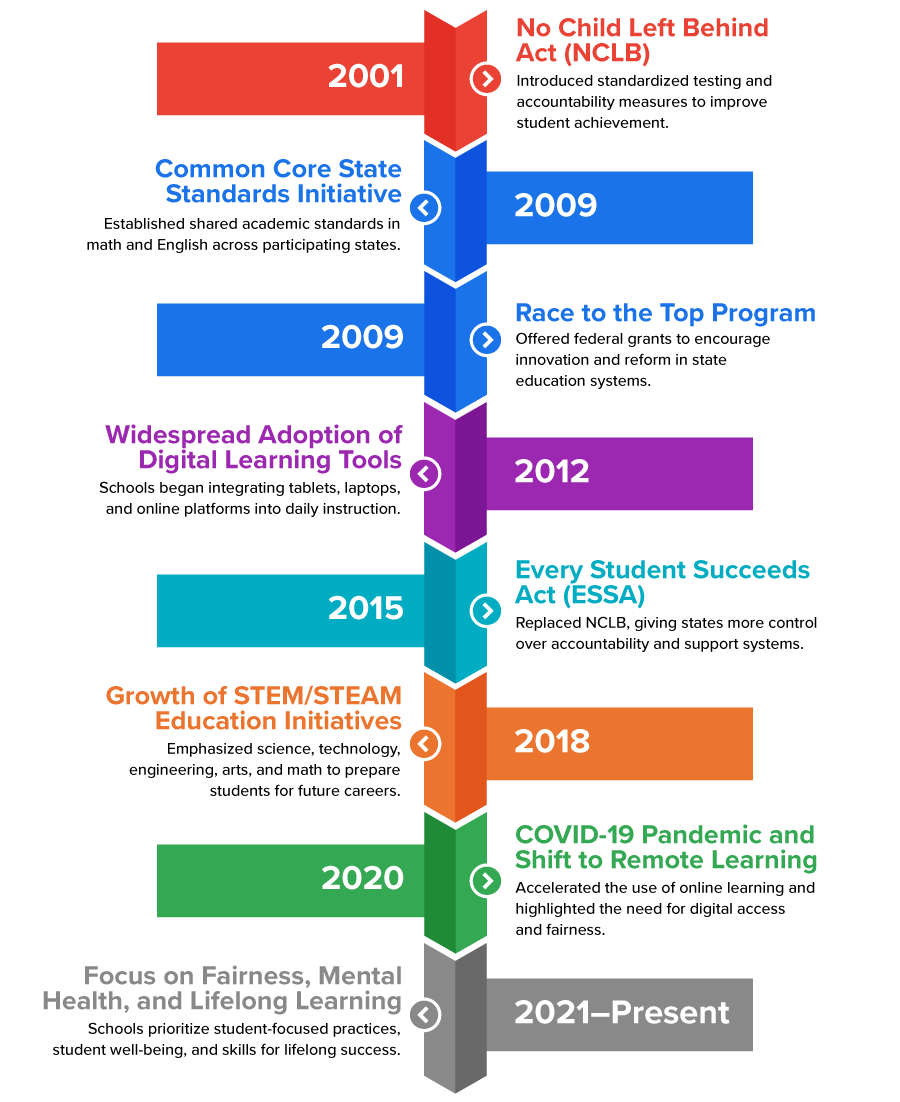
Since 2001, U.S. education has undergone significant reforms aimed at improving student learning and increasing accountability. These changes focused on standardized testing, setting clear learning goals, and providing support for students who need it most while granting states more flexibility over time. At the same time, globalization influenced education by encouraging international collaboration and comparisons through assessments like the Program for International Student Assessment (PISA). PISA, administered by the Organisation for Economic Co-operation and Development (OECD) every 3 years, measures 15-year-olds’ abilities in reading, mathematics, and science across dozens of countries, offering insights into how U.S. students perform relative to their global peers. These international benchmarks have sparked debates about curriculum rigor, fairness, and competitiveness, pushing policymakers to consider best practices from high-performing nations while addressing persistent achievement gaps at home.
This chart summarizes the major U.S. education reforms implemented since 2001 and their respective positive and negative impacts. These policies—No Child Left Behind, Common Core State Standards, Race to the Top, and Every Student Succeeds Act—were designed to improve student achievement, promote fairness, and modernize education systems. While each initiative brought important benefits, it also faced criticism and challenges that have shaped the ongoing debate over how best to prepare students for success in a globalized world.
| Major U.S. Education Reforms: Positive and Negative Impacts | ||
|---|---|---|
| Reform | Positive Impacts | Negative Impacts |
| No Child Left Behind Act (2001) | Highlighted achievement gaps; increased accountability for disadvantaged groups. | Overemphasis on standardized testing; narrowed curriculum; teaching to the test. |
| Common Core State Standards (2009) | Promoted consistent learning goals across states; prepared students for college and careers. | Faced backlash over perceived federal overreach; uneven implementation caused confusion. |
| Race to the Top (2009) | Encouraged innovation; incentivized data-driven instruction and teacher development. | Created competition among states; reforms were difficult to sustain long-term. |
| Every Student Succeeds Act (2015) | Gave states flexibility in accountability; allowed holistic measures of school success. | Reduced federal oversight; risked inconsistencies in addressing fairness across states. |
In 21st-century education, the way students learn has changed to focus more on their interests, needs, and real-world experiences. Instead of just listening to lectures and memorizing facts, many classrooms now use student-centered learning, where students take an active role in their education. This includes inquiry-based learning, where students ask questions and explore topics in depth, and project-based learning, where they work on meaningful projects that connect to real-life experiences. These methods help students develop critical thinking, creativity, and collaboration skills.
Teachers also utilize tools like Universal Design for Learning (UDL) to create lessons that cater to all students, including those with different learning styles or abilities. UDL promotes flexible teaching methods, materials, and assessments to ensure everyone can succeed. Another significant focus is on STEM and STEAM education, which encompasses science, technology, engineering, math, and sometimes art. These subjects prepare students for future careers and enable them to solve problems in innovative and creative ways. Schools are also teaching students to be global citizens, which means understanding other cultures, caring about the planet, and learning how to make a positive impact in the world. This includes lessons on sustainability, climate change, and social responsibility.
Technology has transformed how students engage with learning and how teachers deliver instruction, making education more interactive, flexible, and accessible. Today, many classrooms use digital tools and platforms to support learning, organization, and collaboration. Digital tools are physical or software-based resources, such as tablets, laptops, and interactive whiteboards, that assist with educational tasks. Digital platforms are online systems that host and manage learning activities, such as Google Classroom, Microsoft Teams, and Canvas. These technologies help students complete assignments, communicate with teachers and peers, access learning materials, and participate in interactive lessons, making education more flexible, engaging, and accessible.
IN CONTEXT
During the COVID-19 pandemic, schools had to quickly shift from traditional in-person instruction to remote and hybrid learning. Remote learning refers to students attending classes entirely online from home, using videoconferencing tools and digital platforms. Hybrid learning combines both in-person and online instruction, allowing students to participate in some classes at school and others remotely. This sudden change led to the widespread use of digital resources, such as Zoom, Google Classroom, and Microsoft Teams, to deliver lessons, assign work, and maintain communication. Even after schools reopened, many continued to use these methods to offer more flexible learning options, support students with different needs, and expand access to education beyond the physical classroom.
New technologies, such as artificial intelligence (AI) and gamification, are gaining popularity in classrooms—but both have roots that go back decades. Gamification, the process of incorporating game-like features into learning (such as points, levels, and challenges), has been used for many years because of its ability to make lessons more engaging and enjoyable. Its popularity has continued to grow as technological platforms have made interactive learning easier to implement. Tools like Classcraft and Quizizz use gamification to motivate students and encourage participation.
Similarly, artificial intelligence—computer systems that perform tasks requiring human-like thinking, such as analyzing data and making decisions—has also been present in education for years in basic forms, such as adaptive learning algorithms. However, modern AI technologies have advanced significantly in recent years, enabling personalized learning at scale. Today, platforms like Khan Academy and DreamBox utilize AI to tailor content in real time, adjusting lessons and feedback based on each student’s performance and needs.
The 21st century has brought rapid technological change, rising academic expectations, and new instructional challenges. While schools have expanded their use of digital tools and research-based practices, national assessments continue to show widespread concerns in math, literacy, and science. Recent National Assessment of Educational Progress (NAEP) results highlight that foundational skills remain a significant challenge for many students. The chart below summarizes the most recent NAEP proficiency rates in reading, math, and science across key grade levels, highlighting current performance patterns in core academic areas.
| Proficiency Rates in Reading, Math, and Science | |||
|---|---|---|---|
| Grade Level | Reading | Math | Science |
| 4th Grade | 31% | 39% | - |
| 8th Grade | - | - | 31% |
| 12th Grade | 35% | 22% | - |
Several broader factors continue to influence performance across subjects. Chronic absenteeism has risen among students of all ages, reducing consistent access to instruction. Middle school assessments show reduced reading stamina and difficulties with multi-step mathematical reasoning, contributing to slow progress in literacy and math development. In science, limited instructional time and inconsistent access to hands‑on materials make it difficult for students to build a deeper understanding. Together, these conditions create ongoing challenges for recovery and long-term academic growth in all core areas.
Recent international comparisons show that the United States performs moderately relative to other countries, scoring stronger in reading than in math but still falling behind many high‑performing systems. On the 2022 Programme for International Student Assessment (PISA), five education systems—Singapore, Ireland, Japan, the Republic of Korea, and Chinese Taipei—outperformed the United States in reading, while twenty‑five systems scored higher in mathematics, and nine scored higher in science. Despite being above the global average overall, these results highlight notable performance gaps that continue to shape national efforts to strengthen instruction and long‑term student outcomes.
As society continues to evolve, educational systems must adapt to meet the changing needs of students, families, and communities. One of the most critical areas of focus is providing fair access, which involves ensuring that all students, regardless of background, ability, or circumstance, have access to the resources and opportunities necessary for academic and personal success. Fair access does not mean treating all students the same; instead, it means providing each student with the specific support they need to thrive. Schools are increasingly implementing school-wide practices that address the needs of students from varied racial, linguistic, socioeconomic, and ability groups, thereby removing barriers and promoting fairness in education.
IN CONTEXT
Another essential priority is student well-being, which includes physical health, emotional stability, and mental wellness. Research shows that students are more likely to succeed when they feel safe, supported, and connected to their school environment. In response, schools are expanding access to counseling services, integrating social-emotional learning into the curriculum, and fostering positive school climates that promote belonging and resilience.
Furthermore, the concept of lifelong learning has become increasingly important in preparing students for a dynamic and rapidly changing world. Education is no longer viewed as a one-time experience but as an ongoing process of growth and adaptation. Schools are now emphasizing transferable skills such as critical thinking, collaboration, and curiosity. These skills enable individuals to continue learning throughout their lives and to respond effectively to new challenges, technologies, and career opportunities. By cultivating a mindset of lifelong learning, educators help students become flexible, informed, and engaged members of society.
As education evolves in the 21st century, schools face challenges and opportunities shaped by policy, technology, globalization, and social change. These trends influence how schools design learning environments, support different learners, and prepare students for success in a rapidly changing world. The following key areas highlight the most significant implications for modern education:
Source: THIS TUTORIAL WAS AUTHORED BY SOPHIA LEARNING. PLEASE SEE OUR TERMS OF USE.
REFERENCES
American Enterprise Institute. (2025, June 12). Lingering absence in public schools: Tracking post‑pandemic chronic absenteeism into 2024. www.aei.org/research-products/report/lingering-absence-in-public-schools-tracking-post-pandemic-chronic-absenteeism-into-2024/
American Psychological Association. (2021, September 13). Gender and sexual orientation diversity in children and adolescents in schools. www.apa.org/pi/lgbt/resources/diversity-schools
National Assessment Governing Board. (2025). The 2024 Nation’s Report Card. www.nagb.gov/powered-by-naep/the-2024-nations-report-card.htm
U.S. Department of Education. (2015, December 10). Every Student Succeeds Act (ESSA). www.ed.gov/essa
U.S. Department of Education. (2002). No Child Left Behind Act of 2001, P.L. 107-110, 20 U.S.C. § 6319. www.congress.gov/107/plaws/publ110/PLAW-107publ110.pdf
U.S. Department of Education. (2009). Race to the Top Program: Executive summary. www2.ed.gov/programs/racetothetop/executive-summary.pdf
UNESCO. (2023). Education for sustainable development. www.unesco.org/en/education/sustainable-development



